From the free course AP Computer Science A on Lykke
AP Practice 3
A class-design response earns credit by turning a precise specification into a usable Java class: private data, a constructor that establishes a valid object, and methods whose behavior matches the stated contract.
AP Practice 3
A class-design response earns credit by turning a precise specification into a usable Java class: private data, a constructor that establishes a valid object, and methods whose behavior matches the stated contract.
Task type: Class Design
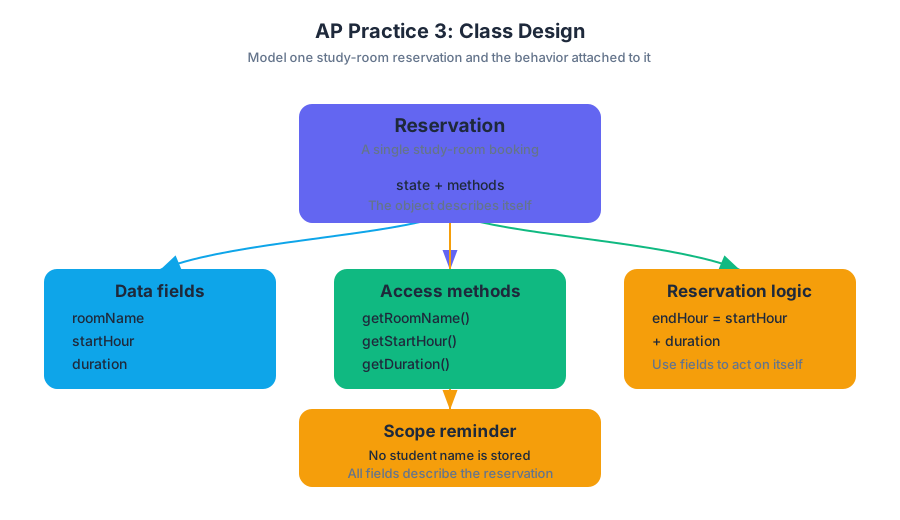
In this original, unofficial practice task, a community center records reservations for study rooms. Each reservation stores a room name, a starting hour, and a duration. The class does not store a student name; all required fields and methods refer only to the reservation itself.
Prompt
Write a Java class named RoomReservation with the following requirements:
- It has three
privateinstance variables:room, aStringstartHour, anintduration, anint
- Its constructor accepts a room name, a starting hour, and a duration, storing those values in the corresponding instance variables.
getEndHour()returns the hour at which the reservation ends. The ending hour is calculated as $startHour + duration$.isInRoom(String roomName)returnstrueif the reservation is for the specified room andfalseotherwise.overlaps(RoomReservation other)returnstruewhen the two reservations are for the same room and share at least one hour. Otherwise, it returnsfalse.move(int newStartHour)changes the reservation’s starting hour tonewStartHour.- You may assume that all durations are positive and that all hour values are valid.
Timing strategy
Allow approximately 25 minutes for a class-design response. Spend the first few minutes extracting the required state and behavior. Then write the constructor and simplest methods first, test boundary cases mentally, and reserve time to check access modifiers, parameter types, and return types.
A useful contract map is:
| Requirement | Code location | Main risk |
|---|---|---|
| Store room, start, duration | Private instance variables | Accidentally using static |
| Initialize one reservation | Constructor | Forgetting this |
| Compute ending time | getEndHour() |
Using subtraction |
| Compare room names | isInRoom and overlaps |
Using == for String objects |
| Detect shared time | overlaps |
Treating touching reservations as overlapping |
| Change start time | move |
Creating a new object instead of updating this one |
Worked solution
public class RoomReservation
{
    private String room;
    private int startHour;
    private int duration;

    public RoomReservation(String roomName, int startingHour, int length)
    {
        room = roomName;
        startHour = startingHour;
        duration = length;
    }

    public int getEndHour()
    {
        return startHour + duration;
    }

    public boolean isInRoom(String roomName)
    {
        return room.equals(roomName);
    }

    public boolean overlaps(RoomReservation other)
    {
        boolean sameRoom = room.equals(other.room);

        boolean thisStartsBeforeOtherEnds =
            startHour < other.getEndHour();

        boolean otherStartsBeforeThisEnds =
            other.startHour < getEndHour();

        return sameRoom
            && thisStartsBeforeOtherEnds
            && otherStartsBeforeThisEnds;
    }

    public void move(int newStartHour)
    {
        startHour = newStartHour;
    }
}
Why the solution works
The constructor creates a complete reservation. For example:
RoomReservation first =
    new RoomReservation("Blue", 9, 2);
The object represents room Blue from hour $9$ through, but not including, hour $11$. Therefore, first.getEndHour() returns $11$.
The overlap test uses the half-open intervals $[startHour, endHour)$. Two reservations overlap exactly when:
$$ start_1 < end_2 \quad \text{and} \quad start_2 < end_1 $$
They must also have the same room. The strict < comparisons matter: a reservation from $9$ to $11$ does not overlap one from $11$ to $13$, because the first reservation has already ended when the second begins.
For example:
RoomReservation a = new RoomReservation("Blue", 9, 2);
RoomReservation b = new RoomReservation("Blue", 10, 1);
RoomReservation c = new RoomReservation("Blue", 11, 2);
RoomReservation d = new RoomReservation("Red", 10, 3);
a.overlaps(b) returns true: both use Blue, and hour $10$ is shared. a.overlaps(c) returns false: the intervals only touch at hour $11$. a.overlaps(d) returns false: their times intersect, but their rooms differ.
Rubric-aligned reasoning
A strong response should visibly satisfy these scoring targets:
- Class and state: The class is named correctly, and all three required variables are instance variables with the
privatemodifier. - Constructor: The constructor has the required parameter types and assigns every parameter to the correct field.
- Accessor behavior:
getEndHour()returns the sum of the starting hour and duration. - String comparison: Room names are compared with
.equals, not==. - Overlap logic: The method requires both equal room names and intersecting time intervals.
- Mutation:
moveupdates the existing object’sstartHour. - Java correctness: Method headers, braces, types, and return statements are syntactically valid.
Common misconception: == compares String contents
In Java, == compares whether two object references point to the same object, not whether two String objects contain the same characters. Use:
room.equals(roomName)
rather than:
room == roomName
Common misconception: touching intervals overlap
If one reservation ends at hour $11$ and another begins at hour $11$, they do not share an hour. Replacing < with <= would incorrectly classify adjacent reservations as overlapping.
Error-review routine
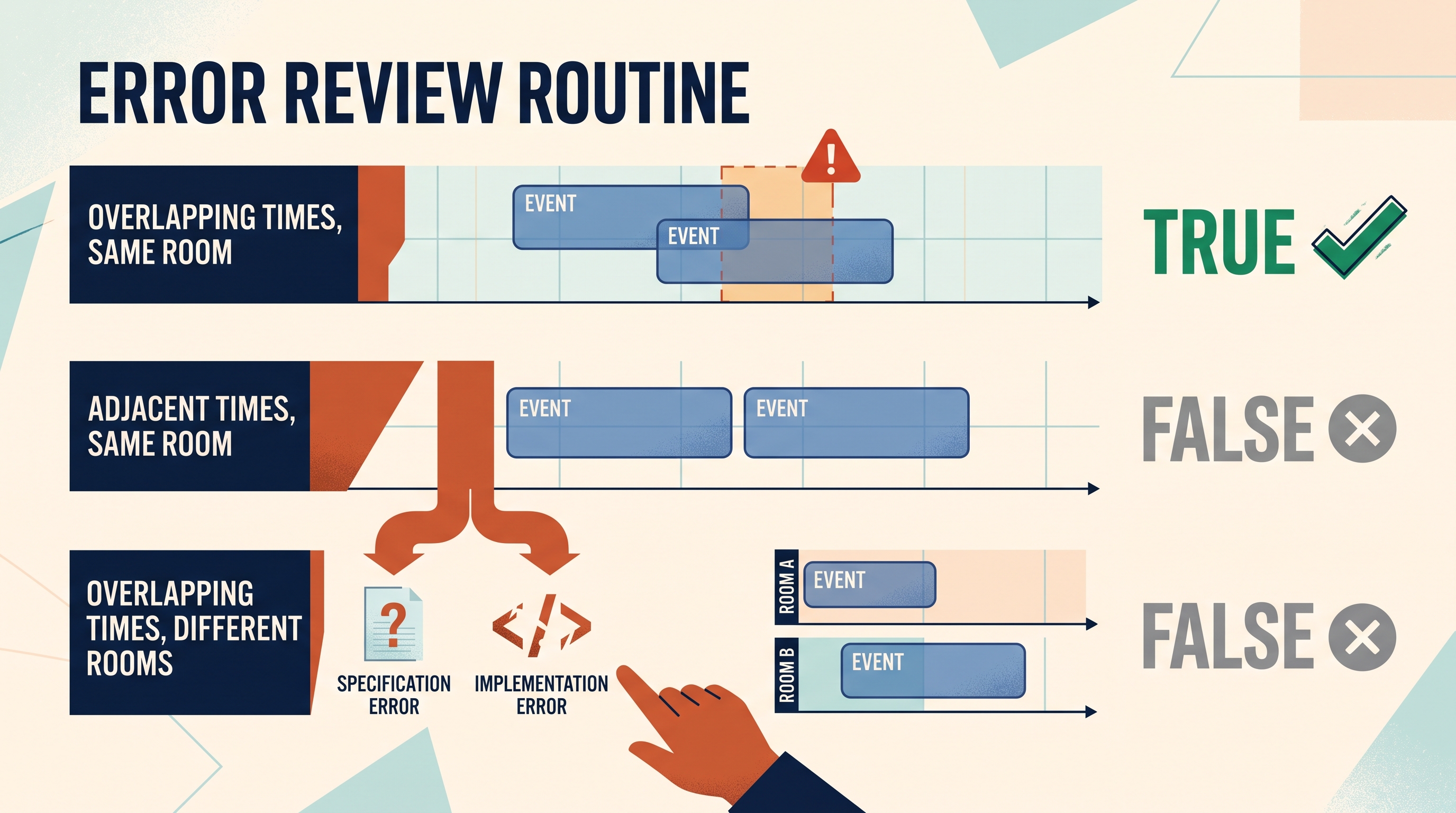
After writing your response, trace these three cases:
- Same room, overlapping times: expected
true - Same room, adjacent times: expected
false - Different rooms, overlapping times: expected
false
Then label every missed point as a specification error—you misunderstood a requirement—or an implementation error—you understood it but wrote incorrect Java. Fix the category, not only the line of code.
Source Materials
- AP Computer Science A Course and Exam Description
- AP Computer Science A Course and Exam Description Clarifications and Corrections
- AP Computer Science A Course Overview
- AP Computer Science A Course at a Glance
- AP Computer Science A Course at a Glance Poster
- Adopt AP Computer Science A
- AP Computer Science A
- AP Computer Science A
- AP Computer Science A-AP Students-College Board
- AP Computer Science A Textbook-Code HS
- AP Computer Science A - Code.org
- Guide to the AP Computer Science A Exam- Princeton Review