From the free course AP Computer Science A on Lykke
4.2 Introduction to Using Data Sets
Key concepts: Data sets can be manipulated and analyzed to solve problems or answer questions · Determining what knowledge can be extracted from data · Contextual relevance of data and the validity of data for a specific problem · Algorithmic bias and strategies to identify and mitigate it · Using arrays and 2D arrays to represent data · Traversing a list from both ends · Handling even- and odd-sized data sets with conditional logic · Creating objects from data and storing them in an ArrayList · Initializing accumulators before loops · Avoiding redundant method calls in loops
A data set is a collection of specific pieces of information that can be examined one value at a time to answer a question or solve a problem.
4.2 Introduction to Using Data Sets
A data set is a collection of specific pieces of information that can be examined one value at a time to answer a question or solve a problem. A weather app, for example, might analyze a data set of hourly temperatures to determine the hottest hour of the day.
From data values to knowledge
The learning objective for this topic is 4.2.A: Represent patterns and algorithms that involve data sets found in everyday life using written language or diagrams. Its essential knowledge begins with 4.2.A.1, the definition of a data set, and continues with 4.2.A.2: data sets can be manipulated and analyzed, with values accessed individually and processed according to a desired outcome.
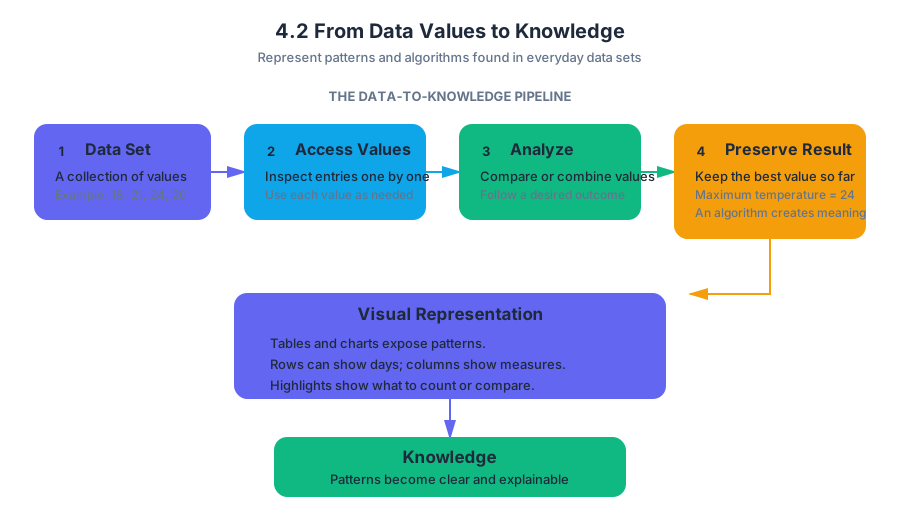
Suppose temperatures contains the readings $18, 21, 24, 20$. The data itself does not automatically state “the maximum temperature was $24$.” An algorithm must inspect each value, compare it with the best value seen so far, and preserve the result.
A chart or table is also a computational tool, not merely decoration. Under 4.2.A.3, a visual representation can expose patterns and help plan the algorithm: rows might represent days, columns might represent measurements, and highlighted values might reveal which entries need to be counted, compared, or combined.
Data must fit the question
A data set is not universally valid. Its usefulness depends on the problem being solved: a list of classroom temperatures may help identify heating problems in that classroom, but it cannot support a reliable conclusion about the climate of an entire city. Before processing data, ask: What does each value represent, how was it collected, and does it actually answer this question?
Algorithmic bias occurs when a program systematically produces unfair or distorted results because the data, the algorithm, or the surrounding assumptions favor some cases over others. Useful mitigation strategies include checking whether important groups are missing, comparing error rates across groups, testing on varied data, examining which variables influence decisions, and revising the data or algorithm when the results are unjustifiably uneven.
Key distinction: Correctly processing inappropriate data still produces an inappropriate answer.
Worked example: pairing data from both ends
Consider an ArrayList of competitors that must be paired from opposite ends. For an even-sized list, index i pairs with index size - i - 1. For an odd-sized list, the first competitor can be treated as a special unpaired entry, so pairing begins at index 1.
The condition size % 2 == 0 detects whether the number of elements is even. The loop then performs roughly half as many iterations as the list has elements, simultaneously moving from the front and the back.
public ArrayList<Match> buildMatches()
{
    ArrayList<Match> matches = new ArrayList<Match>();

    if (competitorList.size() % 2 == 0)
    {
        for (int i = 0; i < competitorList.size() / 2; i++)
        {
            matches.add(new Match(
                competitorList.get(i),
                competitorList.get(competitorList.size() - i - 1)));
        }
    }
    else
    {
        for (int i = 1; i < competitorList.size() / 2 + 1; i++)
        {
            matches.add(new Match(
                competitorList.get(i),
                competitorList.get(competitorList.size() - i)));
        }
    }

    return matches;
}
For a list of six competitors, the pairings use indices $(0,5)$, $(1,4)$, and $(2,3)$. For a list of five, the odd-case logic uses $(1,4)$ and $(2,3)$, leaving index $0$ outside the pairing pattern. Each new Match(...) creates an object from existing data and adds that object to a new ArrayList.
Accumulating results safely
When an algorithm combines values, initialize an integer accumulator before the loop. For example, to total point values, begin with int total = 0; and then use total += value;. Without initialization, the accumulator has no defined starting total.
A two-dimensional array can represent a board whose cells contain objects. If each cell stores a String color and an integer pointValue, then board[row][column] identifies one cell; the cell’s methods or fields provide the information to analyze. Row and column indices are separate: board[2][1] means row $2$, column $1$, not a single flat position.
Misconception check
Misconception: “An odd-sized list can use exactly the same bounds as an even-sized list.” The center or special entry changes how many pairs exist, so the boundary and starting index must be chosen deliberately. Also, size() is a count, while the last valid index is size() - 1.
Retrieval check
A list contains seven values. Which expression identifies the element paired with index i when traversing from both ends? What must an accumulator contain before a loop uses +=? Finally, explain one reason a data set appropriate for measuring school attendance might be inappropriate for predicting regional health outcomes.


Source Materials
- AP Computer Science A Course and Exam Description
- AP Computer Science A Course and Exam Description Clarifications and Corrections
- AP Computer Science A Course Overview
- AP Computer Science A Course at a Glance
- AP Computer Science A Course at a Glance Poster
- Adopt AP Computer Science A
- AP Computer Science A
- AP Computer Science A
- solve a problem or accomplish a task.