From the free course AP Computer Science A on Lykke
Course Framework, Skills and Reasoning Processes
Key concepts: AP course alignment with college-level curricula · Course Framework organization of content and skills into units · Formative assessment through AP Classroom Progress Checks · AP Course Audit requirements · Use of AP Classroom reports and Question Bank · Access to computers and the internet for AP Computer Science A · Independent time for students to develop solutions · AP Computer Science A exam weighting by unit · Code-based reasoning and debugging procedural errors · Connecting programming assignments to student interests
AP Computer Science A is an introductory college-level study of Java programming, object-oriented design, algorithms, data structures, testing, and responsible computing. AP courses are intended for willing, academically prepared students who may earn college credit, advanced placement, or both by demonstrating…
Course Framework, Skills and Reasoning Processes
AP Computer Science A is an introductory college-level study of Java programming, object-oriented design, algorithms, data structures, testing, and responsible computing. AP courses are intended for willing, academically prepared students who may earn college credit, advanced placement, or both by demonstrating college-level achievement.
The Course and Exam Description (CED) is the central map: it identifies the content and skills aligned with the corresponding college course, while still allowing teachers to adapt sequencing, examples, projects, and pacing to local priorities. Its four-unit structure moves from using existing objects and methods to control structures, class design, and collections of data.
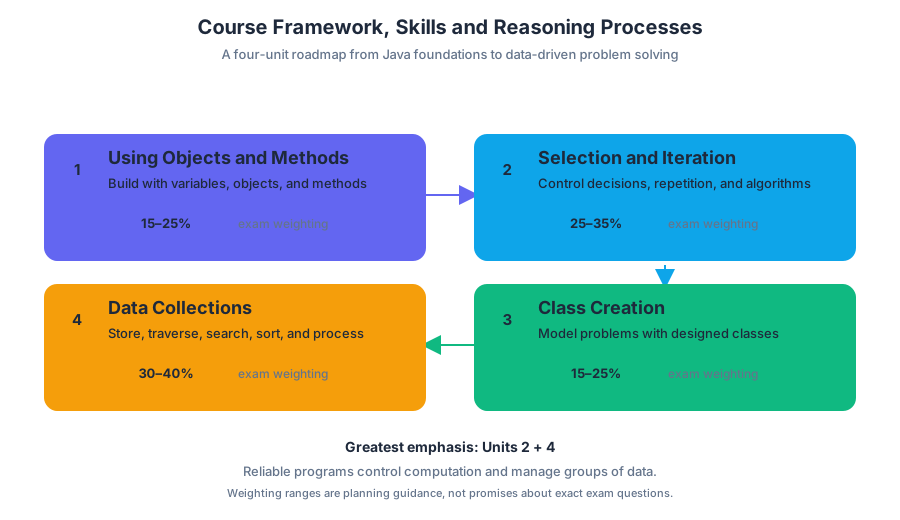
A four-unit roadmap
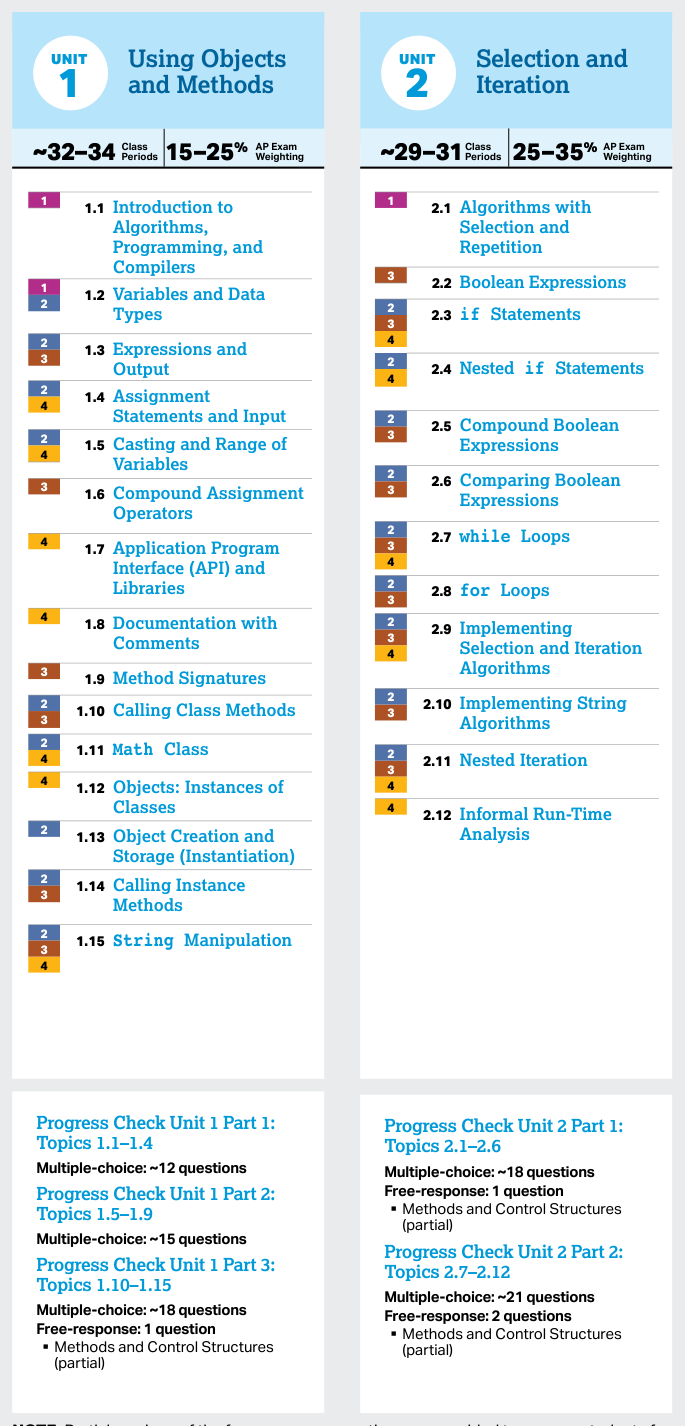
| Unit | Official title | Main intellectual move | AP Exam weighting |
|---|---|---|---|
| Unit 1 | Using Objects and Methods | Use variables, objects, methods, and basic Java expressions | 15–25% |
| Unit 2 | Selection and Iteration | Make decisions, repeat actions, and analyze algorithms | 25–35% |
| Unit 3 | Class Creation | Design and implement classes that model problems | 15–25% |
| Unit 4 | Data Collections | Store, traverse, search, sort, and process collections | 30–40% |
The weighting ranges are planning guidance, not promises about the exact number of questions on a particular exam. Unit 2 and Unit 4 together receive the greatest emphasis because reliable programs must both control computation and manage groups of data.
Five computational practices
The framework treats programming as more than typing syntactically correct Java. Students repeatedly cycle through five named practices:
- Computational Thinking Practice 1: Design Code — plan an algorithm or program before implementation, including the data and steps needed to solve the problem.
- Computational Thinking Practice 2: Develop Code — translate a design into working code, then test and refine it.
- Computational Thinking Practice 3: Analyze Code — trace execution, predict output, test behavior, locate procedural errors, debug, and evaluate whether a solution works as intended.
- Computational Thinking Practice 4: Document Code and Computing Systems — explain code, its purpose, its assumptions, and relevant features of the computing system.
- Computational Thinking Practice 5: Use Computers Responsibly — consider ethical, social, privacy, security, and contextual effects when creating or using computing systems.
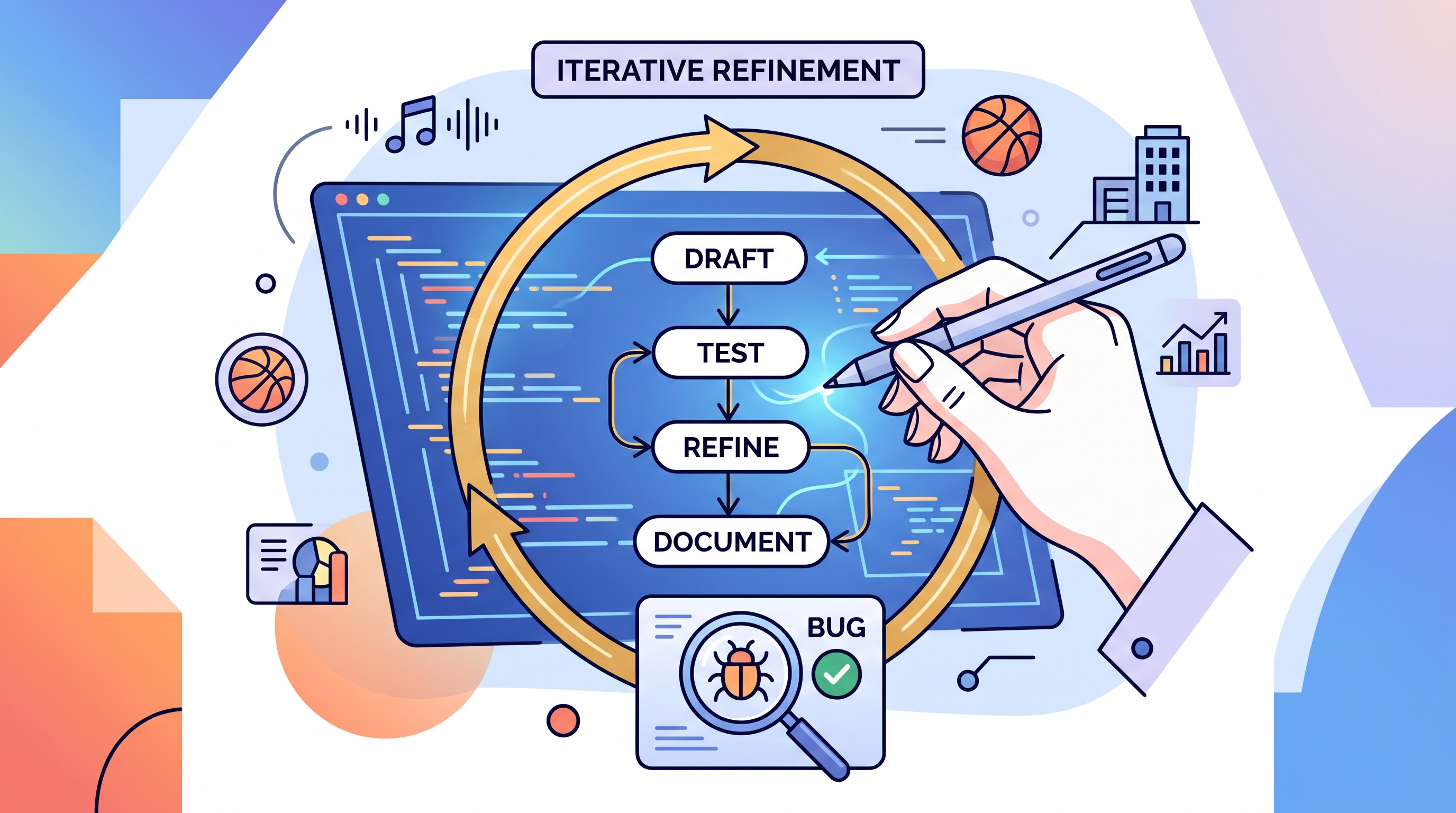
A useful classroom loop is design → develop → analyze → document → reconsider consequences. For example, a student might design a program that summarizes community survey data, implement it with arrays or ArrayList objects, inspect unexpected output, correct the procedural error, document the method, and ask whether the collected data were used fairly.
Plan, teach, assess
The instructional model connects preparation, implementation, and evidence. Unit Guides organize required topics and skills; instruction supplies explanations, labs, and programming tasks; assessment then reveals which ideas and practices students can use independently.
AP Classroom Progress Checks provide formative assessment during the year. A teacher can assign them as homework or complete them in class, then use the immediate feedback to identify misunderstandings in particular topics and skills. Unit checks may combine multiple-choice questions with partial free-response tasks, such as tracing a method, analyzing control structures, or explaining a correction.
AP Classroom reports turn those results into actionable information at the unit and skill levels. If reports show that students can write a loop but cannot establish its initial conditions correctly, instruction can return to initialization, tracing, and boundary testing rather than repeating an entire unit.
The Question Bank extends this cycle by allowing teachers to create additional practice targeted to those needs. Planning therefore becomes responsive: assign a check, inspect the evidence, select focused practice, and reassess the specific weakness.
What AP authorization requires
Before a school labels a course “Advanced Placement” or “AP,” it must participate in the AP Course Audit. The audit verifies that the proposed course meets curricular and resource expectations; once parents enroll a student, the school and teacher should be able to stand behind the claim that the course embodies the stated AP classroom principles.
Required support includes a college-level computer science textbook or equivalent resource for each student, teacher access to appropriate current materials, and access to the AP Computer Science A labs. The course must also provide hands-on opportunities to design and implement computer-based solutions, not merely read or discuss programs.
Access is part of the learning environment
Students need dependable access to a computer and the internet during instruction, plus additional time outside class to develop individual solutions. That extra time matters because programming involves drafting, testing, discovering flaws, and revising—not simply producing a first attempt during a class period.
Programming tasks can connect with students’ interests: a music playlist analyzer, a sports-statistics tool, an animation controller, or a community-data project can exercise the same required practices while making the problem worth solving. The essential test is whether students design, develop, analyze, document, and use computing responsibly.
Key insight: A strong AP CSA course is not defined only by its list of Java topics. It is defined by repeated opportunities to build solutions, inspect what those solutions actually do, explain the results, and improve them responsibly.
Retrieval check: A program produces the wrong output even though it compiles. Which practice most directly asks students to trace the behavior, identify the procedural error, and correct the code? The answer is Computational Thinking Practice 3: Analyze Code; documenting the correction afterward invokes Computational Thinking Practice 4: Document Code and Computing Systems.



Source Materials
- AP Computer Science A Course and Exam Description
- AP Computer Science A Course and Exam Description Clarifications and Corrections
- AP Computer Science A Course Overview
- AP Computer Science A Course at a Glance
- AP Computer Science A Course at a Glance Poster
- Adopt AP Computer Science A
- AP Computer Science A
- AP Computer Science A
- Figure — AP Computer Science A Brochure for Teachers and Administrators (p. 1)
- Figure — AP Computer Science A Brochure for Teachers and Administrators (p. 2)
- Across Careers. Across Industries. Across the World.
- Figure — AP Computer Science A Course and Exam Description (p. 1)