From the free course AP Statistics on Lykke
Unit 2: Probability, Random Variables, and Probability Distributions
Key concepts: Two-way tables and conditional distributions for two categorical variables · Probability as the long-run relative frequency of an outcome · Conditional probability, independence, and mutually exclusive events · Random variable — a distribution of outcomes with a mean and SD · Binomial and normal models, and the conditions each requires · Sampling distributions and the Central Limit Theorem
Integrate the official Unit 2 topics through the AP statistical practices and apply them to contextual problems. Follow the unit roadmap to connect every topic, practice statistical reasoning in context, and prepare for cumulative AP-style questions.
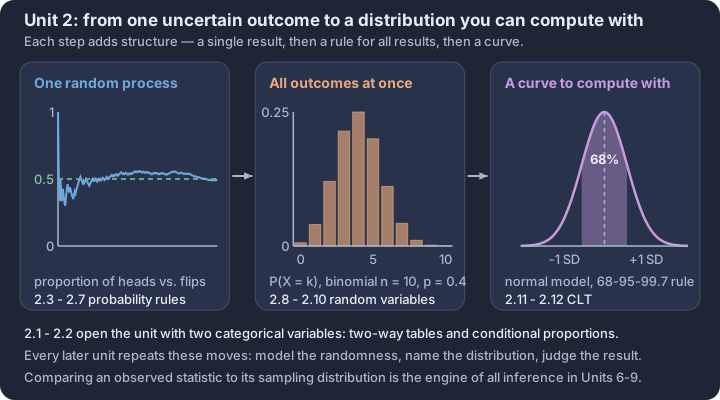
Unit 2: Probability, Random Variables, and Probability Distributions is organized around one recurring question: what evidence would justify the conclusion we want to make? This overview connects the unit's topics before you work through them one at a time.
What you will learn
Integrate the official Unit 2 topics through the AP statistical practices and apply them to contextual problems.
Topic sequence
- 2.1 Tabular and Graphical Representations for the Distributions of Two Categorical Variables — Compare two categorical variables using two-way tables and appropriate graphs.
- 2.2 Summary Statistics for Two Categorical Variables — Calculate and interpret joint, marginal, and conditional relative frequencies.
- 2.3 Estimating Probabilities Using Simulation — Design and use simulations to estimate probabilities.
- 2.4 Introduction to Probability — Calculate probabilities using probability rules and representations.
- 2.5 Mutually Exclusive Events — Determine whether events are mutually exclusive and justify probability claims.
- 2.6 Conditional Probability — Calculate and interpret conditional probabilities in context.
- 2.7 Independent Events and Unions of Events — Use independence and addition or multiplication rules to calculate probabilities.
- 2.8 Introduction to Random Variables and Probability Distributions — Construct and interpret probability distributions for discrete random variables.
- 2.9 Parameters of Random Variables — Calculate and interpret parameters of random variables.
- 2.10 The Binomial Distribution — Verify binomial conditions and calculate and interpret binomial probabilities and parameters.
- 2.11 The Normal Distribution — Calculate probabilities and compare relative positions using normal distributions.
- 2.12 Sampling Distributions and the Central Limit Theorem — Describe sampling distributions and use the Central Limit Theorem to reason about their shape.
The reasoning routine
- Start by naming the statistical question and the population or process in context.
- Choose a representation or procedure because its conditions match the situation.
- Show the numerical or graphical evidence clearly.
- Interpret the result using the variables, groups, and units from the original context.
Before you move on
Use the roadmap above to select the first topic. Keep a running error log with four labels—concept, procedure, calculation, and context—so the practice unit can point you back to the exact kind of repair you need.
Source Materials
- Ap Statistics Course And Exam Description
- AP Statistics Course Overview
- AP Statistics Course at a Glance
- AP Statistics Course at a Glance Poster
- Adopt AP Statistics
- AP Statistics
- AP Statistics
- AP Statistics Past Exam Questions — AP Central
- Khan Academy — AP Statistics
- Guide to the AP Statistics Exam — Princeton Review
- AP Statistics Units — Save My Exams
- AP Statistics Study Guide — EBSCO