From the free course AP Statistics on Lykke
1.1 Introducing Statistics: What Can We Learn from Data?
Key concepts: Statistical study — sample data answer a question about a larger population · Population of size N versus sample of size n · Datum versus data set — one recorded value against the whole collection · Why sample at all — measuring every individual is usually impractical · Valid investigative question — defined purpose, fixed before the analysis · Working in context — every number tied to its individuals and units
Identify the components of a statistical study and construct a purposeful investigative question whose required data can be collected and analyzed.
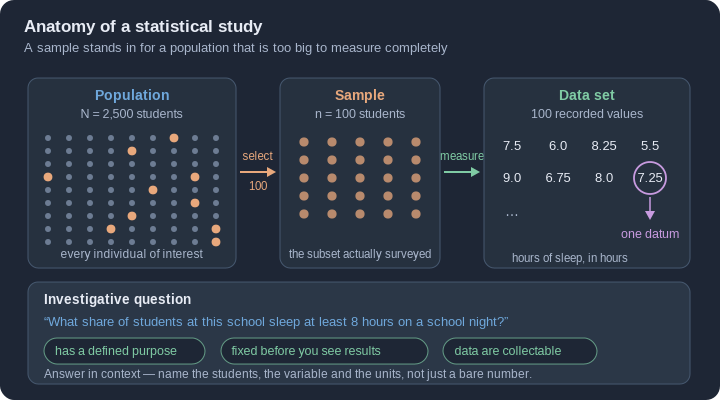
A high school principal notices that students in the hallway seem increasingly tired and wonders if the student body is getting the recommended eight hours of sleep per night. To investigate, the principal could attempt to interview all 2,500 students, but the time and resources required make this nearly impossible. Instead, the principal selects 100 students to survey. This scenario captures the fundamental engine of statistics: the process of collecting data from a manageable subset to answer a specific question about a much larger group.
The Architecture of a Statistical Study
A statistical study is a formal investigation where data are collected from a sample to answer an investigative question about a larger population. These studies become essential when a population—the entire collection of individuals or items of interest—is too vast or difficult to measure in its entirety.
To navigate these studies, we use precise notation and terminology to distinguish between the "whole" and the "part":
- Population ($N$): The complete set of all items or individuals under consideration. The total count of these individuals is represented by the uppercase symbol $N$.
- Sample ($n$): A subset of the population from which we actually obtain information. The number of individuals in this subset is the sample size, represented by the lowercase symbol $n$.
- Datum: A single piece of information (the singular form of data) regarding one individual or item.
- Data Set: The full collection of all individual pieces of information (data) gathered during the study.
The Investigative Question
Every statistical journey begins with a valid investigative question. Unlike a casual inquiry, a statistical investigative question must meet three strict criteria to ensure the integrity of the results.
Criteria for a Valid Investigative Question:
- Defined Purpose: The question must have a clear objective that directs the focus of the study.
- Fixed Before Analysis: The question must be established before any data analysis or results are seen. Changing the question to match what the data "seems to show" later on means it no longer satisfies the fixed-in-advance criterion.
- Collectable and Analyzable: The question must be posed in a way that allows for the collection of specific data that can be processed and interpreted.
Working in Context
In statistics, numbers are never just numbers; they are "in context." This means every component of a study—from the initial question to the final calculation—must be explicitly linked back to the real-world situation. If a study calculates an average of 7.2, that number is meaningless until it is identified as "an average of 7.2 hours of sleep per night for students at North High School."
Worked Example: The Urban Park Project
A city planner wants to know the average number of hours residents of a city use a specific downtown park during the summer. The city has 500,000 residents ($N = 500,000$). The planner conducts a survey of 400 residents ($n = 400$).
- Investigative Question: "What is the average number of hours per week that city residents spend in the downtown park during the months of June, July, and August?" (This is valid: it has a purpose, is set before the survey, and the data—hours—is collectable).
- The Datum: A single resident's response (e.g., "5 hours").
- The Data Set: The list of all 400 responses collected.
- The Population: All 500,000 residents of the city.
- The Sample: The 400 residents who participated in the survey.
Misconception Clinic
The "N vs. n" Confusion
- Misconception: Students often use $N$ and $n$ interchangeably or assume $N$ refers to the sample because it is the "New" data.
- Correction: Always remember that $N$ (uppercase) is for the "BIG" group (Population) and $n$ (lowercase) is for the "small" group (sample).
The "Data" vs. "Datum" Distinction
- Misconception: Treating "data" as a singular noun (e.g., "The data is...") or confusing a single response with the whole set.
- Correction: "Data" is plural. If you have one response, you have a datum. If you have a collection, you have a data set.
The "Moving Target" Question
- Misconception: Thinking it is okay to look at the data first and then decide what question to ask.
- Correction: Changing the question after seeing results does not meet the fixed-in-advance criterion.
Question Builder
Short Response: A wildlife biologist is studying the weight of salmon in a specific river system. There are approximately 12,000 salmon in the river. The biologist catches, weighs, and releases 150 salmon.
- Identify the population size ($N$) and the sample size ($n$).
- Propose a valid investigative question for this study.
Check Your Work:
- $N = 12,000$; $n = 150$.
- A valid question would be: "What is the average weight, in pounds, of the salmon currently living in this river system?"
Exit Check
- Can you distinguish between a population ($N$) and a sample ($n$) in a given scenario?
- Do you know the difference between a single datum and a full data set?
- Can you explain why an investigative question must be fixed before data analysis begins?
- Can you define what it means for a statistical result to be "in context"?