From the free course AP Statistics on Lykke
2.7 Independent Events and Unions of Events
Key concepts: Independent events — conditioning on one leaves the other unchanged · Multiplication rule for independent events — multiply the two probabilities · Union of events — A occurs, B occurs, or both · General addition rule — add both, subtract the overlap once · Checking independence numerically — compare P(A ∩ B) with P(A) · P(B) · Sampling without replacement — independence only approximate under the 10% guideline
Independence is the statistical equivalent of a "clean slate." In a world of dependent variables, independent events are those rare occurrences where the past has no shadow and the present provides no clues about the future.
Independence is the statistical equivalent of a "clean slate." In a world of dependent variables, independent events are those rare occurrences where the past has no shadow and the present provides no clues about the future. If you flip a fair coin and it lands on heads ten times in a row, the probability of it landing on heads the eleventh time remains exactly 0.5. The coin has no memory, and the trials are independent. Understanding how to calculate the probability of these events occurring together (intersections) or at least one of them occurring (unions) is the foundation of risk assessment and predictive modeling (Skill 3.C).
2.7.A Defining Independence
Two events, $A$ and $B$, are independent if the occurrence of one event does not change the probability that the other event will occur. Formally, we use conditional probability to define this relationship. Events $A$ and $B$ are independent if and only if: $$P(A|B) = P(A)$$ $$P(B|A) = P(B)$$ If knowing that $B$ has happened gives you exactly zero new information about the likelihood of $A$, then $A$ is independent of $B$. This is a strict mathematical requirement (LO 2.7.A). In practice, independence is often assumed in experimental designs where subjects are randomly assigned or in sampling with replacement. However, when sampling without replacement from a finite population, independence is technically lost, though we often use the "10% Rule" to treat observations as independent if the sample size is small relative to the population (EK 2.7.A.1).
2.7.B The Multiplication Rule for Independent Events
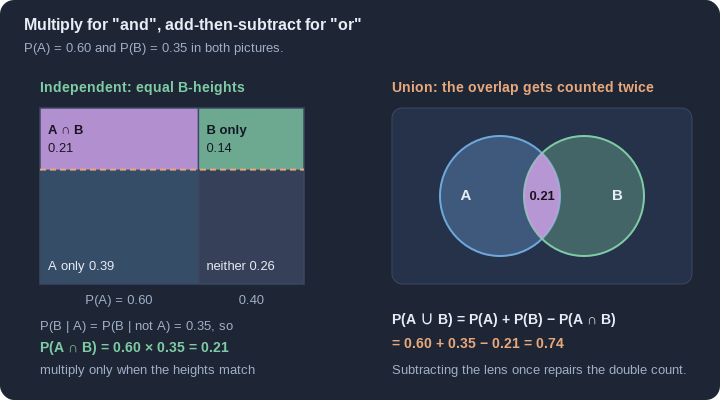
When events are independent, calculating the probability of their intersection—the "And" probability—becomes a simple matter of multiplication. This is the Multiplication Rule for Independent Events (LO 2.7.B): $$P(A \cap B) = P(A) \cdot P(B)$$ This rule extends to any number of independent events. For example, the probability that three independent components in a series all function correctly is the product of their individual reliability probabilities. If any one event has a low probability, the probability of the entire chain succeeding (the intersection) drops rapidly (EK 2.7.B.1).
2.7.C Unions and the General Addition Rule
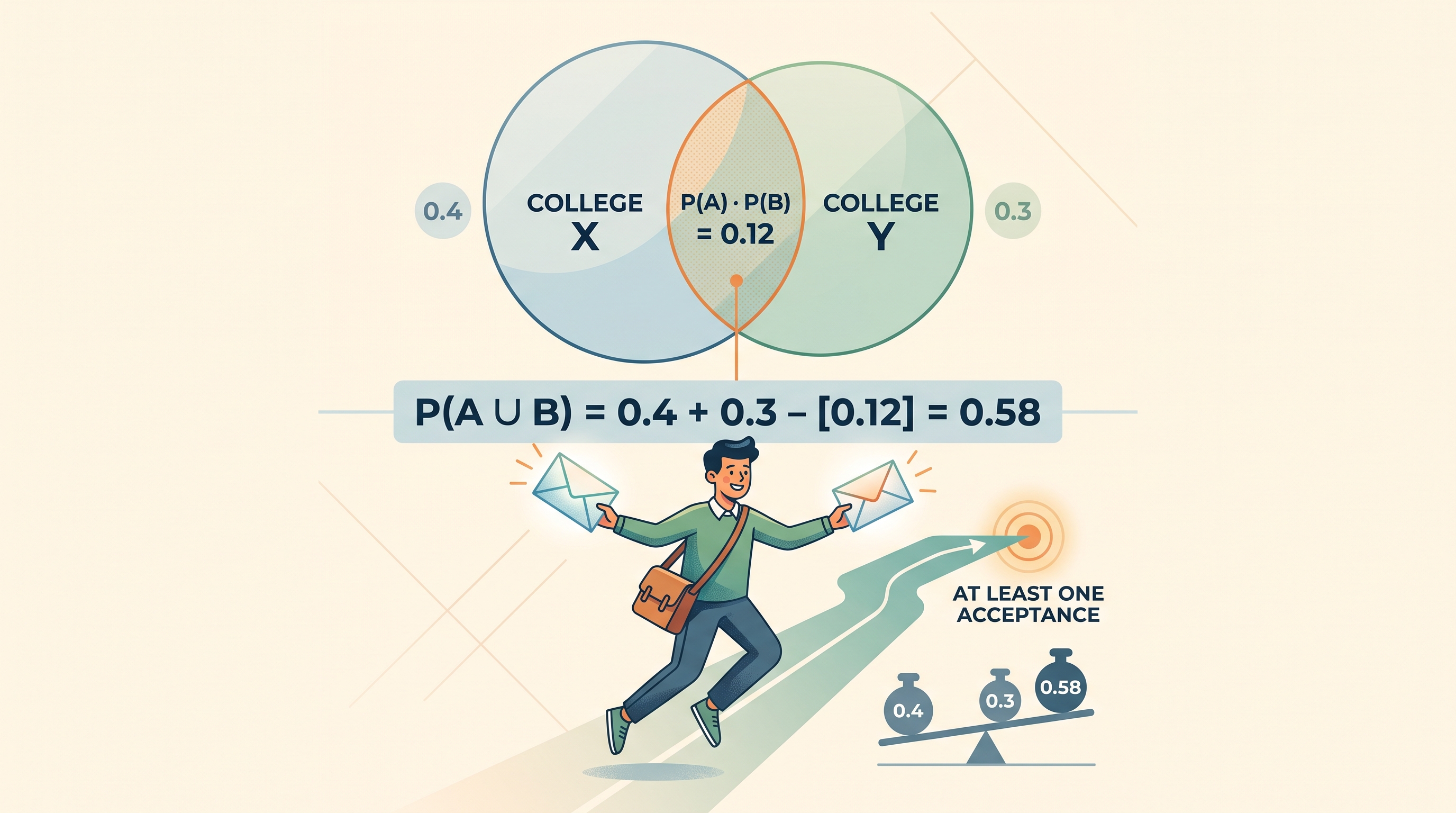
The union of two events ($A \cup B$) represents the probability that event $A$ occurs, event $B$ occurs, or both occur. To find this "Or" probability, we use the General Addition Rule (LO 2.7.C): $$P(A \cup B) = P(A) + P(B) - P(A \cap B)$$ We subtract the intersection $P(A \cap B)$ because those outcomes are included in both $P(A)$ and $P(B)$. If we didn't subtract it, we would be "double-counting" the overlap. If the events are independent, we can substitute the multiplication rule into this formula: $$P(A \cup B) = P(A) + P(B) - [P(A) \cdot P(B)]$$ This formula is essential for calculating "at least one" probabilities. A common strategy for finding the probability that at least one of several independent events occurs is to use the complement: $1 - P(\text{none occur})$.
2.7.D Worked Example: The Redundancy Principle
In aerospace engineering, critical systems often have a backup to ensure safety. Suppose a jet engine has a primary igniter with a 0.99 probability of functioning correctly. To increase safety, engineers add a secondary, independent backup igniter with the same 0.99 probability. What is the probability that the engine ignites (i.e., at least one igniter works)?
Step 1: Define the events. Let $A$ be the event the primary igniter works ($P(A) = 0.99$). Let $B$ be the event the backup igniter works ($P(B) = 0.99$).
Step 2: Calculate the intersection. Since they are independent, $P(A \cap B) = 0.99 \times 0.99 = 0.9801$.
Step 3: Apply the General Addition Rule. $P(A \cup B) = P(A) + P(B) - P(A \cap B)$ $P(A \cup B) = 0.99 + 0.99 - 0.9801 = 0.9999$.
The probability of failure has dropped from 1 in 100 to 1 in 10,000 through the power of independent redundancy.
2.7.E Misconception Clinic: Independent vs. Mutually Exclusive
The most common error in probability is confusing independent events with mutually exclusive (disjoint) events. They are actually opposites in terms of information.
- Mutually Exclusive: If $A$ happens, $B$ cannot happen. Knowing $A$ occurred gives you perfect information about $B$ ($P(B|A) = 0$). Therefore, mutually exclusive events (with non-zero probabilities) can never be independent.
- Independent: If $A$ happens, it has no effect on the probability of $B$. Knowing $A$ occurred gives you zero information about $B$.
The Rule of Thumb: If two events are disjoint, they are highly dependent. If they are independent, they must have an overlap (intersection) equal to the product of their probabilities.
Check for Understanding: A specific genetic trait appears in 20% of a population. If two people are selected at random (independently) from this large population, what is the probability that at least one of them has the trait?
(Answer: $0.20 + 0.20 - (0.20 \times 0.20) = 0.36$, or $1 - (0.80 \times 0.80) = 0.36$.)