From the free course AP Statistics on Lykke
P.2 Multiple-Choice Method: Read, Represent, Eliminate, Verify
Key concepts: Read for the ask — parameter or statistic, calculation or interpretation · Represent — sketch the distribution or table before computing anything · Eliminate — reject choices that break range, units, or direction · Verify — recheck the answer against the context for reasonableness · Range checks — probabilities in [0, 1], r in [−1, 1], standard deviations ≥ 0 · Classic traps — variance for SD, wrong tail, standard error for one observation
Success on the AP Statistics multiple-choice section is less about rapid calculation and more about a disciplined protocol for navigating technical distractors.
Success on the AP Statistics multiple-choice section is less about rapid calculation and more about a disciplined protocol for navigating technical distractors. With 42 questions to answer in 90 minutes, the cognitive load is high; the Read, Represent, Eliminate, Verify (RREV) method serves as a mental circuit breaker, preventing the common "impulse pick" that leads to avoidable errors. This workflow transforms the exam from a test of memory into a systematic search for the single most defensible statistical claim.
Phase 1: Read for the Statistical Goal
The first step is to identify the specific statistical practice being tested. AP questions are rarely "just math"; they are contextual puzzles that require you to distinguish between a population parameter (like $p$ or $\mu$) and a sample statistic (like $\hat{p}$ or $\bar{x}$).
- Identify the "Ask": Is the question asking for a calculation, an interpretation of a p-value, or a critique of a sampling method?
- Highlight Constraints: Look for "trigger words" such as at least, more than, independent, or randomly assigned. These words dictate which formulas or conditions apply.
- Contextualize: Note the units (e.g., "minutes," "proportion of students"). A mathematically correct number with the wrong units is a common distractor.
Phase 2: Represent the Information
Once the goal is clear, translate the prose into a statistical model. This "bridge" phase prevents you from getting lost in the distractors before you have your own answer.
- Symbolic Translation: Write down given values using correct notation. If a problem describes a sample of 50 people with a 12% success rate, write $n = 50$ and $\hat{p} = 0.12$.
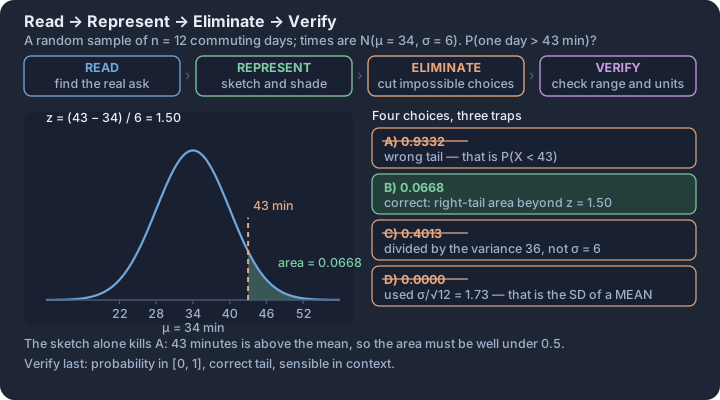
- Visual Sketching: For Normal distribution or sampling distribution problems, a 10-second sketch of a bell curve with the mean and shaded area is more reliable than mental visualization.
- Calculator Judgment: Decide immediately if the calculator is needed. If the question asks for a "Type II error definition," the calculator is a distraction; if it asks for a "probability of $X > 15$," the
normalcdforbinomcdffunction is your primary tool.
Phase 3: Eliminate the "Fatal Flaws"
AP Statistics distractors are rarely random; they are designed to mirror common student misconceptions. Instead of looking for the "right" answer, look for the "fatal flaw" in the wrong ones.
| Distractor Type | The "Fatal Flaw" | Why It Fails |
|---|---|---|
| The Parameter Swap | Uses $\mu$ when it should use $\bar{x}$. | Confuses the fixed population value with the varying sample result. |
| The Directional Error | Calculates $P(X < k)$ when the question asks for $P(X > k)$. | Fails to account for "at least" vs. "at most" logic. |
| The Condition Violation | Claims a result is valid even when $n < 30$ or $np < 10$. | Ignores the necessary requirements for using specific models (like the Normal approximation). |
| The Interpretation Trap | Describes a p-value as "the probability the null hypothesis is true." | Misrepresents the definition of a p-value as a conditional probability. |
Phase 4: Verify and Check Reasonableness
Before committing to a choice, perform a "smell test." Does the answer make sense in the real world?
The Reasonableness Check: If you are calculating the probability of an event and get a value of 1.2, or if you calculate a standard deviation and get a negative number, your representation phase likely had a calculation error. Similarly, if a confidence interval for the proportion of people who like pizza is $(0.02, 0.05)$, ask yourself: is it reasonable that only 2% to 5% of people like pizza? If the context feels "off," re-read the prompt.
Worked Example: Applying RREV
Consider this original practice scenario: A one-sample z-test for a proportion is conducted for $H_0: p = 0.50$ vs $H_a: p < 0.50$. Which of the following represents a Type II error?
- Read: Goal is to identify a Type II error. Context is a proportion test.
- Represent: Recall the definition: A Type II error is failing to reject $H_0$ when $H_a$ is actually true. In symbols: "Fail to reject $H_0$ when $p < 0.50$."
- Eliminate:
- (A) Rejecting $H_0$ when $p = 0.50$: This is a Type I error (rejecting a true null). Eliminate.
- (B) Rejecting $H_0$ when $p < 0.50$: This is a correct decision (power). Eliminate.
- (C) Failing to reject $H_0$ when $p = 0.50$: This is a correct decision. Eliminate.
- (D) Failing to reject $H_0$ when $p < 0.50$: This matches our representation. Keep.
- Verify: Does it make sense? Yes. We missed the opportunity to find evidence for the alternative even though the alternative was the reality.
The Digital Advantage
On the 2027 digital exam, use the "Eliminate Answer" tool in Bluebook to physically cross out choices as you find their fatal flaws. This reduces the "visual noise" on the screen and allows you to focus exclusively on the remaining viable options. If you are stuck between two choices, return to the Read phase—you likely missed a single word that makes one of the choices statistically indefensible.