From the free course AP Statistics on Lykke
1.2 Variables
Key concepts: Observational unit — the individual a datum is collected from · Variable — a characteristic that changes from one observational unit to another · Categorical vs quantitative variables — group labels versus measured amounts · Discrete vs continuous — countable values versus any value in an interval · Parameter vs statistic — population truth versus sample estimate · Numerals are not automatically quantitative — zip codes are labels
Statistical analysis begins not with a calculation, but with a classification. Before a single mean is computed or a bar chart is drawn, a researcher must determine the nature of the information being recorded from each individual in a study.
Statistical analysis begins not with a calculation, but with a classification. Before a single mean is computed or a bar chart is drawn, a researcher must determine the nature of the information being recorded from each individual in a study. This classification—identifying the type of variable—is the foundational step of Skill 2.A, as it dictates every subsequent choice in the statistical problem-solving process, from the graphical display used to the summary statistics calculated.
The Taxonomy of Data
A variable is any characteristic that varies from one individual to another in a population or sample. In the AP Statistics framework (VAR-1.B), these characteristics are divided into two primary domains based on the type of information they provide: categorical and quantitative.
| Variable Type | Definition | Examples |
|---|---|---|
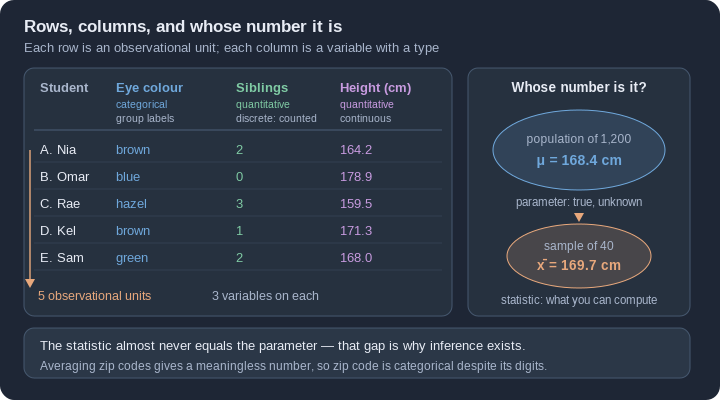
| Categorical | Values that place an individual into one of several groups or categories. These are often labels or names. | Eye color, Grade level (Freshman, etc.), Type of dwelling, Zip code. |
| Quantitative | Values that take on numerical measurements for which it makes sense to find an average or perform arithmetic. | Height in cm, Annual income, Number of siblings, Time spent sleeping. |
The Arithmetic Test: To distinguish between types, ask: "Does calculating an average of these values provide meaningful information?" If you average two zip codes (90210 and 10001), the resulting number (50105.5) is geographically meaningless. Therefore, zip codes are categorical, even though they consist of digits.
Quantitative Sub-types: Discrete vs. Continuous
When a variable is quantitative, we further classify it based on the "set" of possible values it can take. This distinction is critical for choosing between specific types of probability distributions later in the course.
Discrete Variables
A discrete variable (VAR-1.B.2) results from a counting process. It can take on a countable number of values, usually integers, with "gaps" between them.
- Example: The number of cars in a parking lot. You can have 14 or 15 cars, but never 14.62 cars.
- Key Indicator: "How many?"
Continuous Variables
A continuous variable (VAR-1.B.2) results from a measurement process. It can take on any value within a given interval on the number line. The precision of a continuous variable is limited only by the measuring instrument used.
- Example: The weight of a golden retriever. While a scale might show 30.2 kg, the actual weight could be 30.214... kg if measured with infinite precision.
- Key Indicator: "How much?"
Contextual Application: The "Smartwatch" Study
Consider a study tracking 500 athletes using wearable technology. To practice Skill 2.A, we must identify the variables and their types within this data collection plan:
- Brand of Watch: (Apple, Garmin, Fitbit). This is categorical; it sorts athletes into groups.
- Daily Step Count: (e.g., 10,432 steps). This is quantitative and discrete; you cannot take half a step.
- Blood Oxygen Level: (e.g., 98.2%). This is quantitative and continuous; it is a measurement that can take any value in a range.
- User ID Number: (e.g., #88291). This is categorical; it is a numerical label used for identification, not for math.
Misconception Clinic: The "Number" Trap
A common error is assuming that any variable containing numbers is quantitative. This leads to "nonsense" statistics, such as calculating the "average phone area code" in a classroom.
- Incorrect: "The variable 'Jersey Number' is quantitative because it uses numbers."
- Correct: "The variable 'Jersey Number' is categorical."
- Reasoning: A player wearing #10 and a player wearing #20 do not "average out" to a player wearing #15. The numbers are simply identifiers, equivalent to names like "Smith" or "Jones."
Why Classification Matters
The type of variable determines the "legal" operations in data analysis. If you misidentify a categorical variable as quantitative, you might attempt to create a histogram (Topic 1.5) when a bar chart (Topic 1.4) is required, or report a standard deviation for data that has no inherent numerical scale.
Retrieval Check
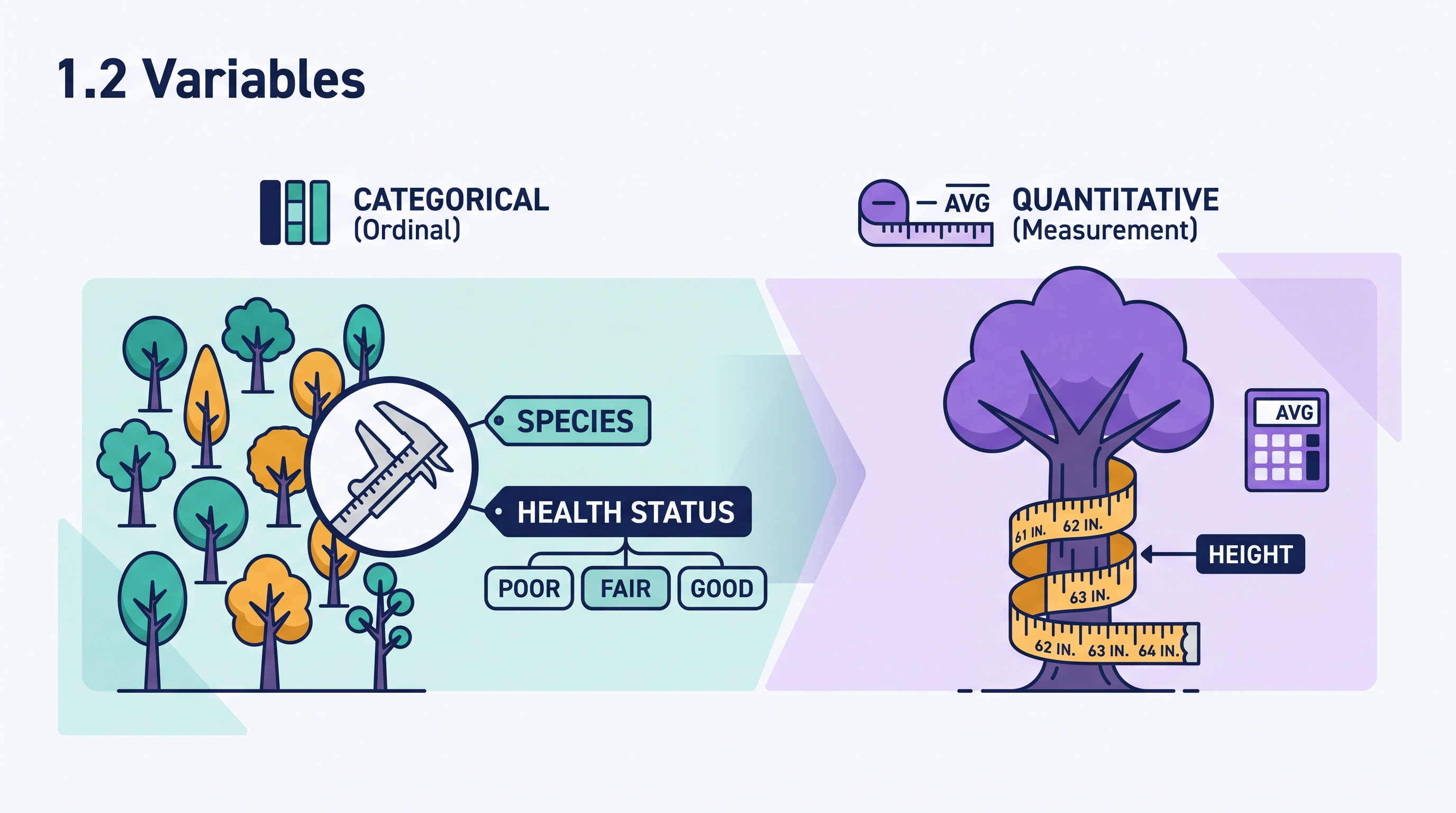
A researcher records the following for each tree in a local park: Species, Height (to the nearest inch), and Health Status (Poor, Fair, Good).
Identify the variable type for "Health Status" and explain why "Height" is considered quantitative even if it is rounded to the nearest whole inch.
Interpretation: Health Status is categorical (ordinal) because it places trees into descriptive groups. Height is quantitative because it is a measurement where arithmetic (like finding the average height of the park's trees) is meaningful. Even if rounded to the nearest inch, the underlying characteristic remains a measurement on a continuous scale.
Source Materials
Study AP Statistics on Lykke
This course page is free to open: signed out, you can read its first two sections, and signing in, on any plan, opens the rest. The free Lykke Chrome extension syncs your own Canvas courses, so ChatGPT, Claude and Muse can answer from your classes and deadlines. It only reads Canvas.
Add the free extensionSign in to open every section