From the free course AP Statistics on Lykke
1.13 Experimental Design
Key concepts: Comparison — at least two treatments, one often a control group · Random assignment balances extraneous variables across groups · Replication — more than one experimental unit per treatment · Direct control — holding other conditions the same for every unit · Blinding, the placebo effect, and confounding variables · Completely randomized, randomized block, and matched-pairs designs
Establishing that one thing causes another is the "holy grail" of statistical inquiry. While observational studies can reveal fascinating correlations, only a well-designed experiment allows us to assert a causal link.
Establishing that one thing causes another is the "holy grail" of statistical inquiry. While observational studies can reveal fascinating correlations, only a well-designed experiment allows us to assert a causal link. In an experiment, researchers deliberately impose treatments on experimental units (the smallest collection of individuals to which treatments are applied) to observe how a response variable changes. This active intervention is what separates experimental data from mere observation.
The Four Pillars of Experimental Design
A well-designed experiment is not a casual trial; it is a rigorous structure built on four essential principles. According to LO 1.13.A and EK 1.13.A.1, these elements must work in concert to ensure that any observed difference in the response variable is actually due to the treatment and not some other factor.
| Principle | Definition | Statistical Purpose |
|---|---|---|
| Comparison | Using at least two treatment groups, one of which may be a control group. | To provide a baseline and account for variables that change over time (like weather or natural healing). |
| Random Assignment | Using a chance process to assign experimental units to treatment groups. | To create roughly equivalent groups at the start by balancing the effects of variables we cannot control or see. |
| Replication | Applying each treatment to many experimental units. | To ensure the observed effect is consistent and not just a "fluke" result from one or two unusual units. |
| Control | Keeping other variables constant for all experimental groups. | To prevent extraneous variables from becoming confounding variables that cloud the results. |
The Logic of Random Assignment
Random assignment is the "great equalizer" of statistics (Skill 2.B). Imagine testing a new energy drink on runners. If we let the fastest runners choose the new drink, we won't know if their fast times were caused by the drink or their natural ability. By using random assignment—such as a random number generator or drawing names from a hat—we ensure that "natural ability" is spread roughly equally across the new drink group and the water group. This allows us to attribute differences in performance to the treatment itself.
Identifying Design Elements in Context
To evaluate or design a study, you must be able to pull apart its components (Skill 2.A). Consider a researcher testing whether a specific blue-light filter improves sleep quality.
- Experimental Units: The 50 volunteers participating in the study.
- Explanatory Variable: The type of light filter used.
- Treatments: Blue-light filtering glasses (Treatment A) and clear "placebo" glasses (Control B).
- Response Variable: Hours of REM sleep recorded by a wearable device.
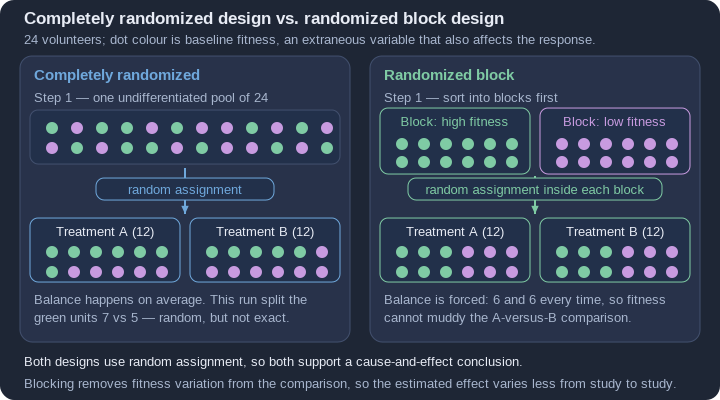
Essential Knowledge 1.13.B & 1.13.C: A completely randomized design occurs when every experimental unit is assigned to a treatment purely by chance. This design is justified when the units are relatively homogeneous or when we want the simplest possible structure to test for a treatment effect.
Misconception Clinic: Random Sampling vs. Random Assignment
One of the most frequent errors in statistical reasoning is confusing how we get our subjects with what we do with them.
- The Error: Assuming that because a study used "randomization," it can prove causation for the whole world.
- The Correction:
- Random Sampling (Topic 1.11) allows us to generalize results to a larger population.
- Random Assignment (Topic 1.13) allows us to determine causation between variables.
- The Reality: Many medical experiments use volunteers (not a random sample), so they can prove a drug works (causation), but they must be cautious about saying it works for everyone (generalization).
Interpretation Check
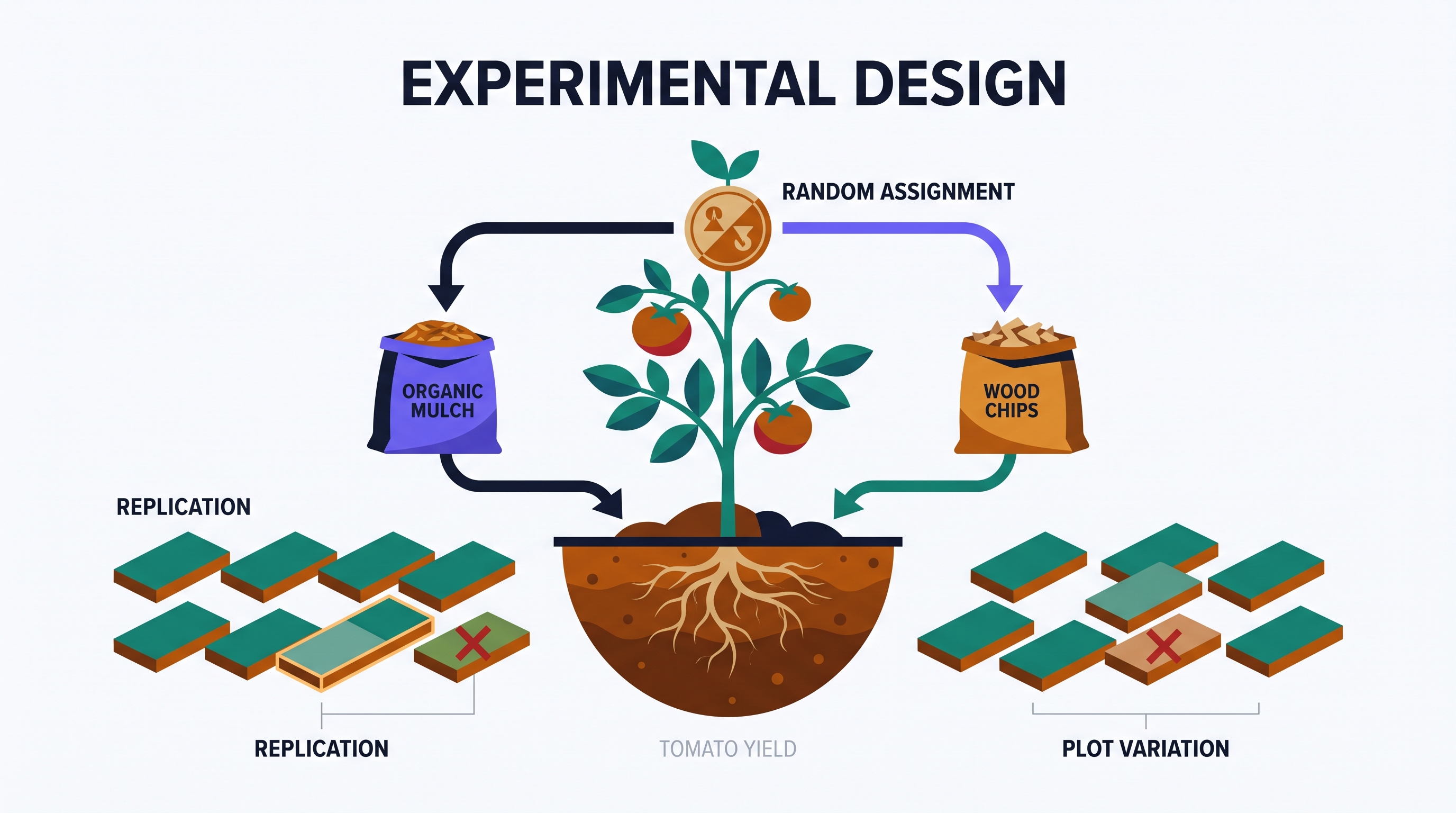
A botanist wants to know if a new organic mulch increases tomato yield. She has 20 identical plots of land. She flips a coin for each plot: "Heads" gets the organic mulch, "Tails" gets standard wood chips. At the end of the season, she weighs the total kilograms of tomatoes from each plot.
- Identify the experimental units.
- Which of the four pillars is represented by the coin flip?
- If she only used one plot for mulch and one for wood chips, which pillar would she be violating?
Check your reasoning: (1) The 20 plots of land. (2) Random assignment. (3) Replication—one unit per treatment is not enough to distinguish a treatment effect from natural plot-to-plot variation.