From the free course AP Statistics on Lykke
1.10 The Investigative Question Revisited and Data Collection
Key concepts: Statistical investigative question — population, variable, and conclusion · Census — recording data from every individual in the population · Observational study — variables measured, nothing imposed · Experiment — treatments deliberately assigned to experimental units · Random selection is what licenses generalizing to the population · Confounding variable — a rival explanation for an association
A statistical investigative question is a purposeful inquiry that identifies a specific population and a measurable characteristic to be analyzed through data that exhibit variability.
A statistical investigative question is a purposeful inquiry that identifies a specific population and a measurable characteristic to be analyzed through data that exhibit variability. Unlike a simple factual question (e.g., "How many students are in this room?"), a statistical question anticipates a range of responses and seeks to uncover patterns, differences, or relationships within a defined group.
Learning Objective T1.10-LO01: Formulate a statistical investigative question and identify the data needed to answer it. (Skill 1.A)
The integrity of a statistical study relies on the Fixed-Question Principle. To ensure the validity of the results, the investigative question must be finalized before any data are collected or analyzed. Formulating a question after viewing the data—a practice sometimes called "data snooping"—can lead to biased conclusions that do not reflect true population characteristics.
Components of a Defensible Plan
To move from an abstract curiosity to a rigorous data collection plan, a researcher must align three critical components: the population of interest, the variables to be measured, and the method of collection.
- The Population: The entire group about which the researcher wants to draw a conclusion.
- The Variables (Skill 2.A): The specific characteristics (categorical or quantitative) that will be recorded for each individual in the sample.
- The Collection Method (Skill 2.B): The strategy used to obtain the data, typically categorized as either an observational study or an experimental design.
Observational Studies vs. Experiments
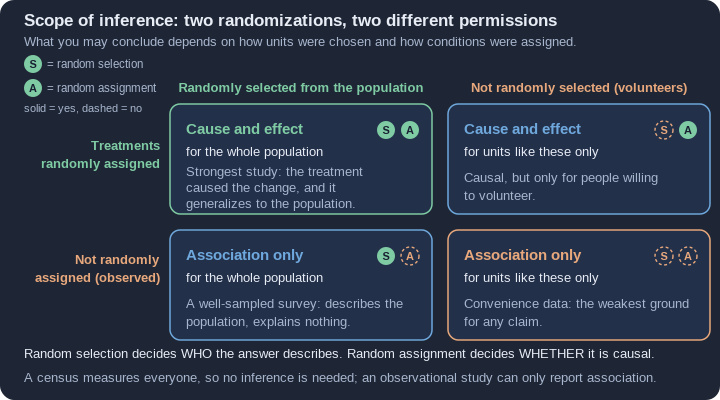
The choice of data collection method determines the scope of the conclusion. In an observational study, researchers measure variables of interest but do not attempt to influence the responses. These studies are ideal for identifying associations or describing populations as they naturally exist.
In contrast, an experiment involves the deliberate imposition of some treatment on individuals to observe their responses. By controlling the environment and randomly assigning treatments, researchers can investigate potential cause-and-forth relationships. Identifying the correct method is a core requirement of Skill 2.B, as it justifies whether a claim of "association" or "causation" is defensible.
Contextual Example: The Sleep and GPA Study
| Component | Implementation |
|---|---|
| Investigative Question | Is there a relationship between the average hours of sleep per night and the cumulative GPA of seniors at West High School? |
| Population | All seniors at West High School. |
| Variables | Sleep (Quantitative, hours); GPA (Quantitative, 0.0–4.0 scale). |
| Method | Observational Study. The researcher would record existing habits rather than forcing students to sleep specific amounts. |
| Scope | Can show an association between sleep and GPA, but cannot prove that more sleep causes a higher GPA. |
Misconception Clinic: The "Post-Hoc" Question
| The Error | Why It Fails | The Repair |
|---|---|---|
| The "Discovery" Question: A researcher collects data on 50 variables, finds a weird spike in one, and then writes the investigative question to target that spike. | This violates the requirement that the question be fixed before analysis (T1.10-EK02). It increases the risk of finding "patterns" that are actually just random noise. | Define the purpose and the specific variables of interest before the first data point is ever recorded. |
Data Collection and the Scope of Inference
The data collection plan must be "defensible," meaning the method chosen must actually be capable of answering the question asked. If the question asks about a "cause," but the plan describes an observational study, the plan is not defensible. Similarly, if the question targets "all teenagers" but the data collection plan only involves "teenagers at one local mall," the scope of the conclusion will be limited by the sampling method.
Interpretation Check
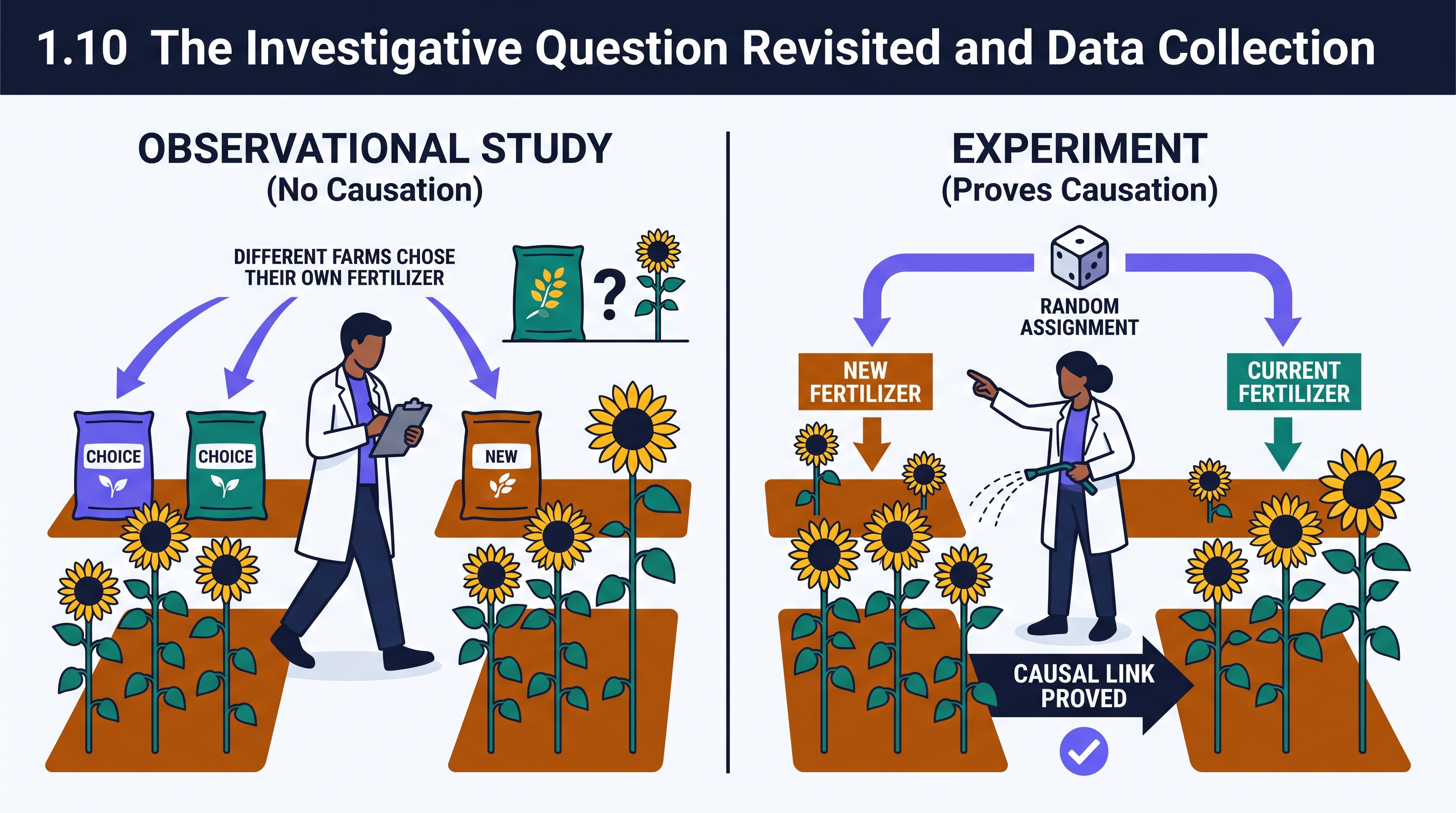
A researcher wants to know if a new fertilizer leads to taller sunflowers compared to the current brand. They plan to visit 20 different farms and measure the height of sunflowers, noting which fertilizer each farm chose to use.
Question: Is this a defensible plan to prove the new fertilizer causes sunflowers to grow taller?
- Answer: No. This is an observational study because the researcher did not impose the treatment (the farms chose their own fertilizer). To prove causation, the researcher would need an experiment where they randomly assign the fertilizer types to different plots of sunflowers.
Source Materials
Study AP Statistics on Lykke
This course page is free to open: signed out, you can read its first two sections, and signing in, on any plan, opens the rest. The free Lykke Chrome extension syncs your own Canvas courses, so ChatGPT, Claude and Muse can answer from your classes and deadlines. It only reads Canvas.
Add the free extensionSign in to open every section