From the free course AP Statistics on Lykke
2.5 Mutually Exclusive Events
Key concepts: Joint probability — P(A ∩ B), both events on the same trial · Mutually exclusive (disjoint) events — P(A ∩ B) = 0 · Addition rule for disjoint events — the probabilities simply add · Exhaustive disjoint categories — probabilities that total 1 · Disjoint is not independent — A occurring rules B out · Justifying disjointness — argue from the joint probability, not from wording
Events that cannot occur at the same time define the boundary of logical possibility in probability. In statistics, these are formally known as mutually exclusive (or disjoint) events.
Events that cannot occur at the same time define the boundary of logical possibility in probability. In statistics, these are formally known as mutually exclusive (or disjoint) events. If one event occurs, the other is strictly prohibited from occurring during that same trial. This structural "gap" between events simplifies the math of the addition rule and provides a foundational check for the validity of probability models.
The Logic of Disjoint Sets
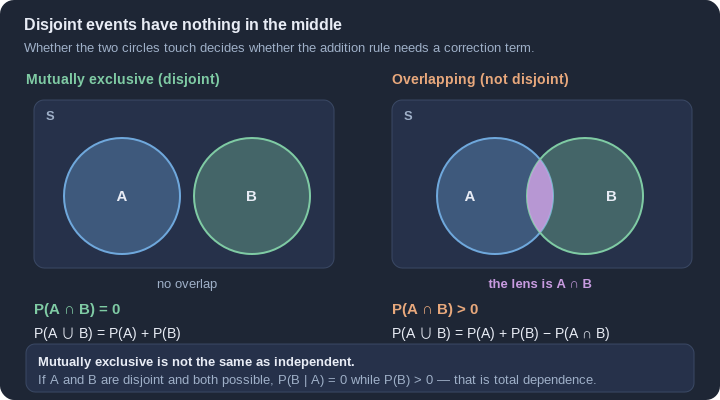
Two events, $A$ and $B$, are mutually exclusive if they have no outcomes in common. In the language of set theory, their intersection is the empty set ($A \cap B = \emptyset$). Because there is no overlap, the probability of both events occurring simultaneously is exactly zero.
Definition: Mutually Exclusive (Disjoint) Two events are mutually exclusive if the occurrence of one event excludes the possibility of the occurrence of the other. Formally: $$P(A \cap B) = 0$$
The Simplified Addition Rule
When events are mutually exclusive, the general addition rule—$P(A \cup B) = P(A) + P(B) - P(A \cap B)$—collapses into a simpler form. Since the "overlap" term is zero, we do not need to worry about double-counting outcomes.
Formula: Addition Rule for Mutually Exclusive Events
For any two mutually exclusive events $A$ and $B$: $$P(A \text{ or } B) = P(A) + P(B)$$ This principle extends to any number of mutually exclusive events. If a set of events is mutually exclusive and exhaustive, meaning they cover every possible outcome in the sample space without overlapping, their probabilities must sum to exactly 1.
Contextual Example: Emergency Room Triage
Consider a hospital's triage system where every incoming patient is assigned exactly one priority level: Immediate, Urgent, or Non-urgent. Because a single patient cannot be classified as both "Immediate" and "Non-urgent" at the same moment, these categories are mutually exclusive.
If $P(\text{Immediate}) = 0.08$ and $P(\text{Urgent}) = 0.32$, we can use the simplified addition rule to find the probability that a randomly selected patient requires significant resources (either Immediate or Urgent): $$P(\text{Immediate} \cup \text{Urgent}) = 0.08 + 0.32 = 0.40$$ Assigning meaning to this finding (Skill 4.B), a hospital administrator can claim that 40% of the incoming patient flow requires prioritized medical intervention.
The "Independence" Trap
The most frequent error in introductory statistics is confusing mutually exclusive events with independent events. While the terms sound similar in everyday English, they are mathematically opposites in the world of probability.
- Independence means the occurrence of one event provides no information about the likelihood of the other.
- Mutual Exclusivity means the occurrence of one event provides perfect information about the other—it tells you the other event definitely did not happen.
If $A$ and $B$ are mutually exclusive and $P(A) > 0$, then $A$ and $B$ cannot be independent. Why? Because if you know $A$ happened, the probability of $B$ immediately drops to zero. Since the probability of $B$ changed, the events are dependent.
Misconception Clinic: Mutual Exclusivity vs. Independence
| Feature | Mutually Exclusive (Disjoint) | Independent |
|---|---|---|
| Definition | Cannot happen at the same time. | One happening doesn't change the other's probability. |
| Intersection | $P(A \cap B) = 0$ | $P(A \cap B) = P(A) \cdot P(B)$ |
| Visual | Non-overlapping circles in a Venn diagram. | Overlapping circles (usually) where the ratio of overlap is consistent. |
| Relationship | Knowing $A$ happened means $B$ is impossible. | Knowing $A$ happened tells you nothing new about $B$. |
Identifying Disjoint Events in Data
To determine if two events are mutually exclusive in a real-world data set, such as a two-way table, look at the joint frequency (the "cell" where the row and column meet). If the count in that cell is 0, the events are mutually exclusive for that data set. If the count is greater than 0, they are not mutually exclusive.
Essential Knowledge (T2.5-C01): Two events are mutually exclusive if they cannot occur simultaneously. This is verified if $P(A \cap B) = 0$. Learning Objective (T2.5-L01): Determine whether events are mutually exclusive (disjoint).
Interpretation Check
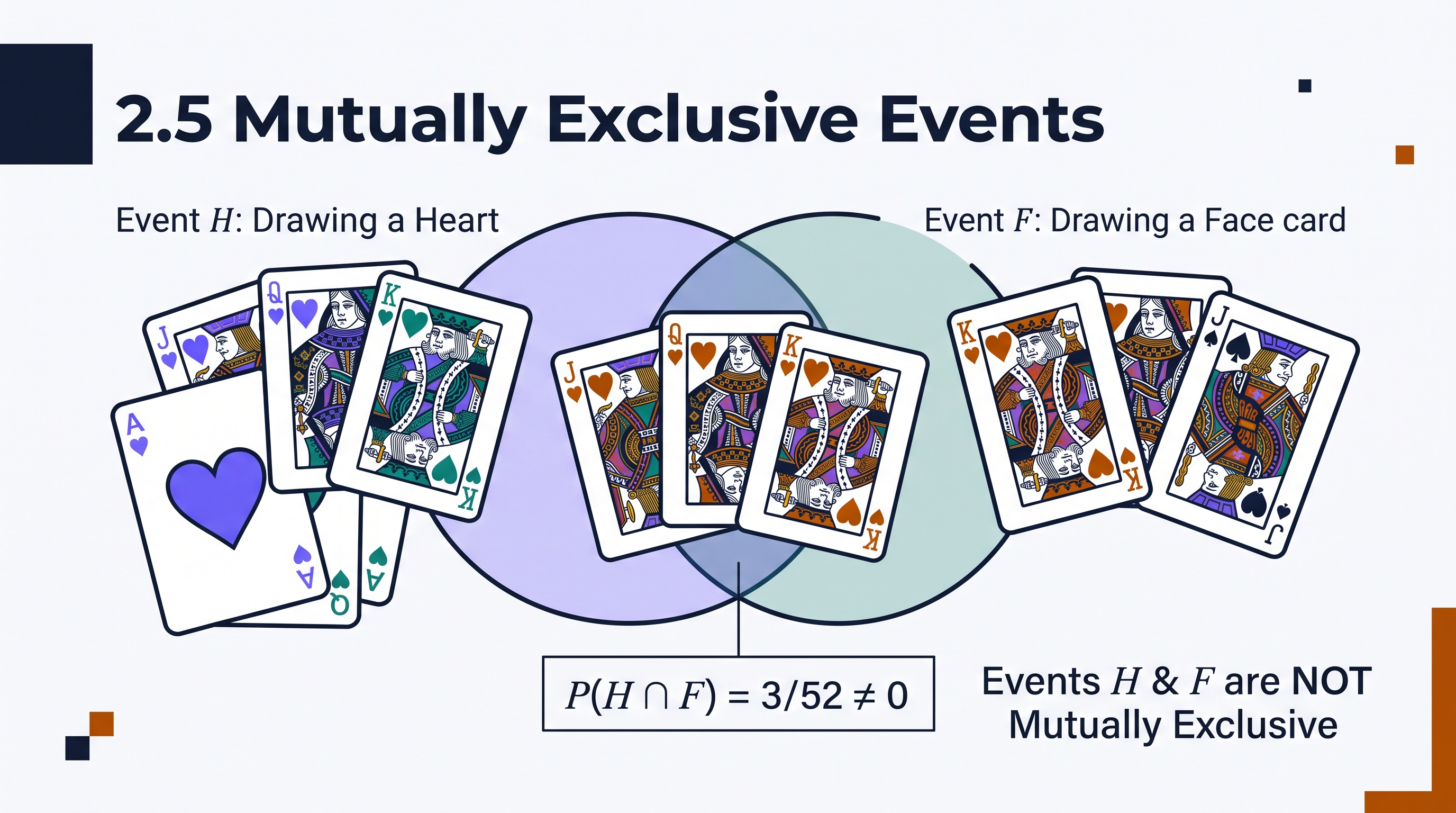
A standard deck of cards is shuffled. Event $H$ is drawing a Heart. Event $F$ is drawing a Face card (Jack, Queen, King).
- Are events $H$ and $F$ mutually exclusive?
- Justify your answer using $P(H \cap F)$.
Check your reasoning: No, they are not mutually exclusive. There are 3 cards (the Jack, Queen, and King of Hearts) that belong to both sets. Therefore, $P(H \cap F) = 3/52 \neq 0$. Because the intersection is not zero, the events can occur simultaneously.