From the free course Literature and Literacy on Lykke
Foundations of Literature and Literacy
Key concepts: Artistic Value · Critical Thinking · Information Literacy · Rhetorical Action
Defines literature and literacy while establishing the relationship between critical thinking and rhetorical action.
Foundations of Literature and Literacy
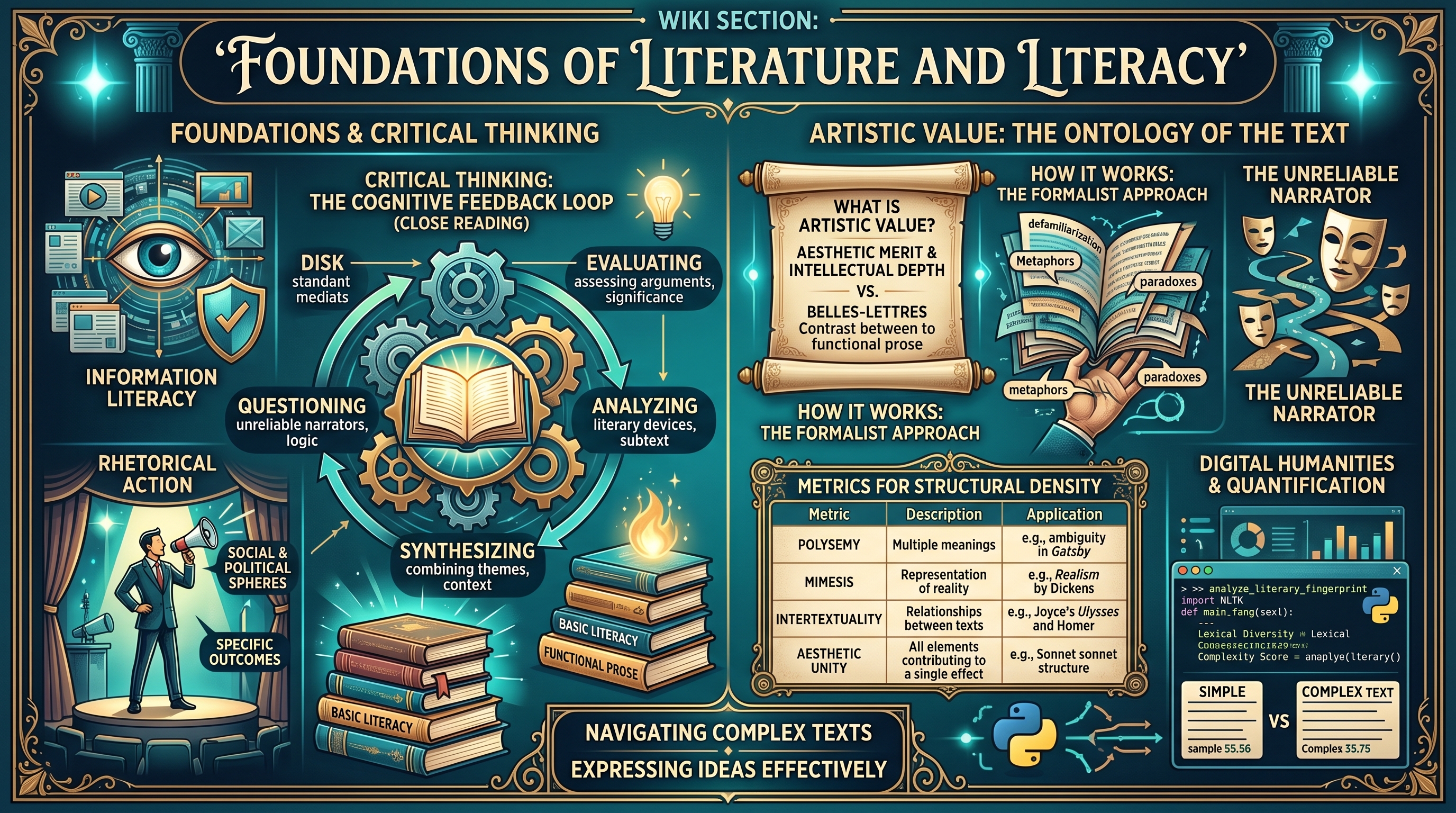
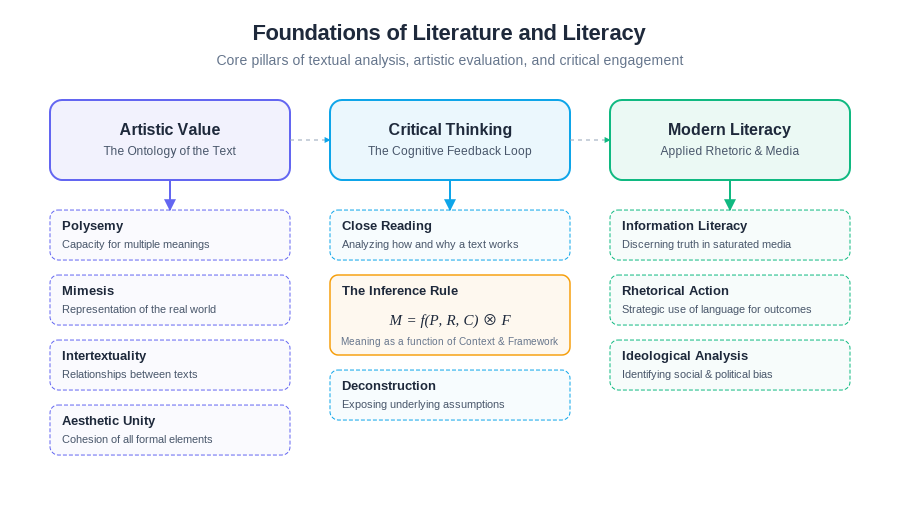
Literature is defined as any body of written works considered an art form or deemed to have significant intellectual value. This section establishes the foundational skills of literacy and critical thinking, which are essential for navigating complex texts and expressing ideas effectively. In the modern era, these foundations have expanded to include information literacy—the ability to discern truth in a saturated media landscape—and rhetorical action, the strategic use of language to achieve specific outcomes in social and political spheres.
Artistic Value: The Ontology of the Text
Artistic Value in literature refers to the aesthetic merit and intellectual depth that distinguishes "belles-lettres" (fine writing) from purely functional or technical prose. While a technical manual aims for clarity and utility, a literary work aims for a "surplus of meaning," where the form, style, and structure are as significant as the content itself.
What it is
Artistic value is often measured through canonization—the process by which certain works are deemed "classics"—and aesthetic distance, the gap between the reader's reality and the world of the text. It involves the use of literary devices (metaphor, synecdoche, irony) to create a "defamiliarization" (Viktor Shklovsky’s ostranenie) that forces the reader to perceive the world anew.
Why it matters
Without an understanding of artistic value, literature is reduced to a data-transfer mechanism. Recognizing value allows us to understand the cultural "zeitgeist" of a period, such as the Puritan focus on divine providence or the Romantic emphasis on the sublime.
How it works: The Formalist Approach
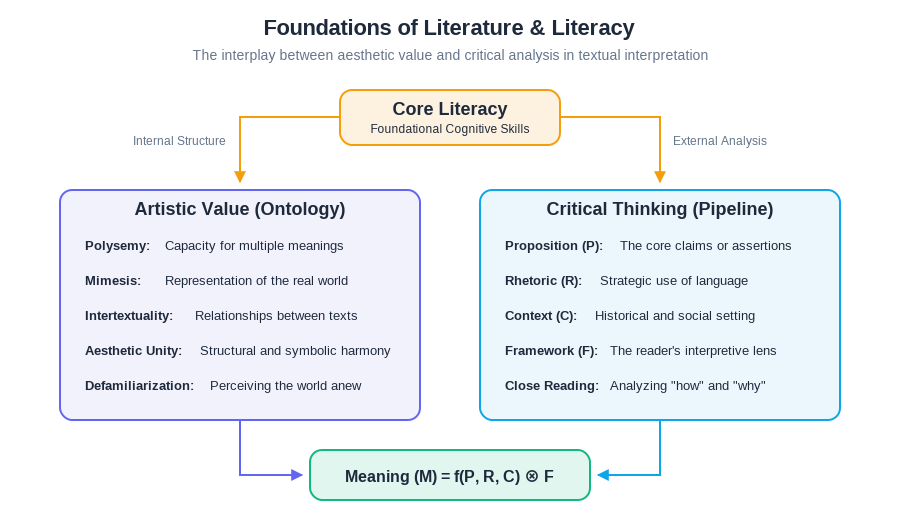
To analyze artistic value, one must look at the Internal Consistency and Complexity of the work. This is often modeled as a function of the text's structural density.
| Metric | Description | Application in Literature |
|---|---|---|
| Polysemy | The capacity for a sign or text to have multiple meanings. | Ambiguity in The Great Gatsby regarding the American Dream. |
| Mimesis | The representation of the real world in art and literature. | The gritty details of 19th-century Realism (e.g., Dickens, Balzac). |
| Intertextuality | The relationship between texts; how one text references another. | Joyce’s Ulysses mapping onto Homer’s Odyssey. |
| Aesthetic Unity | The degree to which all elements of a work contribute to a single effect. | The tight, symbolic structure of a Shakespearean sonnet. |
Concrete Example: Sentiment and Structural Analysis
In modern digital humanities, we can quantify "artistic value" or at least stylistic markers using Natural Language Processing (NLP).
Common Pitfalls
- Subjectivity Trap: Confusing "I like this" with "This has artistic value." Value is often determined by the work's influence on subsequent literature and its internal technical mastery.
- Anachronism: Judging a 17th-century Puritan text by 21st-century aesthetic standards.
Critical Thinking: The Cognitive Feedback Loop
Critical Thinking is the disciplined process of actively and skillfully conceptualizing, applying, analyzing, synthesizing, and evaluating information gathered from, or generated by, observation, experience, reflection, reasoning, or communication.
What it is
In the context of literature, critical thinking is synonymous with Close Reading. It is the move from what the text says to how and why it says it. It requires the identification of logical fallacies, the questioning of the narrator's reliability, and the deconstruction of the author's underlying assumptions.
Why it matters
Critical thinking transforms a reader from a passive consumer into an active participant. In the era of "Post-Truth," the ability to identify a text's ideological bias is a survival skill.
How it works: The Analytical Pipeline
Critical thinking follows a recursive logic. We can represent the "Critical Analysis Algorithm" as a set of logical operations.
The Critical Inference Rule: If a text $T$ asserts proposition $P$ using rhetorical device $R$ in historical context $C$, then the intended meaning $M$ is a function of $(P, R, C)$, subject to the reader's own interpretive framework $F$. $$M = f(P, R, C) \otimes F$$
Mathematical Representation of Argument Mapping
We can view an argument as a directed acyclic graph (DAG) where nodes are claims and edges are logical supports or rebuttals.
[Claim: The narrator is unreliable]
       ^             ^
       | (Support)   | (Support)
[Contradiction A]  [Bias B]
       |             |
[Textual Evidence] [Historical Context]
Variations: Literary Theory
Critical thinking is applied through various "lenses" or theories:
- Marxist Criticism: Analyzing power dynamics and class struggle.
- Feminist Criticism: Examining the representation of women and gender roles.
- Post-Colonialism: Investigating the impact of colonial rule and cultural hegemony.
Information Literacy: Navigating the Epistemic Landscape
Information Literacy is the ability to recognize when information is needed and have the ability to locate, evaluate, and use effectively the needed information.
What it is
While traditional literacy focuses on the mechanics of reading, information literacy focuses on the ecology of information. It involves understanding how information is produced, the economics of attention, and the technical structures (algorithms, databases) that deliver content.
Why it matters
In the 21st century, we are no longer limited by a lack of information, but by an excess of it. Information literacy provides the tools to filter "noise" from "signal."
The SIFT Method (The "Algorithm" for Evaluation)
Professional fact-checkers use the SIFT method to evaluate sources.
| Step | Action | Objective |
|---|---|---|
| Stop | Pause before sharing or reacting. | Prevent emotional contagion and "fast thinking." |
| Investigate | Look up the author, publisher, and funding. | Establish the "Epistemic Authority" of the source. |
| Find | Look for "better coverage" or consensus. | Determine if the claim is an outlier or mainstream. |
| Trace | Find the original context of quotes or data. | Eliminate "contextomy" (quoting out of context). |
Common Pitfalls: The Echo Chamber
The most common failure of information literacy is Confirmation Bias—the tendency to search for, interpret, favor, and recall information in a way that confirms one's preexisting beliefs.
Rhetorical Action: Language as a Tool of Influence
Rhetorical Action is the strategic use of language and symbols to achieve specific goals or influence an audience. It is the "pragmatic" side of literature and literacy.
What it is
Derived from the Aristotelian tradition, rhetoric is the "faculty of observing in any given case the available means of persuasion." It moves beyond the meaning of words to the effect of words.
Why it matters
Every piece of writing—from a Puritan sermon to a Modernist manifesto—is a rhetorical act. Understanding rhetoric allows us to see how texts "do" things in the world: they start revolutions, enforce laws, and build identities.
The Rhetorical Triangle and Beyond
The classic model involves Ethos (Credibility), Pathos (Emotion), and Logos (Logic). However, a more sophisticated model includes Kairos (The Opportune Moment) and Telos (The Ultimate Purpose).
| Element | Focus | Mechanism |
|---|---|---|
| Ethos | The Speaker | Establishing authority, shared values, and character. |
| Logos | The Message | Syllogisms, data, inductive and deductive reasoning. |
| Pathos | The Audience | Vivid imagery, metaphors, and emotional appeals. |
| Kairos | The Setting | Timing the message to coincide with cultural shifts. |
Socio-historical Context and the Evolution of Literacy
Literacy and literature do not exist in a vacuum; they are products of their Socio-historical Context. The movements mentioned in the source materials—Puritanism, Romanticism, Realism, and Modernism—represent shifts in how human beings perceive reality and their place within it.
Timeline of Literary Movements and Literacy Paradigms
| Period | Movement | Primary Literacy Goal | Key Rhetorical Mode |
|---|---|---|---|
| 1600-1750 | Puritanism | Religious Instruction | The Sermon (Plain Style) |
| 1750-1820 | Enlightenment | Civic Participation | The Political Pamphlet (Reason) |
| 1820-1860 | Romanticism | Emotional Expression | The Lyric Poem (Sublime) |
| 1865-1914 | Realism/Naturalism | Social Documentation | The Novel (Objective Observation) |
| 1914-1945 | Modernism | Psychological Exploration | Stream of Consciousness (Fragmentation) |
| 1945-Present | Post-Modernism | Deconstruction | Metafiction (Irony/Pastiche) |
Case Study: Diverse Voices in Early America
Early American literature was not a monolith. While the "Canon" long focused on European settlers, a critical literacy approach reveals a rich tapestry of Diverse Voices.
- Indigenous Oratory: Oral traditions that functioned as sophisticated legal and social frameworks.
- Slave Narratives: (e.g., Frederick Douglass) Rhetorical masterpieces designed to prove the humanity and literacy of the enslaved to a white audience.
- Women’s Captivity Narratives: Texts that negotiated the boundaries of domesticity and the "wilderness."
Conclusion: The Synthesis of Foundations
The foundations of literature and literacy are not disparate skills but an integrated system. Artistic Value provides the depth; Critical Thinking provides the tools for excavation; Information Literacy provides the map of the terrain; and Rhetorical Action provides the means to build something new from the findings.
As we move from the "Gutenberg Galaxy" of printed books into the "Digital Constellation" of hyperlinked, AI-generated content, these foundations become more critical than ever. The "literate" individual of the future is not just one who can read, but one who can navigate the complex interplay of human creativity and algorithmic logic.
Source Materials
Study Literature and Literacy on Lykke
This course page is free to open: signed out, you can read its first two sections, and signing in, on any plan, opens the rest. The free Lykke Chrome extension syncs your own Canvas courses, so ChatGPT, Claude and Muse can answer from your classes and deadlines. It only reads Canvas.
Add the free extensionSign in to open every sectionAll sections of Literature and Literacy · Browse more course pages