From the free course Literature and Literacy on Lykke
British and Irish Literary Evolution
Key concepts: Anglo-Saxon Literature · The Renaissance · Neoclassicism · Irish Gothic
Traces the development of literature in the British Isles from the Anglo-Saxon period to Modernism.
British and Irish Literary Evolution
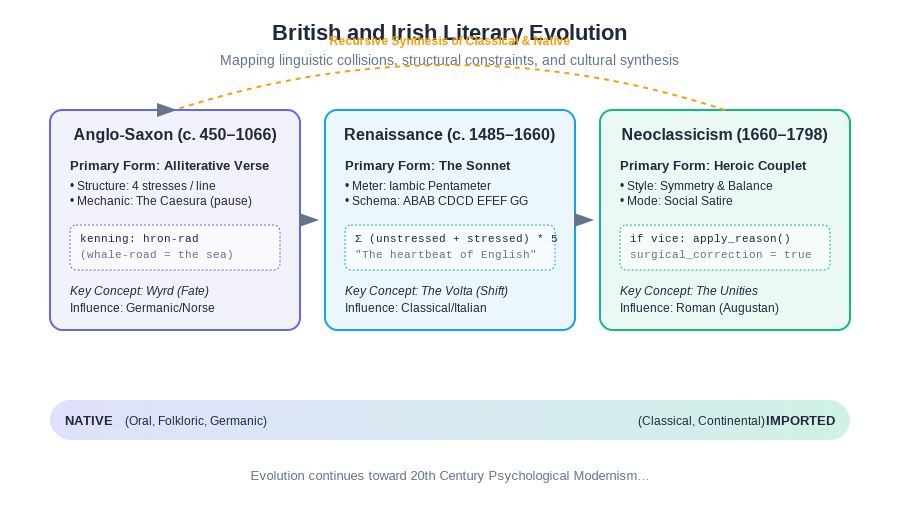
The literary history of the British Isles is not a linear progression but a series of recursive loops, linguistic collisions, and cultural syntheses. From the guttural, alliterative roots of the Germanic tribes to the sophisticated psychological fracturing of the 20th-century modernists, the evolution of British and Irish literature tracks the development of the English language itself. This evolution is characterized by a tension between the "native" (the insular, the oral, the folkloric) and the "imported" (the classical, the continental, the colonial).
Anglo-Saxon Literature (c. 450–1066)
Anglo-Saxon or Old English Literature represents the foundational layer of the English literary tradition. It emerged from the oral traditions of Germanic tribes (Angles, Saxons, and Jutes) who settled in Britain. The literature of this period is defined by a distinct aesthetic of heroism, fate (wyrd), and a melancholy awareness of the transitory nature of life.
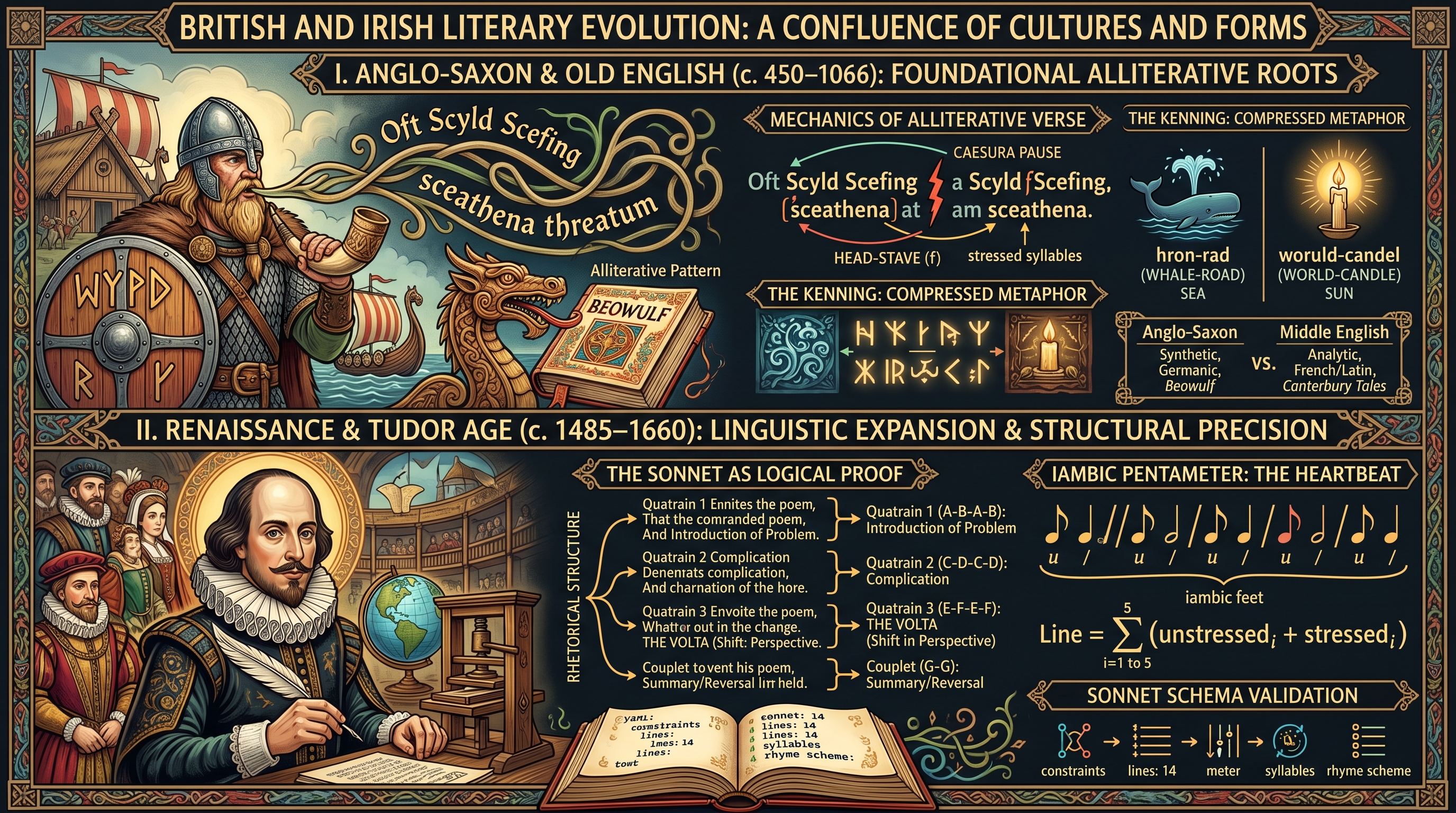
Mechanics of Alliterative Verse
Unlike modern poetry, which often relies on rhyme and meter (syllabic count), Old English poetry is structured around alliteration and the caesura. Each line is divided into two half-lines (verses), separated by a pause (caesura). Each half-line contains two stressed syllables.
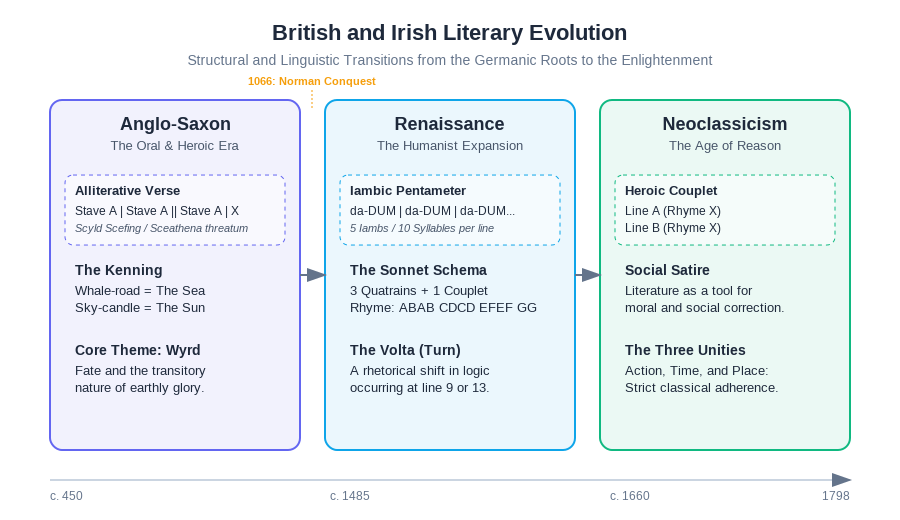
Definition: The Kenning A kenning is a compressed metaphor or a compound figurative expression used in place of a simple noun. For example, the sea is called the hron-rad (whale-road), and the sun is the woruld-candel (world-candle).
Alliterative Pattern Analysis
In a standard line of Old English verse, the first stressed syllable of the second half-line must alliterate with one or both of the stressed syllables in the first half-line.
Comparison of Old English and Middle English
| Feature | Anglo-Saxon (Old English) | Middle English (Post-1066) |
|---|---|---|
| Primary Influence | Germanic/Norse | French/Latin/Norman |
| Poetic Structure | Alliterative Verse | Rhymed Couplets/Stanzas |
| Key Theme | Comitatus (Loyalty to Lord) | Chivalry and Courtly Love |
| Language Status | Synthetic (Inflected) | Analytic (Loss of inflections) |
| Example Work | Beowulf | The Canterbury Tales |
The Renaissance and the Tudor Age (c. 1485–1660)
The English Renaissance was a "rebirth" of classical learning, but in Britain, it manifested as a period of intense linguistic expansion and the professionalization of literature. This era saw the transition from the medieval "Great Chain of Being" to a more human-centric, though still deeply religious, worldview.
The Sonnet as a Logical Proof
The Renaissance introduced the sonnet, a 14-line poem that functions as a mathematical and rhetorical exercise. The Shakespearean (English) sonnet consists of three quatrains and a final couplet, following the rhyme scheme ABAB CDCD EFEF GG.
The structure follows a specific logical derivation:
- Quatrain 1: Introduction of the problem or image.
- Quatrain 2: Expansion or complication of the problem.
- Quatrain 3: A shift in perspective (the volta).
- Couplet: A summary or ironic reversal.
Mathematical Representation of Iambic Pentameter
The "heartbeat" of English Renaissance literature is iambic pentameter.
\text{Line} = \sum_{i=1}^{5} (\text{unstressed}_i + \text{stressed}_i)
Where each $(\text{u} + \text{s})$ unit is an iamb. A perfect line contains exactly 10 syllables.
Neoclassicism and the Enlightenment (1660–1798)
Following the chaos of the English Civil War, the Neoclassical period (often called the Augustan Age) sought order, restraint, and "correctness." Writers like Alexander Pope and Jonathan Swift looked back to the Roman greats (Augustus, Horace, Virgil) for models of stability.
The Rise of the Novel and Satire
This era marks the birth of the modern novel (Robinson Crusoe) and the perfection of Satire. Satire in the Enlightenment was not merely "making fun"; it was a surgical tool used to correct social vice through the application of reason.
The Heroic Couplet
The dominant poetic form was the heroic couplet: two rhymed lines of iambic pentameter that form a complete thought. This mirrored the Enlightenment's obsession with symmetry and balance.
Key Concept: The Unities Neoclassical drama often adhered to the "Three Unities" derived from Aristotle:
- Unity of Action: A play should have one main plot.
- Unity of Place: A play should cover a single physical space.
- Unity of Time: The action should span no more than 24 hours.
Data Model: The Enlightenment Library
To understand the Neoclassical mind, we can look at how they categorized knowledge.
Irish Gothic (18th – 19th Century)
While English Gothic (e.g., Ann Radcliffe) often dealt with foreign threats in Catholic Europe, Irish Gothic is a distinct subgenre that reflects the anxieties of the Anglo-Irish Protestant Ascendancy—a ruling class isolated in a land that felt increasingly hostile and haunted by its own history.
The "Big House" and Colonial Anxiety
The central trope of Irish Gothic is the decaying "Big House." This represents the crumbling power of the Anglo-Irish landlords. The ghosts in Irish Gothic are rarely just spirits; they are manifestations of colonial guilt and the "return of the repressed" (the indigenous Gaelic culture).
Key Figures and Tropes
| Author | Key Work | Primary Contribution |
|---|---|---|
| Sheridan Le Fanu | Carmilla | The female vampire; psychological suspense. |
| Bram Stoker | Dracula | The "outsider" invading the metropole; blood as lineage. |
| Charles Maturin | Melmoth the Wanderer | The "Wandering Jew" motif; extreme narrative nesting. |
| Oscar Wilde | The Picture of Dorian Gray | The double (Doppelgänger); aesthetic corruption. |
Architectural and Atmospheric Logic
Irish Gothic operates on a "pipeline" of dread. We can visualize the generation of a Gothic atmosphere as a series of environmental and psychological transforms.
The Victorian and Modernist Transition
The 19th and 20th centuries saw a radical shift from the Victorian emphasis on moral duty and social realism to the Modernist obsession with subjectivity, time, and the "stream of consciousness."
The Victorian Moral Imperative
Victorian literature (Dickens, George Eliot) functioned as a social conscience. The novel became a tool for exploring the "Condition of England" question—addressing poverty, industrialization, and the loss of faith following Darwin's Origin of Species.
The Modernist Rupture
Modernism (Woolf, Joyce, Yeats) was a response to the trauma of World War I. If the world was fragmented, literature must be fragmented too.
Key Insight: Stream of Consciousness A narrative technique that attempts to render the fluid, non-linear nature of human thought. It ignores traditional syntax to capture the "pre-speech" level of consciousness.
Comparison: Realism vs. Modernism
| Dimension | Victorian Realism | Modernism |
|---|---|---|
| Narrator | Omniscient, reliable | Limited, unreliable |
| Time | Chronological, linear | Circular, fragmented, "Kairos" |
| Language | Transparent, communicative | Opaque, self-referential |
| Subject | Society, the "Middle Class" | The individual psyche |
Common Pitfalls in Literary Analysis
- Anachronistic Reading: Applying 21st-century secular values to Anglo-Saxon texts. For the Anglo-Saxons, fate (wyrd) was an immutable physical force, not a metaphor.
- Over-simplifying the Renaissance: Assuming the Renaissance was a clean break from the Middle Ages. In reality, medieval superstition and Renaissance science coexisted for centuries.
- Confusing English and Irish Gothic: English Gothic is often about the fear of the foreign; Irish Gothic is about the fear of the home.
- Misunderstanding Satire: Thinking satire is just "sarcasm." True Neoclassical satire requires a moral standard against which the subject is being measured.
Source Materials
Study Literature and Literacy on Lykke
This course page is free to open: signed out, you can read its first two sections, and signing in, on any plan, opens the rest. The free Lykke Chrome extension syncs your own Canvas courses, so ChatGPT, Claude and Muse can answer from your classes and deadlines. It only reads Canvas.
Add the free extensionSign in to open every sectionAll sections of Literature and Literacy · Browse more course pages