From the free course Literature and Literacy on Lykke
Writing and Critical Analysis
Key concepts: Literary Criticism · Academic Writing · Research Strategies · Information Literacy
Provides practical guidance on writing about literature and conducting academic research.
Writing and Critical Analysis
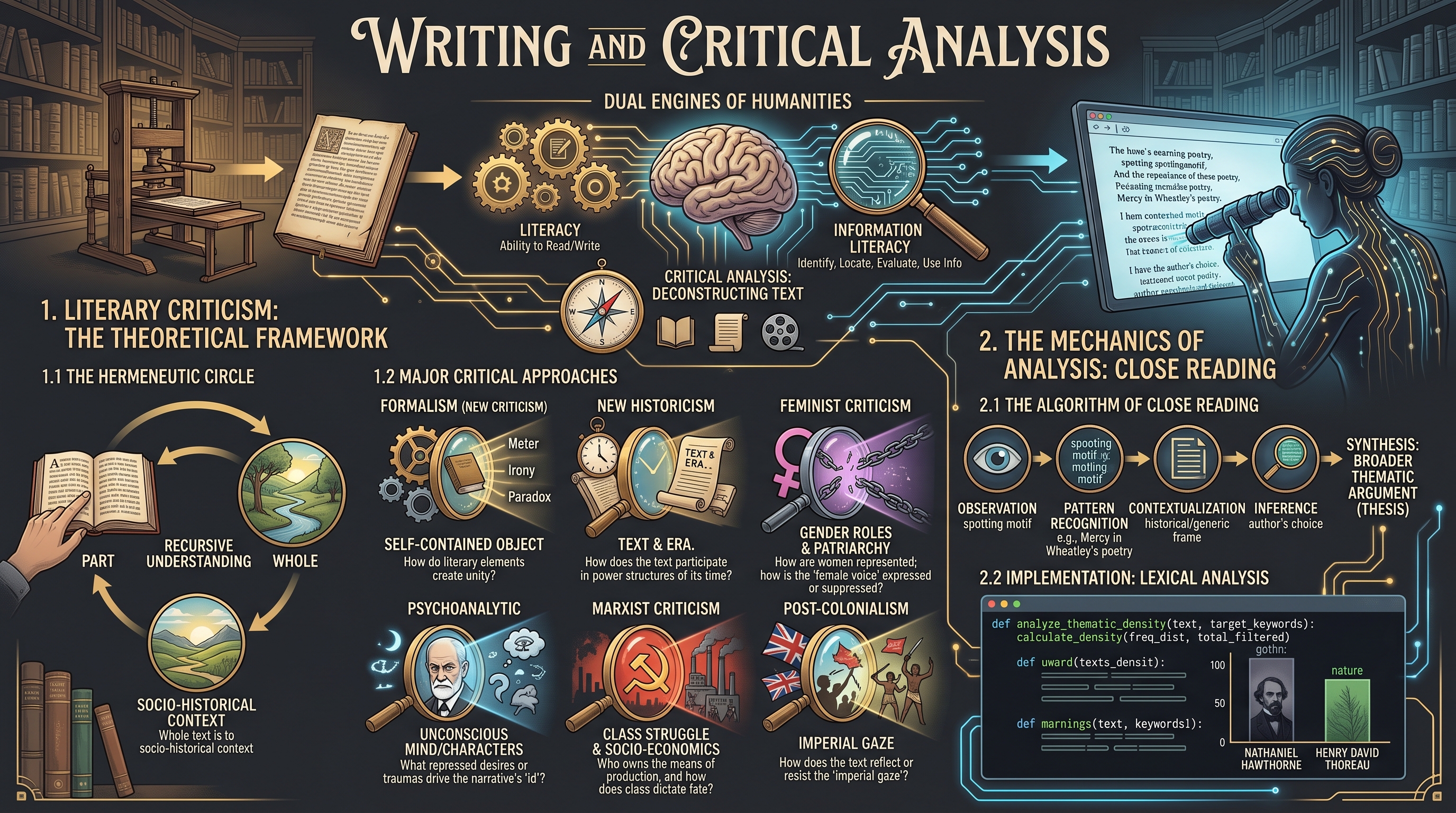
Writing and critical analysis represent the dual engines of the humanities. While Literacy is traditionally defined as the ability to read and write, in an academic context, it evolves into Information Literacy: the capacity to identify, locate, evaluate, and effectively use information to solve a problem or support an argument. Critical analysis is the recursive process of deconstructing a text (literary, historical, or cultural) to understand its internal mechanics, socio-historical context, and the ideological work it performs.
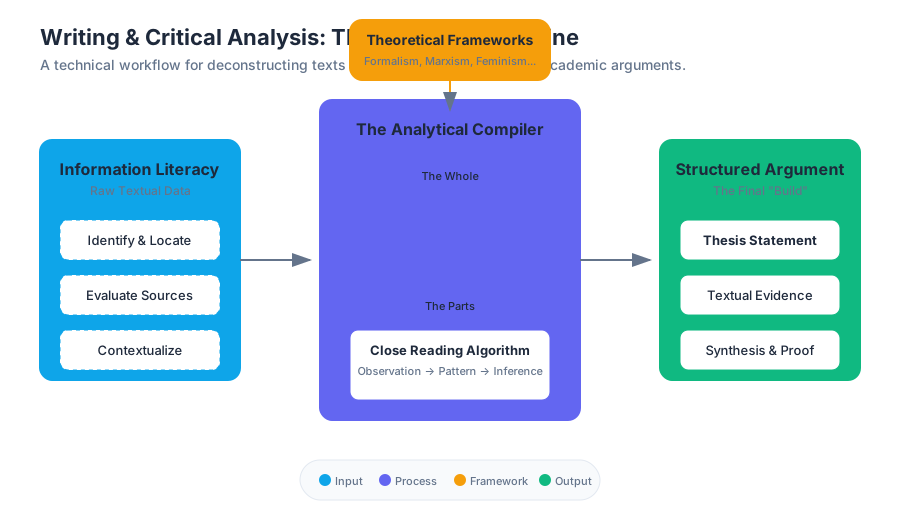
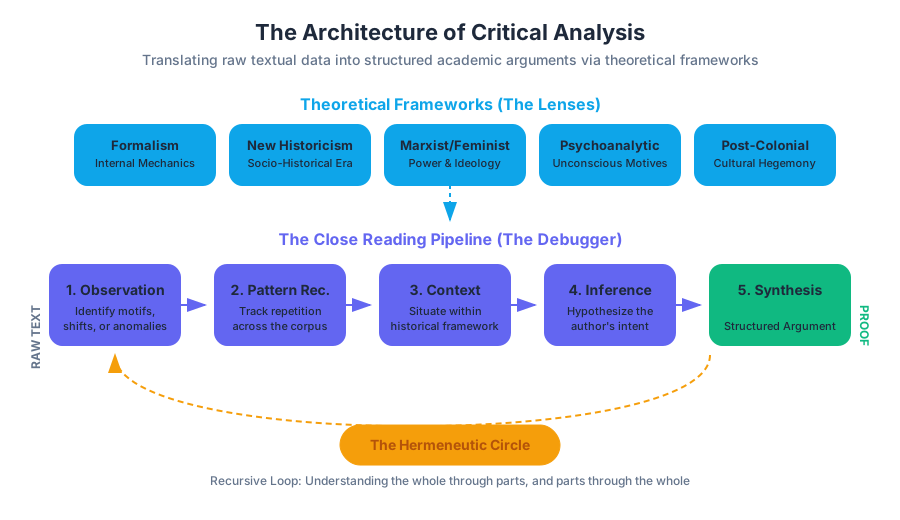
In the study of literature—ranging from the Puritan sermons of early America to the Transcendentalist poetry of Walt Whitman—critical analysis serves as a "compiler" for human thought. It translates raw textual data into structured arguments by applying specific theoretical frameworks. This section provides a technical deep-dive into the methodologies of literary criticism, the architecture of academic writing, and the heuristics of high-level research.
1. Literary Criticism: The Theoretical Framework
Literary Criticism is the systematic study, evaluation, and interpretation of literature. It is not "criticism" in the sense of finding fault, but rather a disciplined activity that attempts to describe the value, meaning, and function of a text.
1.1 The Hermeneutic Circle
The fundamental logic of analysis is the Hermeneutic Circle, which posits that one's understanding of a text as a whole is established by reference to the individual parts, and one's understanding of each individual part by reference to the whole. Neither the whole text nor any individual part can be understood without reference to one another, making it a recursive process.
1.2 Major Critical Approaches
Critics use "lenses" to focus on specific aspects of a text. Choosing a lens is akin to selecting a specific library or module in programming; it determines what functions are available for your analysis.
| Critical Approach | Primary Focus | Key Question |
|---|---|---|
| Formalism (New Criticism) | The text as a self-contained object. | How do literary elements (meter, irony, paradox) create unity? |
| New Historicism | The relationship between the text and its era. | How does the text participate in the power structures of its time? |
| Feminist Criticism | Gender roles and patriarchal structures. | How are women represented, and how is the "female voice" suppressed or expressed? |
| Psychoanalytic | The unconscious mind of the author/characters. | What repressed desires or traumas drive the narrative's "id"? |
| Marxist Criticism | Class struggle and socio-economics. | Who owns the means of production in this story, and how does class dictate fate? |
| Post-Colonialism | Effects of colonization and cultural hegemony. | How does the text reflect or resist the "imperial gaze"? |
2. The Mechanics of Analysis: Close Reading
Close Reading is the "low-level" debugging of a text. It involves a minute examination of the language, looking for patterns, anomalies, and structural choices that reveal the author's intent or the text's latent meaning.
2.1 The Algorithm of Close Reading
- Observation: Identify a recurring motif, a strange word choice, or a shift in tone.
- Pattern Recognition: Determine if this observation repeats (e.g., Phillis Wheatley’s repeated use of "mercy" in her poetry).
- Contextualization: Situate the pattern within the work’s historical or generic framework.
- Inference: Hypothesize why the author made this choice.
- Synthesis: Connect the inference to a broader thematic argument (the Thesis).
3. Academic Writing: Structuring the Argument
Academic writing in literature is the process of building a logical proof. Unlike creative writing, it is highly structured and relies on Textual Evidence.
3.1 The Thesis Statement
A strong thesis is not a statement of fact, but a "claim" that requires proof. It should follow the logic of an implication in discrete mathematics.
Theorem of the Thesis: Let $O$ be an observation of a literary element and $C$ be the socio-historical or theoretical context. A thesis $T$ is valid if $O$ in context $C$ implies a non-obvious interpretation $A$.
$$T = (O \land C) \implies A$$
3.2 The MEAL Plan for Paragraphs
To maintain structural integrity, each body paragraph should follow the MEAL acronym:
- M (Main Idea): The topic sentence (the "header").
- E (Evidence): Quotes or paraphrases from the text (the "data").
- A (Analysis): Your explanation of how the evidence supports the main idea (the "logic").
- L (Link): Transitioning back to the thesis or the next paragraph (the "pointer").
3.3 Comparative Literature: Whitman vs. Wheatley
When performing comparative analysis, researchers often use a Point-by-Point or Subject-by-Subject structure.
| Feature | Phillis Wheatley (Neoclassicism) | Walt Whitman (Romanticism/Transcendentalism) |
|---|---|---|
| Form | Heroic Couplets (Strict Meter/Rhyme) | Free Verse (Organic Structure) |
| Subject | Religious Piety, Moral Virtue | The Body, Democracy, Nature |
| Tone | Restrained, Formal | Boisterous, Expansive |
| Philosophy | Enlightenment Rationalism | Individual Intuition |
4. Research Strategies and Information Literacy
In the era of information abundance, the "search" is a technical skill. Information Literacy involves moving beyond Google to specialized academic databases (JSTOR, Project MUSE, MLA International Bibliography).
4.1 Boolean Logic in Research
Effective research uses Boolean operators to filter the "noise" of irrelevant results.
\text{Search Query} = (\text{"Phillis Wheatley"} \lor \text{"Early African American Poetry"}) \land \text{"Gender"} \neg \text{"Biography"}
4.2 The CRAAP Test for Source Evaluation
Not all sources are equal. Researchers must evaluate secondary sources using the CRAAP heuristic:
- Currency: The timeliness of the information. (Is a 1920s analysis of The Scarlet Letter still relevant, or has it been superseded by modern theory?)
- Relevance: The importance of the information for your needs.
- Authority: The source of the information (Peer-reviewed journals vs. personal blogs).
- Accuracy: The reliability, truthfulness, and correctness of the content.
- Purpose: The reason the information exists (To inform, teach, sell, or persuade?).
4.3 Advanced Querying
For a senior-level researcher, finding sources involves "chaining"—using the bibliography of a foundational text to find older sources, and using "Cited By" tools to find newer ones.
5. Common Pitfalls in Critical Analysis
Even experienced writers fall into "logical traps" that undermine their analysis.
5.1 The Intentional Fallacy
The mistaken belief that the author's intended meaning is the only "correct" meaning. In critical analysis, the text is an independent object; what the author meant to say is secondary to what the text actually says.
5.2 Summary vs. Analysis
- Summary: "In The Great Gatsby, Gatsby throws big parties to attract Daisy." (Telling what happened).
- Analysis: "Gatsby’s parties serve as a performative display of wealth, functioning as a 'green light' that attempts to bridge the class divide between West Egg and East Egg." (Explaining why/how it matters).
5.3 Plagiarism and Citation Errors
Information literacy requires strict adherence to citation styles (MLA, APA, Chicago). Plagiarism is often not intentional theft but a failure of Source Management.
6. Case Study: Analyzing "On Being Brought from Africa to America"
To synthesize these concepts, let us look at a worked example of analyzing Phillis Wheatley’s famous poem.
- Observation: Wheatley uses the word "benighted" to describe her soul.
- Context: In the 18th century, "benighted" meant "overtaken by night" but also "ignorant."
- Critical Lens (Post-Colonial): Wheatley is adopting the language of her captors (Christianity/Enlightenment) to subvert it. By calling her soul "benighted," she acknowledges the white audience's prejudice only to pivot in the final lines: "Remember, Christians, Negros, black as Cain, / May be refin'd, and join th' angelic train."
- Thesis: Wheatley utilizes the formal constraints of the heroic couplet and the rhetoric of Christian salvation to perform a "double-voiced" critique of racial hierarchy, asserting spiritual equality within a system that denied her physical autonomy.
7. Conclusion: The Evolution of the Tradition
Writing and critical analysis are not static. The American literary tradition has moved from the rigid, communal focus of Puritan Literature (e.g., Mary Rowlandson) to the radical individualism of Romanticism (e.g., Whitman), and eventually to the fragmented, skeptical perspectives of Modernism and Post-Modernism.
Mastering these skills allows a student to participate in the "Great Conversation"—the ongoing dialogue between texts across centuries. It transforms the reader from a passive consumer of content into an active producer of knowledge.
- Hermeneutic Circle: The recursive process of understanding a text's parts in relation to the whole and vice versa.
- Close Reading: The disciplined, detailed interpretation of a brief passage of text.
- Information Literacy: The ability to find, evaluate, and use information effectively and ethically.
- CRAAP Test: A heuristic for evaluating sources: Currency, Relevance, Authority, Accuracy, Purpose.
- MEAL Plan: A structural framework for paragraphs: Main Idea, Evidence, Analysis, Link.
- Intentional Fallacy: The logical error of assuming an author's intention is the final word on a text's meaning.
- Heroic Couplet: A traditional form of English poetry, commonly used by Wheatley, consisting of a rhyming pair of lines in iambic pentameter.
- Transcendentalism: A 19th-century movement (Whitman, Emerson) emphasizing the intuitive over the empirical and the divinity of nature/the individual.
- Which critical lens would be most interested in the "means of production" and class hierarchy within a novel?
- A) Formalism
- B) Marxist Criticism
- C) Psychoanalytic Criticism
- D) New Historicism
- In the MEAL plan, what does the "A" stand for?
- A) Abstract
- B) Authority
- C) Analysis
- D) Accuracy
- True or False: The "Intentional Fallacy" suggests that we must interview an author to truly understand their work.
- What is the primary difference between "Summary" and "Analysis"?
- How does Boolean logic improve research queries?
- (Short Answer) Explain how the Hermeneutic Circle applies to reading a poem by Walt Whitman.
Key Objectives:
- Distinguish between different critical "lenses" and apply them to a single text.
- Move from descriptive writing (summary) to argumentative writing (analysis).
- Develop a technical proficiency in academic research using Boolean operators and database filters.
- Understand the historical progression of American literature from Puritanism to Romanticism.
Practice Exercise: Take a short poem (e.g., Whitman’s "A Noiseless Patient Spider").
- Perform a Close Reading focusing on three specific verbs.
- Formulate a Thesis Statement using the $(O \land C) \implies A$ formula.
- Write one MEAL paragraph supporting that thesis.
- Find one Peer-Reviewed article on the poem and evaluate it using the CRAAP test.
Further Reading:
- The Mirror and the Lamp by M.H. Abrams (for understanding Romantic theory).
- The Elements of Style by Strunk & White (for structural clarity).
- The Norton Anthology of American Literature (for primary source context).
Source Materials
Study Literature and Literacy on Lykke
This course page is free to open: signed out, you can read its first two sections, and signing in, on any plan, opens the rest. The free Lykke Chrome extension syncs your own Canvas courses, so ChatGPT, Claude and Muse can answer from your classes and deadlines. It only reads Canvas.
Add the free extensionSign in to open every sectionAll sections of Literature and Literacy · Browse more course pages