From the free course Literature and Literacy on Lykke
World Literature and Genre Studies
Key concepts: World Literature · Non-Western Literature · Ideologies of Space · Genre Studies
Explores the global circulation of literary works and introduces the primary genres of poetry, plays, and essays.
World Literature and Genre Studies
World literature is not merely a collection of the "greatest hits" from various nations; it is a dynamic system of circulation, translation, and reception that transcends linguistic and geopolitical borders. As an academic discipline, it examines how texts function as global commodities and cultural ambassadors. Coupled with Genre Studies, which categorizes literature based on formal and thematic patterns, this field provides a rigorous framework for understanding how human experience is encoded into narrative structures across time and space.
The Mechanics of World Literature: Circulation and Reception
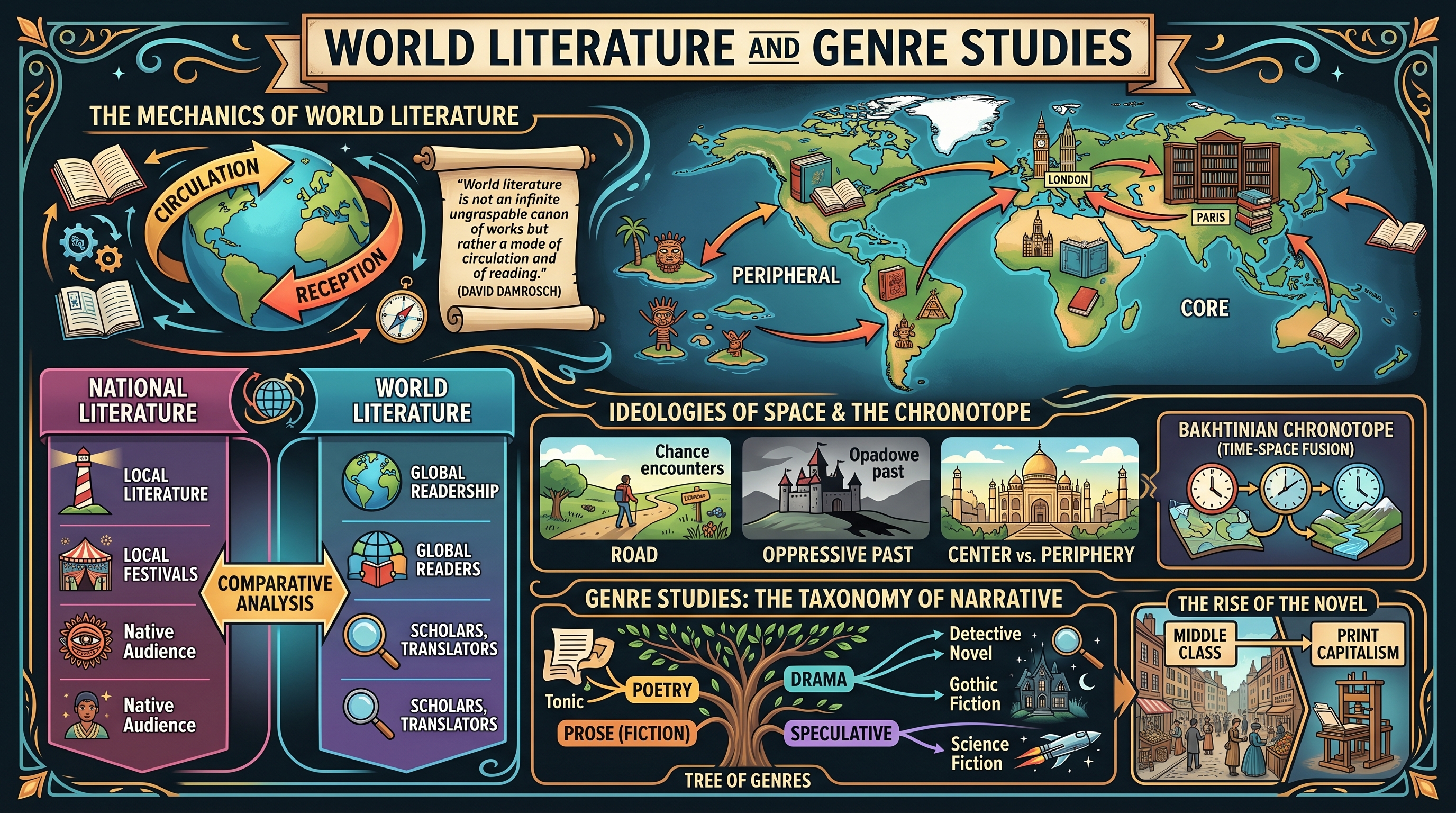
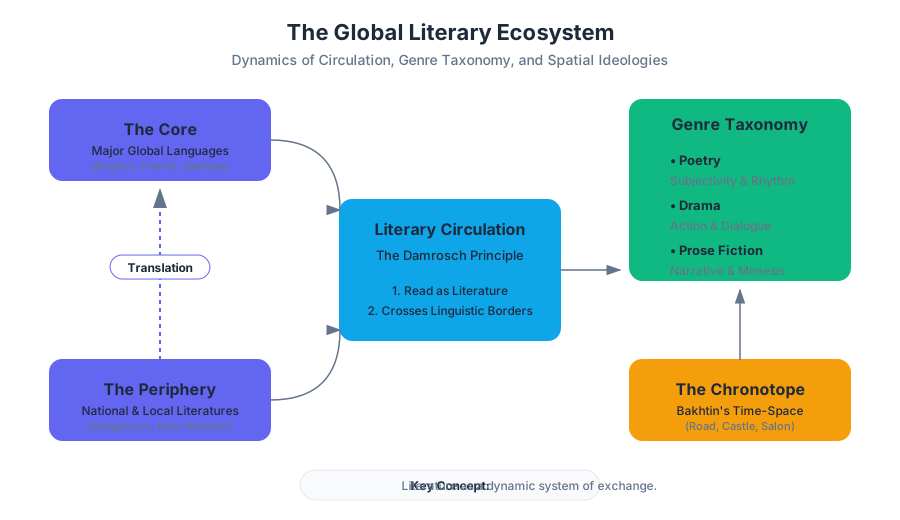
The contemporary understanding of World Literature (often referenced by the German term Weltliteratur, coined by Johann Wolfgang von Goethe) has shifted from a static canon of European masterpieces to a fluid model of "literary networks." According to David Damrosch, a work enters world literature through a double process: first, by being read as literature, and second, by circulating into a broader world beyond its linguistic and cultural point of origin.
The Damrosch Principle: "World literature is not an infinite ungraspable canon of works but rather a mode of circulation and of reading, a mode that is as applicable to individual works as to bodies of material."
The Global System of Literature
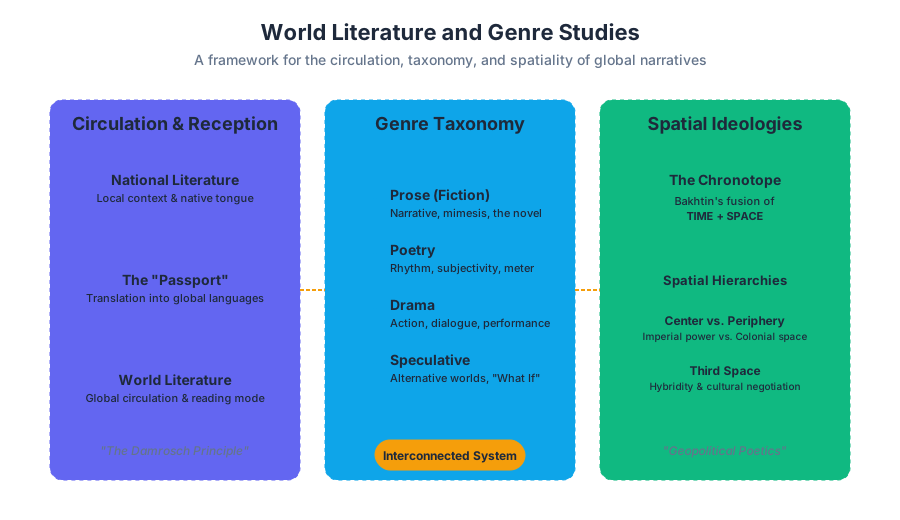
Literature operates within a "world-system" (a concept borrowed from Immanuel Wallerstein’s sociology) where there are "core" literatures (historically French, English, and German) and "peripheral" literatures. The movement of a text from the periphery to the core often requires the "passport" of translation into a major global language.
| Aspect | National Literature | World Literature |
|---|---|---|
| Primary Context | Local history, specific linguistic nuances | Cross-cultural dialogue, universal themes |
| Audience | Native speakers, citizens | Global readers, scholars, translators |
| Function | Identity formation, cultural preservation | Intercultural mediation, aesthetic exchange |
| Medium | Original language | Translation and adaptation |
Ideologies of Space and the Chronotope
In literary analysis, space is never neutral. Ideologies of Space refer to the ways in which physical environments in a text—cities, wilderness, domestic interiors—reflect power structures, colonial histories, and social hierarchies.
The Bakhtinian Chronotope
Mikhail Bakhtin introduced the concept of the Chronotope (literally "time-space") to describe how configurations of time and space are fused in literature. For example, the "road" chronotope in a picaresque novel facilitates chance encounters and social mobility, whereas the "castle" chronotope in Gothic fiction represents a stagnant, oppressive past haunting the present.
Spatial Hierarchies
- The Center vs. The Periphery: In colonial and post-colonial literature, the "Center" (the imperial capital) is often depicted as the site of law and civilization, while the "Periphery" (the colony) is portrayed as a space of chaos or untapped resource.
- The Pastoral vs. The Urban: A classic dichotomy where the rural space represents innocence and the city represents moral decay or industrial progress.
- Third Space: A concept from Homi K. Bhabha describing the "in-between" space where cultural identities are negotiated and hybridity is born.
Genre Studies: The Taxonomy of Narrative
Genre Studies is the systematic analysis of literary types. Genres are not just labels; they are sets of "contracts" between the author and the reader. When you open a "Detective Novel," you expect a crime, an investigation, and a resolution.
The Evolution of Major Genres
Literature has traditionally been divided into a triad of modes, which have since branched into thousands of sub-genres.
| Macro-Genre | Primary Focus | Key Formal Elements |
|---|---|---|
| Poetry | Subjectivity and Rhythm | Meter, rhyme, metaphor, stanzaic structure |
| Drama | Action and Dialogue | Stage directions, soliloquy, conflict, performance |
| Prose (Fiction) | Narrative and Character | Point of view, plot, setting, mimesis |
| Speculative | Alternative Realities | World-building, "What If" scenarios, cognitive estrangement |
The Rise of the Novel
The novel is the "polyphonic" genre par excellence. Unlike the Epic, which deals with a finished, heroic past, the novel is rooted in the "low" language of the present and the everyday lives of ordinary people. Its rise in the 18th century is inextricably linked to the rise of the middle class and the spread of print capitalism.
Non-Western Literature and Decolonizing the Canon
For centuries, "World Literature" was synonymous with "Western Literature." However, modern scholarship emphasizes Non-Western Literature—including African, Asian, and Indigenous traditions—to challenge Eurocentric biases.
African Folklore and Orality
African literature often bridges the gap between orality (the oral tradition) and literacy. Works like Chinua Achebe’s Things Fall Apart integrate Igbo proverbs and folk tales into the structure of the English novel, effectively "colonizing" the language of the colonizer to express a distinct cultural epistemology.
Asian Epics and Philosophy
From the Mahabharata of India to the Journey to the West in China, non-Western traditions offer different structural models for narrative. These works often prioritize cyclical time over the linear progression common in Western "hero's journey" arcs.
Computational Approaches to Genre and World Literature
In the modern era, "Distant Reading" (a term coined by Franco Moretti) uses computational tools to analyze thousands of texts simultaneously, identifying patterns that are invisible to a human reader focusing on a single "masterpiece."
Mathematical Derivation of Literary Distance
To compare two works in "World Literature," we can represent them as vectors in a high-dimensional space where each dimension is a specific word or theme. The Cosine Similarity ($\theta$) between two texts $A$ and $B$ is defined as:
\text{similarity} = \cos(\theta) = \frac{\mathbf{A} \cdot \mathbf{B}}{\|\mathbf{A}\| \|\mathbf{B}\|} = \frac{ \sum_{i=1}^{n} A_i B_i }{ \sqrt{\sum_{i=1}^{n} A_i^2} \sqrt{\sum_{i=1}^{n} B_i^2} }
In this model:
- If $\cos(\theta) = 1$, the texts are identical in their word distribution.
- If $\cos(\theta) = 0$, they share no vocabulary, indicating high "literary distance."
Speculative Fiction: The Literature of Cognitive Estrangement
Speculative Fiction is an umbrella term encompassing Science Fiction, Fantasy, Horror, and Utopian/Dystopian literature. Darko Suvin famously defined Science Fiction as the "literature of cognitive estrangement," where a novum (a new thing, like a time machine or a FTL drive) is introduced into a logically consistent world.
The Function of the Novum
The novum acts as a mirror. By changing one fundamental rule of reality, the author can isolate and examine specific human behaviors or social structures.
| Speculative Sub-genre | The "Novum" | Primary Philosophical Inquiry |
|---|---|---|
| Hard Science Fiction | Technological breakthrough | The limits of human knowledge and physics |
| High Fantasy | Magic systems / Secondary worlds | The nature of good vs. evil and destiny |
| Dystopia | Extreme social/political shift | The fragility of freedom and human rights |
| Afrofuturism | African-centric future/tech | Reclaiming history and imagining black sovereignty |
Common Pitfalls in World Literature Analysis
- The Translation Trap: Assuming that a translation is a transparent window into the original. Every translation is an interpretation that carries the "ideological baggage" of the target language.
- Tokenism: Including one or two non-Western authors in a syllabus to "check a box" without engaging with the specific historical and aesthetic traditions of those cultures.
- Genre Essentialism: Believing that genres are fixed boxes. In reality, the most significant works of literature often occupy the "interstitial spaces" between genres (e.g., the "Prose Poem" or "Magical Realism").
- Ignoring the Materiality: Forgetting that literature is a product of the publishing industry. A book's success in "World Literature" is often as much about marketing and global distribution networks as it is about aesthetic merit.
Historical Context: From Puritanism to Post-Modernism
To understand the current state of World Literature, one must trace the evolution of specific national traditions that have dominated the global conversation.
American Literary Evolution
- Puritanism (1600s): Focused on divine providence and the "City upon a Hill."
- Enlightenment (1700s): Emphasized reason, republicanism, and the individual (e.g., Benjamin Franklin).
- Romanticism/Transcendentalism (1800s): A reaction against industrialization; focus on nature and the "Oversoul" (e.g., Emerson, Thoreau).
- Realism/Naturalism (Late 1800s): Depicting life "as it is," often influenced by Darwinian struggles (e.g., Mark Twain, Stephen Crane).
- Modernism (Early 1900s): Breaking traditional forms to represent a fragmented world ("Make it New").
British and Irish Contributions
The British tradition provided the foundational structures for the English-language novel, while the Irish Gothic (e.g., Bram Stoker’s Dracula) introduced themes of colonial anxiety and the "uncanny" that remain central to genre studies today.
Key Terms Summary Table
| Term | Definition | Context |
|---|---|---|
| Mimesis | The representation of reality in art | Foundational to Realism |
| Intertextuality | The relationship between texts | Central to Post-Modernism |
| Hegemony | Cultural dominance by one group | Used in Post-Colonial studies |
| Canon | The body of "authorized" works | Subject of ongoing debate |
| Epistemology | The theory of knowledge | How characters "know" their world |
| Aesthetic | Principles of beauty and taste | The "artistic" value of a text |
Conclusion: The Future of the Global Text
As digital platforms allow for the instantaneous global distribution of literature, the boundaries of "World Literature" are blurring further. We are moving toward a "Global Literature" where authors write for a planetary audience from the outset, often blending genres and languages in ways that defy traditional categorization. The study of these texts requires a toolkit that is both technically precise (computational) and deeply empathetic (hermeneutic).
Source Materials
Study Literature and Literacy on Lykke
This course page is free to open: signed out, you can read its first two sections, and signing in, on any plan, opens the rest. The free Lykke Chrome extension syncs your own Canvas courses, so ChatGPT, Claude and Muse can answer from your classes and deadlines. It only reads Canvas.
Add the free extensionSign in to open every sectionAll sections of Literature and Literacy · Browse more course pages