From the free course Literature and Literacy on Lykke
Reading and Interpreting Literary Texts
Key concepts: Literary Analysis · Reader-Response Criticism · Textual Analysis · Literary Terms
Introduces methodologies for textual analysis and critical theories like Reader-Response Criticism.
Reading and Interpreting Literary Texts
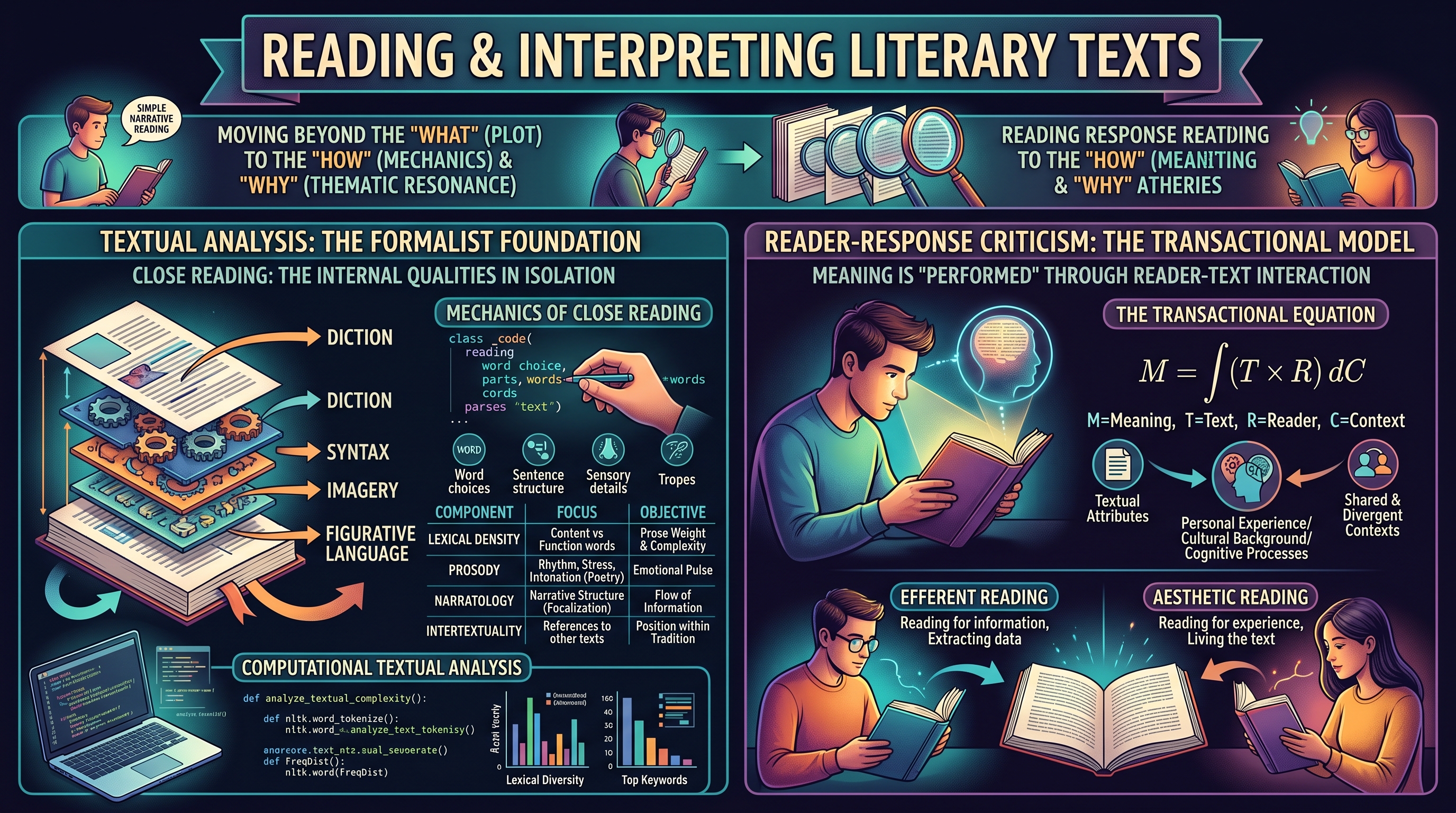
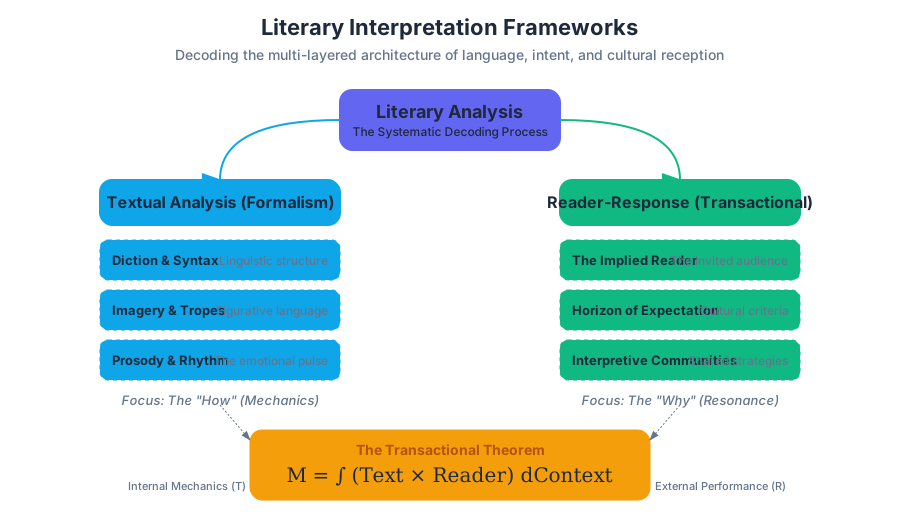
Literary interpretation is the systematic process of decoding complex semiotic systems to derive meaning, aesthetic value, and socio-historical significance. Unlike casual reading, which prioritizes narrative consumption, Literary Analysis treats the text as a multi-layered architecture of language, intent, and cultural reception. To interpret a text is to move beyond the "what" (plot) to the "how" (mechanics) and the "why" (thematic resonance).
This module explores the rigorous frameworks used by scholars to interrogate texts, ranging from the granular precision of Textual Analysis to the interactive dynamics of Reader-Response Criticism.
Textual Analysis: The Formalist Foundation
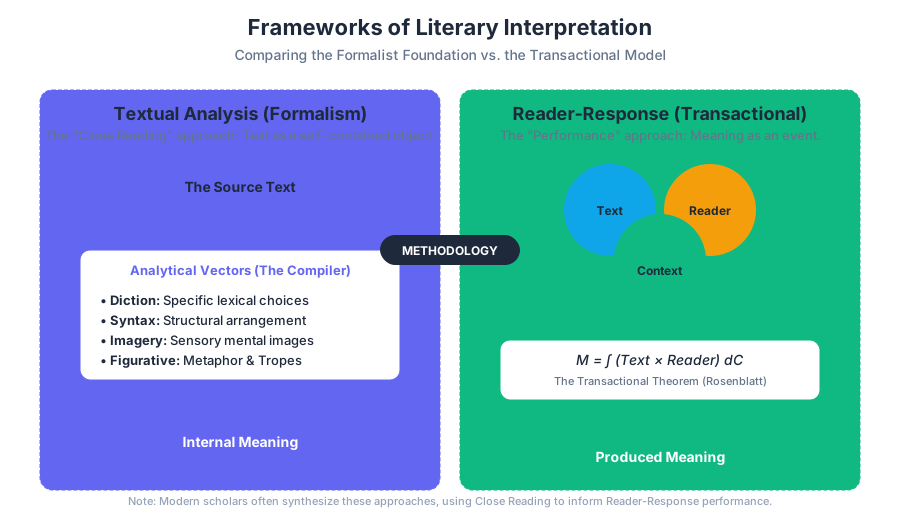
Textual Analysis, often referred to in pedagogical contexts as "Close Reading," is the practice of examining the internal qualities of a text in isolation from external factors like the author's biography or the era's politics. This methodology assumes that the text is a self-contained object where meaning is embedded in its linguistic and structural choices.
The Mechanics of Close Reading
The formalist approach functions like a compiler, parsing the source code of a poem or prose piece to understand how individual units of language generate complex outputs of tone and theme. Analysts focus on four primary vectors:
- Diction: The specific word choices (denotation vs. connotation).
- Syntax: The arrangement of words and phrases to create well-formed sentences.
- Imagery: Sensory details that create "mental images."
- Figurative Language: Tropes such as metaphor, metonymy, and synecdoche.
| Component | Analytical Focus | Objective |
|---|---|---|
| Lexical Density | Ratio of content words to functional words. | Determine the "weight" and complexity of the prose. |
| Prosody | Rhythm, stress, and intonation in poetry. | Identify the emotional "pulse" of the verse. |
| Narratology | The structure of the narrative (e.g., focalization). | Map the flow of information to the reader. |
| Intertextuality | References to other texts/works. | Identify the text's position within a broader tradition. |
Reader-Response Criticism: The Transactional Model
Reader-Response Criticism posits that a literary work does not have a fixed, objective meaning. Instead, meaning is "performed" or "produced" through the interaction between the reader and the text. This theory, championed by scholars like Louise Rosenblatt and Wolfgang Iser, argues that the reader's personal experiences, cultural background, and cognitive processes are essential components of the literary experience.
The Transactional Equation
Rosenblatt distinguished between Efferent Reading (reading for information) and Aesthetic Reading (reading to experience the text). In the aesthetic mode, the "poem" is not the words on the page, but the event that occurs when the reader's consciousness meets the author's language.
The Transactional Theorem: Let $T$ be the Text, $R$ be the Reader, and $C$ be the Context. The resulting Meaning $M$ is not a property of $T$, but a function of the interaction: $$M = \int (T \times R) , dC$$ where the meaning is the integral of the text-reader interaction over the domain of their shared and divergent contexts.
Horizons of Expectation
Hans Robert Jauss introduced the concept of the Horizon of Expectations. This refers to the criteria readers use to judge a text at any given historical moment. As cultural values shift, the "horizon" moves, and the same text is interpreted differently by subsequent generations.
| Theory Layer | Key Concept | Definition |
|---|---|---|
| The Implied Reader | Iser’s Construct | The hypothetical reader the text "invites" or expects. |
| Interpretive Communities | Stanley Fish’s Theory | Groups of readers who share similar strategies for assigning meaning. |
| Affective Fallacy | Wimsatt & Beardsley | The (Formalist) warning against judging a work based on its emotional effect. |
| Subjective Criticism | David Bleich | The idea that all interpretation is an expression of the reader's personality. |
Literary Terms and Taxonomy
To analyze literature effectively, one must master the technical vocabulary used to describe textual phenomena. These terms are not merely labels; they are analytical tools that allow for the categorization of complex linguistic maneuvers.
Tropes vs. Schemes
In classical rhetoric, literary devices are divided into Tropes (which change the meaning of words) and Schemes (which change the arrangement of words).
- Metaphor (Trope): An implied comparison between two unlike things.
- Anaphora (Scheme): The repetition of a word or phrase at the beginning of successive clauses.
- Synecdoche (Trope): A part is used to represent the whole (e.g., "all hands on deck").
- Chiasmus (Scheme): A reversal in the order of words in two otherwise parallel phrases (e.g., "Ask not what your country can do for you; ask what you can do for your country").
Structural Derivation of a Sonnet
The Shakespearean Sonnet is a rigid structural form. Its meaning is often derived from the tension between its three quatrains and its final couplet.
% Mathematical representation of Sonnet Structure
\text{Sonnet} = \sum_{i=1}^{3} Q_i(abab, cdcd, efef) + C(gg)
\text{where } Q = \text{Quatrain (4 lines)}, C = \text{Couplet (2 lines)}
\text{Volta (Turn)} \approx \text{Line 9 or Line 13}
Genre-Specific Interpretation Strategies
Different literary forms require different analytical "toolsets." A strategy used for a 19th-century novel will fail when applied to an Anglo-Saxon epic or a Modernist poem.
1. Poetry: The Architecture of Sound
In poetry, the line is the primary unit of meaning. Interpretation focuses on the tension between the sentence (the grammatical unit) and the line (the rhythmic unit).
- Enjambment: When a sentence carries over a line break without punctuation.
- Caesura: A strong pause within a line.
- Scansion: The process of marking the stresses in a poem to determine its meter.
2. Prose (Short Stories and Novels): Narratology
In prose, we analyze the Narrator and the Chronotope (the configuration of time and space).
- Focalization: Who sees? (Distinguished from who speaks).
- Free Indirect Discourse: A style of third-person narrative that adopts the tone and thoughts of a character.
- Unreliable Narrator: A narrator whose credibility is compromised, forcing the reader to "decode" the truth behind the narration.
3. Drama: The Performative Text
Drama is unique because the text is a blueprint for performance. Interpretation must account for Stage Directions, Soliloquies, and the Dramatic Irony created when the audience knows more than the characters.
| Genre | Primary Analytical Unit | Key Interpretive Question |
|---|---|---|
| Poetry | The Foot / The Line | How does the sound reinforce the sense? |
| Prose | The Paragraph / The Chapter | How is the narrative perspective manipulated? |
| Drama | The Scene / The Beat | How does the physical action subvert the dialogue? |
Socio-Historical Context and Literary Movements
Literature does not exist in a vacuum. It is a product of its Socio-historical Context. Understanding the movements of American, British, and World literature provides the "metadata" necessary to interpret specific works.
The American Literary Timeline
American literature is often categorized by its response to the national identity and the changing landscape.
- Puritanism (1600s-1750s): Focus on divine providence, plain style, and moral instruction (e.g., Bradstreet, Edwards).
- Romanticism & Transcendentalism (1820s-1860s): Emphasis on the individual, nature, and emotion over reason (e.g., Emerson, Thoreau, Hawthorne).
- Realism & Naturalism (1860s-1914): A reaction against Romanticism; a focus on "life as it is" and the deterministic forces of environment and heredity (e.g., Twain, Crane).
- Modernism (1914-1945): Fragmentation, stream of consciousness, and a break with traditional forms following WWI (e.g., Hemingway, Faulkner, Eliot).
The Concept of the Chronotope
Mikhail Bakhtin’s Chronotope (literally "time-space") describes how configurations of time and space are fused in literature. For example, the "Road" in a picaresque novel is a chronotope where time flows through spatial movement, facilitating chance encounters and social diversity.
Critical Thinking and Information Literacy
Interpreting literature is a high-level exercise in Critical Thinking. It requires the ability to evaluate evidence (the text), recognize bias (the narrator or author), and synthesize complex information into a coherent argument.
The Analytical Pipeline
When writing a literary analysis, scholars follow a pipeline similar to a research protocol:
- Observation: Identifying a pattern or anomaly in the text.
- Hypothesis: Proposing a reason for that pattern (e.g., "The recurring bird imagery symbolizes the protagonist's desire for autonomy").
- Evidence Gathering: Selecting specific quotes and structural examples to support the hypothesis.
- Synthesis: Connecting the local observation to a global theme or historical context.
Common Pitfalls in Interpretation
- The Intentional Fallacy: Assuming that the author's stated intention is the only "correct" meaning of the text.
- The Biographical Fallacy: Reducing a work entirely to the events of the author's life.
- Anachronism: Applying modern values or concepts to a historical text without acknowledging the shift in context.
- Over-Reading: Assigning deep symbolic meaning to every incidental detail (sometimes a "blue curtain" is just a blue curtain).
Source Materials
Study Literature and Literacy on Lykke
This course page is free to open: signed out, you can read its first two sections, and signing in, on any plan, opens the rest. The free Lykke Chrome extension syncs your own Canvas courses, so ChatGPT, Claude and Muse can answer from your classes and deadlines. It only reads Canvas.
Add the free extensionSign in to open every sectionAll sections of Literature and Literacy · Browse more course pages