From the free course Literature and Literacy on Lykke
Pre-contact and Colonial Encounters
Key concepts: Native American Texts · Contact Literature · The Requerimiento · Ethnographic Texts
Examines Native American ethnographic texts and the literature of early European exploration.
Pre-contact and Colonial Encounters
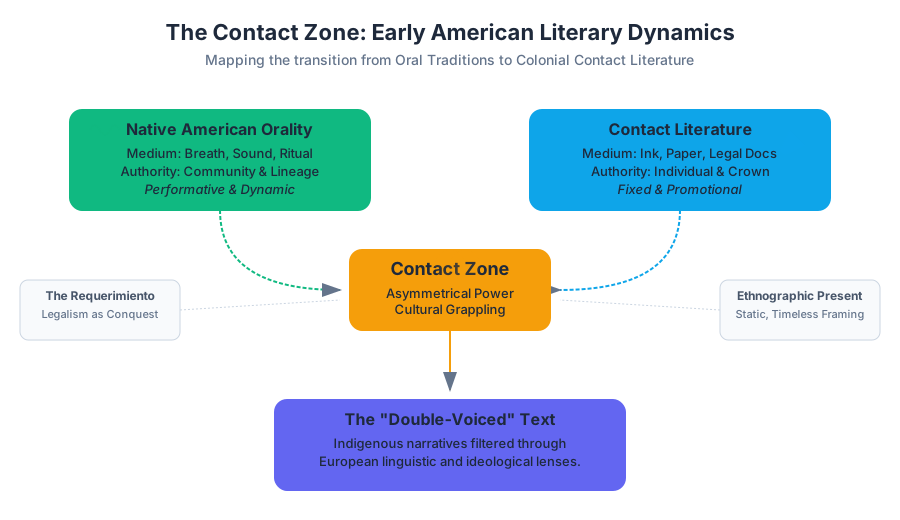
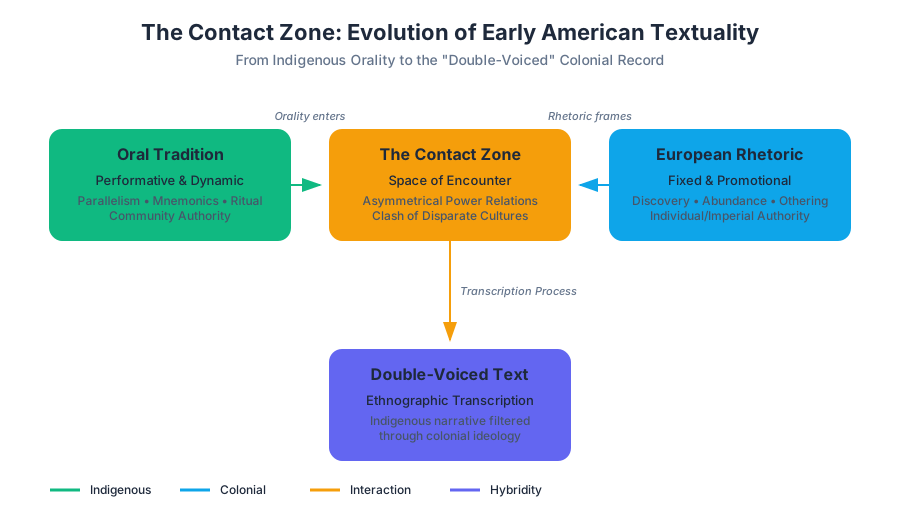
The study of early American literature is not merely an examination of the first English-language novels or Puritan sermons; it is an investigation into the Contact Zone—a social space where disparate cultures meet, clash, and grapple with each other, often in highly asymmetrical relations of domination and subordination. This period is characterized by the transition from purely Oral Traditions to the emergence of Contact Literature, a genre that encompasses the journals, letters, and legal documents of European explorers alongside the transcribed ethnographic records of indigenous peoples.
Native American Orality and Pre-contact Texts
Before the introduction of European alphabetic scripts, Native American "texts" existed as a sophisticated web of oral traditions, mnemonic devices, and visual symbols. These were not "pre-literary" in a pejorative sense but were instead Performative Texts. The meaning of a story was inextricably linked to its performance—the cadence of the speaker, the presence of the audience, and the specific ritual context.
The Mechanics of Orality
Oral traditions utilize specific structural devices to ensure the preservation of complex cultural data across generations. These include:
- Parallelism: The repetition of grammatical structures to create rhythm and aid memory.
- Formulaic Expressions: Standardized phrases that signal transitions or character traits.
- The Trickster Archetype: Figures like Coyote or Iktomi who embody chaos and boundary-crossing, serving as pedagogical tools for social norms.
Definition: The Ethnographic Present A rhetorical device used in early ethnographic texts that describes a culture as if it exists in a static, timeless state, effectively stripping indigenous peoples of their historical agency and evolution.
| Feature | Oral Tradition | Written Tradition |
|---|---|---|
| Medium | Breath, sound, gesture, mnemonic objects (Wampum) | Ink, paper, digital bits |
| Stability | Dynamic; adapts to the needs of the current audience | Fixed; preserves the exact wording of the author |
| Authority | Vested in the community and the lineage of the teller | Vested in the physical document and the individual author |
| Context | Highly situational and ritualistic | Decontextualized; can be read anywhere, anytime |
Transcription and the "Double-Voiced" Text
When Native American oral stories were finally committed to paper by European or European-educated scribes, they became Ethnographic Texts. These are inherently "double-voiced," containing the indigenous narrative filtered through the linguistic and ideological lens of the transcriber.
Contact Literature: The Rhetoric of Discovery
Contact Literature refers to the corpus of writing produced by Europeans (and eventually indigenous people) that documents the initial encounters between the Old and New Worlds. These texts are rarely objective; they are often promotional, defensive, or designed to secure funding from royal patrons.
Christopher Columbus: The Admiral's Epistles
Columbus’s letters to the Spanish court (e.g., the Letter to Santángel) established the foundational tropes of American literature:
- The Terrestrial Paradise: Describing the land as an Edenic space of infinite bounty.
- The Rhetoric of Abundance: Cataloging flora and fauna to prove economic viability.
- The "Othering" of Inhabitants: Categorizing indigenous people as either "noble savages" (gentle, ripe for conversion) or "monsters" (cannibals, justifying conquest).
Alvar Núñez Cabeza de Vaca: The Relación
In contrast to Columbus’s triumphalism, Cabeza de Vaca’s La Relación (1542) represents a shift toward Transculturation. After being shipwrecked and spending eight years wandering the American Southwest, his narrative shifts from that of a conqueror to that of a captive and, eventually, a healer.
| Author | Perspective | Primary Rhetorical Goal | View of Indigenous People |
|---|---|---|---|
| Columbus | Imperial / Mercantilist | Secure funding and titles | Commodities or obstacles |
| Cabeza de Vaca | Survivalist / Ethnographic | Self-justification and mercy | Complex social actors; fellow humans |
| De Las Casas | Polemical / Humanitarian | Abolition of the Encomienda system | Innocent victims of Spanish cruelty |
The Requerimiento: Legalism as Conquest
The Requerimiento (The Requirement) of 1513 is perhaps the most surreal and chilling document in the history of colonial encounters. It was a formal manifesto that Spanish conquistadors were legally required to read to indigenous populations before initiating military action.
The Logic of the Document
The Requerimiento functioned as a legal "if-then" statement. It asserted the Pope’s authority over the world and the Spanish Crown’s right to the Americas. If the indigenous people accepted this authority, they would be spared; if they refused, they were held responsible for the "deaths and losses" that would follow.
The Theorem of Colonial Justification Let $P$ be the acceptance of the Catholic Church and the Spanish Crown. Let $Q$ be the state of peace and protection. Let $R$ be the state of "Just War" (Guerra Justa). The Requerimiento asserts: $P \implies Q$ and $\neg P \implies R$. Crucially, the document was read in Spanish, a language the audience did not understand, ensuring $\neg P$ was the inevitable outcome.
% Formal logic representation of the Requerimiento's legal structure
\begin{math}
\forall x \in \text{IndigenousPopulations}: \\
\text{Recognize}(x, \text{Pope}) \land \text{Submit}(x, \text{SpanishCrown}) \to \text{Peace}(x) \\
\neg (\text{Recognize}(x, \text{Pope}) \land \text{Submit}(x, \text{SpanishCrown})) \to \text{JustWar}(x) \land \text{Enslavement}(x)
\end{math}
The Absurdity of Performance
The document was often read to empty beaches, to the backs of fleeing villagers, or from the decks of ships. This highlights the Ritualistic Function of colonial text: the document was not intended to communicate information to the indigenous people, but to satisfy the legal and theological requirements of the Spanish court. It was a performance of "legality" to mask the reality of plunder.
Ethnographic Texts and the Problem of Mediation
As the colonial period progressed, the need to understand indigenous cultures (for the purposes of conversion or governance) led to the creation of massive ethnographic projects. The most notable is the Florentine Codex, compiled by Bernardino de Sahagún.
The Structure of the Florentine Codex
Sahagún utilized a "triangulated" methodology that was remarkably advanced for the 16th century:
- Nahuatl Text: Narratives provided by Aztec elders in their native language.
- Spanish Translation: Sahagún’s summary/interpretation of the Nahuatl.
- Pictorial Illustrations: Visual representations by indigenous artists (tlacuilos).
Despite its depth, the Codex remains a Mediated Text. Sahagún’s questions were framed by European theological concerns (e.g., looking for "idolatry"), which inevitably shaped the answers he received.
Common Pitfalls in Interpreting Ethnographic Texts
- The Fallacy of the Monolith: Assuming a single "Native American" perspective when, in reality, there were thousands of distinct linguistic and cultural groups.
- Ignoring Agency: Viewing indigenous people as passive subjects of study rather than active participants who often manipulated the ethnographic process to protect their secrets or settle tribal scores.
- The "Vanishing Indian" Trope: Many 19th-century ethnographic texts were written under the assumption that indigenous cultures were doomed to extinction, leading to a "salvage" mentality that biased the data.
Resistance and Synthesis: The Pueblo Revolt of 1680
The Pueblo Revolt serves as a vital counter-narrative to the "inevitability" of colonial conquest. It is one of the few instances where indigenous resistance successfully expelled a colonial power for a significant duration (12 years).
Textual Traces of the Revolt
Because the Pueblo people destroyed many Spanish records and symbols of Christianity during the revolt, the "text" of the revolt is often found in:
- Spanish Inquisitorial Records: Depositions of captured Pueblo leaders which, despite the torture used to obtain them, reveal the strategic coordination of the revolt (e.g., the use of knotted cords to synchronize the timing).
- Oral Histories: Passed down through Pueblo generations, providing a starkly different account of the motivations and leadership of figures like Popé.
| Aspect | Spanish Perspective (Archival) | Pueblo Perspective (Oral/Archaeological) |
|---|---|---|
| Cause | Diabolical influence / Sorcery | Religious persecution / Forced labor |
| Leadership | A single "instigator" (Popé) | Collective action across multiple Pueblos |
| Outcome | A temporary setback for the Faith | A restoration of cosmic and social balance |
The Legacy of Hybridity
Post-contact literature eventually evolved into a Syncretic form. Indigenous writers began to use European genres (the chronicle, the letter, the autobiography) to argue for their rights. This gave rise to figures like Guaman Poma de Ayala in the Andes or later, Samson Occom and William Apess in North America, who used the "master's tools" (Christianity and English law) to critique the colonial project.
Source Materials
Study Literature and Literacy on Lykke
This course page is free to open: signed out, you can read its first two sections, and signing in, on any plan, opens the rest. The free Lykke Chrome extension syncs your own Canvas courses, so ChatGPT, Claude and Muse can answer from your classes and deadlines. It only reads Canvas.
Add the free extensionSign in to open every sectionAll sections of Literature and Literacy · Browse more course pages