From the free course Literature and Literacy on Lykke
Enlightenment and Revolutionary Literature (1760–1820)
Key concepts: Enlightenment · Revolutionary Rhetoric · American Gothic · Autobiography
Traces the shift from religious focus to political reason and the formation of a national identity.
Enlightenment and Revolutionary Literature (1760–1820)
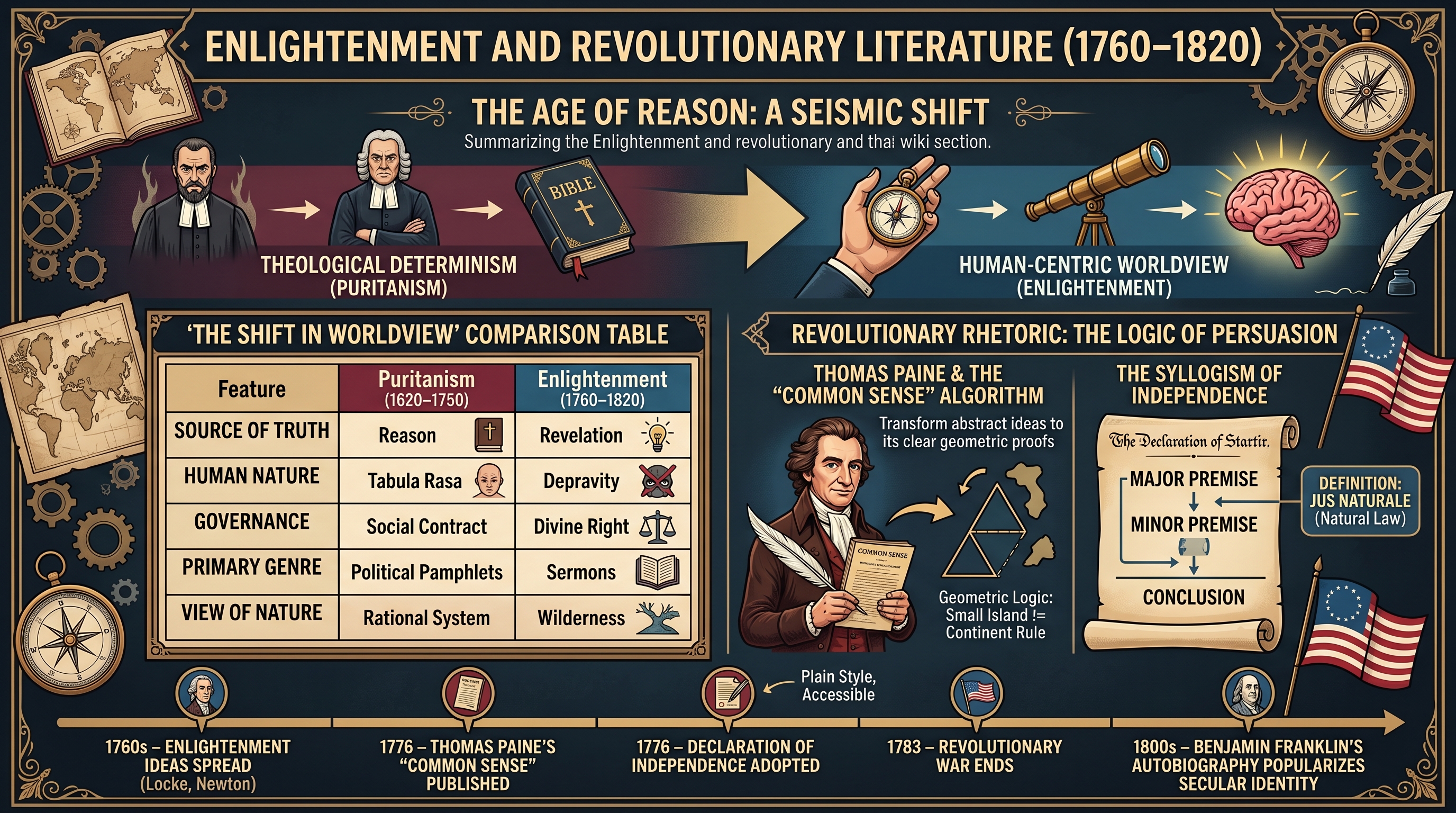
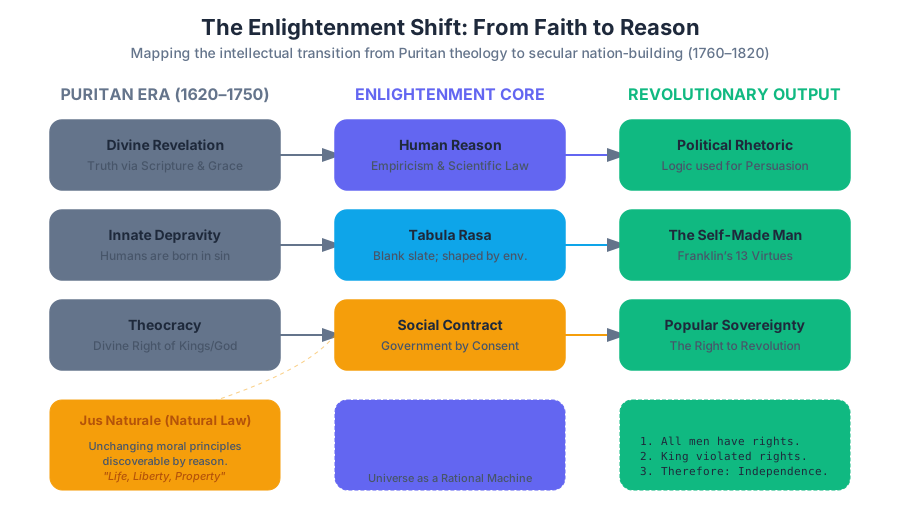
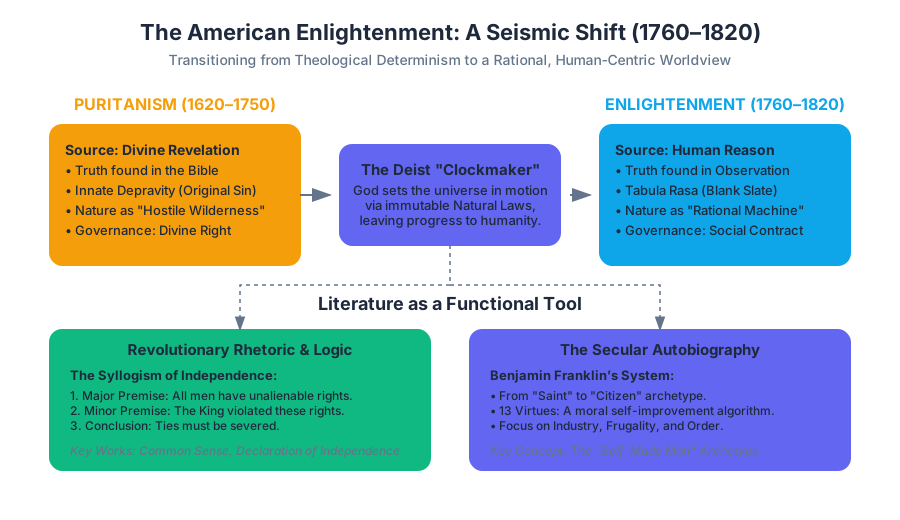
The period between 1760 and 1820 represents the "Age of Reason" in the American context—a seismic shift from the theological determinism of the Puritan era to a secular, empirical, and human-centric worldview. In this era, literature was not merely an aesthetic pursuit but a functional tool for nation-building, political persuasion, and the codification of a new "American" identity.
The Enlightenment Framework: Epistemology and Natural Law
The American Enlightenment was an intellectual movement that emphasized rationalism, empiricism, and individualism. Borrowing heavily from European thinkers like John Locke, Isaac Newton, and Montesquieu, American writers transitioned from viewing the world as a "wilderness of sin" to a "rational machine" governed by discoverable laws.
The Shift in Worldview
The core of Enlightenment thought is the concept of Deism. Unlike the interventionist God of the Puritans, the Deist "Clockmaker" God created the universe, set it in motion with immutable physical laws, and then stepped back. This placed the burden of progress and morality squarely on human shoulders.
| Feature | Puritanism (1620–1750) | Enlightenment (1760–1820) |
|---|---|---|
| Source of Truth | Divine Revelation (The Bible) | Human Reason and Observation |
| Human Nature | Innate Depravity (Original Sin) | Tabula Rasa (Blank Slate) |
| Governance | Theocracy / Divine Right | Social Contract / Popular Sovereignty |
| Primary Genre | Sermons, Diaries, Captivity Narratives | Political Pamphlets, Essays, Autobiography |
| View of Nature | A hostile wilderness to be subdued | A rational system to be studied |
The Social Contract Theory
Central to Revolutionary literature is the Social Contract, a political derivation suggesting that government is a voluntary agreement among individuals to protect their natural rights (Life, Liberty, and Property). When a government violates this contract, the "logic" of the Enlightenment dictates that the people have a mathematical and moral right to dissolve it.
Definition: Jus Naturale (Natural Law) A body of unchanging moral principles regarded as a basis for all human conduct, discoverable through reason rather than revelation. In the American context, this was the "source code" for the Declaration of Independence.
Revolutionary Rhetoric: The Logic of Persuasion
Literature during the Revolutionary War (1775–1783) was dominated by Rhetoric—the art of effective or persuasive speaking and writing. Writers like Thomas Paine, Thomas Jefferson, and Patrick Henry did not just express feelings; they constructed rigorous logical arguments designed to mobilize a disparate population.
Thomas Paine and the "Common Sense" Algorithm
Thomas Paine’s Common Sense (1776) was revolutionary because it abandoned the high-flown, Latinate prose of the elite for a "plain style" accessible to the common man. Paine treated the argument for independence like a geometric proof: if a small island cannot rule a continent, and if a mother does not devour her children, then the British monarchy is logically obsolete.
The Syllogism of Independence
The Declaration of Independence functions as a formal logical syllogism:
- Major Premise: All men have unalienable rights; governments exist to protect these rights.
- Minor Premise: King George III has systematically violated these rights (the "List of Grievances").
- Conclusion: Therefore, the colonies are justified in severing ties.
Benjamin Franklin and the Secular Autobiography
If the Puritans wrote spiritual autobiographies to track the state of their souls, Benjamin Franklin wrote his Autobiography to track the state of his productivity and character. Franklin represents the transition from the "Saint" to the "Citizen."
The 13 Virtues as a System of Optimization
Franklin’s "Project of Arriving at Moral Perfection" is essentially an early version of a self-improvement algorithm. He identified 13 virtues (Temperance, Silence, Order, Resolution, Frugality, Industry, Sincerity, Justice, Moderation, Cleanliness, Tranquility, Chastity, and Humility) and tracked his adherence to them using a daily ledger.
| Virtue | Goal | Modern Equivalent |
|---|---|---|
| Order | Let all your things have their places. | Time Management / GTD |
| Industry | Lose no time; be always employ'd in something useful. | Productivity / Deep Work |
| Frugality | Make no expense but to do good to others or yourself. | Financial Independence (FIRE) |
| Resolution | Perform without fail what you resolve. | Grit / Consistency |
The "Self-Made Man" Archetype
Franklin’s narrative established the American mythos of the Self-Made Man. By emphasizing social mobility through merit and hard work rather than inherited status, Franklin’s literature provided the cultural "operating system" for the new Republic.
The American Gothic: The Shadow of Reason
As the Enlightenment attempted to map the world through reason, a counter-current emerged: the American Gothic. While the European Gothic focused on crumbling castles and ancient curses, the American Gothic focused on the instability of the mind and the darkness of the frontier.
Charles Brockden Brown: The Pioneer of the Irrational
Charles Brockden Brown, often called the "Father of the American Novel," used his works (like Wieland) to challenge Enlightenment optimism. If humans are rational beings, why do they succumb to religious fanaticism, spontaneous combustion, or ventriloquism?
Key Characteristics of American Gothic
- Psychological Terror: Focus on madness and the breakdown of the senses.
- The Frontier as Wilderness: Instead of a haunted castle, the American Gothic uses the vast, unexplored woods as a site of terror.
- The Burden of the Past: Exploring the "sins of the fathers," particularly regarding the displacement of Indigenous peoples and the institution of slavery.
| Element | European Gothic | American Gothic |
|---|---|---|
| Setting | Medieval Castles, Cathedrals | Frontiers, Isolated Farmsteads, Cities |
| Antagonist | Aristocrats, Monks, Ghosts | Madmen, Fanatics, The Self |
| Themes | Class struggle, Ancestral curses | Racial guilt, Mental instability |
| Core Fear | The return of the Feudal past | The failure of the Rational future |
Diverse Voices: The Limits of Enlightenment
The rhetoric of "universal rights" and "equality" stood in stark contrast to the realities of slavery and gender inequality. However, marginalized writers used the very tools of the Enlightenment—literacy and logic—to argue for their own humanity.
Phillis Wheatley
A kidnapped West African woman enslaved in Boston, Wheatley became the first African American to publish a book of poetry (Poems on Various Subjects, Religious and Moral, 1773). She used Neoclassical heroic couplets (the style of Alexander Pope) to prove that African Americans possessed the "rational soul" that Enlightenment thinkers prized. Her poetry often contained "subversive" coding, using Christian imagery to critique the hypocrisy of slave-holding "Christians."
Olaudah Equiano
His Interesting Narrative (1789) combined the spiritual autobiography with the political protest. By detailing the horrors of the Middle Passage through an empirical, observational lens, he appealed to the Enlightenment sense of "humanity" and "natural law" to advocate for the abolition of the slave trade.
The Early National Period and Identity
Post-1783, writers like J. Hector St. John de Crèvecoeur asked the fundamental question: "What then is the American, this new man?" In Letters from an American Farmer, he described the "melting pot" (though limited to Europeans) and the idea that the American environment physically and mentally transformed the immigrant from a "useless plant" into a productive citizen.
Common Pitfalls in Analyzing this Period
- Over-simplifying Deism: It is a mistake to think Enlightenment writers were atheists. Most were deeply "religious" in a sense, but they believed God was found through the study of nature and science, not through miracles or dogma.
- Ignoring the Contradiction: One cannot study the "Literature of Liberty" without acknowledging that it was written in a society where 20% of the population was enslaved. The tension between the text (The Declaration) and the context (Slavery) is the central conflict of the era.
- Assuming "Reason" meant "Emotionless": Revolutionary rhetoric was often highly emotional (Pathos). The "Reason" of the Enlightenment was the justification for the passion, not a replacement for it.
Summary of Key Works and Authors
- Thomas Paine: Common Sense, The American Crisis (Rhetoric/Politics)
- Thomas Jefferson: The Declaration of Independence, Notes on the State of Virginia (Political Philosophy/Science)
- Benjamin Franklin: The Autobiography, Poor Richard's Almanack (Aphorism/Self-Improvement)
- Phillis Wheatley: Poems on Various Subjects (Neoclassical Poetry)
- Charles Brockden Brown: Wieland, Edgar Huntly (American Gothic)
- Philip Freneau: Known as the "Poet of the American Revolution," transitioning from Neoclassicism to early Romanticism.
Source Materials
Study Literature and Literacy on Lykke
This course page is free to open: signed out, you can read its first two sections, and signing in, on any plan, opens the rest. The free Lykke Chrome extension syncs your own Canvas courses, so ChatGPT, Claude and Muse can answer from your classes and deadlines. It only reads Canvas.
Add the free extensionSign in to open every sectionAll sections of Literature and Literacy · Browse more course pages