From the free course Literature and Literacy on Lykke
Early American and Puritan Literature (1650–1750)
Key concepts: Puritanism · Colonial Religious Discourse · Sermons · Anne Bradstreet
Analyzes the influence of Puritanism on colonial American identity and writing.
Early American and Puritan Literature (1650–1750)
The period between 1650 and 1750 in North America represents a unique literary epoch where theocratic rigor met the harsh realities of frontier survival. This era is defined by Puritanism, a reform movement within English Protestantism that sought to "purify" the Church of England from its remaining Catholic practices. In the American colonies, specifically the Massachusetts Bay Colony, this theological framework evolved into a comprehensive socio-political and literary system.
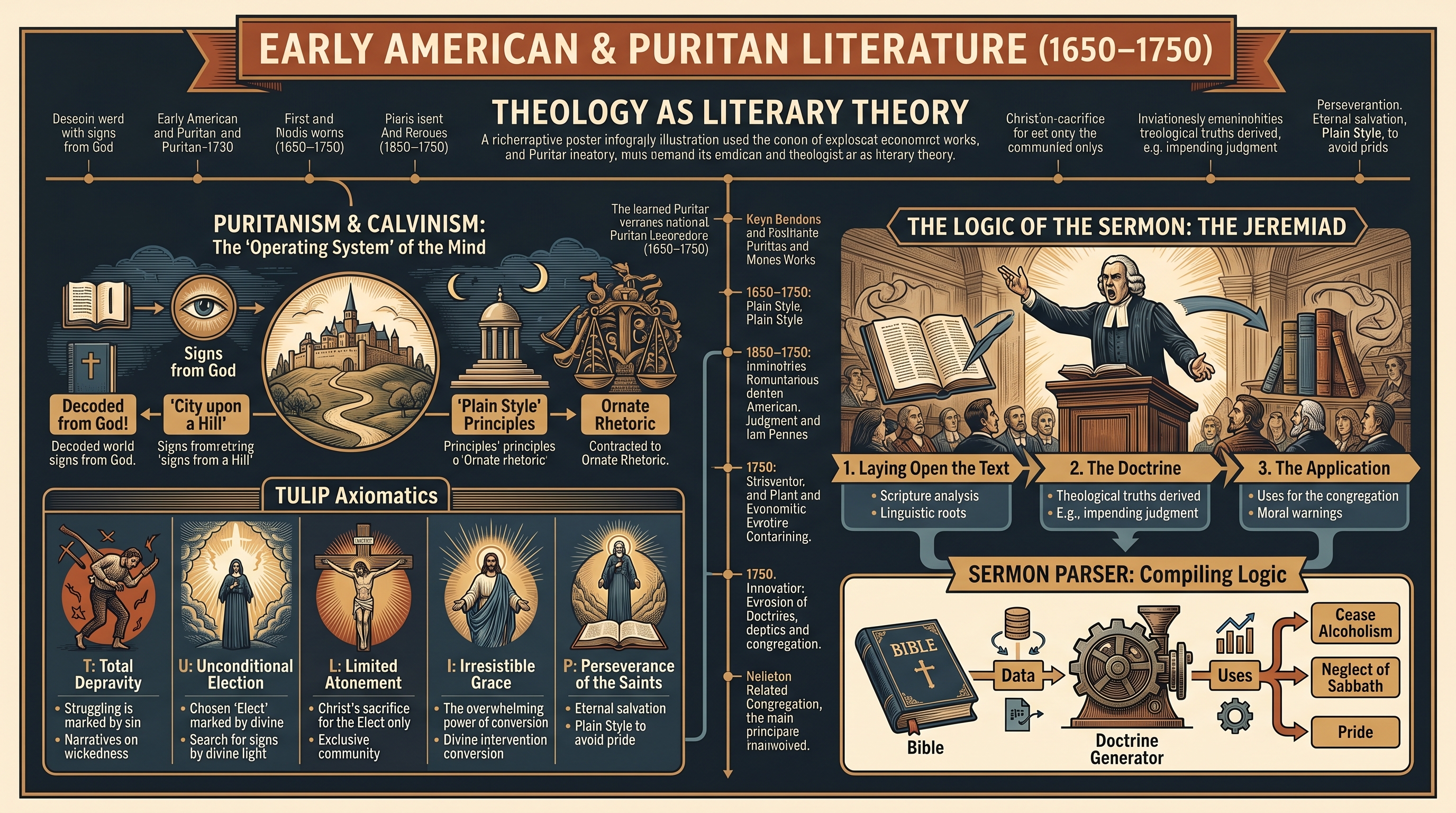
The Puritan Axiomatics: Theology as Literary Theory
To understand early American literature, one must first understand the "operating system" of the Puritan mind: Calvinism. The Puritans viewed the world as a decoded text where every event—from a crop failure to a successful voyage—was a sign from God. This perspective, known as Providential History, dictated that literature was not for entertainment, but for the instruction of the soul and the recording of God’s will.
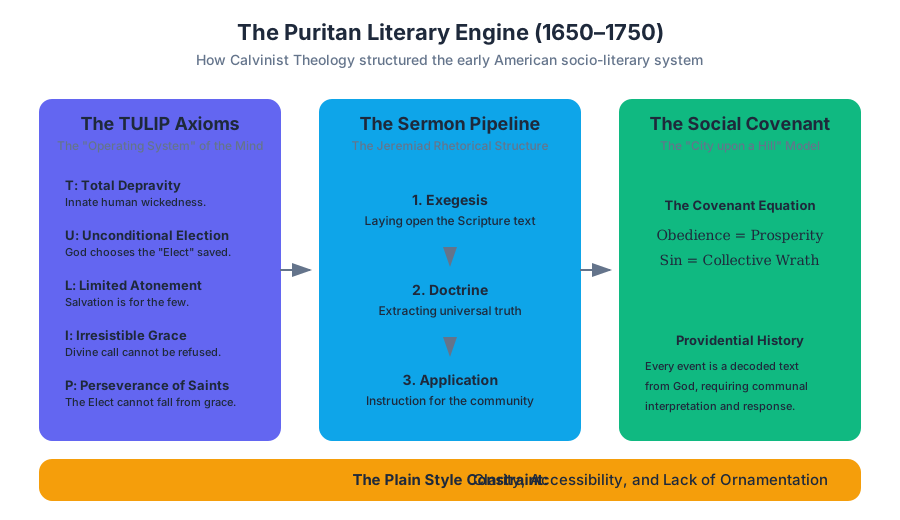
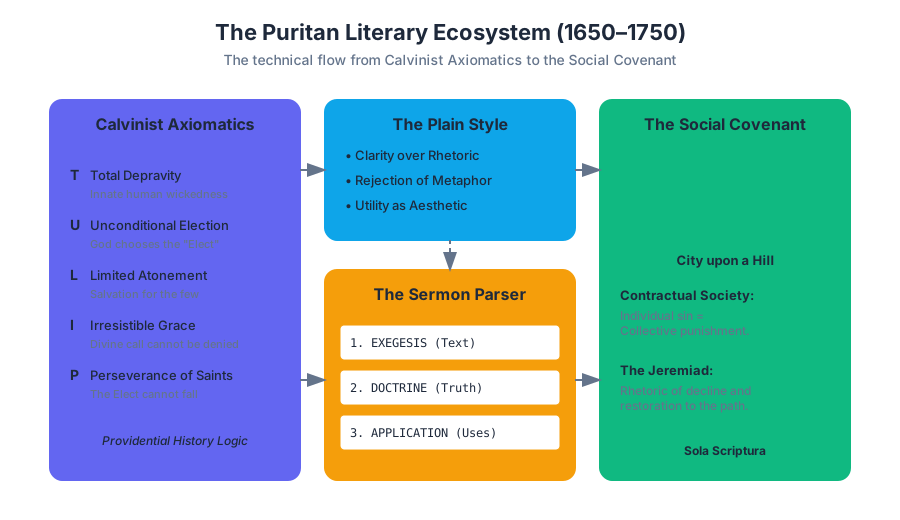
The core of Puritan belief is often summarized by the TULIP acronym, which served as the foundational logic for almost every poem, sermon, and diary entry written during this century.
| Doctrine | Term | Definition | Literary Implication |
|---|---|---|---|
| T | Total Depravity | Every human is born in sin and incapable of self-redemption. | Narratives focus on the struggle against innate "wickedness." |
| U | Unconditional Election | God chooses the "Elect" (those saved) regardless of merit. | Literature serves as a search for "signs" of one's election. |
| L | Limited Atonement | Jesus died only for the Elect, not for all of humanity. | Creates an exclusionary, "City upon a Hill" community identity. |
| I | Irresistible Grace | When God chooses to save someone, they cannot resist. | Conversion narratives emphasize the overwhelming power of the divine. |
| P | Perseverance of the Saints | The Elect cannot lose their salvation. | Encourages the "Plain Style" to avoid the sin of pride. |
Definition: The Plain Style A mode of expression characterized by clarity, accessibility, and a lack of ornamental rhetoric (such as metaphors or classical allusions). Puritans believed that "the word of God should be delivered in its own power," and that ornate language distracted from the divine message.
The Logic of the Sermon: The Jeremiad and the Three-Part Structure
The sermon was the primary literary genre of the 17th century. It was not merely a speech but a formal logical derivation. The most significant sub-genre was the Jeremiad, named after the prophet Jeremiah. This form followed a specific rhetorical arc: it lamented the moral decline of the community, warned of impending divine judgment, and offered a path to restoration.
The technical implementation of a sermon followed a rigid tripartite structure:
- The Laying Open of the Text: A linguistic and historical analysis of a specific Bible verse.
- The Doctrine: The extraction of a universal theological truth from that verse.
- The Application (or Uses): How the congregation must change their behavior based on the doctrine.
The Social Covenant and John Winthrop
John Winthrop’s 1630 sermon, "A Model of Christian Charity," established the socio-political framework of the New England experiment. He introduced the Covenant—a legalistic contract between God and the community.
Winthrop famously stated:
"For we must consider that we shall be as a city upon a hill. The eyes of all people are upon us."
This "City upon a Hill" metaphor created a high-stakes environment where the failure of an individual was seen as a breach of the community’s contract with God, potentially inviting collective punishment.
The Equation of the Covenant
We can represent the logic of the Puritan social contract as a conditional probability:
P(\text{Prosperity} | \text{Obedience}) \approx 1.0
P(\text{Calamity} | \text{Disobedience}) \to 1.0
Where the "Obedience" variable is a summation of the community's adherence to the Sola Scriptura (Scripture alone) principle.
Anne Bradstreet: The Dialectics of Domesticity and Devotion
Anne Bradstreet (1612–1672) was the first significant poet in the American colonies. Her work is a fascinating study in the tension between Earthly Attachment and Heavenly Aspiration. While she remained a devout Puritan, her poetry often reveals a "rebellious" affection for her husband, her children, and her home—things the theology warned were merely temporary "vanities."
Key Work: "The Tenth Muse Lately Sprung Up in America" (1650)
Bradstreet’s poetry often employs a technique called The Dialectic, where she presents a worldly desire and then "corrects" herself with a spiritual resolution.
| Poem | Earthly Tension | Spiritual Resolution |
|---|---|---|
| "Upon the Burning of Our House" | Mourning the loss of "pleasant things" (furniture, roof). | "Thou hast a house on high erected / Framed by that mighty Architect." |
| "To My Dear and Loving Husband" | Intense, almost erotic love for a mortal man. | "Then while we live, in love let’s so persevere / That when we live no more, we may live ever." |
| "The Author to Her Book" | Maternal pride and embarrassment over her "ill-formed" writing. | The book is a "child" that must be sent into the world despite flaws. |
Stylistic Analysis: The Bradstreet Meter
Bradstreet primarily used Iambic Tetrameter or Pentameter, which provided a rhythmic stability that mirrored the perceived order of the Puritan universe.
Captivity Narratives: Mary Rowlandson and the Wilderness Allegory
The Captivity Narrative was the first uniquely American literary genre. Mary Rowlandson’s A Narrative of the Captivity and Restoration of Mrs. Mary Rowlandson (1682) is the definitive example. These texts were not just adventure stories; they were Spiritual Allegories.
- The Capture: Represented the soul being snatched by sin or the devil.
- The Wilderness: Represented the "testing ground" of faith (reminiscent of the Israelites in the desert).
- The Restoration: Represented the soul’s redemption and return to the community of the Elect.
Rowlandson’s narrative is structured by "Removes"—the 20 times she was forced to move with her Wampanoag captors. Each remove is punctuated by a scriptural citation that "decodes" her suffering.
The Great Awakening and Jonathan Edwards (1730–1750)
By the early 1700s, Puritan zeal had begun to wane as the colonies became more prosperous and secular. The Great Awakening was a religious revival designed to shock the population back into spiritual fervor.
Jonathan Edwards: The Intellectual Firebrand
Jonathan Edwards was a polymath who bridged the gap between Puritanism and the Enlightenment. He studied Locke and Newton but used their empirical methods to defend traditional Calvinism.
His most famous sermon, "Sinners in the Hands of an Angry God" (1741), is a masterpiece of psychological rhetoric. He moved away from the "Plain Style" toward a sensory-heavy, terrifying imagery designed to trigger a physical reaction in the listener.
The Mechanics of Fear
Edwards used "The Image of the Spider" to illustrate the precariousness of human life:
"The God that holds you over the pit of hell, much as one holds a spider, or some loathsome insect over the fire, abhors you, and is dreadfully provoked."
| Rhetorical Device | Purpose | Effect |
|---|---|---|
| Metaphor | "The bow of God's wrath is bent." | Implies immediate, physical tension. |
| Simile | "Your wickedness makes you as it were heavy as lead." | Appeals to the Newtonian concept of gravity. |
| Polysyndeton | Repeated use of "and" or "or" in lists of horrors. | Creates an overwhelming sense of inevitability. |
Transition to the Enlightenment (1750 and Beyond)
As we approach 1750, the literary landscape began to shift. The focus on Revelation (truth from God) began to give way to Reason (truth from observation).
- Deism: The belief in a "Clockmaker God" who created the universe and then stepped back.
- The Rise of the Essay: Moving from the sermon to the political pamphlet (e.g., Benjamin Franklin).
- Humanism: A shift from "Total Depravity" to the "Perfectibility of Man."
Common Pitfalls in Analyzing Puritan Literature
- The "Boring" Fallacy: Modern readers often find Puritan texts dry because they lack plot. However, for a Puritan, the "plot" was the internal struggle for salvation—the highest stakes possible.
- Monolithic View: It is a mistake to think all Puritans were identical. The tension in Anne Bradstreet’s poetry or the radicalism of Roger Williams (who founded Rhode Island) shows a complex internal diversity.
- Misunderstanding "Plain Style": Plain style was not a lack of skill; it was a deliberate, sophisticated aesthetic choice intended to mimic the perceived simplicity of the Apostles.
Source Materials
Study Literature and Literacy on Lykke
This course page is free to open: signed out, you can read its first two sections, and signing in, on any plan, opens the rest. The free Lykke Chrome extension syncs your own Canvas courses, so ChatGPT, Claude and Muse can answer from your classes and deadlines. It only reads Canvas.
Add the free extensionSign in to open every sectionAll sections of Literature and Literacy · Browse more course pages