From the free course Literature and Literacy on Lykke
Classical and Medieval Traditions
Key concepts: Classical Antiquity · Epic Poetry · Medieval Period · Religious vs. Secular Literature
Surveys the foundational works of Ancient Greece and Rome through the European Middle Ages.
Classical and Medieval Traditions
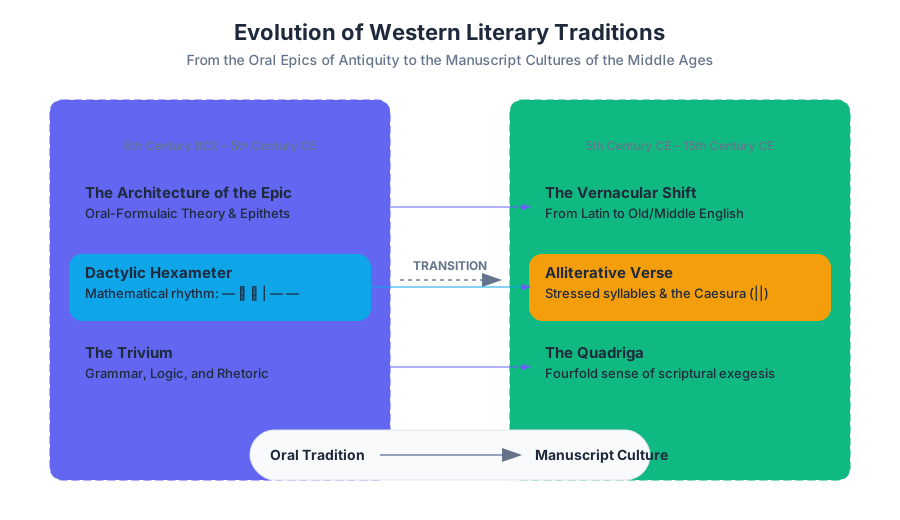
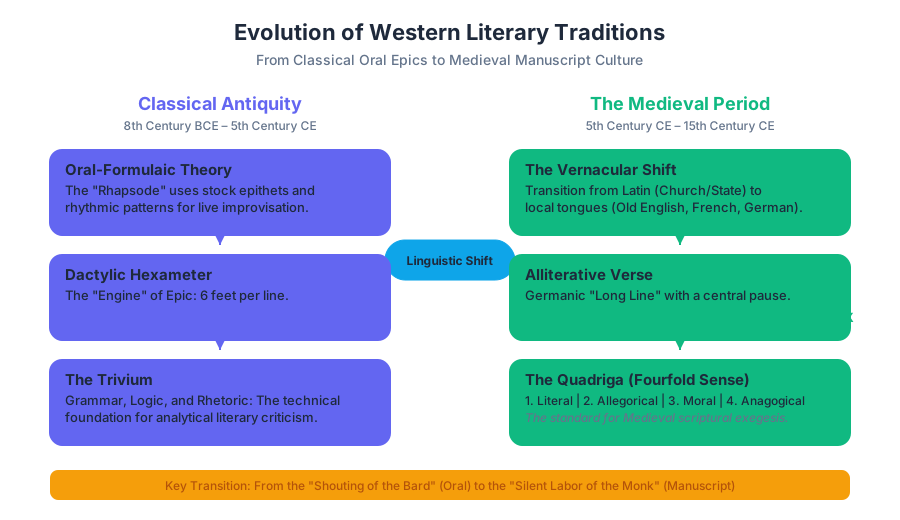
The literary landscape of the Western world is built upon the dual pillars of Classical Antiquity and the Medieval Period. This era, spanning roughly from the 8th century BCE to the 15th century CE, represents a monumental shift from oral traditions and polytheistic epics to the codified, manuscript-driven cultures of the Christian Middle Ages. Understanding this transition requires more than a chronological summary; it demands an analysis of the structural, linguistic, and philosophical frameworks that allowed literature to evolve from the "shouting" of the bard to the silent, scholarly labor of the monk.
Classical Antiquity: The Architecture of the Epic
Classical Antiquity refers to the period of cultural history centered on the Mediterranean Sea, comprising the interlocking civilizations of Ancient Greece and Ancient Rome. In this context, literature was not merely entertainment; it was the primary vehicle for cultural identity, education, and the preservation of history.
The Mechanics of Epic Poetry
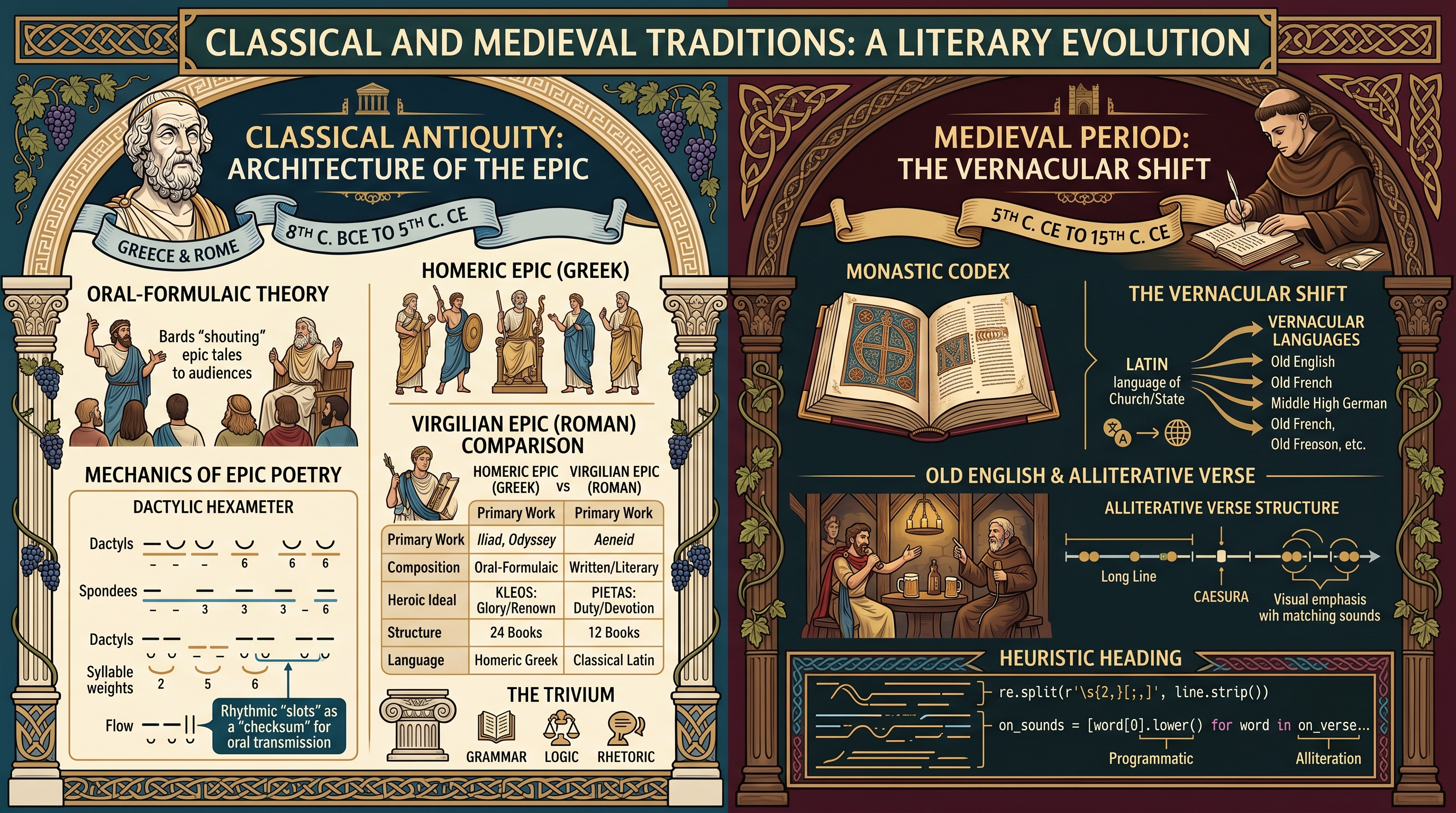
The Epic Poem is the foundational genre of the Classical tradition. It is defined by its scale, its focus on heroic deeds, and its use of elevated language. However, the technical "engine" of the epic is the Oral-Formulaic Theory, pioneered by Milman Parry and Albert Lord. This theory posits that epics like the Iliad and the Odyssey were composed through a system of stock phrases (epithets) and rhythmic patterns that allowed the poet (the rhapsode) to improvise thousands of lines within a strict metrical constraint.
Definition: Dactylic Hexameter The standard meter of Classical epic poetry, consisting of six feet per line. Each foot is either a dactyl (one long syllable followed by two short:
— ◡ ◡) or a spondee (two long syllables:— —).
The mathematical precision of this meter acted as a checksum for the oral transmission of data. If a poet forgot a word, the rhythmic "slot" required a specific syllable weight to maintain the integrity of the line.
| Feature | Homeric Epic (Greek) | Virgilian Epic (Roman) |
|---|---|---|
| Primary Work | Iliad, Odyssey | Aeneid |
| Composition | Oral-Formulaic | Written/Literary |
| Heroic Ideal | Kleos (Glory/Renown) | Pietas (Duty/Devotion) |
| Structure | 24 Books | 12 Books |
| Language | Homeric Greek (Ionic/Aeolic) | Classical Latin |
Greco-Roman Philosophy and Rhetoric
Beyond poetry, the Classical tradition established the Trivium (Grammar, Logic, and Rhetoric). Thinkers like Plato and Aristotle provided the analytical tools used to dissect literature for the next two millennia. Aristotle’s Poetics serves as the first technical manual for literary criticism, defining concepts such as mimesis (imitation) and catharsis (emotional purging).
The Medieval Period: The Vernacular Shift
The Medieval Period (ca. 500–1500 CE) begins with the fragmentation of the Western Roman Empire. This era is often mischaracterized as a "dark age," but in literary terms, it was a period of intense linguistic hybridization. The transition from Latin (the language of the Church and State) to the Vernacular (the languages of the people, such as Old English, Old French, and Middle High German) is the defining technical challenge of the era.
Old English and Alliterative Verse
Before the Norman Conquest of 1066, English literature was dominated by Alliterative Verse. Unlike the syllable-counting meters of the Greeks, Germanic poetry relied on a "long line" divided by a caesura (a pause), with two heavily stressed syllables on each side linked by alliteration.
Middle English and the Influence of Chaucer
By the 14th century, English had evolved into Middle English. This version of the language was a "creole" of Anglo-Saxon roots and Norman-French vocabulary. Geoffrey Chaucer, in The Canterbury Tales, abandoned alliterative verse in favor of the Rhyme Royal and the Iambic Pentameter, effectively importing Continental European aesthetics into the English tradition.
Religious vs. Secular Literature
The Medieval mind operated on a spectrum between the sacred and the profane. However, these categories were not mutually exclusive; they often utilized the same rhetorical devices.
Religious Literature: The Fourfold Sense
Medieval theological texts were often interpreted using the Quadriga, a method of exegesis that looked for four levels of meaning in a single text. This was applied not only to the Bible but also to allegorical works like Dante’s Divine Comedy.
| Level | Name | Focus | Example (Jerusalem) |
|---|---|---|---|
| Literal | Littera | Historical events | The physical city in Palestine |
| Allegorical | Allegoria | Faith/Christology | The Church of Christ |
| Moral | Tropologia | The soul/Ethics | The human soul |
| Anagogical | Anagogia | Future/Eschatology | The Heavenly City (New Jerusalem) |
Secular Literature: Courtly Love and Chivalry
Secular literature flourished in the courts of Eleanor of Aquitaine and her contemporaries. The Chanson de Geste (Song of Deeds) and the Romance became the dominant forms. These works introduced the concept of Fin'amor (Courtly Love), a highly ritualized, often adulterous, and strictly hierarchical form of devotion that mirrored the feudal relationship between a lord and vassal.
The structure of a Medieval Scholastic argument (often used in both religious and secular debates) can be formalized as a logical derivation:
\begin{array}{ll}
\text{1. Propositio:} & \text{Whether love is a passion of the soul?} \\
\text{2. Oppositio:} & \text{It seems not, for love is a virtue (Aristotle).} \\
\text{3. Sed Contra:} & \text{But the Philosopher says love is in the concupiscible power.} \\
\text{4. Respondeo:} & \text{I answer that love is the primary movement of the will.} \\
\text{5. Determinatio:} & \text{Therefore, love is a passion, but its object defines its virtue.}
\end{array}
The Technological Impact: From Scriptorium to Press
The production of literature during the Classical and Medieval periods was a physical, labor-intensive process. Before the Printing Press, every book was a Manuscript (manu scriptus — written by hand).
The Scriptorium Pipeline
The production of a medieval codex (book) followed a specific industrial pipeline:
- Parchment Preparation: Skinning sheep or calves (vellum), soaking in lime, and stretching on a "herse."
- Pricking and Ruling: Using a dry point or lead to create guidelines for the scribe.
- Copying: The scribe (scriptor) copies the text from a source (exemplar).
- Illumination: Artists add gold leaf and pigments to "illuminate" the page.
- Binding: Sewing the quires (gatherings of pages) together between wooden boards.
The Caxton Revolution
In 1476, William Caxton established the first printing press in England. This was the "disruptive technology" of the 15th century. It shifted the value of a text from its unique, handcrafted beauty to its accuracy and availability.
| Metric | Manuscript Culture | Print Culture (Incunabula) |
|---|---|---|
| Speed | 1–5 pages per day | 500–1000 pages per day |
| Cost | Extremely High (Price of a farm) | Moderate (Accessible to merchants) |
| Error Rate | Cumulative (Scribe drift) | Fixed (One error = 1000 copies) |
| Standardization | Regional dialects/scripts | Emergence of Standard English |
To manage the transition of these texts into the modern digital era, we often use relational databases to track manuscript variants (the field of Textual Criticism).
Common Pitfalls in Studying the Tradition
- The "Dark Ages" Fallacy: Assuming that the fall of Rome led to a total loss of literacy. In reality, the Irish monasteries and the Carolingian Renaissance preserved and expanded upon Classical knowledge.
- Homogeneity Bias: Viewing "The Middle Ages" as a single, unchanging block of time. The difference between the 7th-century Beowulf and the 14th-century Canterbury Tales is as vast as the difference between Chaucer and T.S. Eliot.
- Anachronistic Reading: Applying modern concepts of "authorship" and "originality" to Medieval texts. Medieval writers viewed themselves as "compilers" or "commentators" rather than "creators," often attributing their work to older, more authoritative sources to gain legitimacy.
Summary of Genre Evolution
The transition from Classical to Medieval can be viewed as a transformation of the Heroic Archetype. The Classical hero (Achilles) seeks personal glory through violence; the early Medieval hero (Beowulf) seeks the protection of the tribe through violence; the late Medieval hero (Gawain) seeks moral perfection through the restraint of violence.
Final Synthesis
The Classical and Medieval traditions are not merely "old books." They are the source code of Western literature. The Epic Poetry of the Greeks provided the structural DNA, while the Medieval Period provided the linguistic and theological complexity that allowed literature to move beyond simple narrative into the realm of deep, multi-layered allegory. Whether it is the dactylic hexameter of Virgil or the alliterative long line of the Pearl poet, these traditions represent a masterful fusion of technical constraint and creative expression.
Source Materials
Study Literature and Literacy on Lykke
This course page is free to open: signed out, you can read its first two sections, and signing in, on any plan, opens the rest. The free Lykke Chrome extension syncs your own Canvas courses, so ChatGPT, Claude and Muse can answer from your classes and deadlines. It only reads Canvas.
Add the free extensionSign in to open every sectionAll sections of Literature and Literacy · Browse more course pages