Literature and Literacy
Institution: MIT
84 study materials · 11 sections
This course provides a comprehensive exploration of literature as an art form and an intellectual discipline, emphasizing the development of literacy and critical thinking skills. Students will survey global literary traditions, ranging from Classical Antiquity and the Medieval period to Modernism, with a specialized focus on the evolution of American and British literature. By analyzing diverse genres—including poetry, drama, and prose—and applying various critical theories, learners will develop the ability to interpret complex texts within their socio-historical contexts. The curriculum also bridges the gap between reading and writing, offering practical frameworks for literary analysis and academic research.
Course Sections
Foundations of Literature and Literacy
Key concepts: Artistic Value · Critical Thinking · Information Literacy · Rhetorical Action
Defines literature and literacy while establishing the relationship between critical thinking and rhetorical action.
Foundations of Literature and Literacy
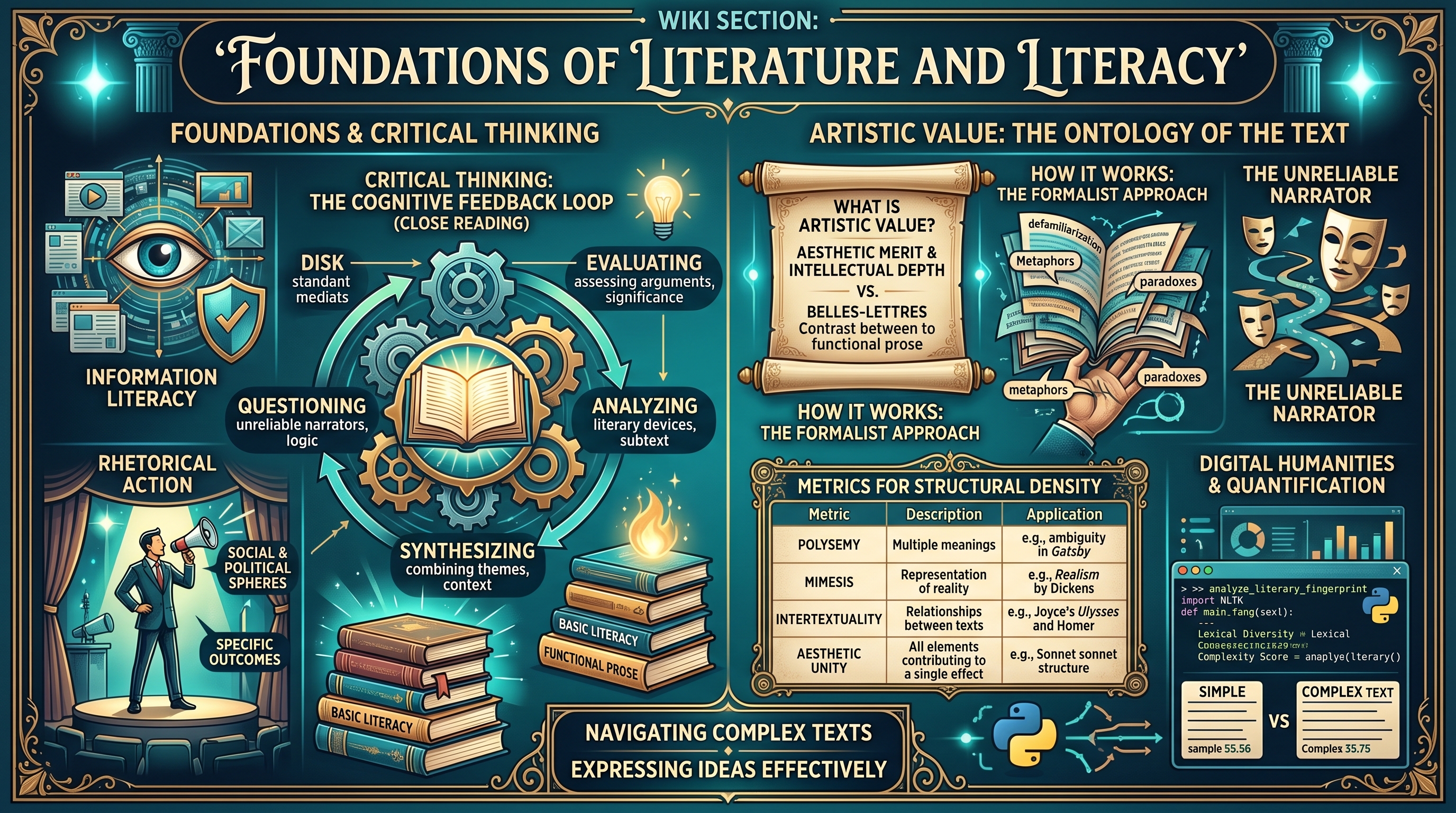
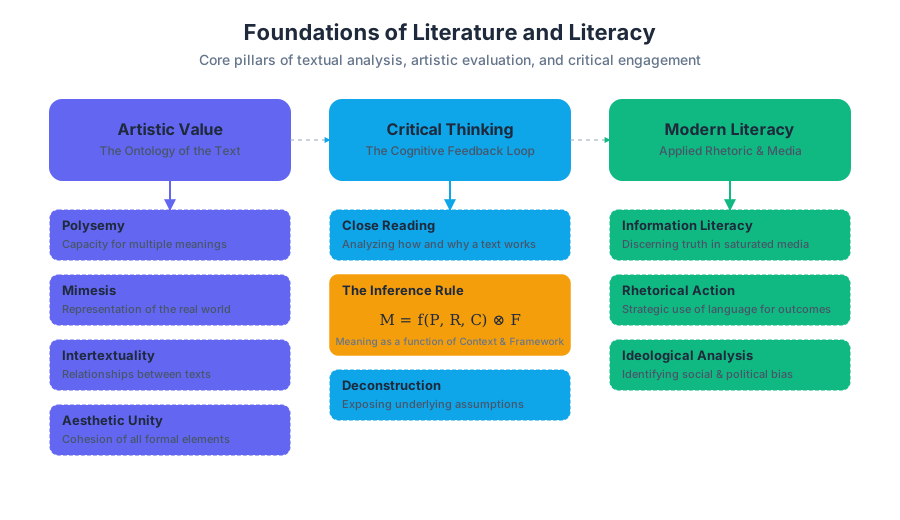
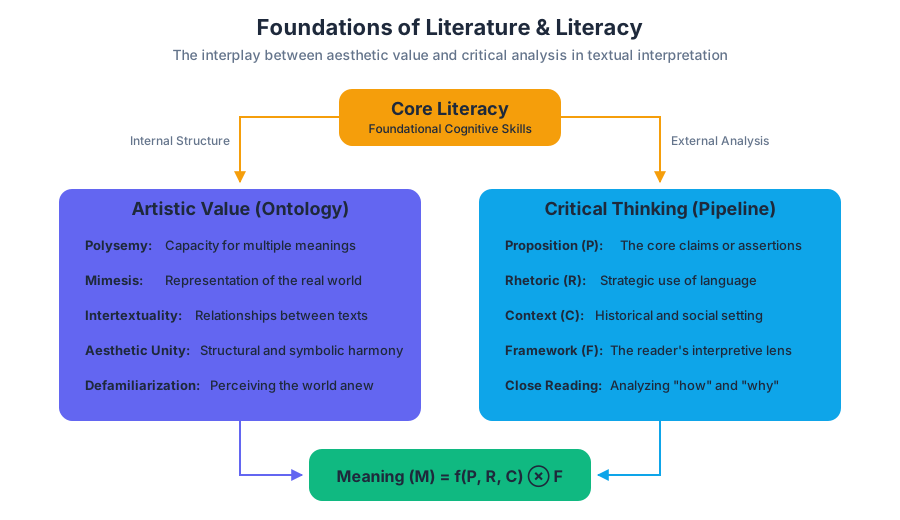
Literature is defined as any body of written works considered an art form or deemed to have significant intellectual value. This section establishes the foundational skills of literacy and critical thinking, which are essential for navigating complex texts and expressing ideas effectively. In the modern era, these foundations have expanded to include information literacy—the ability to discern truth in a saturated media landscape—and rhetorical action, the strategic use of language to achieve specific outcomes in social and political spheres.
Artistic Value: The Ontology of the Text
Artistic Value in literature refers to the aesthetic merit and intellectual depth that distinguishes "belles-lettres" (fine writing) from purely functional or technical prose. While a technical manual aims for clarity and utility, a literary work aims for a "surplus of meaning," where the form, style, and structure are as significant as the content itself.
What it is
Artistic value is often measured through canonization—the process by which certain works are deemed "classics"—and aesthetic distance, the gap between the reader's reality and the world of the text. It involves the use of literary devices (metaphor, synecdoche, irony) to create a "defamiliarization" (Viktor Shklovsky’s ostranenie) that forces the reader to perceive the world anew.
Why it matters
Without an understanding of artistic value, literature is reduced to a data-transfer mechanism. Recognizing value allows us to understand the cultural "zeitgeist" of a period, such as the Puritan focus on divine providence or the Romantic emphasis on the sublime.
How it works: The Formalist Approach
To analyze artistic value, one must look at the Internal Consistency and Complexity of the work. This is often modeled as a function of the text's structural density.
| Metric | Description | Application in Literature |
|---|---|---|
| Polysemy | The capacity for a sign or text to have multiple meanings. | Ambiguity in The Great Gatsby regarding the American Dream. |
| Mimesis | The representation of the real world in art and literature. | The gritty details of 19th-century Realism (e.g., Dickens, Balzac). |
| Intertextuality | The relationship between texts; how one text references another. | Joyce’s Ulysses mapping onto Homer’s Odyssey. |
| Aesthetic Unity | The degree to which all elements of a work contribute to a single effect. | The tight, symbolic structure of a Shakespearean sonnet. |
Concrete Example: Sentiment and Structural Analysis
In modern digital humanities, we can quantify "artistic value" or at least stylistic markers using Natural Language Processing (NLP). Below is a low-level implementation of a lexical diversity and sentiment analysis tool, often used to differentiate between genre fiction and high-literary prose.
import nltk
from nltk.tokenize import word_tokenize
from collections import Counter

def analyze_literary_fingerprint(text):
    """
    Calculates the Lexical Diversity and Sentiment Variance of a text.
    High lexical diversity often correlates with 'literary' complexity.
    """
    tokens = [t.lower() for t in word_tokenize(text) if t.isalpha()]
    total_words = len(tokens)
    unique_words = len(set(tokens))

    # Type-Token Ratio (TTR)
    ttr = unique_words / total_words if total_words > 0 else 0

    # Hapax Legomena (words appearing only once)
    counts = Counter(tokens)
    hapax = [w for w in counts if counts[w] == 1]
    hapax_ratio = len(hapax) / total_words

    return {
        "lexical_diversity": round(ttr, 4),
        "hapax_ratio": round(hapax_ratio, 4),
        "complexity_score": round((ttr + hapax_ratio) * 100, 2)
    }

# Example: Comparing a simple sentence vs. a complex literary line
sample_text = "It was the best of times, it was the worst of times, it was the age of wisdom..."
print(analyze_literary_fingerprint(sample_text))
Common Pitfalls
- Subjectivity Trap: Confusing "I like this" with "This has artistic value." Value is often determined by the work's influence on subsequent literature and its internal technical mastery.
- Anachronism: Judging a 17th-century Puritan text by 21st-century aesthetic standards.
Critical Thinking: The Cognitive Feedback Loop
Critical Thinking is the disciplined process of actively and skillfully conceptualizing, applying, analyzing, synthesizing, and evaluating information gathered from, or generated by, observation, experience, reflection, reasoning, or communication.
What it is
In the context of literature, critical thinking is synonymous with Close Reading. It is the move from what the text says to how and why it says it. It requires the identification of logical fallacies, the questioning of the narrator's reliability, and the deconstruction of the author's underlying assumptions.
Why it matters
Critical thinking transforms a reader from a passive consumer into an active participant. In the era of "Post-Truth," the ability to identify a text's ideological bias is a survival skill.
How it works: The Analytical Pipeline
Critical thinking follows a recursive logic. We can represent the "Critical Analysis Algorithm" as a set of logical operations.
The Critical Inference Rule: If a text $T$ asserts proposition $P$ using rhetorical device $R$ in historical context $C$, then the intended meaning $M$ is a function of $(P, R, C)$, subject to the reader's own interpretive framework $F$. $$M = f(P, R, C) \otimes F$$
Mathematical Representation of Argument Mapping
We can view an argument as a directed acyclic graph (DAG) where nodes are claims and edges are logical supports or rebuttals.
[Claim: The narrator is unreliable]
       ^             ^
       | (Support)   | (Support)
[Contradiction A]  [Bias B]
       |             |
[Textual Evidence] [Historical Context]
Variations: Literary Theory
Critical thinking is applied through various "lenses" or theories:
- Marxist Criticism: Analyzing power dynamics and class struggle.
- Feminist Criticism: Examining the representation of women and gender roles.
- Post-Colonialism: Investigating the impact of colonial rule and cultural hegemony.
Information Literacy: Navigating the Epistemic Landscape
Information Literacy is the ability to recognize when information is needed and have the ability to locate, evaluate, and use effectively the needed information.
What it is
While traditional literacy focuses on the mechanics of reading, information literacy focuses on the ecology of information. It involves understanding how information is produced, the economics of attention, and the technical structures (algorithms, databases) that deliver content.
Why it matters
In the 21st century, we are no longer limited by a lack of information, but by an excess of it. Information literacy provides the tools to filter "noise" from "signal."
The SIFT Method (The "Algorithm" for Evaluation)
Professional fact-checkers use the SIFT method to evaluate sources.
| Step | Action | Objective |
|---|---|---|
| Stop | Pause before sharing or reacting. | Prevent emotional contagion and "fast thinking." |
| Investigate | Look up the author, publisher, and funding. | Establish the "Epistemic Authority" of the source. |
| Find | Look for "better coverage" or consensus. | Determine if the claim is an outlier or mainstream. |
| Trace | Find the original context of quotes or data. | Eliminate "contextomy" (quoting out of context). |
Concrete Example: Verifying a Source via CLI
An information-literate researcher might use command-line tools to quickly inspect the metadata of a document or the headers of a website to verify its origin.
# Investigating a source's domain and registration history
whois example-news-site.com | grep -E "Holder|Date|Organization"

# Checking if a PDF document has been tampered with or viewing its origin
pdfinfo "suspicious_report.pdf"

# Using curl to check for redirects (seeing if a site is masking its identity)
curl -IL http://bit.ly/3xyz789
Common Pitfalls: The Echo Chamber
The most common failure of information literacy is Confirmation Bias—the tendency to search for, interpret, favor, and recall information in a way that confirms one's preexisting beliefs.
Rhetorical Action: Language as a Tool of Influence
Rhetorical Action is the strategic use of language and symbols to achieve specific goals or influence an audience. It is the "pragmatic" side of literature and literacy.
What it is
Derived from the Aristotelian tradition, rhetoric is the "faculty of observing in any given case the available means of persuasion." It moves beyond the meaning of words to the effect of words.
Why it matters
Every piece of writing—from a Puritan sermon to a Modernist manifesto—is a rhetorical act. Understanding rhetoric allows us to see how texts "do" things in the world: they start revolutions, enforce laws, and build identities.
The Rhetorical Triangle and Beyond
The classic model involves Ethos (Credibility), Pathos (Emotion), and Logos (Logic). However, a more sophisticated model includes Kairos (The Opportune Moment) and Telos (The Ultimate Purpose).
| Element | Focus | Mechanism |
|---|---|---|
| Ethos | The Speaker | Establishing authority, shared values, and character. |
| Logos | The Message | Syllogisms, data, inductive and deductive reasoning. |
| Pathos | The Audience | Vivid imagery, metaphors, and emotional appeals. |
| Kairos | The Setting | Timing the message to coincide with cultural shifts. |
Real-World Usage: The Structure of a Persuasive API Call
In the digital age, rhetoric is even embedded in how we structure requests to AI or interact with social media algorithms. A "Prompt Engineer" is essentially a modern rhetorician.
POST /v1/completions HTTP/1.1
Host: api.openai.com
Content-Type: application/json
Authorization: Bearer $OPENAI_API_KEY

{
  "model": "gpt-4",
  "prompt": "Write a persuasive essay (Ethos: Scientific Expert, Pathos: Urgency)
             on the necessity of literacy in the age of AI.
             Target Audience: Policy Makers.
             Tone: Formal and Authoritative.",
  "temperature": 0.7,
  "max_tokens": 500
}
Socio-historical Context and the Evolution of Literacy
Literacy and literature do not exist in a vacuum; they are products of their Socio-historical Context. The movements mentioned in the source materials—Puritanism, Romanticism, Realism, and Modernism—represent shifts in how human beings perceive reality and their place within it.
Timeline of Literary Movements and Literacy Paradigms
| Period | Movement | Primary Literacy Goal | Key Rhetorical Mode |
|---|---|---|---|
| 1600-1750 | Puritanism | Religious Instruction | The Sermon (Plain Style) |
| 1750-1820 | Enlightenment | Civic Participation | The Political Pamphlet (Reason) |
| 1820-1860 | Romanticism | Emotional Expression | The Lyric Poem (Sublime) |
| 1865-1914 | Realism/Naturalism | Social Documentation | The Novel (Objective Observation) |
| 1914-1945 | Modernism | Psychological Exploration | Stream of Consciousness (Fragmentation) |
| 1945-Present | Post-Modernism | Deconstruction | Metafiction (Irony/Pastiche) |
Case Study: Diverse Voices in Early America
Early American literature was not a monolith. While the "Canon" long focused on European settlers, a critical literacy approach reveals a rich tapestry of Diverse Voices.
- Indigenous Oratory: Oral traditions that functioned as sophisticated legal and social frameworks.
- Slave Narratives: (e.g., Frederick Douglass) Rhetorical masterpieces designed to prove the humanity and literacy of the enslaved to a white audience.
- Women’s Captivity Narratives: Texts that negotiated the boundaries of domesticity and the "wilderness."
Conclusion: The Synthesis of Foundations
The foundations of literature and literacy are not disparate skills but an integrated system. Artistic Value provides the depth; Critical Thinking provides the tools for excavation; Information Literacy provides the map of the terrain; and Rhetorical Action provides the means to build something new from the findings.
As we move from the "Gutenberg Galaxy" of printed books into the "Digital Constellation" of hyperlinked, AI-generated content, these foundations become more critical than ever. The "literate" individual of the future is not just one who can read, but one who can navigate the complex interplay of human creativity and algorithmic logic.
World Literature and Genre Studies
Key concepts: World Literature · Non-Western Literature · Ideologies of Space · Genre Studies
Explores the global circulation of literary works and introduces the primary genres of poetry, plays, and essays.
World Literature and Genre Studies
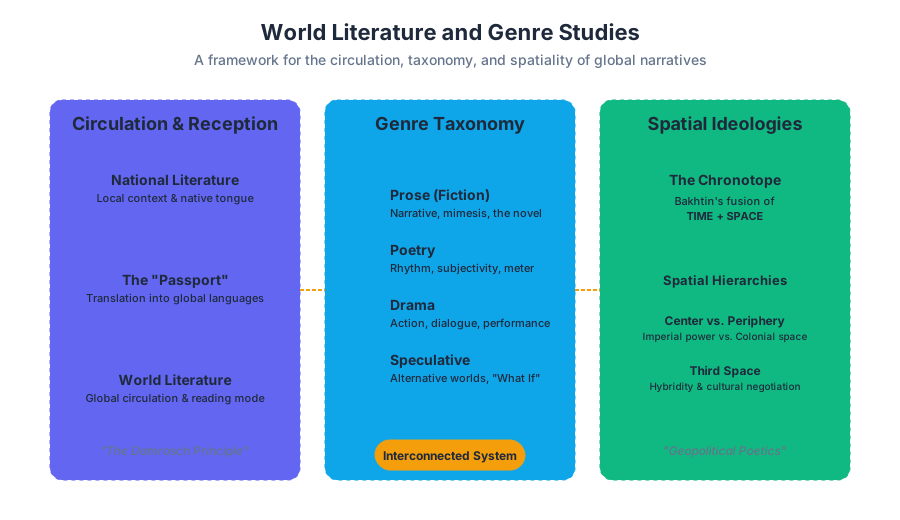
World literature is not merely a collection of the "greatest hits" from various nations; it is a dynamic system of circulation, translation, and reception that transcends linguistic and geopolitical borders. As an academic discipline, it examines how texts function as global commodities and cultural ambassadors. Coupled with Genre Studies, which categorizes literature based on formal and thematic patterns, this field provides a rigorous framework for understanding how human experience is encoded into narrative structures across time and space.
The Mechanics of World Literature: Circulation and Reception
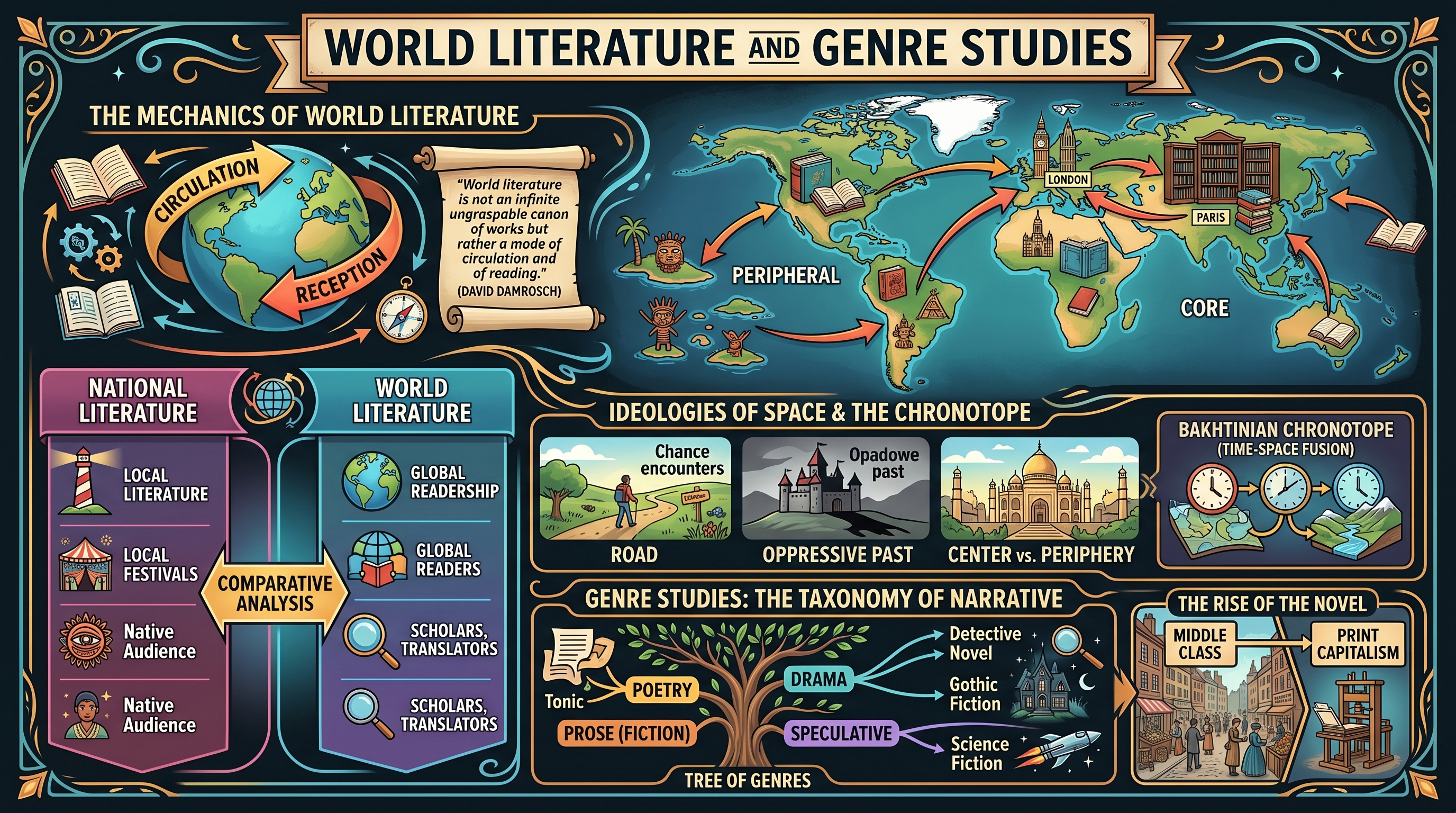
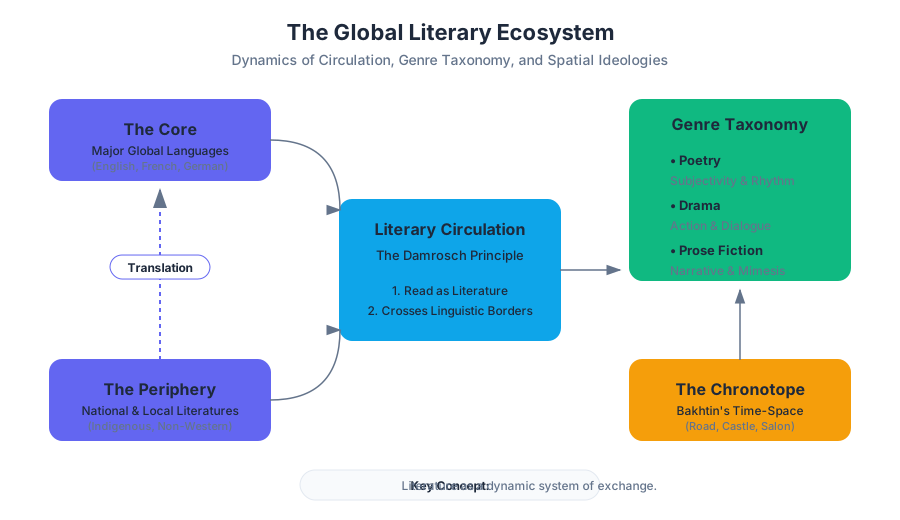
The contemporary understanding of World Literature (often referenced by the German term Weltliteratur, coined by Johann Wolfgang von Goethe) has shifted from a static canon of European masterpieces to a fluid model of "literary networks." According to David Damrosch, a work enters world literature through a double process: first, by being read as literature, and second, by circulating into a broader world beyond its linguistic and cultural point of origin.
The Damrosch Principle: "World literature is not an infinite ungraspable canon of works but rather a mode of circulation and of reading, a mode that is as applicable to individual works as to bodies of material."
The Global System of Literature
Literature operates within a "world-system" (a concept borrowed from Immanuel Wallerstein’s sociology) where there are "core" literatures (historically French, English, and German) and "peripheral" literatures. The movement of a text from the periphery to the core often requires the "passport" of translation into a major global language.
| Aspect | National Literature | World Literature |
|---|---|---|
| Primary Context | Local history, specific linguistic nuances | Cross-cultural dialogue, universal themes |
| Audience | Native speakers, citizens | Global readers, scholars, translators |
| Function | Identity formation, cultural preservation | Intercultural mediation, aesthetic exchange |
| Medium | Original language | Translation and adaptation |
Ideologies of Space and the Chronotope
In literary analysis, space is never neutral. Ideologies of Space refer to the ways in which physical environments in a text—cities, wilderness, domestic interiors—reflect power structures, colonial histories, and social hierarchies.
The Bakhtinian Chronotope
Mikhail Bakhtin introduced the concept of the Chronotope (literally "time-space") to describe how configurations of time and space are fused in literature. For example, the "road" chronotope in a picaresque novel facilitates chance encounters and social mobility, whereas the "castle" chronotope in Gothic fiction represents a stagnant, oppressive past haunting the present.
Spatial Hierarchies
- The Center vs. The Periphery: In colonial and post-colonial literature, the "Center" (the imperial capital) is often depicted as the site of law and civilization, while the "Periphery" (the colony) is portrayed as a space of chaos or untapped resource.
- The Pastoral vs. The Urban: A classic dichotomy where the rural space represents innocence and the city represents moral decay or industrial progress.
- Third Space: A concept from Homi K. Bhabha describing the "in-between" space where cultural identities are negotiated and hybridity is born.
Genre Studies: The Taxonomy of Narrative
Genre Studies is the systematic analysis of literary types. Genres are not just labels; they are sets of "contracts" between the author and the reader. When you open a "Detective Novel," you expect a crime, an investigation, and a resolution.
The Evolution of Major Genres
Literature has traditionally been divided into a triad of modes, which have since branched into thousands of sub-genres.
| Macro-Genre | Primary Focus | Key Formal Elements |
|---|---|---|
| Poetry | Subjectivity and Rhythm | Meter, rhyme, metaphor, stanzaic structure |
| Drama | Action and Dialogue | Stage directions, soliloquy, conflict, performance |
| Prose (Fiction) | Narrative and Character | Point of view, plot, setting, mimesis |
| Speculative | Alternative Realities | World-building, "What If" scenarios, cognitive estrangement |
The Rise of the Novel
The novel is the "polyphonic" genre par excellence. Unlike the Epic, which deals with a finished, heroic past, the novel is rooted in the "low" language of the present and the everyday lives of ordinary people. Its rise in the 18th century is inextricably linked to the rise of the middle class and the spread of print capitalism.
Non-Western Literature and Decolonizing the Canon
For centuries, "World Literature" was synonymous with "Western Literature." However, modern scholarship emphasizes Non-Western Literature—including African, Asian, and Indigenous traditions—to challenge Eurocentric biases.
African Folklore and Orality
African literature often bridges the gap between orality (the oral tradition) and literacy. Works like Chinua Achebe’s Things Fall Apart integrate Igbo proverbs and folk tales into the structure of the English novel, effectively "colonizing" the language of the colonizer to express a distinct cultural epistemology.
Asian Epics and Philosophy
From the Mahabharata of India to the Journey to the West in China, non-Western traditions offer different structural models for narrative. These works often prioritize cyclical time over the linear progression common in Western "hero's journey" arcs.
Computational Approaches to Genre and World Literature
In the modern era, "Distant Reading" (a term coined by Franco Moretti) uses computational tools to analyze thousands of texts simultaneously, identifying patterns that are invisible to a human reader focusing on a single "masterpiece."
Implementation: Stylometry and Genre Classification
Below is a low-level implementation using Python and the scikit-learn library to demonstrate how a machine can "learn" to distinguish between genres based on word frequency distributions (stylometry).
import numpy as np
from sklearn.feature_extraction.text import TfidfVectorizer
from sklearn.svm import SVC
from sklearn.pipeline import Pipeline
from sklearn.model_selection import train_test_split

# Corpus: Small sample of 'Gothic' vs 'Realist' snippets
corpus = [
    "The dark corridors of the castle echoed with a ghostly moan.", # Gothic
    "The damp walls of the dungeon smelled of ancient rot.",        # Gothic
    "The shadow moved across the moonlit graveyard silently.",      # Gothic
    "John sat at his desk and calculated the quarterly taxes.",     # Realist
    "The market was crowded with merchants selling grain.",         # Realist
    "She walked to the shop to buy a loaf of bread for dinner."     # Realist
]
labels = [0, 0, 0, 1, 1, 1] # 0: Gothic, 1: Realist

# Build a pipeline: TF-IDF Vectorizer + Support Vector Classifier
text_clf = Pipeline([
    ('tfidf', TfidfVectorizer(stop_words='english', ngram_range=(1, 2))),
    ('clf', SVC(kernel='linear', C=1.0))
])

# Train the model
text_clf.fit(corpus, labels)

# Predict a new, unseen snippet
test_snippet = ["The phantom drifted through the stone hall."]
prediction = text_clf.predict(test_snippet)

print(f"Predicted Genre: {'Gothic' if prediction[0] == 0 else 'Realist'}")
Mathematical Derivation of Literary Distance
To compare two works in "World Literature," we can represent them as vectors in a high-dimensional space where each dimension is a specific word or theme. The Cosine Similarity ($\theta$) between two texts $A$ and $B$ is defined as:
\text{similarity} = \cos(\theta) = \frac{\mathbf{A} \cdot \mathbf{B}}{\|\mathbf{A}\| \|\mathbf{B}\|} = \frac{ \sum_{i=1}^{n} A_i B_i }{ \sqrt{\sum_{i=1}^{n} A_i^2} \sqrt{\sum_{i=1}^{n} B_i^2} }
In this model:
- If $\cos(\theta) = 1$, the texts are identical in their word distribution.
- If $\cos(\theta) = 0$, they share no vocabulary, indicating high "literary distance."
Real-World Usage: Querying Global Literary Metadata
Using SPARQL to query the Wikidata endpoint, a researcher can map the influence of a specific author (e.g., Gabriel García Márquez) across different languages and cultures.
# Find all translations of 'One Hundred Years of Solitude'
SELECT ?workLabel ?languageLabel WHERE {
  ?work wdt:P144 wd:Q123456; # P144: based on 'One Hundred Years of Solitude'
        wdt:P407 ?language.  # P407: language of work or name
  SERVICE wikibase:label { bd:serviceParam wikibase:language "[AUTO_LANGUAGE],en". }
}
LIMIT 100
Speculative Fiction: The Literature of Cognitive Estrangement
Speculative Fiction is an umbrella term encompassing Science Fiction, Fantasy, Horror, and Utopian/Dystopian literature. Darko Suvin famously defined Science Fiction as the "literature of cognitive estrangement," where a novum (a new thing, like a time machine or a FTL drive) is introduced into a logically consistent world.
The Function of the Novum
The novum acts as a mirror. By changing one fundamental rule of reality, the author can isolate and examine specific human behaviors or social structures.
| Speculative Sub-genre | The "Novum" | Primary Philosophical Inquiry |
|---|---|---|
| Hard Science Fiction | Technological breakthrough | The limits of human knowledge and physics |
| High Fantasy | Magic systems / Secondary worlds | The nature of good vs. evil and destiny |
| Dystopia | Extreme social/political shift | The fragility of freedom and human rights |
| Afrofuturism | African-centric future/tech | Reclaiming history and imagining black sovereignty |
Common Pitfalls in World Literature Analysis
- The Translation Trap: Assuming that a translation is a transparent window into the original. Every translation is an interpretation that carries the "ideological baggage" of the target language.
- Tokenism: Including one or two non-Western authors in a syllabus to "check a box" without engaging with the specific historical and aesthetic traditions of those cultures.
- Genre Essentialism: Believing that genres are fixed boxes. In reality, the most significant works of literature often occupy the "interstitial spaces" between genres (e.g., the "Prose Poem" or "Magical Realism").
- Ignoring the Materiality: Forgetting that literature is a product of the publishing industry. A book's success in "World Literature" is often as much about marketing and global distribution networks as it is about aesthetic merit.
Historical Context: From Puritanism to Post-Modernism
To understand the current state of World Literature, one must trace the evolution of specific national traditions that have dominated the global conversation.
American Literary Evolution
- Puritanism (1600s): Focused on divine providence and the "City upon a Hill."
- Enlightenment (1700s): Emphasized reason, republicanism, and the individual (e.g., Benjamin Franklin).
- Romanticism/Transcendentalism (1800s): A reaction against industrialization; focus on nature and the "Oversoul" (e.g., Emerson, Thoreau).
- Realism/Naturalism (Late 1800s): Depicting life "as it is," often influenced by Darwinian struggles (e.g., Mark Twain, Stephen Crane).
- Modernism (Early 1900s): Breaking traditional forms to represent a fragmented world ("Make it New").
British and Irish Contributions
The British tradition provided the foundational structures for the English-language novel, while the Irish Gothic (e.g., Bram Stoker’s Dracula) introduced themes of colonial anxiety and the "uncanny" that remain central to genre studies today.
Key Terms Summary Table
| Term | Definition | Context |
|---|---|---|
| Mimesis | The representation of reality in art | Foundational to Realism |
| Intertextuality | The relationship between texts | Central to Post-Modernism |
| Hegemony | Cultural dominance by one group | Used in Post-Colonial studies |
| Canon | The body of "authorized" works | Subject of ongoing debate |
| Epistemology | The theory of knowledge | How characters "know" their world |
| Aesthetic | Principles of beauty and taste | The "artistic" value of a text |
Conclusion: The Future of the Global Text
As digital platforms allow for the instantaneous global distribution of literature, the boundaries of "World Literature" are blurring further. We are moving toward a "Global Literature" where authors write for a planetary audience from the outset, often blending genres and languages in ways that defy traditional categorization. The study of these texts requires a toolkit that is both technically precise (computational) and deeply empathetic (hermeneutic).
Classical and Medieval Traditions
Key concepts: Classical Antiquity · Epic Poetry · Medieval Period · Religious vs. Secular Literature
Surveys the foundational works of Ancient Greece and Rome through the European Middle Ages.
Classical and Medieval Traditions
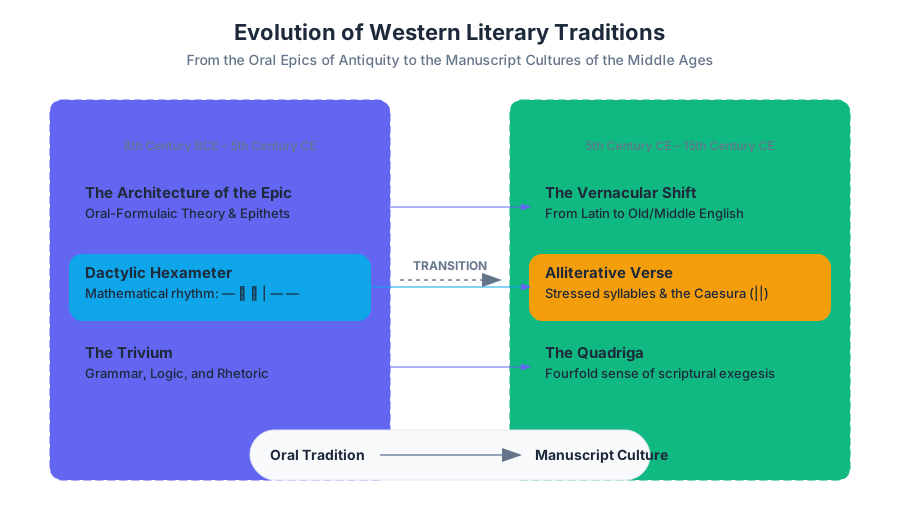
The literary landscape of the Western world is built upon the dual pillars of Classical Antiquity and the Medieval Period. This era, spanning roughly from the 8th century BCE to the 15th century CE, represents a monumental shift from oral traditions and polytheistic epics to the codified, manuscript-driven cultures of the Christian Middle Ages. Understanding this transition requires more than a chronological summary; it demands an analysis of the structural, linguistic, and philosophical frameworks that allowed literature to evolve from the "shouting" of the bard to the silent, scholarly labor of the monk.
Classical Antiquity: The Architecture of the Epic
Classical Antiquity refers to the period of cultural history centered on the Mediterranean Sea, comprising the interlocking civilizations of Ancient Greece and Ancient Rome. In this context, literature was not merely entertainment; it was the primary vehicle for cultural identity, education, and the preservation of history.
The Mechanics of Epic Poetry
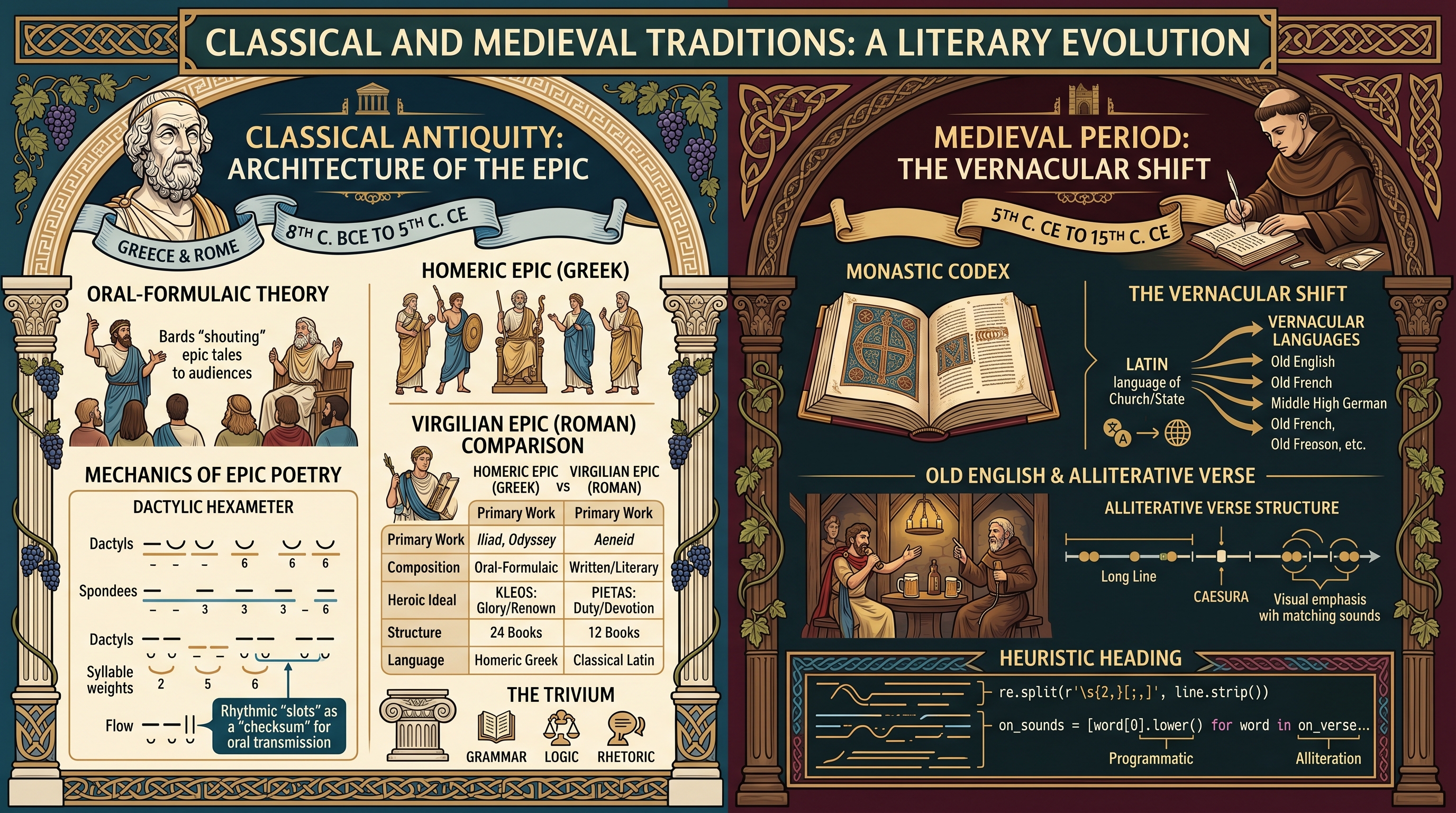
The Epic Poem is the foundational genre of the Classical tradition. It is defined by its scale, its focus on heroic deeds, and its use of elevated language. However, the technical "engine" of the epic is the Oral-Formulaic Theory, pioneered by Milman Parry and Albert Lord. This theory posits that epics like the Iliad and the Odyssey were composed through a system of stock phrases (epithets) and rhythmic patterns that allowed the poet (the rhapsode) to improvise thousands of lines within a strict metrical constraint.
Definition: Dactylic Hexameter The standard meter of Classical epic poetry, consisting of six feet per line. Each foot is either a dactyl (one long syllable followed by two short:
— ◡ ◡) or a spondee (two long syllables:— —).
The mathematical precision of this meter acted as a checksum for the oral transmission of data. If a poet forgot a word, the rhythmic "slot" required a specific syllable weight to maintain the integrity of the line.
| Feature | Homeric Epic (Greek) | Virgilian Epic (Roman) |
|---|---|---|
| Primary Work | Iliad, Odyssey | Aeneid |
| Composition | Oral-Formulaic | Written/Literary |
| Heroic Ideal | Kleos (Glory/Renown) | Pietas (Duty/Devotion) |
| Structure | 24 Books | 12 Books |
| Language | Homeric Greek (Ionic/Aeolic) | Classical Latin |
Greco-Roman Philosophy and Rhetoric
Beyond poetry, the Classical tradition established the Trivium (Grammar, Logic, and Rhetoric). Thinkers like Plato and Aristotle provided the analytical tools used to dissect literature for the next two millennia. Aristotle’s Poetics serves as the first technical manual for literary criticism, defining concepts such as mimesis (imitation) and catharsis (emotional purging).
The Medieval Period: The Vernacular Shift
The Medieval Period (ca. 500–1500 CE) begins with the fragmentation of the Western Roman Empire. This era is often mischaracterized as a "dark age," but in literary terms, it was a period of intense linguistic hybridization. The transition from Latin (the language of the Church and State) to the Vernacular (the languages of the people, such as Old English, Old French, and Middle High German) is the defining technical challenge of the era.
Old English and Alliterative Verse
Before the Norman Conquest of 1066, English literature was dominated by Alliterative Verse. Unlike the syllable-counting meters of the Greeks, Germanic poetry relied on a "long line" divided by a caesura (a pause), with two heavily stressed syllables on each side linked by alliteration.
The following Python script demonstrates a simplified heuristic for identifying alliterative patterns in Old English text, such as Beowulf.
import re

def analyze_alliterative_line(line):
    """
    Analyzes a line of Old English verse for alliterative patterns.
    Standard structure: (A1, A2) || (A3, X) where A is the alliterating sound.
    """
    # Split line by the caesura (often represented by double space or punctuation)
    halves = re.split(r'\s{2,}|[;.,]', line.strip())
    if len(halves) < 2:
        return "Invalid Line: No Caesura detected."

    on_verse = halves[0].split()
    off_verse = halves[1].split()

    # Get the initial sound of stressed words (simplified)
    on_sounds = [word[0].lower() for word in on_verse if len(word) > 2]
    off_sounds = [word[0].lower() for word in off_verse if len(word) > 2]

    # Check for the 'head stave' (the first stressed sound of the off-verse)
    head_stave = off_sounds[0] if off_sounds else None

    matches = [s for s in on_sounds if s == head_stave]

    return {
        "line": line,
        "head_stave": head_stave,
        "alliteration_count": len(matches) + 1,
        "valid_structure": len(matches) >= 1
    }

# Example from Beowulf: "Oft Scyld Scefing sceathena threatum"
print(analyze_alliterative_line("Oft Scyld Scefing  sceathena threatum"))
Middle English and the Influence of Chaucer
By the 14th century, English had evolved into Middle English. This version of the language was a "creole" of Anglo-Saxon roots and Norman-French vocabulary. Geoffrey Chaucer, in The Canterbury Tales, abandoned alliterative verse in favor of the Rhyme Royal and the Iambic Pentameter, effectively importing Continental European aesthetics into the English tradition.
Religious vs. Secular Literature
The Medieval mind operated on a spectrum between the sacred and the profane. However, these categories were not mutually exclusive; they often utilized the same rhetorical devices.
Religious Literature: The Fourfold Sense
Medieval theological texts were often interpreted using the Quadriga, a method of exegesis that looked for four levels of meaning in a single text. This was applied not only to the Bible but also to allegorical works like Dante’s Divine Comedy.
| Level | Name | Focus | Example (Jerusalem) |
|---|---|---|---|
| Literal | Littera | Historical events | The physical city in Palestine |
| Allegorical | Allegoria | Faith/Christology | The Church of Christ |
| Moral | Tropologia | The soul/Ethics | The human soul |
| Anagogical | Anagogia | Future/Eschatology | The Heavenly City (New Jerusalem) |
Secular Literature: Courtly Love and Chivalry
Secular literature flourished in the courts of Eleanor of Aquitaine and her contemporaries. The Chanson de Geste (Song of Deeds) and the Romance became the dominant forms. These works introduced the concept of Fin'amor (Courtly Love), a highly ritualized, often adulterous, and strictly hierarchical form of devotion that mirrored the feudal relationship between a lord and vassal.
The structure of a Medieval Scholastic argument (often used in both religious and secular debates) can be formalized as a logical derivation:
\begin{array}{ll}
\text{1. Propositio:} & \text{Whether love is a passion of the soul?} \\
\text{2. Oppositio:} & \text{It seems not, for love is a virtue (Aristotle).} \\
\text{3. Sed Contra:} & \text{But the Philosopher says love is in the concupiscible power.} \\
\text{4. Respondeo:} & \text{I answer that love is the primary movement of the will.} \\
\text{5. Determinatio:} & \text{Therefore, love is a passion, but its object defines its virtue.}
\end{array}
The Technological Impact: From Scriptorium to Press
The production of literature during the Classical and Medieval periods was a physical, labor-intensive process. Before the Printing Press, every book was a Manuscript (manu scriptus — written by hand).
The Scriptorium Pipeline
The production of a medieval codex (book) followed a specific industrial pipeline:
- Parchment Preparation: Skinning sheep or calves (vellum), soaking in lime, and stretching on a "herse."
- Pricking and Ruling: Using a dry point or lead to create guidelines for the scribe.
- Copying: The scribe (scriptor) copies the text from a source (exemplar).
- Illumination: Artists add gold leaf and pigments to "illuminate" the page.
- Binding: Sewing the quires (gatherings of pages) together between wooden boards.
The Caxton Revolution
In 1476, William Caxton established the first printing press in England. This was the "disruptive technology" of the 15th century. It shifted the value of a text from its unique, handcrafted beauty to its accuracy and availability.
| Metric | Manuscript Culture | Print Culture (Incunabula) |
|---|---|---|
| Speed | 1–5 pages per day | 500–1000 pages per day |
| Cost | Extremely High (Price of a farm) | Moderate (Accessible to merchants) |
| Error Rate | Cumulative (Scribe drift) | Fixed (One error = 1000 copies) |
| Standardization | Regional dialects/scripts | Emergence of Standard English |
To manage the transition of these texts into the modern digital era, we often use relational databases to track manuscript variants (the field of Textual Criticism).
-- Schema for a Digital Scriptorium Tracking System
CREATE TABLE Manuscripts (
    ms_id INT PRIMARY KEY,
    shelfmark VARCHAR(100),
    material_type ENUM('Vellum', 'Parchment', 'Paper'),
    origin_date YEAR,
    script_type VARCHAR(50) -- e.g., 'Uncial', 'Blackletter', 'Secretary'
);

CREATE TABLE Text_Variants (
    variant_id INT PRIMARY KEY,
    ms_id INT,
    line_number INT,
    original_text TEXT,
    variant_text TEXT,
    scribe_notes TEXT,
    FOREIGN KEY (ms_id) REFERENCES Manuscripts(ms_id)
);

-- Query to find all variations of a specific line in Beowulf
SELECT m.shelfmark, v.variant_text
FROM Manuscripts m
JOIN Text_Variants v ON m.ms_id = v.ms_id
WHERE v.line_number = 1;
Common Pitfalls in Studying the Tradition
- The "Dark Ages" Fallacy: Assuming that the fall of Rome led to a total loss of literacy. In reality, the Irish monasteries and the Carolingian Renaissance preserved and expanded upon Classical knowledge.
- Homogeneity Bias: Viewing "The Middle Ages" as a single, unchanging block of time. The difference between the 7th-century Beowulf and the 14th-century Canterbury Tales is as vast as the difference between Chaucer and T.S. Eliot.
- Anachronistic Reading: Applying modern concepts of "authorship" and "originality" to Medieval texts. Medieval writers viewed themselves as "compilers" or "commentators" rather than "creators," often attributing their work to older, more authoritative sources to gain legitimacy.
Summary of Genre Evolution
The transition from Classical to Medieval can be viewed as a transformation of the Heroic Archetype. The Classical hero (Achilles) seeks personal glory through violence; the early Medieval hero (Beowulf) seeks the protection of the tribe through violence; the late Medieval hero (Gawain) seeks moral perfection through the restraint of violence.
To analyze these shifts across a large corpus of text, researchers often use command-line tools to identify the frequency of specific keywords that signal cultural shifts.
# Analyze the shift from 'Glory' (Classical/Early Med) to 'Grace' (Late Med)
# Usage: ./analyze_corpus.sh ./texts/early_medieval ./texts/late_medieval

echo "Early Medieval Term Frequency:"
grep -rioE "glory|fame|lof" $1 | wc -l

echo "Late Medieval Term Frequency:"
grep -rioE "grace|mercy|pity" $2 | wc -l
Final Synthesis
The Classical and Medieval traditions are not merely "old books." They are the source code of Western literature. The Epic Poetry of the Greeks provided the structural DNA, while the Medieval Period provided the linguistic and theological complexity that allowed literature to move beyond simple narrative into the realm of deep, multi-layered allegory. Whether it is the dactylic hexameter of Virgil or the alliterative long line of the Pearl poet, these traditions represent a masterful fusion of technical constraint and creative expression.
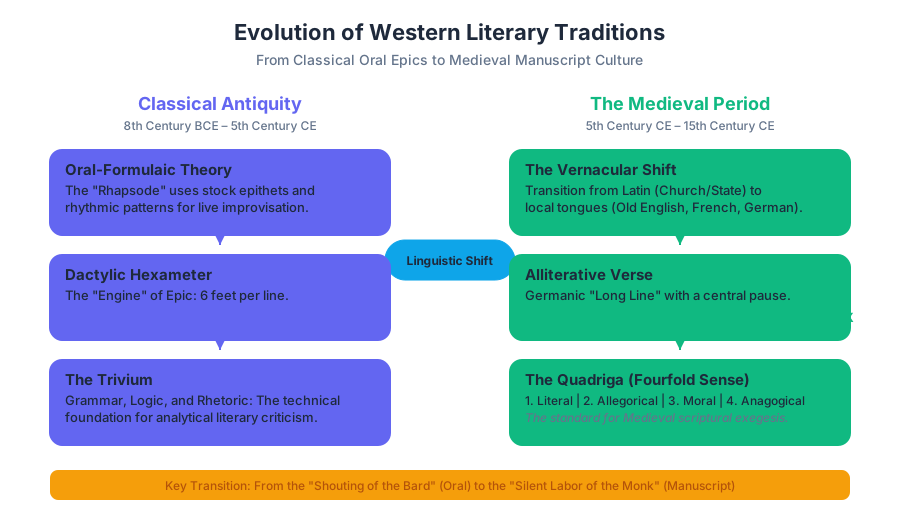
British and Irish Literary Evolution
Key concepts: Anglo-Saxon Literature · The Renaissance · Neoclassicism · Irish Gothic
Traces the development of literature in the British Isles from the Anglo-Saxon period to Modernism.
British and Irish Literary Evolution
The literary history of the British Isles is not a linear progression but a series of recursive loops, linguistic collisions, and cultural syntheses. From the guttural, alliterative roots of the Germanic tribes to the sophisticated psychological fracturing of the 20th-century modernists, the evolution of British and Irish literature tracks the development of the English language itself. This evolution is characterized by a tension between the "native" (the insular, the oral, the folkloric) and the "imported" (the classical, the continental, the colonial).
Anglo-Saxon Literature (c. 450–1066)
Anglo-Saxon or Old English Literature represents the foundational layer of the English literary tradition. It emerged from the oral traditions of Germanic tribes (Angles, Saxons, and Jutes) who settled in Britain. The literature of this period is defined by a distinct aesthetic of heroism, fate (wyrd), and a melancholy awareness of the transitory nature of life.
Mechanics of Alliterative Verse
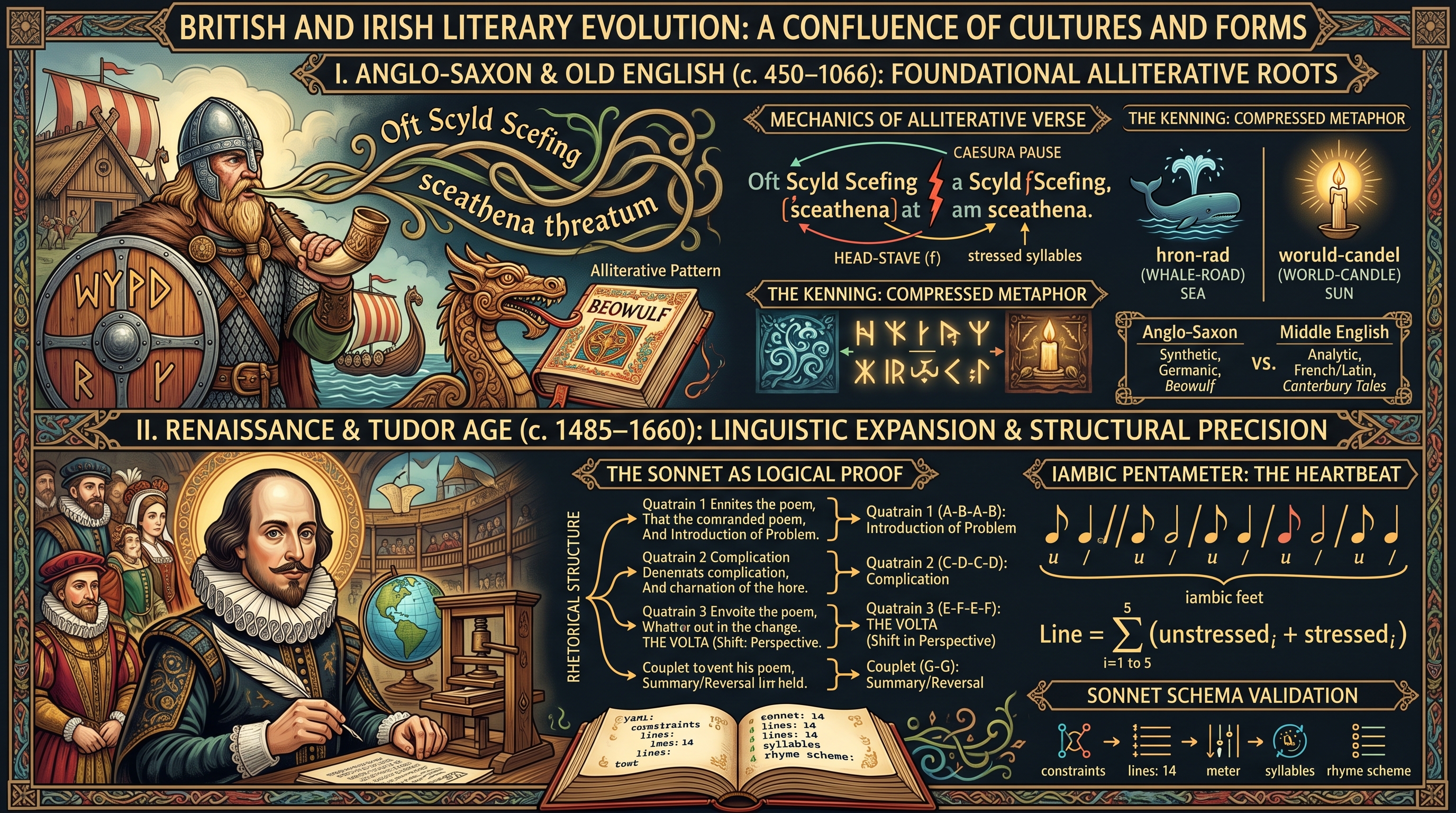
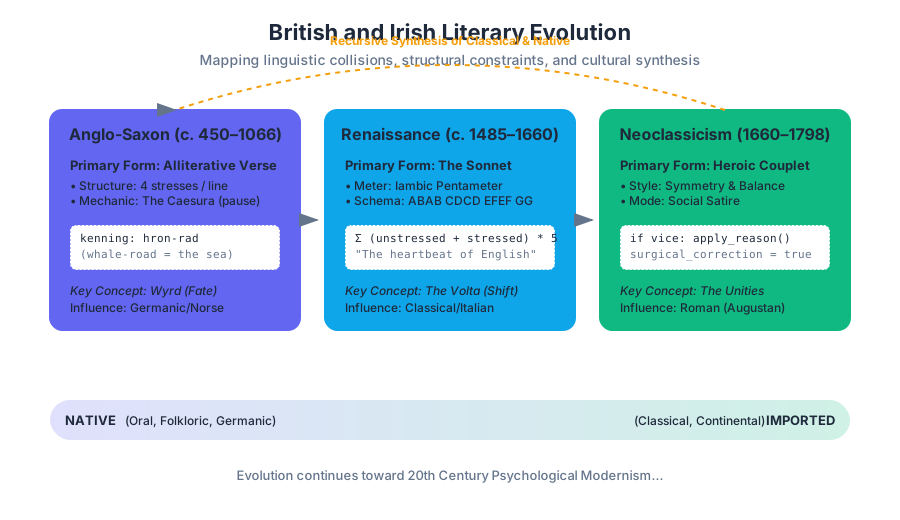
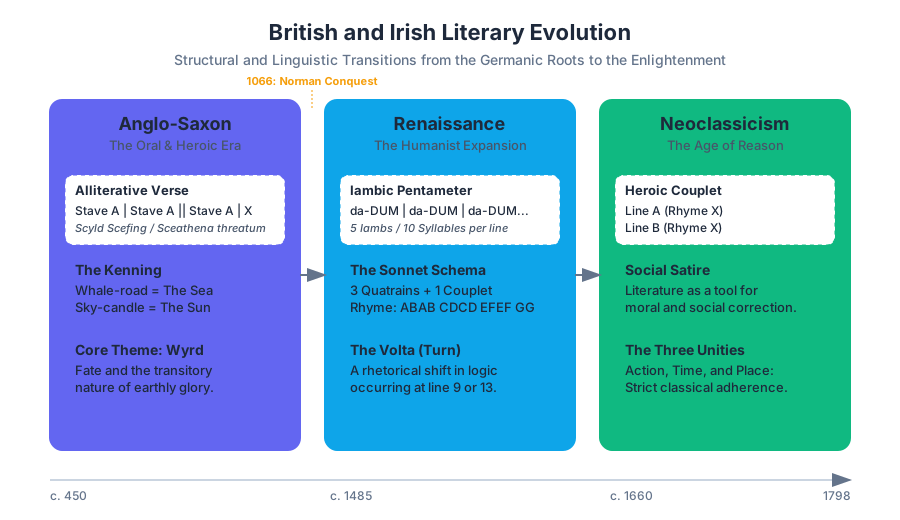
Unlike modern poetry, which often relies on rhyme and meter (syllabic count), Old English poetry is structured around alliteration and the caesura. Each line is divided into two half-lines (verses), separated by a pause (caesura). Each half-line contains two stressed syllables.
Definition: The Kenning A kenning is a compressed metaphor or a compound figurative expression used in place of a simple noun. For example, the sea is called the hron-rad (whale-road), and the sun is the woruld-candel (world-candle).
Technical Implementation: Alliterative Pattern Analysis
In a standard line of Old English verse, the first stressed syllable of the second half-line must alliterate with one or both of the stressed syllables in the first half-line.
def analyze_alliteration(half_line_a, half_line_b):
    """
    A simplified heuristic to check for Anglo-Saxon alliterative patterns.
    Expects tuples of (stressed_syllable_start_char, word).
    """
    # In Old English, the first stress of the second half-line (the 'head-stave')
    # is the anchor for the entire line's alliteration.
    head_stave = half_line_b[0][0].lower()

    # Check if at least one stress in the first half-line matches the head-stave
    matches = [word for char, word in half_line_a if char.lower() == head_stave]

    is_valid = len(matches) >= 1
    return {
        "valid_alliteration": is_valid,
        "matching_staves": matches,
        "head_stave": head_stave
    }

# Example: "Oft Scyld Scefing / sceathena threatum"
line_a = [('S', 'Scyld'), ('S', 'Scefing')]
line_b = [('s', 'sceathena'), ('th', 'threatum')]

print(analyze_alliteration(line_a, line_b))
Comparison of Old English and Middle English
| Feature | Anglo-Saxon (Old English) | Middle English (Post-1066) |
|---|---|---|
| Primary Influence | Germanic/Norse | French/Latin/Norman |
| Poetic Structure | Alliterative Verse | Rhymed Couplets/Stanzas |
| Key Theme | Comitatus (Loyalty to Lord) | Chivalry and Courtly Love |
| Language Status | Synthetic (Inflected) | Analytic (Loss of inflections) |
| Example Work | Beowulf | The Canterbury Tales |
The Renaissance and the Tudor Age (c. 1485–1660)
The English Renaissance was a "rebirth" of classical learning, but in Britain, it manifested as a period of intense linguistic expansion and the professionalization of literature. This era saw the transition from the medieval "Great Chain of Being" to a more human-centric, though still deeply religious, worldview.
The Sonnet as a Logical Proof
The Renaissance introduced the sonnet, a 14-line poem that functions as a mathematical and rhetorical exercise. The Shakespearean (English) sonnet consists of three quatrains and a final couplet, following the rhyme scheme ABAB CDCD EFEF GG.
The structure follows a specific logical derivation:
- Quatrain 1: Introduction of the problem or image.
- Quatrain 2: Expansion or complication of the problem.
- Quatrain 3: A shift in perspective (the volta).
- Couplet: A summary or ironic reversal.
Mathematical Representation of Iambic Pentameter
The "heartbeat" of English Renaissance literature is iambic pentameter.
\text{Line} = \sum_{i=1}^{5} (\text{unstressed}_i + \text{stressed}_i)
Where each $(\text{u} + \text{s})$ unit is an iamb. A perfect line contains exactly 10 syllables.
Code Representation: Sonnet Schema Validation
This YAML configuration represents the "constraints" of a Shakespearean Sonnet, used in modern computational linguistics to validate poetic forms.
sonnet_type: Shakespearean
constraints:
  lines: 14
  meter: iambic_pentameter
  syllables_per_line: 10
  rhyme_scheme:
    quatrain_1: [A, B, A, B]
    quatrain_2: [C, D, C, D]
    quatrain_3: [E, F, E, F]
    couplet: [G, G]
  logical_structure:
    0-8: proposition
    9-12: volta_resolution
    13-14: epigrammatic_conclusion
Neoclassicism and the Enlightenment (1660–1798)
Following the chaos of the English Civil War, the Neoclassical period (often called the Augustan Age) sought order, restraint, and "correctness." Writers like Alexander Pope and Jonathan Swift looked back to the Roman greats (Augustus, Horace, Virgil) for models of stability.
The Rise of the Novel and Satire
This era marks the birth of the modern novel (Robinson Crusoe) and the perfection of Satire. Satire in the Enlightenment was not merely "making fun"; it was a surgical tool used to correct social vice through the application of reason.
The Heroic Couplet
The dominant poetic form was the heroic couplet: two rhymed lines of iambic pentameter that form a complete thought. This mirrored the Enlightenment's obsession with symmetry and balance.
Key Concept: The Unities Neoclassical drama often adhered to the "Three Unities" derived from Aristotle:
- Unity of Action: A play should have one main plot.
- Unity of Place: A play should cover a single physical space.
- Unity of Time: The action should span no more than 24 hours.
Data Model: The Enlightenment Library
To understand the Neoclassical mind, we can look at how they categorized knowledge. The following SQL schema represents a conceptual "Enlightenment Catalog" where reason and hierarchy are paramount.
CREATE TABLE Authors (
    author_id INT PRIMARY KEY,
    name VARCHAR(100),
    classical_model VARCHAR(50), -- e.g., 'Horace', 'Juvenal'
    genre_specialty ENUM('Satire', 'Epic', 'Essay', 'Epistolary')
);

CREATE TABLE Works (
    work_id INT PRIMARY KEY,
    author_id INT,
    title VARCHAR(255),
    publication_year INT,
    is_didactic BOOLEAN DEFAULT TRUE,
    FOREIGN KEY (author_id) REFERENCES Authors(author_id)
);

-- Query to find works that prioritize 'Reason' over 'Emotion'
SELECT title, name
FROM Works
JOIN Authors ON Works.author_id = Authors.author_id
WHERE publication_year BETWEEN 1660 AND 1780
ORDER BY publication_year ASC;
Irish Gothic (18th – 19th Century)
While English Gothic (e.g., Ann Radcliffe) often dealt with foreign threats in Catholic Europe, Irish Gothic is a distinct subgenre that reflects the anxieties of the Anglo-Irish Protestant Ascendancy—a ruling class isolated in a land that felt increasingly hostile and haunted by its own history.
The "Big House" and Colonial Anxiety
The central trope of Irish Gothic is the decaying "Big House." This represents the crumbling power of the Anglo-Irish landlords. The ghosts in Irish Gothic are rarely just spirits; they are manifestations of colonial guilt and the "return of the repressed" (the indigenous Gaelic culture).
Key Figures and Tropes
| Author | Key Work | Primary Contribution |
|---|---|---|
| Sheridan Le Fanu | Carmilla | The female vampire; psychological suspense. |
| Bram Stoker | Dracula | The "outsider" invading the metropole; blood as lineage. |
| Charles Maturin | Melmoth the Wanderer | The "Wandering Jew" motif; extreme narrative nesting. |
| Oscar Wilde | The Picture of Dorian Gray | The double (Doppelgänger); aesthetic corruption. |
Architectural and Atmospheric Logic
Irish Gothic operates on a "pipeline" of dread. We can visualize the generation of a Gothic atmosphere as a series of environmental and psychological transforms.
#!/bin/bash
# A CLI tool to generate an Irish Gothic setting

GENRE="Irish Gothic"
ELEMENTS=("Decaying Manor" "Mist-shrouded Bog" "Hidden Lineage" "Ancient Curse")
ATMOSPHERE="Colonial Anxiety"

function generate_setting() {
    echo "Initializing $GENRE environment..."
    sleep 1
    for item in "${ELEMENTS[@]}"; do
        echo "Adding element: $item"
    done
    echo "Injecting $ATMOSPHERE..."
    echo "Result: A landscape where the past refuses to stay buried."
}

generate_setting
The Victorian and Modernist Transition
The 19th and 20th centuries saw a radical shift from the Victorian emphasis on moral duty and social realism to the Modernist obsession with subjectivity, time, and the "stream of consciousness."
The Victorian Moral Imperative
Victorian literature (Dickens, George Eliot) functioned as a social conscience. The novel became a tool for exploring the "Condition of England" question—addressing poverty, industrialization, and the loss of faith following Darwin's Origin of Species.
The Modernist Rupture
Modernism (Woolf, Joyce, Yeats) was a response to the trauma of World War I. If the world was fragmented, literature must be fragmented too.
Key Insight: Stream of Consciousness A narrative technique that attempts to render the fluid, non-linear nature of human thought. It ignores traditional syntax to capture the "pre-speech" level of consciousness.
Comparison: Realism vs. Modernism
| Dimension | Victorian Realism | Modernism |
|---|---|---|
| Narrator | Omniscient, reliable | Limited, unreliable |
| Time | Chronological, linear | Circular, fragmented, "Kairos" |
| Language | Transparent, communicative | Opaque, self-referential |
| Subject | Society, the "Middle Class" | The individual psyche |
Common Pitfalls in Literary Analysis
- Anachronistic Reading: Applying 21st-century secular values to Anglo-Saxon texts. For the Anglo-Saxons, fate (wyrd) was an immutable physical force, not a metaphor.
- Over-simplifying the Renaissance: Assuming the Renaissance was a clean break from the Middle Ages. In reality, medieval superstition and Renaissance science coexisted for centuries.
- Confusing English and Irish Gothic: English Gothic is often about the fear of the foreign; Irish Gothic is about the fear of the home.
- Misunderstanding Satire: Thinking satire is just "sarcasm." True Neoclassical satire requires a moral standard against which the subject is being measured.
Reading and Interpreting Literary Texts
Key concepts: Literary Analysis · Reader-Response Criticism · Textual Analysis · Literary Terms
Introduces methodologies for textual analysis and critical theories like Reader-Response Criticism.
Reading and Interpreting Literary Texts
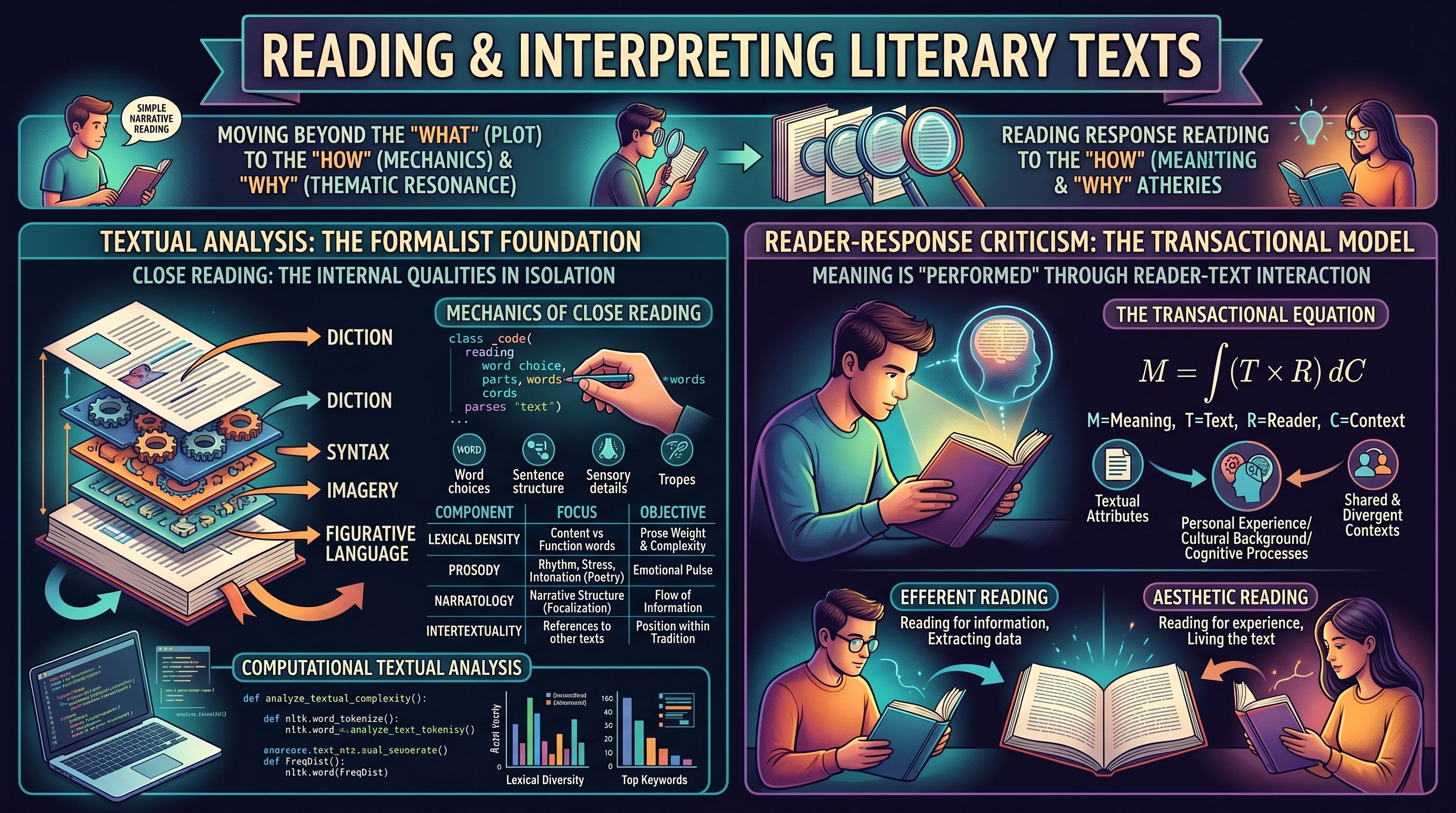
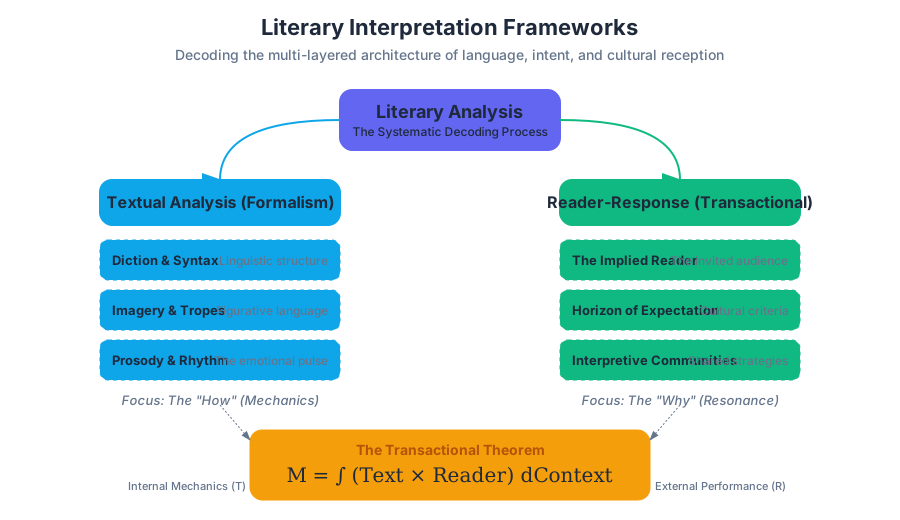
Literary interpretation is the systematic process of decoding complex semiotic systems to derive meaning, aesthetic value, and socio-historical significance. Unlike casual reading, which prioritizes narrative consumption, Literary Analysis treats the text as a multi-layered architecture of language, intent, and cultural reception. To interpret a text is to move beyond the "what" (plot) to the "how" (mechanics) and the "why" (thematic resonance).
This module explores the rigorous frameworks used by scholars to interrogate texts, ranging from the granular precision of Textual Analysis to the interactive dynamics of Reader-Response Criticism.
Textual Analysis: The Formalist Foundation
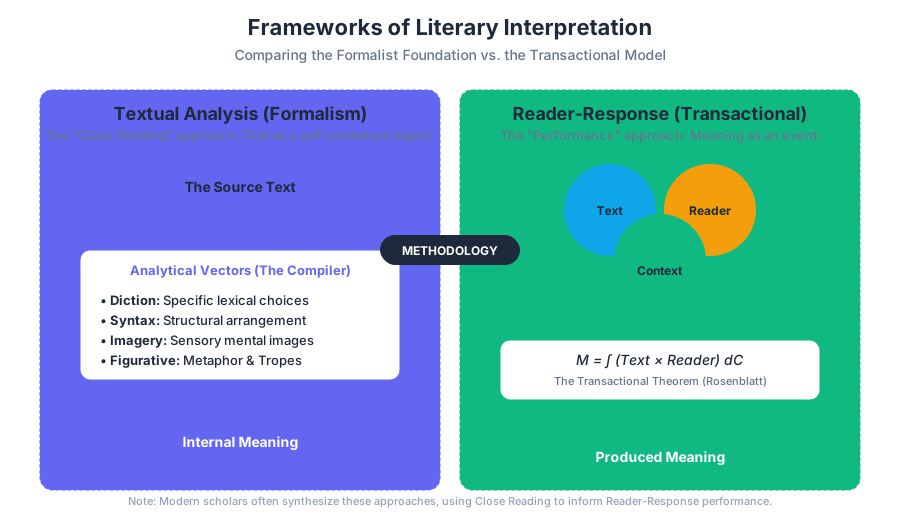
Textual Analysis, often referred to in pedagogical contexts as "Close Reading," is the practice of examining the internal qualities of a text in isolation from external factors like the author's biography or the era's politics. This methodology assumes that the text is a self-contained object where meaning is embedded in its linguistic and structural choices.
The Mechanics of Close Reading
The formalist approach functions like a compiler, parsing the source code of a poem or prose piece to understand how individual units of language generate complex outputs of tone and theme. Analysts focus on four primary vectors:
- Diction: The specific word choices (denotation vs. connotation).
- Syntax: The arrangement of words and phrases to create well-formed sentences.
- Imagery: Sensory details that create "mental images."
- Figurative Language: Tropes such as metaphor, metonymy, and synecdoche.
| Component | Analytical Focus | Objective |
|---|---|---|
| Lexical Density | Ratio of content words to functional words. | Determine the "weight" and complexity of the prose. |
| Prosody | Rhythm, stress, and intonation in poetry. | Identify the emotional "pulse" of the verse. |
| Narratology | The structure of the narrative (e.g., focalization). | Map the flow of information to the reader. |
| Intertextuality | References to other texts/works. | Identify the text's position within a broader tradition. |
Implementation: Computational Textual Analysis
In modern literary studies, textual analysis often incorporates computational methods to identify patterns that are invisible to the naked eye. Below is a Python implementation using the nltk (Natural Language Toolkit) to analyze lexical diversity and frequency—a digital "close reading" of a text's vocabulary.
import nltk
from nltk.tokenize import word_tokenize
from nltk.probability import FreqDist

def analyze_textual_complexity(raw_text):
    """
    Performs a basic formalist analysis on a text string.
    Calculates Lexical Diversity and identifies high-frequency thematic markers.
    """
    # Tokenization and normalization
    tokens = [word.lower() for word in word_tokenize(raw_text) if word.isalpha()]

    # Lexical Diversity: The ratio of unique words to total words
    unique_words = set(tokens)
    diversity_score = len(unique_words) / len(tokens)

    # Frequency Distribution of content words (excluding common stop words)
    stop_words = set(nltk.corpus.stopwords.words('english'))
    content_tokens = [t for t in tokens if t not in stop_words]
    fdist = FreqDist(content_tokens)

    return {
        "lexical_diversity": diversity_score,
        "top_keywords": fdist.most_common(10),
        "total_word_count": len(tokens)
    }

# Example usage with a snippet of American Romanticism
sample_text = "The woods are lovely, dark and deep, But I have promises to keep..."
analysis = analyze_textual_complexity(sample_text)
print(f"Diversity Score: {analysis['lexical_diversity']:.4f}")
Reader-Response Criticism: The Transactional Model
Reader-Response Criticism posits that a literary work does not have a fixed, objective meaning. Instead, meaning is "performed" or "produced" through the interaction between the reader and the text. This theory, championed by scholars like Louise Rosenblatt and Wolfgang Iser, argues that the reader's personal experiences, cultural background, and cognitive processes are essential components of the literary experience.
The Transactional Equation
Rosenblatt distinguished between Efferent Reading (reading for information) and Aesthetic Reading (reading to experience the text). In the aesthetic mode, the "poem" is not the words on the page, but the event that occurs when the reader's consciousness meets the author's language.
The Transactional Theorem: Let $T$ be the Text, $R$ be the Reader, and $C$ be the Context. The resulting Meaning $M$ is not a property of $T$, but a function of the interaction: $$M = \int (T \times R) , dC$$ where the meaning is the integral of the text-reader interaction over the domain of their shared and divergent contexts.
Horizons of Expectation
Hans Robert Jauss introduced the concept of the Horizon of Expectations. This refers to the criteria readers use to judge a text at any given historical moment. As cultural values shift, the "horizon" moves, and the same text is interpreted differently by subsequent generations.
| Theory Layer | Key Concept | Definition |
|---|---|---|
| The Implied Reader | Iser’s Construct | The hypothetical reader the text "invites" or expects. |
| Interpretive Communities | Stanley Fish’s Theory | Groups of readers who share similar strategies for assigning meaning. |
| Affective Fallacy | Wimsatt & Beardsley | The (Formalist) warning against judging a work based on its emotional effect. |
| Subjective Criticism | David Bleich | The idea that all interpretation is an expression of the reader's personality. |
Literary Terms and Taxonomy
To analyze literature effectively, one must master the technical vocabulary used to describe textual phenomena. These terms are not merely labels; they are analytical tools that allow for the categorization of complex linguistic maneuvers.
Tropes vs. Schemes
In classical rhetoric, literary devices are divided into Tropes (which change the meaning of words) and Schemes (which change the arrangement of words).
- Metaphor (Trope): An implied comparison between two unlike things.
- Anaphora (Scheme): The repetition of a word or phrase at the beginning of successive clauses.
- Synecdoche (Trope): A part is used to represent the whole (e.g., "all hands on deck").
- Chiasmus (Scheme): A reversal in the order of words in two otherwise parallel phrases (e.g., "Ask not what your country can do for you; ask what you can do for your country").
Structural Derivation of a Sonnet
The Shakespearean Sonnet is a rigid structural form. Its meaning is often derived from the tension between its three quatrains and its final couplet.
% Mathematical representation of Sonnet Structure
\text{Sonnet} = \sum_{i=1}^{3} Q_i(abab, cdcd, efef) + C(gg)
\text{where } Q = \text{Quatrain (4 lines)}, C = \text{Couplet (2 lines)}
\text{Volta (Turn)} \approx \text{Line 9 or Line 13}
Genre-Specific Interpretation Strategies
Different literary forms require different analytical "toolsets." A strategy used for a 19th-century novel will fail when applied to an Anglo-Saxon epic or a Modernist poem.
1. Poetry: The Architecture of Sound
In poetry, the line is the primary unit of meaning. Interpretation focuses on the tension between the sentence (the grammatical unit) and the line (the rhythmic unit).
- Enjambment: When a sentence carries over a line break without punctuation.
- Caesura: A strong pause within a line.
- Scansion: The process of marking the stresses in a poem to determine its meter.
2. Prose (Short Stories and Novels): Narratology
In prose, we analyze the Narrator and the Chronotope (the configuration of time and space).
- Focalization: Who sees? (Distinguished from who speaks).
- Free Indirect Discourse: A style of third-person narrative that adopts the tone and thoughts of a character.
- Unreliable Narrator: A narrator whose credibility is compromised, forcing the reader to "decode" the truth behind the narration.
3. Drama: The Performative Text
Drama is unique because the text is a blueprint for performance. Interpretation must account for Stage Directions, Soliloquies, and the Dramatic Irony created when the audience knows more than the characters.
| Genre | Primary Analytical Unit | Key Interpretive Question |
|---|---|---|
| Poetry | The Foot / The Line | How does the sound reinforce the sense? |
| Prose | The Paragraph / The Chapter | How is the narrative perspective manipulated? |
| Drama | The Scene / The Beat | How does the physical action subvert the dialogue? |
Socio-Historical Context and Literary Movements
Literature does not exist in a vacuum. It is a product of its Socio-historical Context. Understanding the movements of American, British, and World literature provides the "metadata" necessary to interpret specific works.
The American Literary Timeline
American literature is often categorized by its response to the national identity and the changing landscape.
- Puritanism (1600s-1750s): Focus on divine providence, plain style, and moral instruction (e.g., Bradstreet, Edwards).
- Romanticism & Transcendentalism (1820s-1860s): Emphasis on the individual, nature, and emotion over reason (e.g., Emerson, Thoreau, Hawthorne).
- Realism & Naturalism (1860s-1914): A reaction against Romanticism; a focus on "life as it is" and the deterministic forces of environment and heredity (e.g., Twain, Crane).
- Modernism (1914-1945): Fragmentation, stream of consciousness, and a break with traditional forms following WWI (e.g., Hemingway, Faulkner, Eliot).
The Concept of the Chronotope
Mikhail Bakhtin’s Chronotope (literally "time-space") describes how configurations of time and space are fused in literature. For example, the "Road" in a picaresque novel is a chronotope where time flows through spatial movement, facilitating chance encounters and social diversity.
Critical Thinking and Information Literacy
Interpreting literature is a high-level exercise in Critical Thinking. It requires the ability to evaluate evidence (the text), recognize bias (the narrator or author), and synthesize complex information into a coherent argument.
The Analytical Pipeline
When writing a literary analysis, scholars follow a pipeline similar to a research protocol:
- Observation: Identifying a pattern or anomaly in the text.
- Hypothesis: Proposing a reason for that pattern (e.g., "The recurring bird imagery symbolizes the protagonist's desire for autonomy").
- Evidence Gathering: Selecting specific quotes and structural examples to support the hypothesis.
- Synthesis: Connecting the local observation to a global theme or historical context.
Real-World Usage: Pattern Matching with Regex
Scholars often use regular expressions (Regex) to find specific structural patterns in large corpora of digital texts. For example, finding all instances of a specific rhyme scheme or identifying anaphora in a long poem.
# Using grep to find potential anaphora (repeated words at start of lines)
# This command looks for lines starting with the same word in a text file.
cat paradise_lost.txt | grep -oE '^[[:space:]]*[[:alpha:]]+' | uniq -c | sort -nr | head -n 10
Common Pitfalls in Interpretation
- The Intentional Fallacy: Assuming that the author's stated intention is the only "correct" meaning of the text.
- The Biographical Fallacy: Reducing a work entirely to the events of the author's life.
- Anachronism: Applying modern values or concepts to a historical text without acknowledging the shift in context.
- Over-Reading: Assigning deep symbolic meaning to every incidental detail (sometimes a "blue curtain" is just a blue curtain).
Pre-contact and Colonial Encounters
Key concepts: Native American Texts · Contact Literature · The Requerimiento · Ethnographic Texts
Examines Native American ethnographic texts and the literature of early European exploration.
Pre-contact and Colonial Encounters
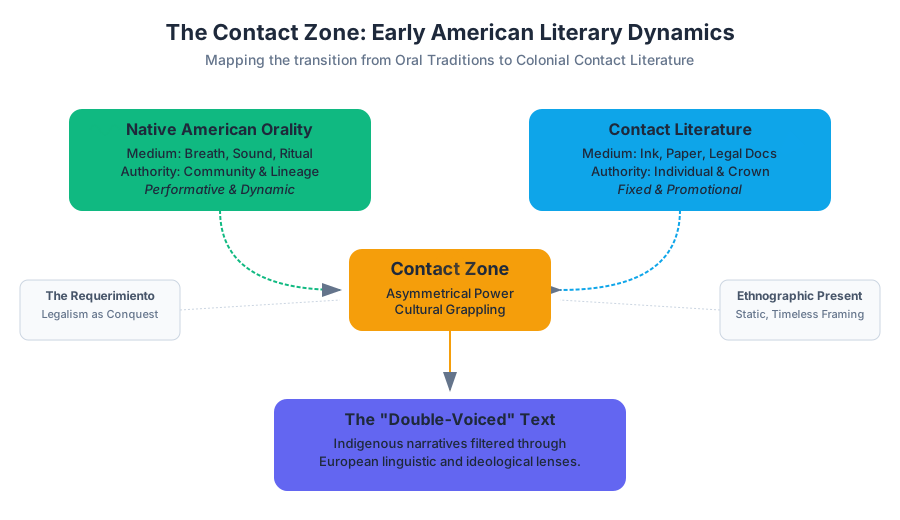
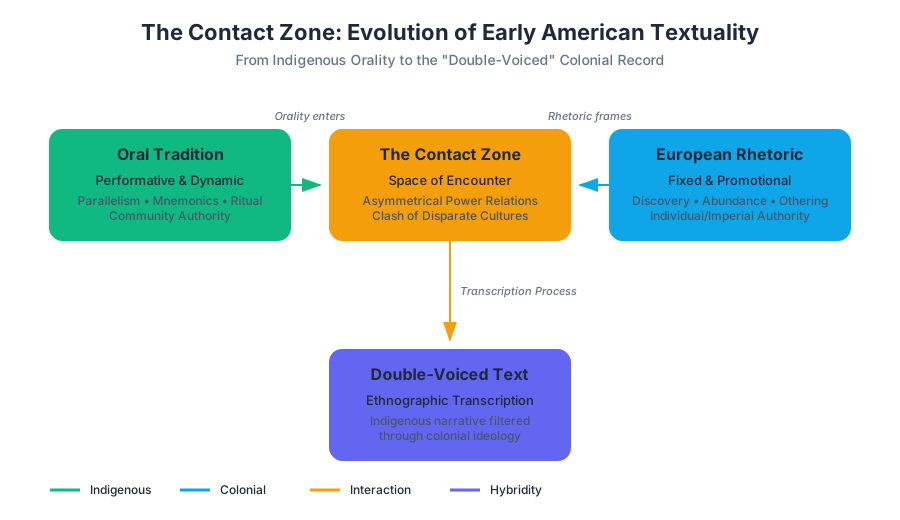
The study of early American literature is not merely an examination of the first English-language novels or Puritan sermons; it is an investigation into the Contact Zone—a social space where disparate cultures meet, clash, and grapple with each other, often in highly asymmetrical relations of domination and subordination. This period is characterized by the transition from purely Oral Traditions to the emergence of Contact Literature, a genre that encompasses the journals, letters, and legal documents of European explorers alongside the transcribed ethnographic records of indigenous peoples.
Native American Orality and Pre-contact Texts
Before the introduction of European alphabetic scripts, Native American "texts" existed as a sophisticated web of oral traditions, mnemonic devices, and visual symbols. These were not "pre-literary" in a pejorative sense but were instead Performative Texts. The meaning of a story was inextricably linked to its performance—the cadence of the speaker, the presence of the audience, and the specific ritual context.
The Mechanics of Orality
Oral traditions utilize specific structural devices to ensure the preservation of complex cultural data across generations. These include:
- Parallelism: The repetition of grammatical structures to create rhythm and aid memory.
- Formulaic Expressions: Standardized phrases that signal transitions or character traits.
- The Trickster Archetype: Figures like Coyote or Iktomi who embody chaos and boundary-crossing, serving as pedagogical tools for social norms.
Definition: The Ethnographic Present A rhetorical device used in early ethnographic texts that describes a culture as if it exists in a static, timeless state, effectively stripping indigenous peoples of their historical agency and evolution.
| Feature | Oral Tradition | Written Tradition |
|---|---|---|
| Medium | Breath, sound, gesture, mnemonic objects (Wampum) | Ink, paper, digital bits |
| Stability | Dynamic; adapts to the needs of the current audience | Fixed; preserves the exact wording of the author |
| Authority | Vested in the community and the lineage of the teller | Vested in the physical document and the individual author |
| Context | Highly situational and ritualistic | Decontextualized; can be read anywhere, anytime |
Transcription and the "Double-Voiced" Text
When Native American oral stories were finally committed to paper by European or European-educated scribes, they became Ethnographic Texts. These are inherently "double-voiced," containing the indigenous narrative filtered through the linguistic and ideological lens of the transcriber.
# A conceptual NLP model to detect "Double-Voicing" in ethnographic transcriptions
# Comparing indigenous semantic markers vs. European rhetorical structures

import nltk
from nltk.tokenize import word_tokenize

def analyze_text_hybridity(text):
    """
    Analyzes a text for markers of indigenous oral structure
    (parallelism) vs. European legalistic/theological markers.
    """
    indigenous_markers = ['cycle', 'earth', 'grandfather', 'trickster', 'repetition']
    colonial_markers = ['sovereign', 'heathen', 'property', 'salvation', 'behalf']

    tokens = [w.lower() for w in word_tokenize(text)]

    indigenous_score = sum(1 for w in tokens if w in indigenous_markers)
    colonial_score = sum(1 for w in tokens if w in colonial_markers)

    # Calculate the 'Hybridity Index'
    hybridity_index = (indigenous_score + colonial_score) / len(tokens)

    return {
        "indigenous_density": indigenous_score / len(tokens),
        "colonial_density": colonial_score / len(tokens),
        "hybridity_index": hybridity_index
    }

# Example usage with a hypothetical fragment of a transcribed Navajo creation myth
sample_fragment = "In the beginning, the First Man and First Woman moved through the worlds. They sought the sovereign grace of the Creator to claim this property."
print(analyze_text_hybridity(sample_fragment))
Contact Literature: The Rhetoric of Discovery
Contact Literature refers to the corpus of writing produced by Europeans (and eventually indigenous people) that documents the initial encounters between the Old and New Worlds. These texts are rarely objective; they are often promotional, defensive, or designed to secure funding from royal patrons.
Christopher Columbus: The Admiral's Epistles
Columbus’s letters to the Spanish court (e.g., the Letter to Santángel) established the foundational tropes of American literature:
- The Terrestrial Paradise: Describing the land as an Edenic space of infinite bounty.
- The Rhetoric of Abundance: Cataloging flora and fauna to prove economic viability.
- The "Othering" of Inhabitants: Categorizing indigenous people as either "noble savages" (gentle, ripe for conversion) or "monsters" (cannibals, justifying conquest).
Alvar Núñez Cabeza de Vaca: The Relación
In contrast to Columbus’s triumphalism, Cabeza de Vaca’s La Relación (1542) represents a shift toward Transculturation. After being shipwrecked and spending eight years wandering the American Southwest, his narrative shifts from that of a conqueror to that of a captive and, eventually, a healer.
| Author | Perspective | Primary Rhetorical Goal | View of Indigenous People |
|---|---|---|---|
| Columbus | Imperial / Mercantilist | Secure funding and titles | Commodities or obstacles |
| Cabeza de Vaca | Survivalist / Ethnographic | Self-justification and mercy | Complex social actors; fellow humans |
| De Las Casas | Polemical / Humanitarian | Abolition of the Encomienda system | Innocent victims of Spanish cruelty |
The Requerimiento: Legalism as Conquest
The Requerimiento (The Requirement) of 1513 is perhaps the most surreal and chilling document in the history of colonial encounters. It was a formal manifesto that Spanish conquistadors were legally required to read to indigenous populations before initiating military action.
The Logic of the Document
The Requerimiento functioned as a legal "if-then" statement. It asserted the Pope’s authority over the world and the Spanish Crown’s right to the Americas. If the indigenous people accepted this authority, they would be spared; if they refused, they were held responsible for the "deaths and losses" that would follow.
The Theorem of Colonial Justification Let $P$ be the acceptance of the Catholic Church and the Spanish Crown. Let $Q$ be the state of peace and protection. Let $R$ be the state of "Just War" (Guerra Justa). The Requerimiento asserts: $P \implies Q$ and $\neg P \implies R$. Crucially, the document was read in Spanish, a language the audience did not understand, ensuring $\neg P$ was the inevitable outcome.
% Formal logic representation of the Requerimiento's legal structure
\begin{math}
\forall x \in \text{IndigenousPopulations}: \\
\text{Recognize}(x, \text{Pope}) \land \text{Submit}(x, \text{SpanishCrown}) \to \text{Peace}(x) \\
\neg (\text{Recognize}(x, \text{Pope}) \land \text{Submit}(x, \text{SpanishCrown})) \to \text{JustWar}(x) \land \text{Enslavement}(x)
\end{math}
The Absurdity of Performance
The document was often read to empty beaches, to the backs of fleeing villagers, or from the decks of ships. This highlights the Ritualistic Function of colonial text: the document was not intended to communicate information to the indigenous people, but to satisfy the legal and theological requirements of the Spanish court. It was a performance of "legality" to mask the reality of plunder.
Ethnographic Texts and the Problem of Mediation
As the colonial period progressed, the need to understand indigenous cultures (for the purposes of conversion or governance) led to the creation of massive ethnographic projects. The most notable is the Florentine Codex, compiled by Bernardino de Sahagún.
The Structure of the Florentine Codex
Sahagún utilized a "triangulated" methodology that was remarkably advanced for the 16th century:
- Nahuatl Text: Narratives provided by Aztec elders in their native language.
- Spanish Translation: Sahagún’s summary/interpretation of the Nahuatl.
- Pictorial Illustrations: Visual representations by indigenous artists (tlacuilos).
Despite its depth, the Codex remains a Mediated Text. Sahagún’s questions were framed by European theological concerns (e.g., looking for "idolatry"), which inevitably shaped the answers he received.
Common Pitfalls in Interpreting Ethnographic Texts
- The Fallacy of the Monolith: Assuming a single "Native American" perspective when, in reality, there were thousands of distinct linguistic and cultural groups.
- Ignoring Agency: Viewing indigenous people as passive subjects of study rather than active participants who often manipulated the ethnographic process to protect their secrets or settle tribal scores.
- The "Vanishing Indian" Trope: Many 19th-century ethnographic texts were written under the assumption that indigenous cultures were doomed to extinction, leading to a "salvage" mentality that biased the data.
<!-- Example of TEI (Text Encoding Initiative) markup for an ethnographic archive -->
<!-- This shows how modern scholars structure colonial texts for digital analysis -->

<TEI xmlns="http://www.tei-c.org/ns/1.0">
  <teiHeader>
    <fileDesc>
      <titleStmt>
        <title>The Pueblo Revolt: A Digital Transcription</title>
        <respStmt>
          <resp>Transcribed by</resp>
          <name>DeepWiki Digital Humanities Lab</name>
        </respStmt>
      </titleStmt>
    </fileDesc>
  </teiHeader>
  <text>
    <body>
      <div type="entry" n="1" xml:lang="es">
        <p>En el año de 1680, los indios de las provincias del Nuevo México se rebelaron...</p>
        <note type="critical">The term 'rebelaron' reflects the Spanish legal view of the Pueblo people as subjects of the crown.</note>
      </div>
    </body>
  </text>
</TEI>
Resistance and Synthesis: The Pueblo Revolt of 1680
The Pueblo Revolt serves as a vital counter-narrative to the "inevitability" of colonial conquest. It is one of the few instances where indigenous resistance successfully expelled a colonial power for a significant duration (12 years).
Textual Traces of the Revolt
Because the Pueblo people destroyed many Spanish records and symbols of Christianity during the revolt, the "text" of the revolt is often found in:
- Spanish Inquisitorial Records: Depositions of captured Pueblo leaders which, despite the torture used to obtain them, reveal the strategic coordination of the revolt (e.g., the use of knotted cords to synchronize the timing).
- Oral Histories: Passed down through Pueblo generations, providing a starkly different account of the motivations and leadership of figures like Popé.
| Aspect | Spanish Perspective (Archival) | Pueblo Perspective (Oral/Archaeological) |
|---|---|---|
| Cause | Diabolical influence / Sorcery | Religious persecution / Forced labor |
| Leadership | A single "instigator" (Popé) | Collective action across multiple Pueblos |
| Outcome | A temporary setback for the Faith | A restoration of cosmic and social balance |
The Legacy of Hybridity
Post-contact literature eventually evolved into a Syncretic form. Indigenous writers began to use European genres (the chronicle, the letter, the autobiography) to argue for their rights. This gave rise to figures like Guaman Poma de Ayala in the Andes or later, Samson Occom and William Apess in North America, who used the "master's tools" (Christianity and English law) to critique the colonial project.
# A simple CLI pipeline to search for keywords in a directory of colonial journals
# Useful for identifying the 'Rhetoric of Abundance' across different authors

grep -riE "gold|pearls|spices|infinite|abundance" ./colonial_archives/ | \
awk -F: '{print $1}' | \
sort | \
uniq -c | \
sort -nr

# This command:
# 1. Searches for mercantilist keywords (case-insensitive)
# 2. Extracts the filenames
# 3. Counts occurrences per file
# 4. Ranks authors by their focus on resource extraction
Early American and Puritan Literature (1650–1750)
Key concepts: Puritanism · Colonial Religious Discourse · Sermons · Anne Bradstreet
Analyzes the influence of Puritanism on colonial American identity and writing.
Early American and Puritan Literature (1650–1750)
The period between 1650 and 1750 in North America represents a unique literary epoch where theocratic rigor met the harsh realities of frontier survival. This era is defined by Puritanism, a reform movement within English Protestantism that sought to "purify" the Church of England from its remaining Catholic practices. In the American colonies, specifically the Massachusetts Bay Colony, this theological framework evolved into a comprehensive socio-political and literary system.
The Puritan Axiomatics: Theology as Literary Theory
To understand early American literature, one must first understand the "operating system" of the Puritan mind: Calvinism. The Puritans viewed the world as a decoded text where every event—from a crop failure to a successful voyage—was a sign from God. This perspective, known as Providential History, dictated that literature was not for entertainment, but for the instruction of the soul and the recording of God’s will.
The core of Puritan belief is often summarized by the TULIP acronym, which served as the foundational logic for almost every poem, sermon, and diary entry written during this century.
| Doctrine | Term | Definition | Literary Implication |
|---|---|---|---|
| T | Total Depravity | Every human is born in sin and incapable of self-redemption. | Narratives focus on the struggle against innate "wickedness." |
| U | Unconditional Election | God chooses the "Elect" (those saved) regardless of merit. | Literature serves as a search for "signs" of one's election. |
| L | Limited Atonement | Jesus died only for the Elect, not for all of humanity. | Creates an exclusionary, "City upon a Hill" community identity. |
| I | Irresistible Grace | When God chooses to save someone, they cannot resist. | Conversion narratives emphasize the overwhelming power of the divine. |
| P | Perseverance of the Saints | The Elect cannot lose their salvation. | Encourages the "Plain Style" to avoid the sin of pride. |
Definition: The Plain Style A mode of expression characterized by clarity, accessibility, and a lack of ornamental rhetoric (such as metaphors or classical allusions). Puritans believed that "the word of God should be delivered in its own power," and that ornate language distracted from the divine message.
The Logic of the Sermon: The Jeremiad and the Three-Part Structure
The sermon was the primary literary genre of the 17th century. It was not merely a speech but a formal logical derivation. The most significant sub-genre was the Jeremiad, named after the prophet Jeremiah. This form followed a specific rhetorical arc: it lamented the moral decline of the community, warned of impending divine judgment, and offered a path to restoration.
The technical implementation of a sermon followed a rigid tripartite structure:
- The Laying Open of the Text: A linguistic and historical analysis of a specific Bible verse.
- The Doctrine: The extraction of a universal theological truth from that verse.
- The Application (or Uses): How the congregation must change their behavior based on the doctrine.
Implementation Example: The Sermon Parser
In modern terms, we can think of the Puritan sermon as a structured data object. Below is a low-level representation of how a sermon's logic is "compiled" for the audience.
class PuritanSermon:
    def __init__(self, scripture_verse, context):
        self.scripture = scripture_verse
        self.context = context
        self.structure = {
            "Exegesis": None,
            "Doctrine": [],
            "Uses": []
        }

    def lay_open_text(self, linguistic_analysis):
        """Step 1: Break down the Hebrew/Greek roots."""
        self.structure["Exegesis"] = f"Analyzing {self.scripture}: {linguistic_analysis}"

    def derive_doctrine(self, theological_axioms):
        """Step 2: Extract the universal truth."""
        for axiom in theological_axioms:
            self.structure["Doctrine"].append(f"PROPOSITION: {axiom}")

    def generate_application(self, community_sins):
        """Step 3: Apply the doctrine to the current failures of the colony."""
        for sin in community_sins:
            self.structure["Uses"].append(f"REBUKE: Cease {sin} or face the wrath of the Covenant.")

# Example instantiation for Jonathan Edwards
sermon = PuritanSermon("Deuteronomy 32:35", "The Great Awakening")
sermon.lay_open_text("Their foot shall slide in due time.")
sermon.derive_doctrine(["God's wrath is imminent", "Human stability is an illusion"])
sermon.generate_application(["Alcoholism", "Neglect of the Sabbath", "Pride in wealth"])

print(sermon.structure)
The Social Covenant and John Winthrop
John Winthrop’s 1630 sermon, "A Model of Christian Charity," established the socio-political framework of the New England experiment. He introduced the Covenant—a legalistic contract between God and the community.
Winthrop famously stated:
"For we must consider that we shall be as a city upon a hill. The eyes of all people are upon us."
This "City upon a Hill" metaphor created a high-stakes environment where the failure of an individual was seen as a breach of the community’s contract with God, potentially inviting collective punishment.
The Equation of the Covenant
We can represent the logic of the Puritan social contract as a conditional probability:
P(\text{Prosperity} | \text{Obedience}) \approx 1.0
P(\text{Calamity} | \text{Disobedience}) \to 1.0
Where the "Obedience" variable is a summation of the community's adherence to the Sola Scriptura (Scripture alone) principle.
Anne Bradstreet: The Dialectics of Domesticity and Devotion
Anne Bradstreet (1612–1672) was the first significant poet in the American colonies. Her work is a fascinating study in the tension between Earthly Attachment and Heavenly Aspiration. While she remained a devout Puritan, her poetry often reveals a "rebellious" affection for her husband, her children, and her home—things the theology warned were merely temporary "vanities."
Key Work: "The Tenth Muse Lately Sprung Up in America" (1650)
Bradstreet’s poetry often employs a technique called The Dialectic, where she presents a worldly desire and then "corrects" herself with a spiritual resolution.
| Poem | Earthly Tension | Spiritual Resolution |
|---|---|---|
| "Upon the Burning of Our House" | Mourning the loss of "pleasant things" (furniture, roof). | "Thou hast a house on high erected / Framed by that mighty Architect." |
| "To My Dear and Loving Husband" | Intense, almost erotic love for a mortal man. | "Then while we live, in love let’s so persevere / That when we live no more, we may live ever." |
| "The Author to Her Book" | Maternal pride and embarrassment over her "ill-formed" writing. | The book is a "child" that must be sent into the world despite flaws. |
Stylistic Analysis: The Bradstreet Meter
Bradstreet primarily used Iambic Tetrameter or Pentameter, which provided a rhythmic stability that mirrored the perceived order of the Puritan universe.
# A hypothetical CLI tool to analyze Bradstreet's meter and vocabulary
# Usage: ./analyze_poetry.sh bradstreet_house.txt

grep -oE '\w+' $1 | tr '[:upper:]' '[:lower:]' | sort | uniq -c | sort -nr | head -n 5
# Output might show high frequency of: 'god', 'house', 'heaven', 'dust', 'pelf'
Captivity Narratives: Mary Rowlandson and the Wilderness Allegory
The Captivity Narrative was the first uniquely American literary genre. Mary Rowlandson’s A Narrative of the Captivity and Restoration of Mrs. Mary Rowlandson (1682) is the definitive example. These texts were not just adventure stories; they were Spiritual Allegories.
- The Capture: Represented the soul being snatched by sin or the devil.
- The Wilderness: Represented the "testing ground" of faith (reminiscent of the Israelites in the desert).
- The Restoration: Represented the soul’s redemption and return to the community of the Elect.
Rowlandson’s narrative is structured by "Removes"—the 20 times she was forced to move with her Wampanoag captors. Each remove is punctuated by a scriptural citation that "decodes" her suffering.
The Great Awakening and Jonathan Edwards (1730–1750)
By the early 1700s, Puritan zeal had begun to wane as the colonies became more prosperous and secular. The Great Awakening was a religious revival designed to shock the population back into spiritual fervor.
Jonathan Edwards: The Intellectual Firebrand
Jonathan Edwards was a polymath who bridged the gap between Puritanism and the Enlightenment. He studied Locke and Newton but used their empirical methods to defend traditional Calvinism.
His most famous sermon, "Sinners in the Hands of an Angry God" (1741), is a masterpiece of psychological rhetoric. He moved away from the "Plain Style" toward a sensory-heavy, terrifying imagery designed to trigger a physical reaction in the listener.
The Mechanics of Fear
Edwards used "The Image of the Spider" to illustrate the precariousness of human life:
"The God that holds you over the pit of hell, much as one holds a spider, or some loathsome insect over the fire, abhors you, and is dreadfully provoked."
| Rhetorical Device | Purpose | Effect |
|---|---|---|
| Metaphor | "The bow of God's wrath is bent." | Implies immediate, physical tension. |
| Simile | "Your wickedness makes you as it were heavy as lead." | Appeals to the Newtonian concept of gravity. |
| Polysyndeton | Repeated use of "and" or "or" in lists of horrors. | Creates an overwhelming sense of inevitability. |
Transition to the Enlightenment (1750 and Beyond)
As we approach 1750, the literary landscape began to shift. The focus on Revelation (truth from God) began to give way to Reason (truth from observation).
- Deism: The belief in a "Clockmaker God" who created the universe and then stepped back.
- The Rise of the Essay: Moving from the sermon to the political pamphlet (e.g., Benjamin Franklin).
- Humanism: A shift from "Total Depravity" to the "Perfectibility of Man."
Comparison: 1650 vs. 1750
# Comparison of Intellectual Frameworks
1650_Puritanism:
  Source_of_Truth: "Holy Scripture (Sola Scriptura)"
  Human_Nature: "Innate Depravity"
  Government: "Theocracy (Covenant)"
  Primary_Genre: "Sermon / Diary"
  Goal: "Salvation of the Soul"

1750_Enlightenment:
  Source_of_Truth: "Reason and Empirical Observation"
  Human_Nature: "Tabula Rasa (Blank Slate)"
  Government: "Social Contract (Democracy)"
  Primary_Genre: "Political Pamphlet / Essay"
  Goal: "Improvement of Society"
Common Pitfalls in Analyzing Puritan Literature
- The "Boring" Fallacy: Modern readers often find Puritan texts dry because they lack plot. However, for a Puritan, the "plot" was the internal struggle for salvation—the highest stakes possible.
- Monolithic View: It is a mistake to think all Puritans were identical. The tension in Anne Bradstreet’s poetry or the radicalism of Roger Williams (who founded Rhode Island) shows a complex internal diversity.
- Misunderstanding "Plain Style": Plain style was not a lack of skill; it was a deliberate, sophisticated aesthetic choice intended to mimic the perceived simplicity of the Apostles.
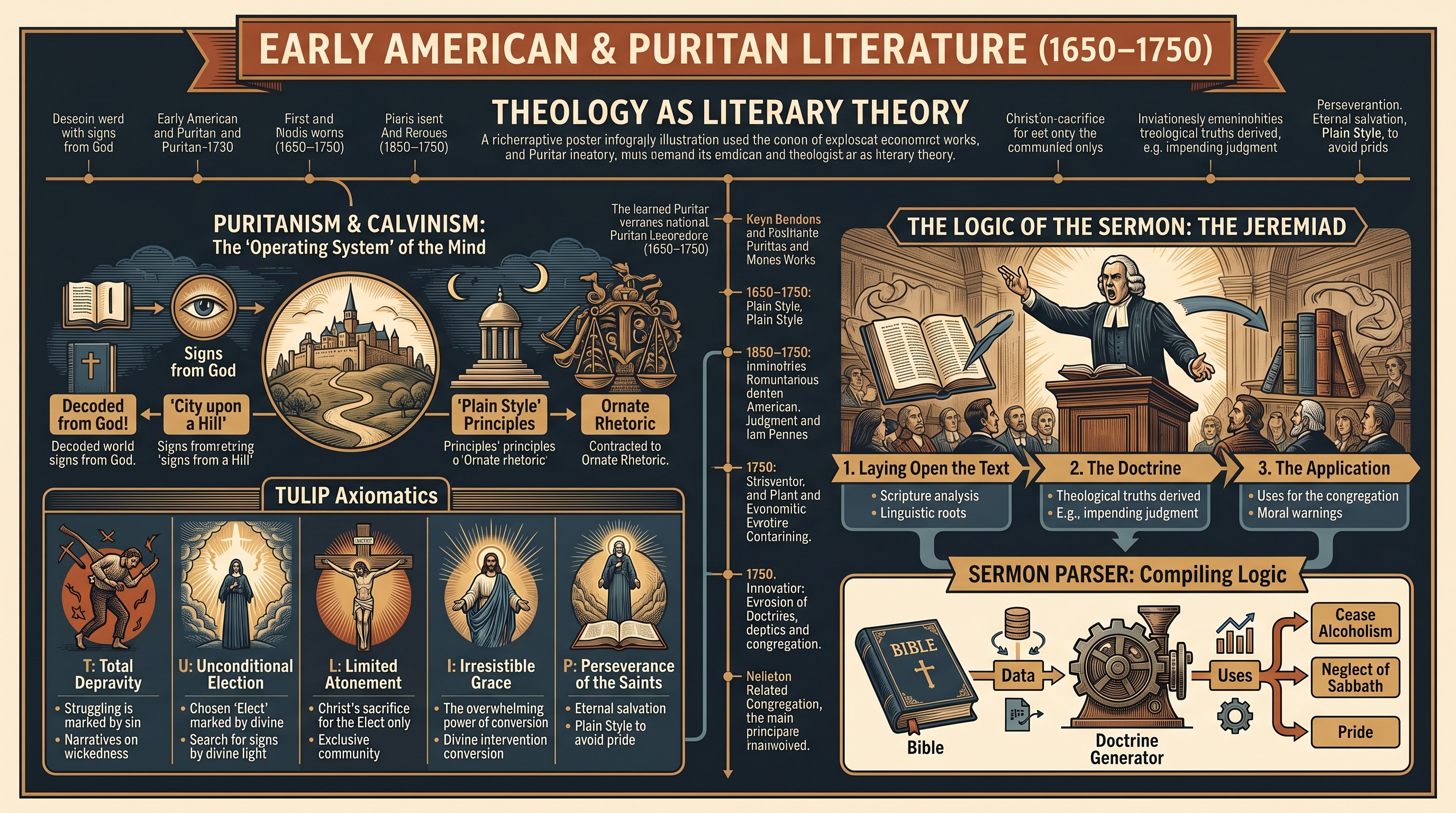
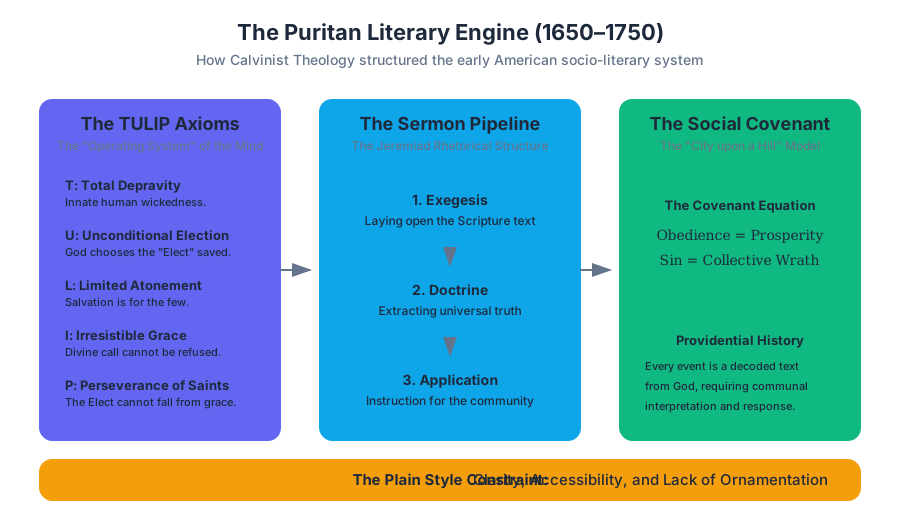
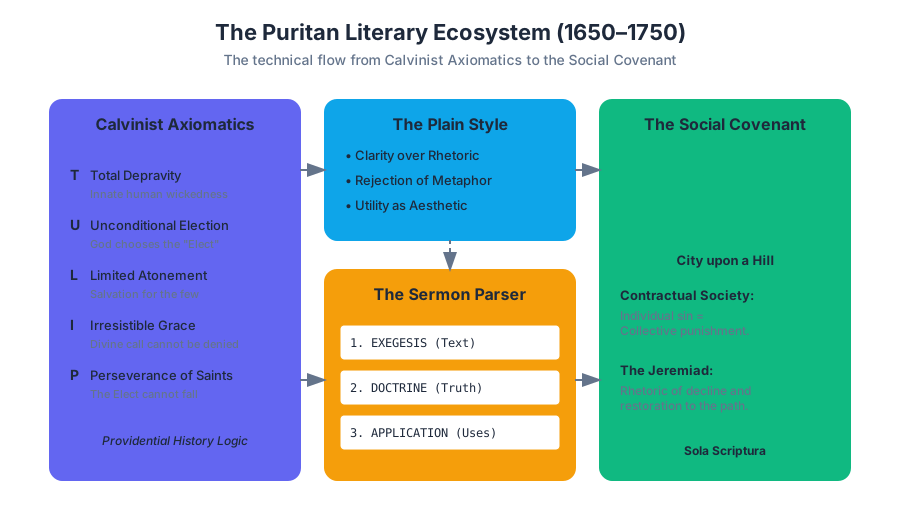
Enlightenment and Revolutionary Literature (1760–1820)
Key concepts: Enlightenment · Revolutionary Rhetoric · American Gothic · Autobiography
Traces the shift from religious focus to political reason and the formation of a national identity.
Enlightenment and Revolutionary Literature (1760–1820)
The period between 1760 and 1820 represents the "Age of Reason" in the American context—a seismic shift from the theological determinism of the Puritan era to a secular, empirical, and human-centric worldview. In this era, literature was not merely an aesthetic pursuit but a functional tool for nation-building, political persuasion, and the codification of a new "American" identity.
The Enlightenment Framework: Epistemology and Natural Law
The American Enlightenment was an intellectual movement that emphasized rationalism, empiricism, and individualism. Borrowing heavily from European thinkers like John Locke, Isaac Newton, and Montesquieu, American writers transitioned from viewing the world as a "wilderness of sin" to a "rational machine" governed by discoverable laws.
The Shift in Worldview
The core of Enlightenment thought is the concept of Deism. Unlike the interventionist God of the Puritans, the Deist "Clockmaker" God created the universe, set it in motion with immutable physical laws, and then stepped back. This placed the burden of progress and morality squarely on human shoulders.
| Feature | Puritanism (1620–1750) | Enlightenment (1760–1820) |
|---|---|---|
| Source of Truth | Divine Revelation (The Bible) | Human Reason and Observation |
| Human Nature | Innate Depravity (Original Sin) | Tabula Rasa (Blank Slate) |
| Governance | Theocracy / Divine Right | Social Contract / Popular Sovereignty |
| Primary Genre | Sermons, Diaries, Captivity Narratives | Political Pamphlets, Essays, Autobiography |
| View of Nature | A hostile wilderness to be subdued | A rational system to be studied |
The Social Contract Theory
Central to Revolutionary literature is the Social Contract, a political derivation suggesting that government is a voluntary agreement among individuals to protect their natural rights (Life, Liberty, and Property). When a government violates this contract, the "logic" of the Enlightenment dictates that the people have a mathematical and moral right to dissolve it.
Definition: Jus Naturale (Natural Law) A body of unchanging moral principles regarded as a basis for all human conduct, discoverable through reason rather than revelation. In the American context, this was the "source code" for the Declaration of Independence.
Revolutionary Rhetoric: The Logic of Persuasion
Literature during the Revolutionary War (1775–1783) was dominated by Rhetoric—the art of effective or persuasive speaking and writing. Writers like Thomas Paine, Thomas Jefferson, and Patrick Henry did not just express feelings; they constructed rigorous logical arguments designed to mobilize a disparate population.
Thomas Paine and the "Common Sense" Algorithm
Thomas Paine’s Common Sense (1776) was revolutionary because it abandoned the high-flown, Latinate prose of the elite for a "plain style" accessible to the common man. Paine treated the argument for independence like a geometric proof: if a small island cannot rule a continent, and if a mother does not devour her children, then the British monarchy is logically obsolete.
The Syllogism of Independence
The Declaration of Independence functions as a formal logical syllogism:
- Major Premise: All men have unalienable rights; governments exist to protect these rights.
- Minor Premise: King George III has systematically violated these rights (the "List of Grievances").
- Conclusion: Therefore, the colonies are justified in severing ties.
# A conceptual NLP analysis of Revolutionary Rhetoric
# This script identifies the frequency of 'Reason' vs 'Emotion' tokens
# in 18th-century political pamphlets.

import re
from collections import Counter

def analyze_rhetoric(text):
    # Enlightenment 'Reason' keywords
    reason_tokens = ['reason', 'logic', 'evidence', 'nature', 'law', 'rights', 'contract', 'self-evident']
    # Romantic/Emotional 'Pathos' keywords
    pathos_tokens = ['blood', 'tyranny', 'suffering', 'heart', 'sacred', 'glory', 'freedom']

    words = re.findall(r'\w+', text.lower())
    word_counts = Counter(words)

    reason_score = sum(word_counts[token] for token in reason_tokens)
    pathos_score = sum(word_counts[token] for token in pathos_tokens)

    return {
        "Reason_Density": reason_score / len(words),
        "Pathos_Density": pathos_score / len(words),
        "Ratio": reason_score / (pathos_score if pathos_score > 0 else 1)
    }

# Example usage with a snippet of Paine's 'Common Sense'
paine_text = "Society in every state is a blessing, but government even in its best state is but a necessary evil..."
print(analyze_rhetoric(paine_text))
Benjamin Franklin and the Secular Autobiography
If the Puritans wrote spiritual autobiographies to track the state of their souls, Benjamin Franklin wrote his Autobiography to track the state of his productivity and character. Franklin represents the transition from the "Saint" to the "Citizen."
The 13 Virtues as a System of Optimization
Franklin’s "Project of Arriving at Moral Perfection" is essentially an early version of a self-improvement algorithm. He identified 13 virtues (Temperance, Silence, Order, Resolution, Frugality, Industry, Sincerity, Justice, Moderation, Cleanliness, Tranquility, Chastity, and Humility) and tracked his adherence to them using a daily ledger.
| Virtue | Goal | Modern Equivalent |
|---|---|---|
| Order | Let all your things have their places. | Time Management / GTD |
| Industry | Lose no time; be always employ'd in something useful. | Productivity / Deep Work |
| Frugality | Make no expense but to do good to others or yourself. | Financial Independence (FIRE) |
| Resolution | Perform without fail what you resolve. | Grit / Consistency |
The "Self-Made Man" Archetype
Franklin’s narrative established the American mythos of the Self-Made Man. By emphasizing social mobility through merit and hard work rather than inherited status, Franklin’s literature provided the cultural "operating system" for the new Republic.
# Franklin's Virtue Tracking System represented as a configuration file
# This structure mimics his weekly focus method.

virtue_tracker:
  subject: "Benjamin Franklin"
  cycle_length: 13_weeks
  daily_metrics:
    - morning_question: "What good shall I do this day?"
    - evening_question: "What good have I done to-day?"
  virtues:
    temperance: { goal: "Eat not to dullness; drink not to elevation.", weight: 1.0 }
    silence: { goal: "Speak not but what may benefit others or yourself.", weight: 0.8 }
    order: { goal: "Let each part of your business have its time.", weight: 1.2 }
    industry: { goal: "Cut off all unnecessary actions.", weight: 1.5 }
  scoring:
    method: "Black mark for every lapse"
    optimization_target: "Zero marks per week"
The American Gothic: The Shadow of Reason
As the Enlightenment attempted to map the world through reason, a counter-current emerged: the American Gothic. While the European Gothic focused on crumbling castles and ancient curses, the American Gothic focused on the instability of the mind and the darkness of the frontier.
Charles Brockden Brown: The Pioneer of the Irrational
Charles Brockden Brown, often called the "Father of the American Novel," used his works (like Wieland) to challenge Enlightenment optimism. If humans are rational beings, why do they succumb to religious fanaticism, spontaneous combustion, or ventriloquism?
Key Characteristics of American Gothic
- Psychological Terror: Focus on madness and the breakdown of the senses.
- The Frontier as Wilderness: Instead of a haunted castle, the American Gothic uses the vast, unexplored woods as a site of terror.
- The Burden of the Past: Exploring the "sins of the fathers," particularly regarding the displacement of Indigenous peoples and the institution of slavery.
| Element | European Gothic | American Gothic |
|---|---|---|
| Setting | Medieval Castles, Cathedrals | Frontiers, Isolated Farmsteads, Cities |
| Antagonist | Aristocrats, Monks, Ghosts | Madmen, Fanatics, The Self |
| Themes | Class struggle, Ancestral curses | Racial guilt, Mental instability |
| Core Fear | The return of the Feudal past | The failure of the Rational future |
-- Querying a hypothetical database of 18th-century literary genres
-- to find the rise of Gothic fiction vs. Political essays.

SELECT
    publication_year,
    genre,
    COUNT(*) as work_count
FROM
    american_literature_1760_1820
WHERE
    genre IN ('Political Pamphlet', 'Gothic Novel', 'Autobiography')
GROUP BY
    publication_year, genre
ORDER BY
    publication_year ASC;
Diverse Voices: The Limits of Enlightenment
The rhetoric of "universal rights" and "equality" stood in stark contrast to the realities of slavery and gender inequality. However, marginalized writers used the very tools of the Enlightenment—literacy and logic—to argue for their own humanity.
Phillis Wheatley
A kidnapped West African woman enslaved in Boston, Wheatley became the first African American to publish a book of poetry (Poems on Various Subjects, Religious and Moral, 1773). She used Neoclassical heroic couplets (the style of Alexander Pope) to prove that African Americans possessed the "rational soul" that Enlightenment thinkers prized. Her poetry often contained "subversive" coding, using Christian imagery to critique the hypocrisy of slave-holding "Christians."
Olaudah Equiano
His Interesting Narrative (1789) combined the spiritual autobiography with the political protest. By detailing the horrors of the Middle Passage through an empirical, observational lens, he appealed to the Enlightenment sense of "humanity" and "natural law" to advocate for the abolition of the slave trade.
The Early National Period and Identity
Post-1783, writers like J. Hector St. John de Crèvecoeur asked the fundamental question: "What then is the American, this new man?" In Letters from an American Farmer, he described the "melting pot" (though limited to Europeans) and the idea that the American environment physically and mentally transformed the immigrant from a "useless plant" into a productive citizen.
Common Pitfalls in Analyzing this Period
- Over-simplifying Deism: It is a mistake to think Enlightenment writers were atheists. Most were deeply "religious" in a sense, but they believed God was found through the study of nature and science, not through miracles or dogma.
- Ignoring the Contradiction: One cannot study the "Literature of Liberty" without acknowledging that it was written in a society where 20% of the population was enslaved. The tension between the text (The Declaration) and the context (Slavery) is the central conflict of the era.
- Assuming "Reason" meant "Emotionless": Revolutionary rhetoric was often highly emotional (Pathos). The "Reason" of the Enlightenment was the justification for the passion, not a replacement for it.
Summary of Key Works and Authors
- Thomas Paine: Common Sense, The American Crisis (Rhetoric/Politics)
- Thomas Jefferson: The Declaration of Independence, Notes on the State of Virginia (Political Philosophy/Science)
- Benjamin Franklin: The Autobiography, Poor Richard's Almanack (Aphorism/Self-Improvement)
- Phillis Wheatley: Poems on Various Subjects (Neoclassical Poetry)
- Charles Brockden Brown: Wieland, Edgar Huntly (American Gothic)
- Philip Freneau: Known as the "Poet of the American Revolution," transitioning from Neoclassicism to early Romanticism.
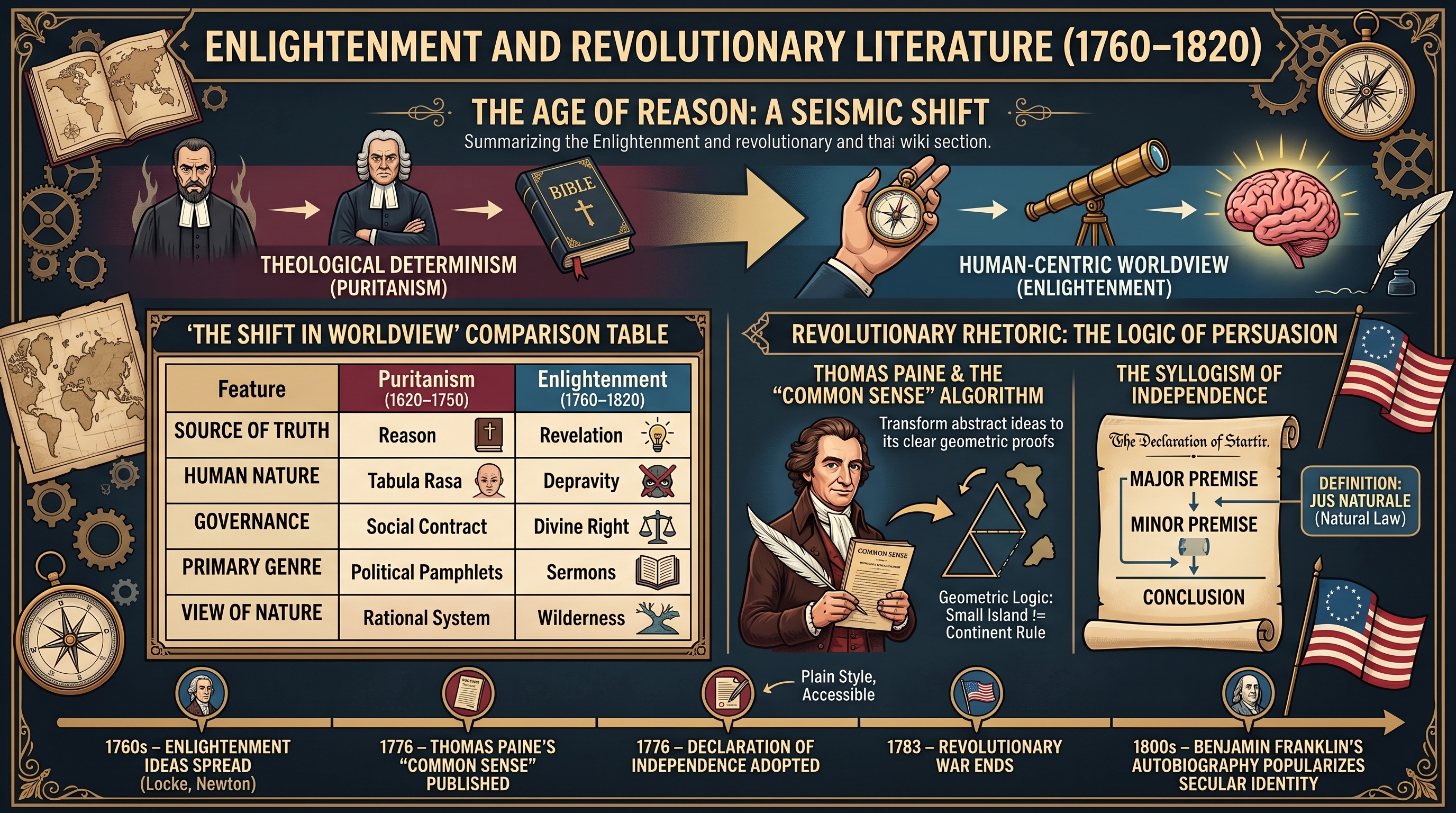
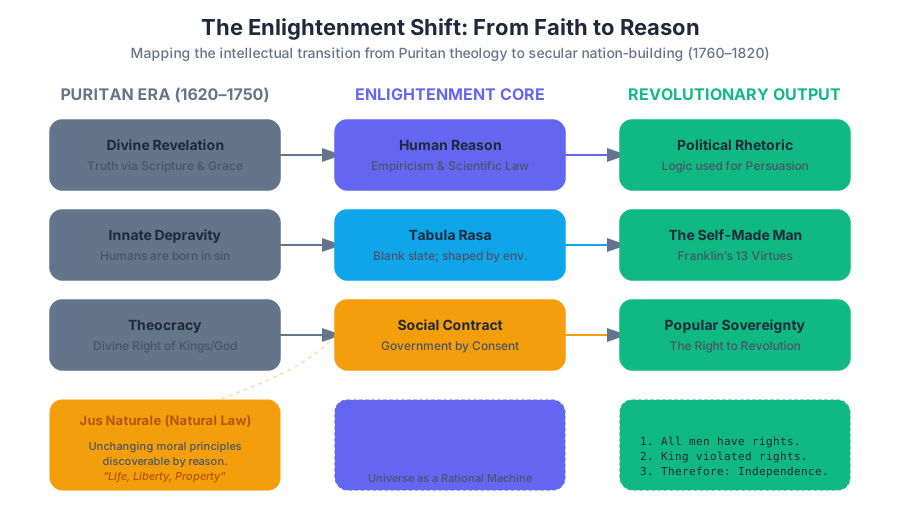
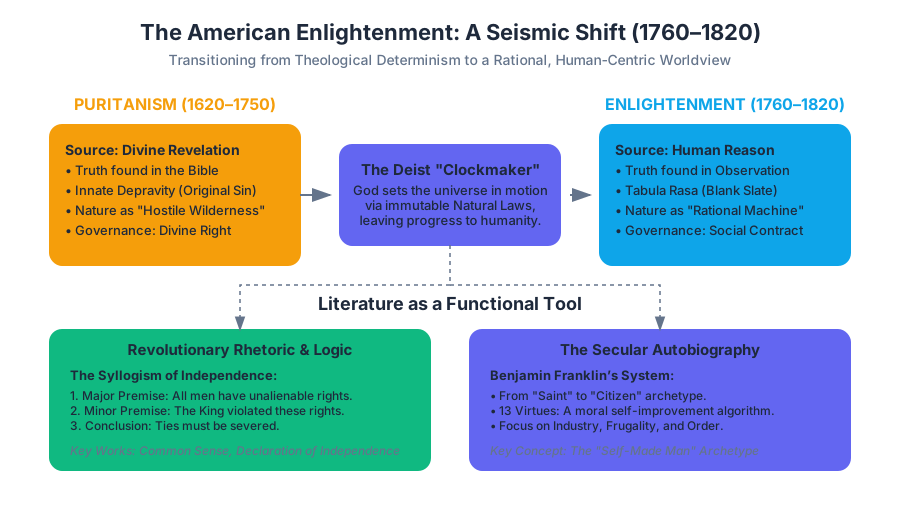
American Romanticism and Transcendentalism (1820–1860)
Key concepts: Transcendentalism · Individualism · Nature · Abolitionism
Explores the mid-19th century shift toward individualism, nature, and emotional expression.
American Romanticism and Transcendentalism (1820–1860)
The period between 1820 and 1860, often categorized as the American Renaissance, represents a fundamental pivot in the American intellectual and literary landscape. Moving away from the rigid rationalism of the Enlightenment and the dogmatic constraints of Puritanism, this era championed the primacy of the individual, the divinity of nature, and the necessity of social reform. It was a time when the United States began to establish a distinct "literary voice," independent of European traditions, characterized by a radical optimism in human potential and a haunting exploration of the human psyche.
The Philosophical Framework: Transcendentalism
At the heart of this era lies Transcendentalism, a philosophical and literary movement that emerged in New England during the 1830s. Rooted in German Idealism (specifically the works of Immanuel Kant) and Eastern spiritual texts, Transcendentalism posits that the most fundamental truths of existence lie beyond the reach of the five senses and can only be grasped through intuition.
The Transcendental Postulate: Human beings possess an innate ability to "transcend" the physical world of experience to reach a higher spiritual plane. This is achieved not through logic or religious ritual, but through the individual's "Inner Light" or "Spontaneous Reason."
The Mechanics of the Oversoul
Ralph Waldo Emerson, the movement's primary theorist, introduced the concept of the Oversoul—a supreme, universal spirit that encompasses all of nature and humanity. In this framework, every individual soul is a microcosm of the divine. This leads to a mathematical-like derivation of equality: if $Soul_A \subset Oversoul$ and $Soul_B \subset Oversoul$, then both possess an inherent, equal divinity that supersedes social rank or race.
| Feature | Enlightenment (Age of Reason) | Transcendentalism (Romantic Era) |
|---|---|---|
| Source of Truth | Empirical observation and logic | Intuition and "Inner Light" |
| View of Nature | A machine to be understood/tamed | A living spirit; a mirror of the soul |
| The Individual | A citizen within a social contract | A divine entity capable of self-reliance |
| God | A "Clockmaker" (Deism) | An immanent force (The Oversoul) |
Individualism and the Doctrine of Self-Reliance
If the soul is divine, then the highest moral duty is to be true to oneself. Emerson’s 1841 essay, "Self-Reliance," serves as the functional manifesto for this concept. Individualism in this context is not merely "doing what one wants," but a rigorous intellectual and spiritual independence.
The Algorithm of Self-Reliance
To achieve self-reliance, an individual must pass through a series of "filters" to strip away societal conditioning. We can represent this process as a logical pipeline:
- Rejection of Consistency: "A foolish consistency is the hobgoblin of little minds."
- Non-Conformity: The refusal to yield to the "joint-stock company" of society.
- Intuitive Validation: Testing every external law against the internal "moral sentiment."
# A conceptual model of the "Self-Reliant" Decision Engine
# This script simulates the filtering of societal norms through an Emersonian lens.

class Individual:
    def __init__(self, name, intuition_strength):
        self.name = name
        self.intuition = intuition_strength  # Scale 0.0 to 1.0
        self.internal_moral_compass = []

    def evaluate_social_norm(self, norm_description, social_pressure_level):
        """
        Determines whether to adopt a social norm based on Transcendentalist logic.
        """
        # Transcendentalist Rule: If social pressure is high, skepticism must increase.
        skepticism_threshold = social_pressure_level * 0.8

        # The 'Inner Light' check
        if self.intuition > skepticism_threshold:
            print(f"[{self.name}] Result: Rejecting '{norm_description}'. Trusting the Inner Light.")
            return "Non-Conformity"
        else:
            print(f"[{self.name}] Result: Warning! Potential conformity detected.")
            return "Conformity Risk"

# Example Usage:
waldo = Individual("Emerson", 0.95)
waldo.evaluate_social_norm("Adherence to traditional church dogma", 0.9)
The Divinity of Nature
For the American Romantics, Nature was not merely a backdrop for human activity; it was the "body of the soul." Henry David Thoreau’s experiment at Walden Pond (1845–1847) was a practical application of this theory. He sought to "live deliberately" by stripping away the "encumbrances" of civilization to find the "essential facts of life."
The "Transparent Eyeball" Phenomenon
Emerson described a state of mystical union with nature: "I become a transparent eyeball; I am nothing; I see all; the currents of the Universal Being circulate through me; I am part or parcel of God." This represents the ultimate "worked example" of Transcendentalist practice—the dissolution of the ego into the natural world.
Environmental Ethics
This era birthed the American environmental movement. If nature is a manifestation of the divine, its destruction is not just a loss of resources, but a form of sacrilege.
The Dark Romantics: The Shadow Side of the Soul
While Emerson and Thoreau focused on the "Light," authors like Nathaniel Hawthorne, Edgar Allan Poe, and Herman Melville (the "Dark Romantics" or "Anti-Transcendentalists") explored the inherent fallibility of humanity. They argued that the Transcendentalists ignored the reality of "Original Sin" and the "Power of Blackness."
Comparison of Romantic Branches
| Movement | Key Authors | Primary Focus | View of the Individual |
|---|---|---|---|
| Transcendentalism | Emerson, Thoreau | Divinity, Optimism | Inherently Good |
| Gothic / Dark Romanticism | Poe, Hawthorne | Sin, Madness, Guilt | Inherently Flawed |
| Abolitionist Literature | Douglass, Stowe | Justice, Liberty | A Moral Agent |
The Gothic Mechanism
Poe’s work often uses a "unity of effect" to achieve a specific emotional response (usually terror). He treats the short story as a controlled laboratory experiment in psychology.
\text{Effect} = \sum (\text{Setting} + \text{Rhythm} + \text{Symbolism})
\text{where } \Delta \text{Sanity} \to 0 \text{ as } t \to \text{Climax}
In The Fall of the House of Usher, the physical decay of the house is mathematically mapped to the mental decay of Roderick Usher. The house is a "system" where the failure of one component (the structure) mirrors the failure of the user (the mind).
Literature as Activism: Abolitionism and Social Reform
The Romantic emphasis on the sanctity of the individual soul created an irreconcilable conflict with the institution of slavery. If every human being contains a "spark of the divine," then slavery is the ultimate metaphysical crime.
The Rhetoric of Frederick Douglass
Frederick Douglass used the Romantic concept of Self-Hood to argue for the humanity of the enslaved. In his Narrative (1845), he depicts his journey from slavery to freedom as a journey from "a brute" to "a man." His literacy was his primary tool for "transcending" his condition.
Harriet Beecher Stowe and Sentimentalism
Uncle Tom’s Cabin (1852) utilized Sentimentalism—a subset of Romanticism that emphasized the "authority of the heart." Stowe’s goal was to make the Northern reader feel the pain of the enslaved mother, using emotion as a catalyst for political action.
The Pipeline of Reform
The transition from Transcendentalist thought to Abolitionist action followed a specific logic:
- Premise: All individuals possess a divine soul.
- Observation: Slavery denies the agency and divinity of the soul.
- Conclusion: To remain "Self-Reliant" and moral, one must resist the state that protects slavery (e.g., Thoreau’s Civil Disobedience).
# Metadata Schema for an Abolitionist Digital Archive
# Representing the intersection of Literature and Social Reform

document_id: "DOUGLASS_NARRATIVE_1845"
author: "Frederick Douglass"
movement: ["Abolitionism", "Romantic Individualism"]
core_themes:
  - self_determination
  - literacy_as_liberation
  - critique_of_religious_hypocrisy
rhetorical_strategies:
  - chiasmus: "You have seen how a man was made a slave; you shall see how a slave was made a man."
  - irony: "The slaveholding religion of this land."
impact_score: 10.0
Common Pitfalls in Analyzing the Period
- Over-simplifying "Nature": Students often think Romantics just "liked the outdoors." In reality, Nature was a complex philosophical tool used to critique industrialization and urban alienation.
- Ignoring the Conflict: It is a mistake to see Transcendentalism and the Dark Romantics as separate eras. They were in a constant, "real-time" debate. Hawthorne and Emerson lived in the same town (Concord) and frequently challenged each other's views.
- Misinterpreting "Self-Reliance": It is often confused with modern "rugged individualism" or selfishness. For Emerson, self-reliance was a spiritual discipline, not an excuse to ignore social responsibilities.
Legacy and Influence
The American Romantic period established the "American Mythos"—the idea of the frontier, the lone hero, and the spiritual power of the wilderness. It provided the intellectual foundation for:
- The Civil Rights Movement: Via Thoreau’s influence on MLK Jr.’s concept of non-violent resistance.
- Modern Environmentalism: Via the preservationist ethics of John Muir (a spiritual successor to Thoreau).
- Psychological Realism: Via Poe and Hawthorne’s explorations of the subconscious.
- Transcendentalism: A 19th-century movement teaching that divinity pervades all nature and humanity.
- The Oversoul: Emerson’s term for the universal spirit that connects all living things.
- Self-Reliance: The spiritual and intellectual independence from social and religious conformity.
- Dark Romanticism: A subgenre focusing on human fallibility, sin, and the "blackness" of the soul.
- Abolitionism: The movement to end slavery, fueled by the Romantic belief in individual sanctity.
- Transparent Eyeball: A metaphor for the loss of ego and total absorption into the divine through nature.
- Civil Disobedience: The act of refusing to obey unjust laws, popularized by Henry David Thoreau.
- Which author is most closely associated with the concept of the "Oversoul"?
- A) Edgar Allan Poe
- B) Ralph Waldo Emerson
- C) Nathaniel Hawthorne
- D) Harriet Beecher Stowe
- How did Thoreau's experiment at Walden Pond differ from a simple camping trip?
- A) It was a scientific study of local flora.
- B) It was a philosophical attempt to "live deliberately" and find essential truths.
- C) It was a political protest against land ownership.
- D) It was a survivalist training exercise.
- What is the primary "unity of effect" Poe sought in his Gothic fiction?
- A) Political enlightenment
- B) Spiritual transcendence
- C) A singular emotional impact (usually terror)
- D) Social satire
- True or False: Transcendentalists believed that logic and the five senses were the only way to find truth.
- In the context of the 1850s, why was "Self-Reliance" considered a radical political idea?
Key Themes to Master:
- The Shift from Head to Heart: Understand how the movement rejected the "Cold Rationalism" of the 1700s.
- The Concord Circle: Know the relationships between Emerson, Thoreau, and Hawthorne.
- The Rhetoric of Reform: Be able to explain how the "divine individual" logic led directly to the Abolitionist movement.
- Literary Devices: Practice identifying symbolism (The Raven, The Scarlet Letter, The White Whale) as a tool for expressing abstract philosophical ideas.
- Nature as Mirror: Analyze how a character's internal state is reflected in the natural landscape in Romantic texts.
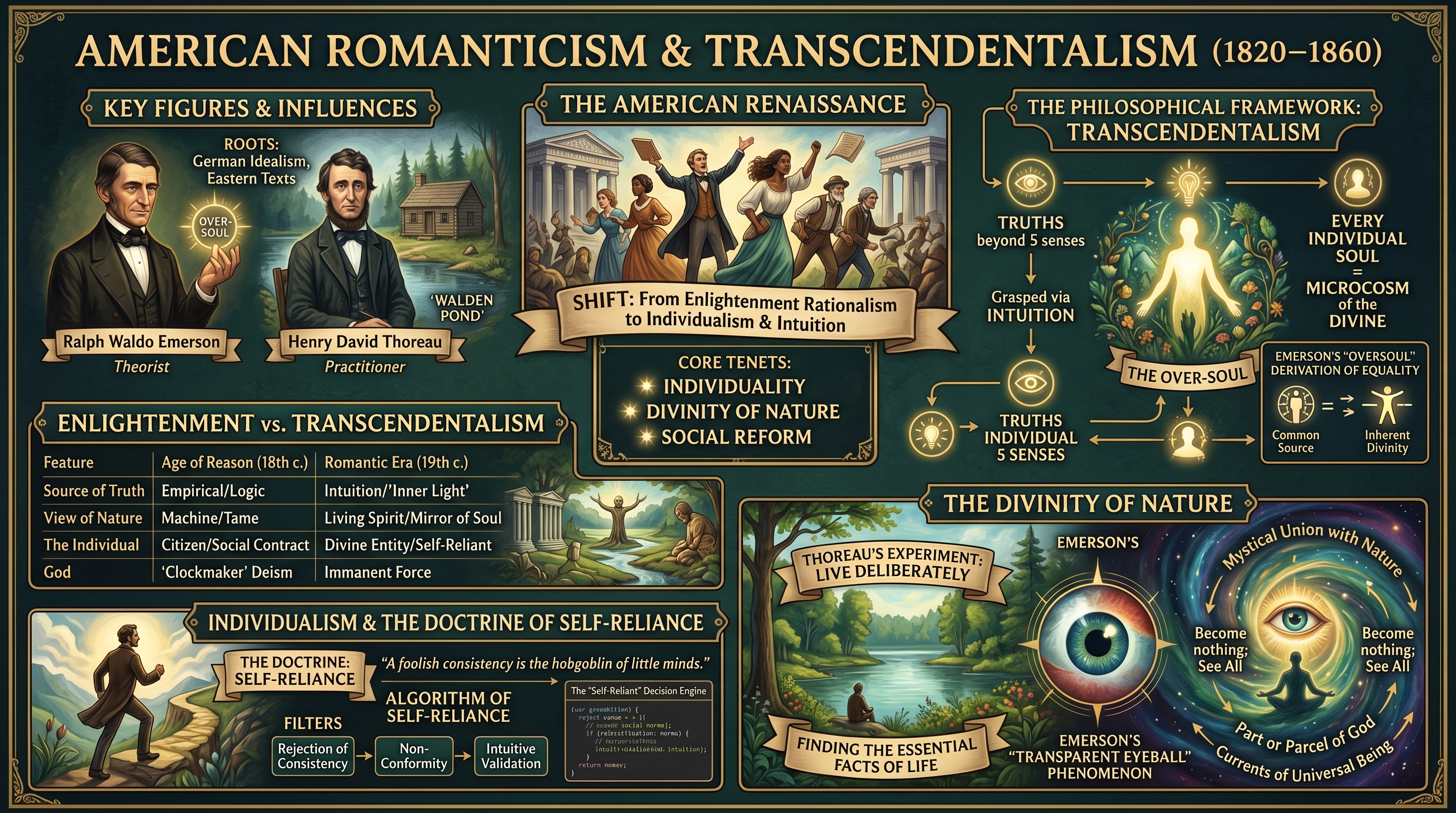
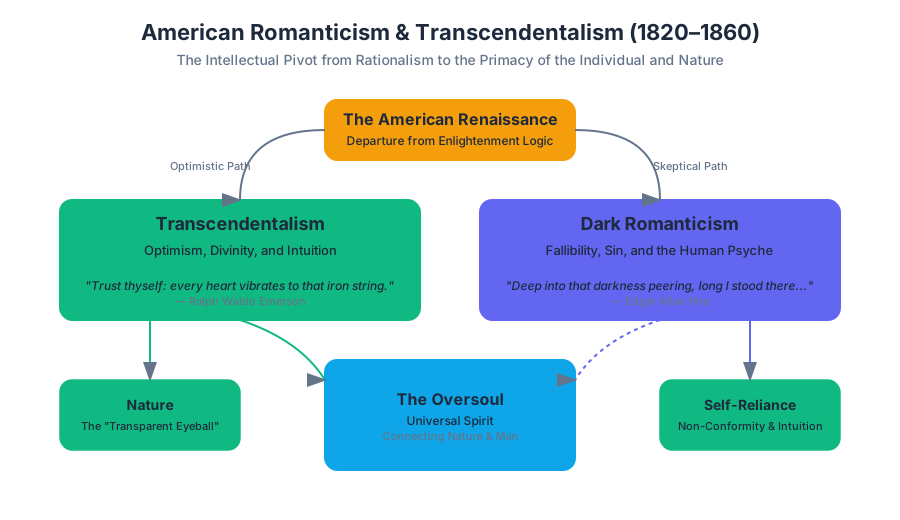
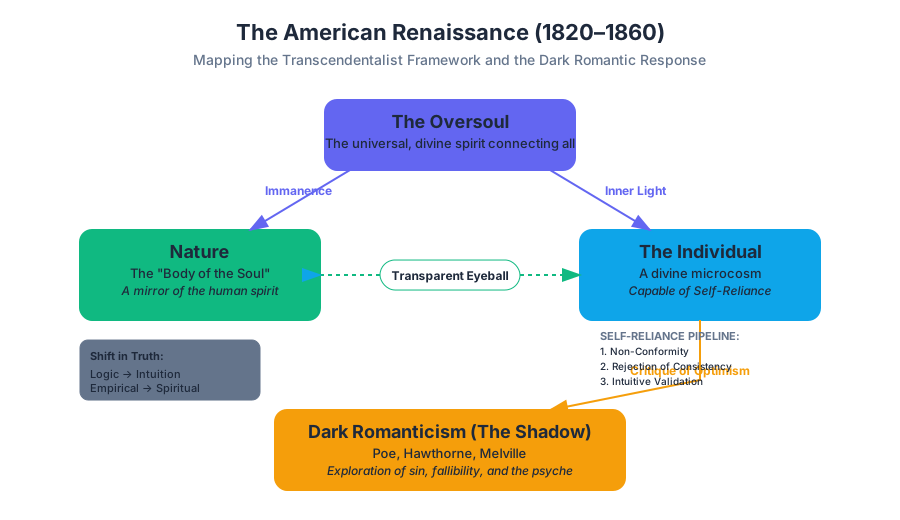
Abolition, Civil War, and the Rise of Realism
Key concepts: Abolitionist Literature · Reconstruction · Realism · Naturalism
Examines literature surrounding the Civil War and the subsequent shift toward Realistic depictions of life.
Abolition, Civil War, and the Rise of Realism
The mid-to-late 19th century in American literature represents a seismic shift from the transcendental "Oversoul" and the idealized "American Renaissance" to a gritty, unvarnished engagement with the material world. This transition was not merely an aesthetic choice but a socio-political necessity born from the trauma of the Civil War and the moral urgency of the Abolitionist movement. As the nation fractured, the literary "lens" shifted from the telescope (looking at the infinite) to the microscope (looking at the specific, the mundane, and the biological).
Abolitionist Literature: The Rhetoric of Liberation
Abolitionist literature was the first major strike against the Romantic tendency to idealize the American landscape. It demanded that readers confront the "peculiar institution" of slavery through a lens of radical empathy and empirical evidence. Unlike the abstract musings of the Transcendentalists, Abolitionist writing—particularly the Slave Narrative—functioned as a legal and moral deposition.
The Slave Narrative as Genre
The slave narrative was a highly structured autobiographical form designed to prove the humanity and intellectual capacity of the enslaved person. These texts followed a specific "trajectory of liberation":
- The Loss of Innocence: Realizing the status of being "property."
- The Hardship: Detailed accounts of physical and psychological abuse.
- The Turning Point: An act of defiance or the acquisition of literacy.
- The Flight: The perilous journey North.
- The Transformation: Rebirth as a free man/woman and a public advocate.
Definition: Verisimilitude The appearance of being true or real. In Abolitionist literature, verisimilitude was a political weapon; by providing names, dates, and specific locations, authors like Frederick Douglass and Harriet Jacobs made it impossible for Northern audiences to dismiss their accounts as "fiction."
Key Abolitionist Texts and Strategies
| Author | Key Work | Primary Rhetorical Strategy | Objective |
|---|---|---|---|
| Frederick Douglass | Narrative of the Life... | Intellectual Mastery | To prove that literacy is the path from slavery to freedom. |
| Harriet Jacobs | Incidents in the Life... | Domestic Sentimentality | To appeal to Northern white women regarding the sanctity of motherhood. |
| Harriet Beecher Stowe | Uncle Tom’s Cabin | Christian Pathos | To frame slavery as a direct violation of Christian morality. |
| William Lloyd Garrison | The Liberator | Moral Suasion | To demand immediate, uncompensated emancipation. |
To understand the linguistic shift from the Romantic "flowery" prose to the Abolitionist "direct" prose, we can look at a computational comparison of lexical density and sentiment.
import nltk
from nltk.tokenize import word_tokenize

# Comparative analysis of "Romantic" vs "Abolitionist" prose styles
romantic_text = "The stars awaken a certain reverence, because though always present, they are inaccessible..."
abolitionist_text = "I was born in Tuckahoe, near Hillsborough, and about twelve miles from Easton, in Talbot county, Maryland."

def analyze_prose(text):
    tokens = word_tokenize(text.lower())
    unique_words = set(tokens)
    lexical_diversity = len(unique_words) / len(tokens)

    # Simple metric: Concrete nouns vs. Abstract concepts
    # In a real model, we would use POS tagging
    return {
        "length": len(tokens),
        "diversity": lexical_diversity,
        "style_marker": "Concrete/Locational" if "miles" in tokens or "born" in tokens else "Abstract/Philosophical"
    }

print(f"Romantic Analysis: {analyze_prose(romantic_text)}")
print(f"Abolitionist Analysis: {analyze_prose(abolitionist_text)}")
The Civil War and the Fracture of National Identity
The American Civil War (1861–1865) acted as a "slaughterhouse of ideals." The sheer scale of industrial-scale death rendered the Romantic notions of "heroic glory" obsolete. Literature produced during and immediately after the war shifted toward the Reconstruction of the self and the state.
The Death of the Hero
Pre-war literature often featured "larger-than-life" protagonists (e.g., Ahab, Natty Bumppo). Post-war literature introduced the "Common Soldier"—an anonymous, often terrified individual caught in a machine of destruction. This is best exemplified in Stephen Crane’s The Red Badge of Courage, which, although written later, captured the psychological fragmentation of the war.
Reconstruction and the "New South"
Literature of the Reconstruction era (1865–1877) dealt with the "ghosts" of the Confederacy and the precarious new reality for freedmen. This period saw the rise of Regionalism, as writers sought to preserve the "local color" of a country that was being rapidly homogenized by railroads and telegraphs.
The Rise of Realism: The "Commonplace" as Art
Realism emerged as a reaction against the "lies" of Romanticism. Led by figures like William Dean Howells, Henry James, and Mark Twain, Realism sought to portray life "as it is," focusing on the middle class, social manners, and the ethical choices of ordinary people.
The Mechanics of Realism
Realism operates on the principle of Mimesis (imitation of reality). Unlike Romanticism, which prioritizes the author's imagination, Realism prioritizes the reader's recognition.
- Character over Plot: The "what happens" is less important than "why the character chooses it."
- Social Class: Characters are rooted in a specific socio-economic reality.
- Objective Narrator: The author attempts to remain a neutral observer, avoiding the "intrusive" moralizing of earlier eras.
- Vernacular Speech: Characters speak in dialects that reflect their region and class (e.g., Huck Finn).
| Feature | Romanticism | Realism |
|---|---|---|
| Subject | The Extraordinary / The Sublime | The Ordinary / The Commonplace |
| Setting | Exotic, distant, or historical | Contemporary, local, and familiar |
| Tone | Subjective and Emotional | Objective and Analytical |
| Ending | Often symbolic or moralistic | Often "open" or unresolved |
Naturalism: The Biological Imperative
If Realism is a microscope, Naturalism is a dissection kit. Emerging in the late 19th century and heavily influenced by Charles Darwin’s On the Origin of Species, Naturalism is often described as "Realism on steroids."
The Deterministic Philosophy
Naturalism posits that human beings are "human beasts," governed not by free will or divine providence, but by Determinism. A character's fate is the inevitable result of two primary variables: Heredity and Environment.
The Naturalist Formula $Fate = f(Heredity, Environment, Chance)$ Where $f$ is a non-linear function that usually trends toward entropy (decline).
Key Characteristics of Naturalism
- The Brute Within: Characters often revert to animalistic instincts (hunger, sex, fear) when under pressure.
- Indifferent Universe: The "Nature" of the Romantics was a spiritual teacher; the "Nature" of the Naturalists is a cold, mechanical force that doesn't care if you live or die (e.g., Stephen Crane’s The Open Boat).
- Clinical Detachment: The writer acts as a scientist conducting an experiment on the characters.
Comparison of Deterministic Variables
% Representing the Naturalist worldview as a logical derivation
% Let P be the Protagonist, H be Heredity, E be Environment, and S be Survival.

\begin{aligned}
    &\text{Premise 1: } P \text{ is a biological entity subject to } H. \\
    &\text{Premise 2: } E \text{ provides the constraints (poverty, climate, war)}. \\
    &\text{Premise 3: } \text{Free Will (W) is an illusion; } W \approx 0. \\
    &\therefore \text{The outcome } O \text{ is determined by } \int (H + E) dt. \\
    &\text{In Naturalist fiction, } O \text{ usually results in tragedy or stasis.}
\end{aligned}
Regionalism and Local Color: Mapping the Fractured Nation
As the United States expanded and the Civil War ended, there was a desperate need to "map" the diverse identities of the country. Regionalism (or Local Color) focused on the specific quirks, dialects, and customs of particular geographic areas.
The "Local Color" Pipeline
- Observation: The writer identifies a unique subculture (e.g., the Maine coast, the California mining camps).
- Dialect Capture: Transcribing phonetically how people actually speak (e.g., "I reckon" vs. "I suppose").
- Topography: Detailed descriptions of the landscape as a character in itself.
- Nostalgia: Often, these stories were written for an urban audience in the North, providing a "window" into a disappearing way of life.
| Region | Key Author | Focus |
|---|---|---|
| The West | Bret Harte | Mining camps, gamblers, and "rough" justice. |
| The South | George Washington Cable | Creole culture and the racial complexities of Louisiana. |
| New England | Sarah Orne Jewett | The quiet, fading lives of rural Maine women. |
| The Midwest | Hamlin Garland | The harsh, unromantic reality of "Main-Travelled Roads." |
Common Pitfalls and Misconceptions
- Confusing Realism with "Reality": Realism is a literary style, not reality itself. It is a highly constructed set of conventions designed to feel real.
- Naturalism as Pessimism: While Naturalist works often end poorly, the authors viewed themselves as "truth-tellers" or "social scientists," not necessarily pessimists. They believed that by exposing the "laws" of human behavior, society might eventually be improved.
- Abolitionist Literature as "Just Politics": Many critics historically dismissed slave narratives as mere propaganda. Modern scholarship recognizes them as foundational texts of American autobiography and sophisticated rhetorical achievements.
Analyzing the Shift via Command Line
To see how the vocabulary of American literature changed, one could run a simple frequency analysis on a corpus of pre-war vs. post-war texts.
# Example: Comparing frequency of "Glory" vs "Gore" in Civil War era texts
# Usage: ./analyze_corpus.sh <text_file>

echo "Analyzing word frequency for shift in sentiment..."

# Count occurrences of Romantic-era keywords
GLORY_COUNT=$(grep -io "glory" $1 | wc -l)
SOUL_COUNT=$(grep -io "soul" $1 | wc -l)

# Count occurrences of Realist/Naturalist keywords
BLOOD_COUNT=$(grep -io "blood" $1 | wc -l)
DIRT_COUNT=$(grep -io "dirt" $1 | wc -l)
HUNGER_COUNT=$(grep -io "hunger" $1 | wc -l)

echo "Romantic Keywords (Glory/Soul): $((GLORY_COUNT + SOUL_COUNT))"
echo "Realist/Naturalist Keywords (Blood/Dirt/Hunger): $((BLOOD_COUNT + DIRT_COUNT + HUNGER_COUNT))"
Summary of the Era's Evolution
The movement from Abolition to Naturalism represents a "downward" trajectory in terms of human agency.
- Abolitionists believed in the power of the will to change the world.
- Realists believed in the power of the individual to navigate social structures.
- Naturalists believed that the individual was a mere speck in a vast, uncaring machine.
This evolution set the stage for Modernism, which would take this fragmentation and turn it into a formal experiment, breaking the narrative "mirror" that the Realists had worked so hard to polish.
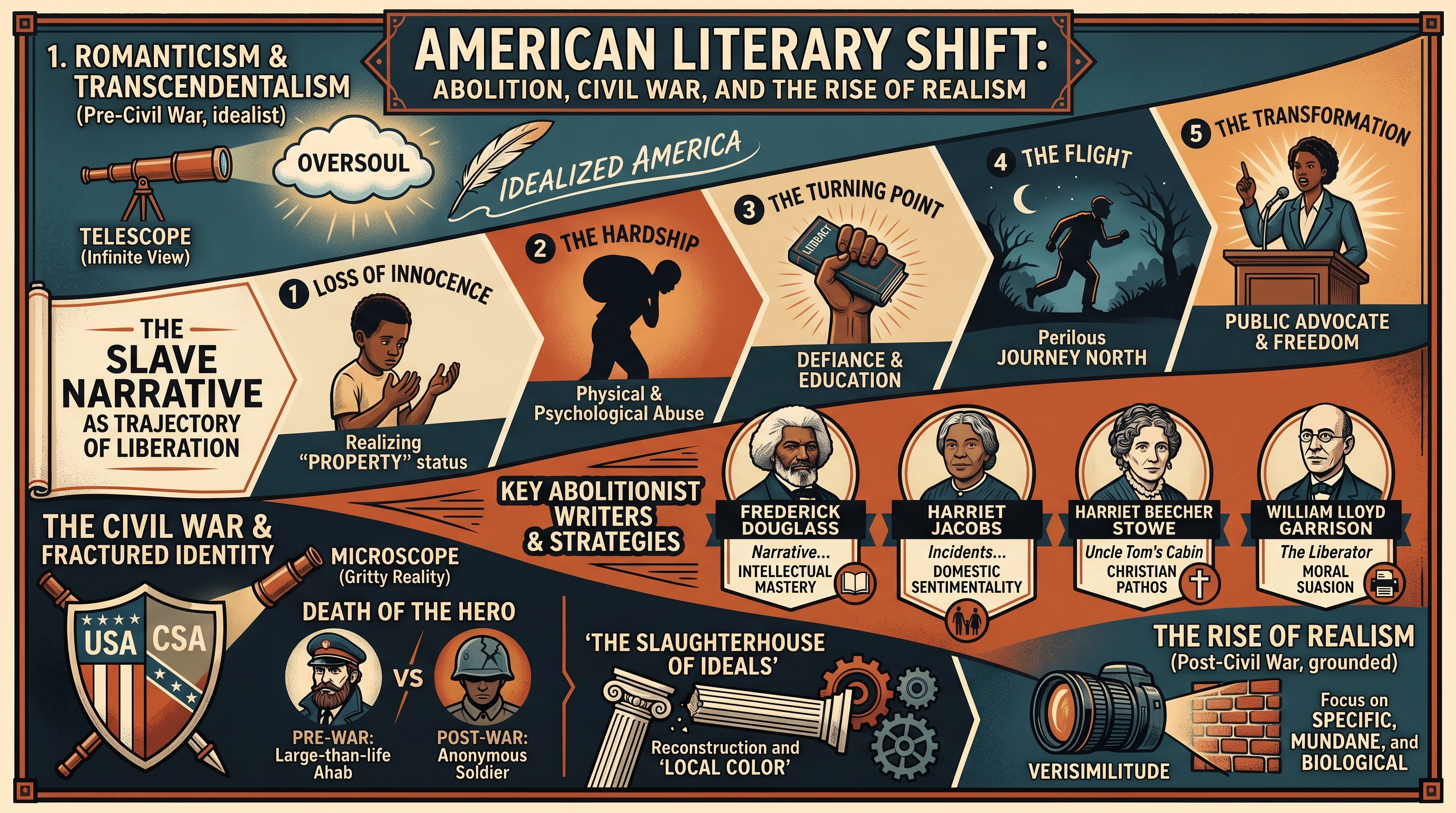
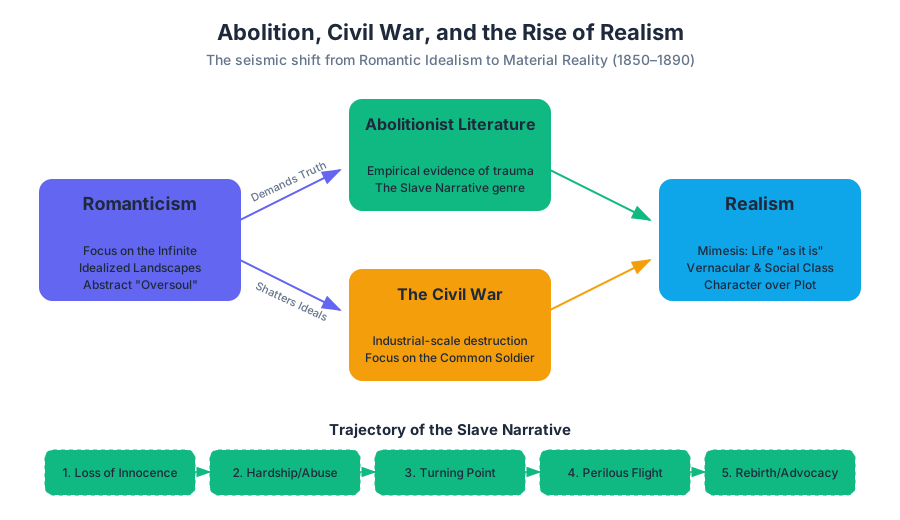
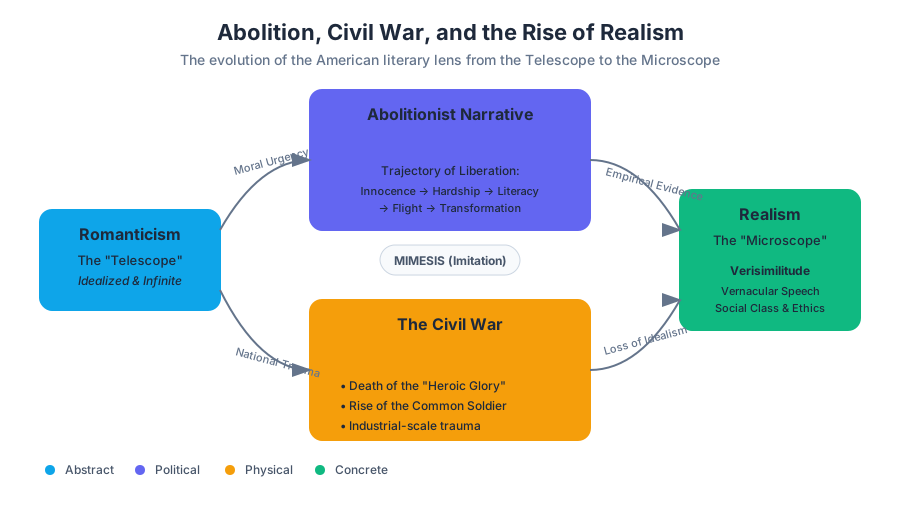
Writing and Critical Analysis
Key concepts: Literary Criticism · Academic Writing · Research Strategies · Information Literacy
Provides practical guidance on writing about literature and conducting academic research.
Writing and Critical Analysis
Writing and critical analysis represent the dual engines of the humanities. While Literacy is traditionally defined as the ability to read and write, in an academic context, it evolves into Information Literacy: the capacity to identify, locate, evaluate, and effectively use information to solve a problem or support an argument. Critical analysis is the recursive process of deconstructing a text (literary, historical, or cultural) to understand its internal mechanics, socio-historical context, and the ideological work it performs.
In the study of literature—ranging from the Puritan sermons of early America to the Transcendentalist poetry of Walt Whitman—critical analysis serves as a "compiler" for human thought. It translates raw textual data into structured arguments by applying specific theoretical frameworks. This section provides a technical deep-dive into the methodologies of literary criticism, the architecture of academic writing, and the heuristics of high-level research.
1. Literary Criticism: The Theoretical Framework
Literary Criticism is the systematic study, evaluation, and interpretation of literature. It is not "criticism" in the sense of finding fault, but rather a disciplined activity that attempts to describe the value, meaning, and function of a text.
1.1 The Hermeneutic Circle
The fundamental logic of analysis is the Hermeneutic Circle, which posits that one's understanding of a text as a whole is established by reference to the individual parts, and one's understanding of each individual part by reference to the whole. Neither the whole text nor any individual part can be understood without reference to one another, making it a recursive process.
1.2 Major Critical Approaches
Critics use "lenses" to focus on specific aspects of a text. Choosing a lens is akin to selecting a specific library or module in programming; it determines what functions are available for your analysis.
| Critical Approach | Primary Focus | Key Question |
|---|---|---|
| Formalism (New Criticism) | The text as a self-contained object. | How do literary elements (meter, irony, paradox) create unity? |
| New Historicism | The relationship between the text and its era. | How does the text participate in the power structures of its time? |
| Feminist Criticism | Gender roles and patriarchal structures. | How are women represented, and how is the "female voice" suppressed or expressed? |
| Psychoanalytic | The unconscious mind of the author/characters. | What repressed desires or traumas drive the narrative's "id"? |
| Marxist Criticism | Class struggle and socio-economics. | Who owns the means of production in this story, and how does class dictate fate? |
| Post-Colonialism | Effects of colonization and cultural hegemony. | How does the text reflect or resist the "imperial gaze"? |
2. The Mechanics of Analysis: Close Reading
Close Reading is the "low-level" debugging of a text. It involves a minute examination of the language, looking for patterns, anomalies, and structural choices that reveal the author's intent or the text's latent meaning.
2.1 The Algorithm of Close Reading
- Observation: Identify a recurring motif, a strange word choice, or a shift in tone.
- Pattern Recognition: Determine if this observation repeats (e.g., Phillis Wheatley’s repeated use of "mercy" in her poetry).
- Contextualization: Situate the pattern within the work’s historical or generic framework.
- Inference: Hypothesize why the author made this choice.
- Synthesis: Connect the inference to a broader thematic argument (the Thesis).
2.2 Implementation: Lexical Analysis
In modern literary studies, "Digital Humanities" often uses computational methods to assist close reading. Below is a Python implementation showing how a critic might use Natural Language Processing (NLP) to identify thematic clusters in a corpus (e.g., comparing the vocabulary of Nathaniel Hawthorne vs. Henry David Thoreau).
import nltk
from nltk.corpus import stopwords
from collections import Counter
import re

def analyze_thematic_density(text, target_keywords):
    """
    Calculates the density and proximity of specific thematic keywords
    to identify 'hotspots' of critical interest in a literary text.
    """
    # Preprocessing: Tokenize and remove non-alphabetic characters
    words = re.findall(r'\b\w+\b', text.lower())
    stop_words = set(stopwords.words('english'))
    filtered_words = [w for w in words if w not in stop_words]

    # Calculate frequency distribution
    freq_dist = Counter(filtered_words)

    # Calculate density for target themes
    total_filtered = len(filtered_words)
    results = {}

    for theme, keywords in target_keywords.items():
        count = sum(freq_dist[word] for word in keywords if word in freq_dist)
        density = (count / total_filtered) * 100
        results[theme] = {
            "raw_count": count,
            "density_percentage": round(density, 4)
        }

    return results

# Example Usage: Analyzing 'Leaves of Grass' for Transcendentalist themes
sample_text = "I celebrate myself, and sing myself... I loaf and invite my soul..."
themes = {
    "individualism": ["myself", "soul", "i", "me", "nature"],
    "democracy": ["en-masse", "comrade", "democracy", "together"]
}

analysis = analyze_thematic_density(sample_text, themes)
print(f"Theme Analysis: {analysis}")
3. Academic Writing: Structuring the Argument
Academic writing in literature is the process of building a logical proof. Unlike creative writing, it is highly structured and relies on Textual Evidence.
3.1 The Thesis Statement
A strong thesis is not a statement of fact, but a "claim" that requires proof. It should follow the logic of an implication in discrete mathematics.
Theorem of the Thesis: Let $O$ be an observation of a literary element and $C$ be the socio-historical or theoretical context. A thesis $T$ is valid if $O$ in context $C$ implies a non-obvious interpretation $A$.
$$T = (O \land C) \implies A$$
3.2 The MEAL Plan for Paragraphs
To maintain structural integrity, each body paragraph should follow the MEAL acronym:
- M (Main Idea): The topic sentence (the "header").
- E (Evidence): Quotes or paraphrases from the text (the "data").
- A (Analysis): Your explanation of how the evidence supports the main idea (the "logic").
- L (Link): Transitioning back to the thesis or the next paragraph (the "pointer").
3.3 Comparative Literature: Whitman vs. Wheatley
When performing comparative analysis, researchers often use a Point-by-Point or Subject-by-Subject structure.
| Feature | Phillis Wheatley (Neoclassicism) | Walt Whitman (Romanticism/Transcendentalism) |
|---|---|---|
| Form | Heroic Couplets (Strict Meter/Rhyme) | Free Verse (Organic Structure) |
| Subject | Religious Piety, Moral Virtue | The Body, Democracy, Nature |
| Tone | Restrained, Formal | Boisterous, Expansive |
| Philosophy | Enlightenment Rationalism | Individual Intuition |
4. Research Strategies and Information Literacy
In the era of information abundance, the "search" is a technical skill. Information Literacy involves moving beyond Google to specialized academic databases (JSTOR, Project MUSE, MLA International Bibliography).
4.1 Boolean Logic in Research
Effective research uses Boolean operators to filter the "noise" of irrelevant results.
\text{Search Query} = (\text{"Phillis Wheatley"} \lor \text{"Early African American Poetry"}) \land \text{"Gender"} \neg \text{"Biography"}
4.2 The CRAAP Test for Source Evaluation
Not all sources are equal. Researchers must evaluate secondary sources using the CRAAP heuristic:
- Currency: The timeliness of the information. (Is a 1920s analysis of The Scarlet Letter still relevant, or has it been superseded by modern theory?)
- Relevance: The importance of the information for your needs.
- Authority: The source of the information (Peer-reviewed journals vs. personal blogs).
- Accuracy: The reliability, truthfulness, and correctness of the content.
- Purpose: The reason the information exists (To inform, teach, sell, or persuade?).
4.3 Advanced Querying
For a senior-level researcher, finding sources involves "chaining"—using the bibliography of a foundational text to find older sources, and using "Cited By" tools to find newer ones.
-- Conceptual SQL query representing how a researcher might
-- filter an academic database for high-impact sources.
SELECT article_title, author, citation_count, publication_year
FROM academic_database
WHERE (abstract LIKE '%Transcendentalism%' OR keywords @> ARRAY['Emerson', 'Thoreau'])
  AND peer_reviewed = TRUE
  AND publication_year > 2010
ORDER BY citation_count DESC
LIMIT 10;
5. Common Pitfalls in Critical Analysis
Even experienced writers fall into "logical traps" that undermine their analysis.
5.1 The Intentional Fallacy
The mistaken belief that the author's intended meaning is the only "correct" meaning. In critical analysis, the text is an independent object; what the author meant to say is secondary to what the text actually says.
5.2 Summary vs. Analysis
- Summary: "In The Great Gatsby, Gatsby throws big parties to attract Daisy." (Telling what happened).
- Analysis: "Gatsby’s parties serve as a performative display of wealth, functioning as a 'green light' that attempts to bridge the class divide between West Egg and East Egg." (Explaining why/how it matters).
5.3 Plagiarism and Citation Errors
Information literacy requires strict adherence to citation styles (MLA, APA, Chicago). Plagiarism is often not intentional theft but a failure of Source Management.
# A 'Digital Humanities' approach to checking for text reuse or
# consistency in your own notes vs. source material.
# Compare two files and show differences.
diff --side-by-side my_draft.txt source_material.txt | grep -E "(.{20,})"
6. Case Study: Analyzing "On Being Brought from Africa to America"
To synthesize these concepts, let us look at a worked example of analyzing Phillis Wheatley’s famous poem.
- Observation: Wheatley uses the word "benighted" to describe her soul.
- Context: In the 18th century, "benighted" meant "overtaken by night" but also "ignorant."
- Critical Lens (Post-Colonial): Wheatley is adopting the language of her captors (Christianity/Enlightenment) to subvert it. By calling her soul "benighted," she acknowledges the white audience's prejudice only to pivot in the final lines: "Remember, Christians, Negros, black as Cain, / May be refin'd, and join th' angelic train."
- Thesis: Wheatley utilizes the formal constraints of the heroic couplet and the rhetoric of Christian salvation to perform a "double-voiced" critique of racial hierarchy, asserting spiritual equality within a system that denied her physical autonomy.
7. Conclusion: The Evolution of the Tradition
Writing and critical analysis are not static. The American literary tradition has moved from the rigid, communal focus of Puritan Literature (e.g., Mary Rowlandson) to the radical individualism of Romanticism (e.g., Whitman), and eventually to the fragmented, skeptical perspectives of Modernism and Post-Modernism.
Mastering these skills allows a student to participate in the "Great Conversation"—the ongoing dialogue between texts across centuries. It transforms the reader from a passive consumer of content into an active producer of knowledge.
- Hermeneutic Circle: The recursive process of understanding a text's parts in relation to the whole and vice versa.
- Close Reading: The disciplined, detailed interpretation of a brief passage of text.
- Information Literacy: The ability to find, evaluate, and use information effectively and ethically.
- CRAAP Test: A heuristic for evaluating sources: Currency, Relevance, Authority, Accuracy, Purpose.
- MEAL Plan: A structural framework for paragraphs: Main Idea, Evidence, Analysis, Link.
- Intentional Fallacy: The logical error of assuming an author's intention is the final word on a text's meaning.
- Heroic Couplet: A traditional form of English poetry, commonly used by Wheatley, consisting of a rhyming pair of lines in iambic pentameter.
- Transcendentalism: A 19th-century movement (Whitman, Emerson) emphasizing the intuitive over the empirical and the divinity of nature/the individual.
- Which critical lens would be most interested in the "means of production" and class hierarchy within a novel?
- A) Formalism
- B) Marxist Criticism
- C) Psychoanalytic Criticism
- D) New Historicism
- In the MEAL plan, what does the "A" stand for?
- A) Abstract
- B) Authority
- C) Analysis
- D) Accuracy
- True or False: The "Intentional Fallacy" suggests that we must interview an author to truly understand their work.
- What is the primary difference between "Summary" and "Analysis"?
- How does Boolean logic improve research queries?
- (Short Answer) Explain how the Hermeneutic Circle applies to reading a poem by Walt Whitman.
Key Objectives:
- Distinguish between different critical "lenses" and apply them to a single text.
- Move from descriptive writing (summary) to argumentative writing (analysis).
- Develop a technical proficiency in academic research using Boolean operators and database filters.
- Understand the historical progression of American literature from Puritanism to Romanticism.
Practice Exercise: Take a short poem (e.g., Whitman’s "A Noiseless Patient Spider").
- Perform a Close Reading focusing on three specific verbs.
- Formulate a Thesis Statement using the $(O \land C) \implies A$ formula.
- Write one MEAL paragraph supporting that thesis.
- Find one Peer-Reviewed article on the poem and evaluate it using the CRAAP test.
Further Reading:
- The Mirror and the Lamp by M.H. Abrams (for understanding Romantic theory).
- The Elements of Style by Strunk & White (for structural clarity).
- The Norton Anthology of American Literature (for primary source context).
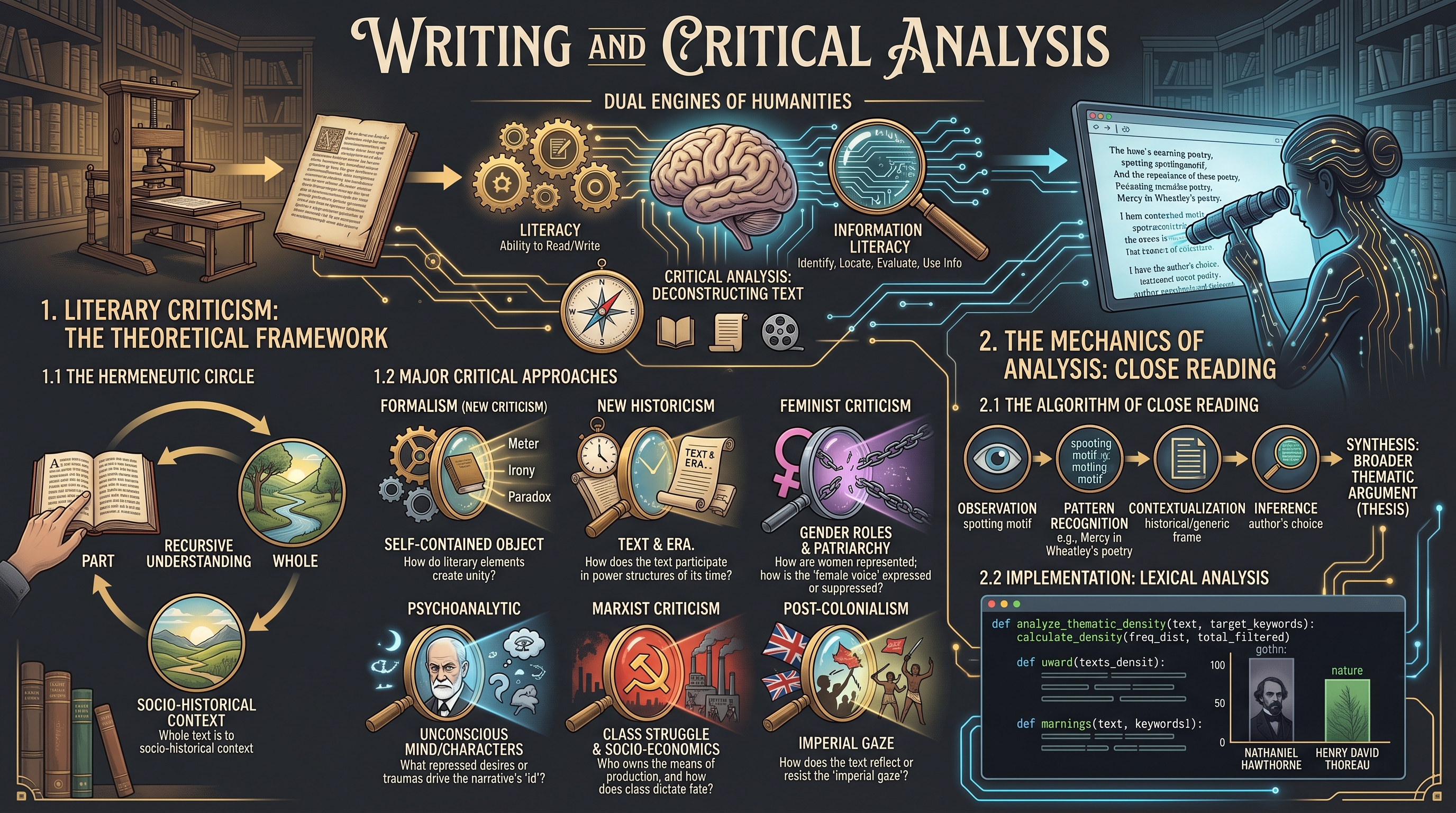
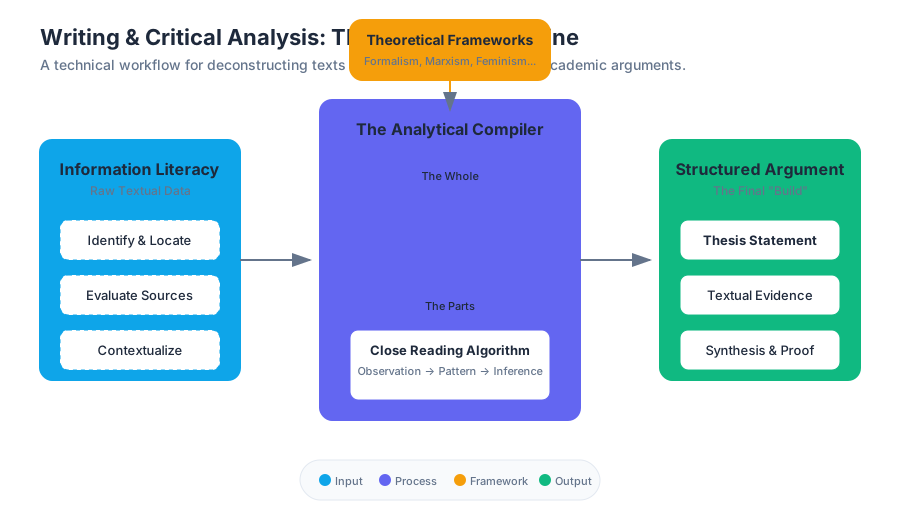
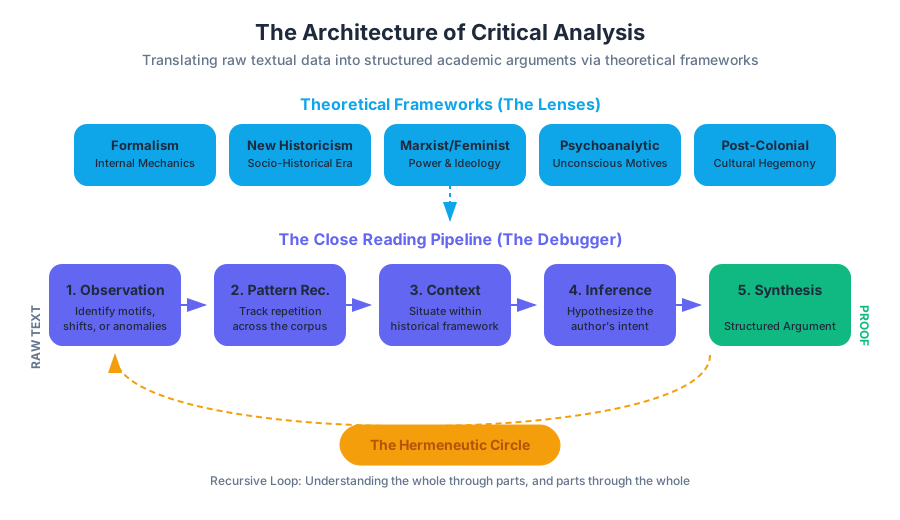
Source Materials
- Literacy and Critical Thinking
- Literature and Literacy
- British and Irish Literature
- American Literature
- Medieval Literature
- Supplementary Materials (Literature)
- 2: Early American and Puritan Literature (1650–1750)
- World Literature
- Classics
- Poetry, Plays, Essays, and other Genres
- American Literature I (Eidenmuller)
- 1: Reading and Interpreting Literary Texts
Study Literature and Literacy with AI — Free on Lykke
Sign up for free to generate personalized flashcards, quizzes, and study guides from this course. Chat with an AI tutor that knows the material.
Get Started FreeView this course wiki on Lykke · Browse all public course wikis