From the free course Literature and Literacy on Lykke
Abolition, Civil War, and the Rise of Realism
Key concepts: Abolitionist Literature · Reconstruction · Realism · Naturalism
Examines literature surrounding the Civil War and the subsequent shift toward Realistic depictions of life.
Abolition, Civil War, and the Rise of Realism
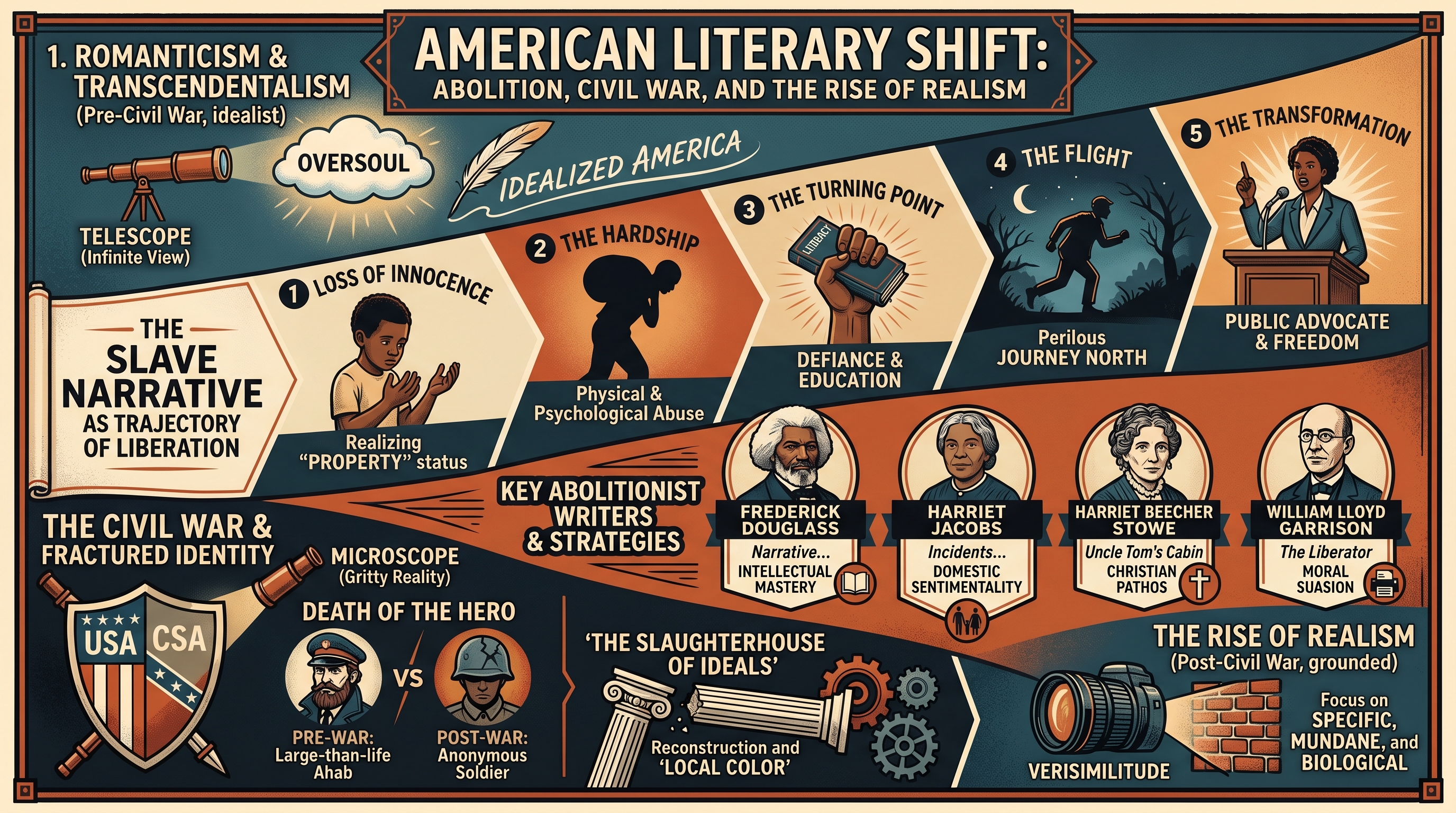
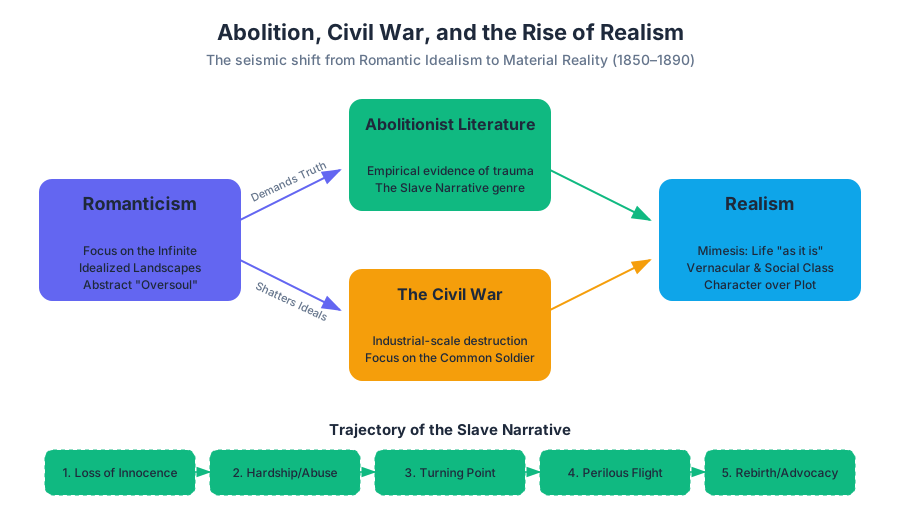
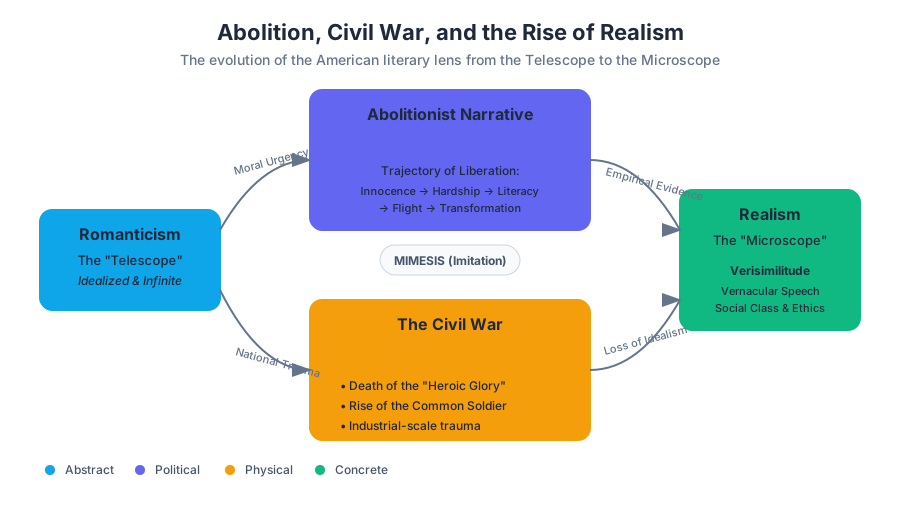
The mid-to-late 19th century in American literature represents a seismic shift from the transcendental "Oversoul" and the idealized "American Renaissance" to a gritty, unvarnished engagement with the material world. This transition was not merely an aesthetic choice but a socio-political necessity born from the trauma of the Civil War and the moral urgency of the Abolitionist movement. As the nation fractured, the literary "lens" shifted from the telescope (looking at the infinite) to the microscope (looking at the specific, the mundane, and the biological).
Abolitionist Literature: The Rhetoric of Liberation
Abolitionist literature was the first major strike against the Romantic tendency to idealize the American landscape. It demanded that readers confront the "peculiar institution" of slavery through a lens of radical empathy and empirical evidence. Unlike the abstract musings of the Transcendentalists, Abolitionist writing—particularly the Slave Narrative—functioned as a legal and moral deposition.
The Slave Narrative as Genre
The slave narrative was a highly structured autobiographical form designed to prove the humanity and intellectual capacity of the enslaved person. These texts followed a specific "trajectory of liberation":
- The Loss of Innocence: Realizing the status of being "property."
- The Hardship: Detailed accounts of physical and psychological abuse.
- The Turning Point: An act of defiance or the acquisition of literacy.
- The Flight: The perilous journey North.
- The Transformation: Rebirth as a free man/woman and a public advocate.
Definition: Verisimilitude The appearance of being true or real. In Abolitionist literature, verisimilitude was a political weapon; by providing names, dates, and specific locations, authors like Frederick Douglass and Harriet Jacobs made it impossible for Northern audiences to dismiss their accounts as "fiction."
Key Abolitionist Texts and Strategies
| Author | Key Work | Primary Rhetorical Strategy | Objective |
|---|---|---|---|
| Frederick Douglass | Narrative of the Life... | Intellectual Mastery | To prove that literacy is the path from slavery to freedom. |
| Harriet Jacobs | Incidents in the Life... | Domestic Sentimentality | To appeal to Northern white women regarding the sanctity of motherhood. |
| Harriet Beecher Stowe | Uncle Tom’s Cabin | Christian Pathos | To frame slavery as a direct violation of Christian morality. |
| William Lloyd Garrison | The Liberator | Moral Suasion | To demand immediate, uncompensated emancipation. |
To understand the linguistic shift from the Romantic "flowery" prose to the Abolitionist "direct" prose, we can look at a computational comparison of lexical density and sentiment.
The Civil War and the Fracture of National Identity
The American Civil War (1861–1865) acted as a "slaughterhouse of ideals." The sheer scale of industrial-scale death rendered the Romantic notions of "heroic glory" obsolete. Literature produced during and immediately after the war shifted toward the Reconstruction of the self and the state.
The Death of the Hero
Pre-war literature often featured "larger-than-life" protagonists (e.g., Ahab, Natty Bumppo). Post-war literature introduced the "Common Soldier"—an anonymous, often terrified individual caught in a machine of destruction. This is best exemplified in Stephen Crane’s The Red Badge of Courage, which, although written later, captured the psychological fragmentation of the war.
Reconstruction and the "New South"
Literature of the Reconstruction era (1865–1877) dealt with the "ghosts" of the Confederacy and the precarious new reality for freedmen. This period saw the rise of Regionalism, as writers sought to preserve the "local color" of a country that was being rapidly homogenized by railroads and telegraphs.
The Rise of Realism: The "Commonplace" as Art
Realism emerged as a reaction against the "lies" of Romanticism. Led by figures like William Dean Howells, Henry James, and Mark Twain, Realism sought to portray life "as it is," focusing on the middle class, social manners, and the ethical choices of ordinary people.
The Mechanics of Realism
Realism operates on the principle of Mimesis (imitation of reality). Unlike Romanticism, which prioritizes the author's imagination, Realism prioritizes the reader's recognition.
- Character over Plot: The "what happens" is less important than "why the character chooses it."
- Social Class: Characters are rooted in a specific socio-economic reality.
- Objective Narrator: The author attempts to remain a neutral observer, avoiding the "intrusive" moralizing of earlier eras.
- Vernacular Speech: Characters speak in dialects that reflect their region and class (e.g., Huck Finn).
| Feature | Romanticism | Realism |
|---|---|---|
| Subject | The Extraordinary / The Sublime | The Ordinary / The Commonplace |
| Setting | Exotic, distant, or historical | Contemporary, local, and familiar |
| Tone | Subjective and Emotional | Objective and Analytical |
| Ending | Often symbolic or moralistic | Often "open" or unresolved |
Naturalism: The Biological Imperative
If Realism is a microscope, Naturalism is a dissection kit. Emerging in the late 19th century and heavily influenced by Charles Darwin’s On the Origin of Species, Naturalism is often described as "Realism on steroids."
The Deterministic Philosophy
Naturalism posits that human beings are "human beasts," governed not by free will or divine providence, but by Determinism. A character's fate is the inevitable result of two primary variables: Heredity and Environment.
The Naturalist Formula $Fate = f(Heredity, Environment, Chance)$ Where $f$ is a non-linear function that usually trends toward entropy (decline).
Key Characteristics of Naturalism
- The Brute Within: Characters often revert to animalistic instincts (hunger, sex, fear) when under pressure.
- Indifferent Universe: The "Nature" of the Romantics was a spiritual teacher; the "Nature" of the Naturalists is a cold, mechanical force that doesn't care if you live or die (e.g., Stephen Crane’s The Open Boat).
- Clinical Detachment: The writer acts as a scientist conducting an experiment on the characters.
Comparison of Deterministic Variables
% Representing the Naturalist worldview as a logical derivation
% Let P be the Protagonist, H be Heredity, E be Environment, and S be Survival.

\begin{aligned}
    &\text{Premise 1: } P \text{ is a biological entity subject to } H. \\
    &\text{Premise 2: } E \text{ provides the constraints (poverty, climate, war)}. \\
    &\text{Premise 3: } \text{Free Will (W) is an illusion; } W \approx 0. \\
    &\therefore \text{The outcome } O \text{ is determined by } \int (H + E) dt. \\
    &\text{In Naturalist fiction, } O \text{ usually results in tragedy or stasis.}
\end{aligned}
Regionalism and Local Color: Mapping the Fractured Nation
As the United States expanded and the Civil War ended, there was a desperate need to "map" the diverse identities of the country. Regionalism (or Local Color) focused on the specific quirks, dialects, and customs of particular geographic areas.
The "Local Color" Pipeline
- Observation: The writer identifies a unique subculture (e.g., the Maine coast, the California mining camps).
- Dialect Capture: Transcribing phonetically how people actually speak (e.g., "I reckon" vs. "I suppose").
- Topography: Detailed descriptions of the landscape as a character in itself.
- Nostalgia: Often, these stories were written for an urban audience in the North, providing a "window" into a disappearing way of life.
| Region | Key Author | Focus |
|---|---|---|
| The West | Bret Harte | Mining camps, gamblers, and "rough" justice. |
| The South | George Washington Cable | Creole culture and the racial complexities of Louisiana. |
| New England | Sarah Orne Jewett | The quiet, fading lives of rural Maine women. |
| The Midwest | Hamlin Garland | The harsh, unromantic reality of "Main-Travelled Roads." |
Common Pitfalls and Misconceptions
- Confusing Realism with "Reality": Realism is a literary style, not reality itself. It is a highly constructed set of conventions designed to feel real.
- Naturalism as Pessimism: While Naturalist works often end poorly, the authors viewed themselves as "truth-tellers" or "social scientists," not necessarily pessimists. They believed that by exposing the "laws" of human behavior, society might eventually be improved.
- Abolitionist Literature as "Just Politics": Many critics historically dismissed slave narratives as mere propaganda. Modern scholarship recognizes them as foundational texts of American autobiography and sophisticated rhetorical achievements.
Summary of the Era's Evolution
The movement from Abolition to Naturalism represents a "downward" trajectory in terms of human agency.
- Abolitionists believed in the power of the will to change the world.
- Realists believed in the power of the individual to navigate social structures.
- Naturalists believed that the individual was a mere speck in a vast, uncaring machine.
This evolution set the stage for Modernism, which would take this fragmentation and turn it into a formal experiment, breaking the narrative "mirror" that the Realists had worked so hard to polish.
Source Materials
Study Literature and Literacy on Lykke
This course page is free to open: signed out, you can read its first two sections, and signing in, on any plan, opens the rest. The free Lykke Chrome extension syncs your own Canvas courses, so ChatGPT, Claude and Muse can answer from your classes and deadlines. It only reads Canvas.
Add the free extensionSign in to open every sectionAll sections of Literature and Literacy · Browse more course pages