From the free course Introduction to Literature on Lykke
Genres: Fiction and Creative Nonfiction
Key concepts: Literary Fiction · Literary Nonfiction · Truth Claims · Narrative Elements
Distinguishing between fictional narratives and the literary techniques used in factual reporting.
Genres: Fiction and Creative Nonfiction
The distinction between Fiction and Creative Nonfiction (CNF) is often misunderstood as a binary between "lies" and "truth." In literary theory and academic analysis, however, these genres are defined not by the objective accuracy of their content, but by the Truth Claim established between the author and the reader. Both genres utilize a shared toolkit of narrative elements—characterization, pacing, imagery, and structure—to achieve their ends. This section explores the formal mechanics of these genres, the philosophical implications of the "Authorial Contract," and the technical frameworks used to analyze narrative prose.
The Taxonomy of Narrative Prose
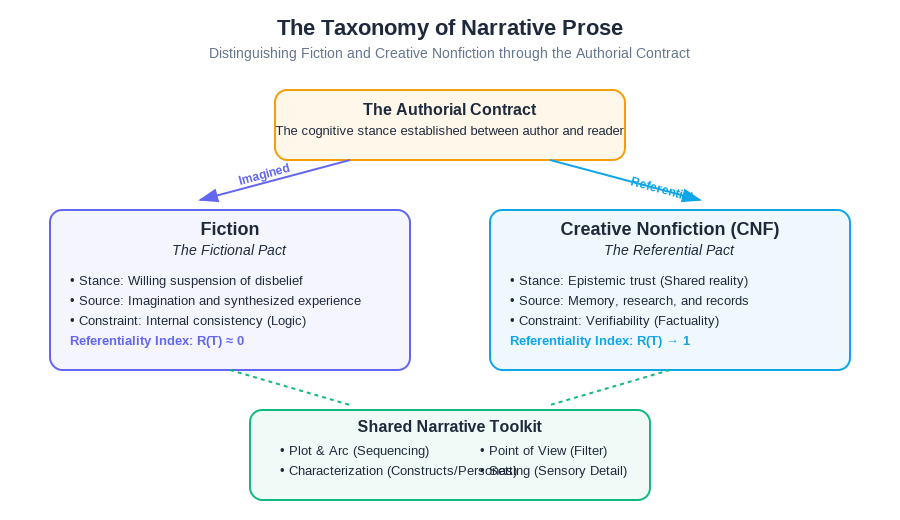
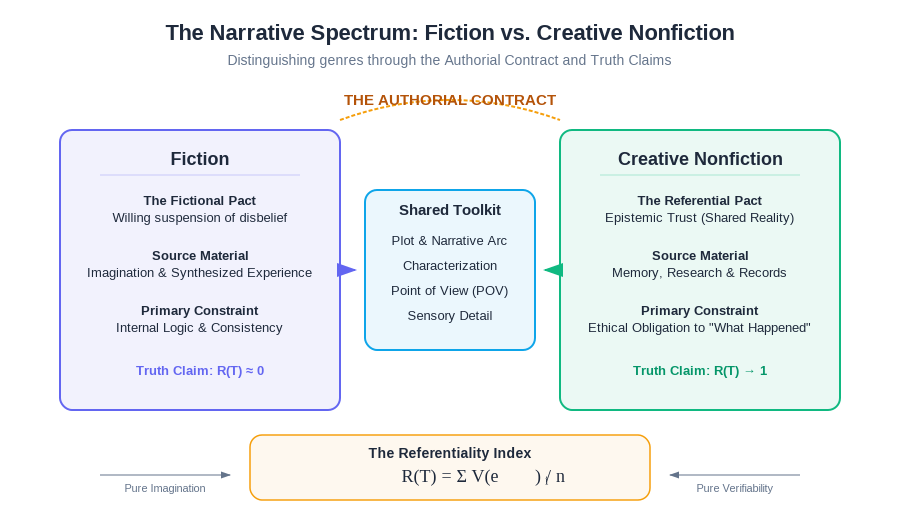
In the context of Open Educational Resources (OER) and literary study, prose is categorized based on its relationship to the "real world." While Fiction creates a self-contained universe governed by its own internal logic, Creative Nonfiction seeks to interpret the actual world through a subjective, artistic lens.
| Feature | Fiction | Creative Nonfiction |
|---|---|---|
| Primary Goal | Aesthetic experience, thematic exploration, or entertainment via imagination. | Aesthetic exploration of factual events, personal reflection, or reportage. |
| Truth Claim | Implicitly "untrue" or "imagined" (The Fictional Pact). | Explicitly "true" or "factually grounded" (The Referential Pact). |
| Source Material | Imagination, archetypes, and synthesized experience. | Memory, research, interviews, and historical records. |
| Ethical Constraint | Minimal; restricted primarily by internal consistency. | High; restricted by the obligation to represent "what happened." |
| Structural Basis | Plot (causal sequences). | Narrative (thematic or chronological arrangement of facts). |
The Authorial Contract: A theoretical agreement where the reader adopts a specific cognitive stance based on the genre label. In fiction, the reader engages in the willing suspension of disbelief. In nonfiction, the reader grants the author epistemic trust, assuming the events described have a basis in shared reality.
Truth Claims and the Referentiality Index
The defining characteristic of a genre is its Truth Claim. This is not a guarantee of 100% accuracy—human memory is fallible, and perspectives are biased—but rather a declaration of intent.
The Mechanics of the Claim
A truth claim functions as a metadata tag for the text. If a book is labeled "A Novel," the author is permitted to invent dialogue and compress time. If labeled "A Memoir," the same inventions may be viewed as a breach of ethics or "literary fraud."
Formalizing the Truth Claim
We can represent the relationship between the text ($T$) and the world ($W$) as a function of Referentiality ($R$).
R(T) = \frac{\sum_{i=1}^{n} V(e_i)}{n}
Where:
- $e_i$ is a narrative event.
- $V(e_i)$ is the verifiability of that event against external records or shared experience.
- In Fiction, $R(T)$ may approach 0 (pure fantasy) or be high (historical fiction), but the claim remains $R \approx 0$.
- In Creative Nonfiction, the claim is $R \rightarrow 1$.
Narrative Elements: The Shared Toolkit
Regardless of the truth claim, both genres rely on Narrative Elements to function. These are the "variables" that an author manipulates to create meaning.
1. Plot and Arc
Plot is the sequence of events, while the Arc is the emotional or thematic trajectory. In fiction, the plot is engineered for maximum tension. In CNF, the author must find the plot within the chaos of real events, a process known as Narrative Shaping.
2. Characterization
In fiction, characters are Constructs built from scratch to serve the theme. In CNF, "characters" are Personas—versions of real people (including the author) who are curated to fit the narrative's focus.
3. Point of View (POV)
POV determines the "camera angle" and the "filter" of the story.
| POV Type | Fiction Usage | CNF Usage |
|---|---|---|
| First Person (I) | Used for intimacy or "unreliable narrators." | The standard "I" of the memoirist or essayist. |
| Third Person Limited | Focuses on one character's internal state. | Rare; used in "Literary Journalism" to reconstruct someone else's experience. |
| Third Person Omniscient | The "God-like" narrator; common in 19th-century novels. | Extremely rare; implies a level of knowledge a real human cannot have. |
4. Setting and World-Building
In fiction, the setting can be a character itself (e.g., the moors in Wuthering Heights). In CNF, setting is established through Sensory Detail and Atmospheric Research to ground the reader in a specific time and place.
Creative Nonfiction: The "Fourth Genre"
Creative Nonfiction (also called Literary Nonfiction) is often defined as "true stories well told." It distinguishes itself from standard journalism or technical writing through its use of Subjectivity and Aesthetic Style.
Subgenres of CNF
- The Memoir: A focus on a specific period or theme in the author's life (unlike an autobiography, which is chronological and exhaustive).
- The Personal Essay: A meditative journey where the author "essays" (tries out) an idea.
- Literary Journalism: Using the techniques of fiction (scene-building, dialogue) to report on real-world events (e.g., Truman Capote’s In Cold Blood).
- The Lyric Essay: A hybrid form that leans toward poetry, using fragmentation and imagery rather than linear narrative.
The Ethics of "Creative" Truth
The "Creative" in CNF refers to the form, not the facts. However, certain technical "deviations" are generally accepted in the field:
- Compression: Combining two minor real-life figures into one "character" to simplify the narrative.
- Dialogue Reconstruction: Writing dialogue that "sounds like" what was said, as few people remember exact quotes from years ago.
- Internal Monologue: Speculating on the thoughts of others (highly controversial and must be signaled to the reader).
\text{The Ethics of CNF (E)} = \frac{\text{Aesthetic Quality (A)} \times \text{Emotional Truth (T)}}{\text{Fact Distortion (D)}}
\text{Where } D \to 0 \implies E \to \infty
Literary Fiction vs. Genre Fiction
Within the realm of fiction, a major technical distinction exists between Literary Fiction and Genre (Commercial) Fiction. This is not a value judgment but a difference in Structural Priority.
| Aspect | Literary Fiction | Genre Fiction (Mystery, Sci-Fi, Romance) |
|---|---|---|
| Primary Driver | Character and Theme. | Plot and Trope. |
| Language | Often experimental, lyrical, or "dense." | Transparent, "window-pane" prose focused on clarity. |
| Resolution | Often ambiguous; focuses on internal change. | Usually provides "closure" (the killer is caught, the couple weds). |
| Market Logic | Defined by critical reception and "permanence." | Defined by reader expectations and category conventions. |
Common Pitfalls in Genre Classification
- The "Based on a True Story" Trap: Movies and books often use this disclaimer. Technically, if the author changes names and invents scenes for dramatic effect, it is Fiction (specifically Historical or Biographical Fiction), not CNF.
- Confusing "Truth" with "Fact": A poem can be "true" in its emotional resonance while being entirely "fictional" in its events. CNF aims for both; Fiction aims for the former.
- Assuming Nonfiction is Objective: All nonfiction is filtered through a human brain. The "Creative" in CNF acknowledges this bias, whereas "Standard Journalism" attempts to minimize it.
Summary of Narrative Mechanics
The study of fiction and creative nonfiction is the study of how humans encode meaning into sequences of events. Whether the events are "found" (nonfiction) or "made" (fiction), the success of the work depends on the author's mastery of the Narrative Elements and their adherence to the Truth Claim established at the outset. For the student of literature, recognizing these frameworks is the first step toward deep critical analysis.
- Truth Claim: The author's explicit or implicit declaration of the text's relationship to reality.
- Referential Pact: The agreement that a nonfiction work is based on verifiable facts.
- Willing Suspension of Disbelief: The reader's decision to accept the internal logic of a fictional world.
- Persona: The "version" of the self presented by the author in creative nonfiction.
- Narrative Shaping: The process of selecting and arranging real-world facts to create a cohesive story arc.
- Freytag’s Pyramid: A common structural model for fiction involving exposition, rising action, climax, falling action, and denouement.
- Literary Journalism: A subgenre of CNF that applies fictional techniques to factual reporting.
-
What is the primary difference between an autobiography and a memoir?
- A) An autobiography is fiction; a memoir is nonfiction.
- B) An autobiography is an exhaustive life story; a memoir is themed or focused on a specific period.
- C) A memoir uses characters, while an autobiography does not.
- D) There is no difference.
-
If an author changes the names of people in a factual account to protect their privacy, is the work still Creative Nonfiction?
- A) No, it becomes fiction immediately.
- B) Yes, this is an accepted convention of the "Creative" aspect of CNF.
- C) Only if the author provides a legal disclaimer.
- D) No, it is classified as "False Nonfiction."
-
Which narrative element is most likely to be "unreliable" in a first-person fictional story?
- A) The Setting.
- B) The Plot.
- C) The Point of View (The Narrator).
- D) The Theme.
-
In the "Referentiality Index," a score of 1.0 would most likely belong to:
- A) A high-fantasy novel.
- B) A historical fiction novel.
- C) A peer-reviewed scientific paper or a strict biography.
- D) A lyric essay.
Core Learning Objectives
- Distinguish between the "Referential Pact" of nonfiction and the "Fictional Pact" of literature.
- Identify the five key narrative elements (Plot, Character, Setting, POV, Theme) in any prose text.
- Analyze the ethical boundaries of Creative Nonfiction, specifically regarding dialogue reconstruction and compression.
- Compare the structural priorities of Literary Fiction versus Genre Fiction.
Deep-Dive Questions
- How does the "Truth Claim" of a text change your emotional response to a character's suffering?
- If a memoir is later discovered to be entirely fabricated (e.g., the James Frey scandal), why does it lose its value as a "literary" work even if the prose remains the same?
- In what ways can "Narrative Shaping" be seen as a form of bias in journalism?
- Can a work of fiction be "truer" than a work of nonfiction? Defend your answer using the concept of "Emotional Truth."
Source Materials
Study Introduction to Literature on Lykke
This course page is free to open: signed out, you can read its first two sections, and signing in, on any plan, opens the rest. The free Lykke Chrome extension syncs your own Canvas courses, so ChatGPT, Claude and Muse can answer from your classes and deadlines. It only reads Canvas.
Add the free extensionSign in to open every sectionAll sections of Introduction to Literature · Browse more course pages