From the free course Introduction to Literature on Lykke
Comprehensive Literary Terminology
Key concepts: Allegory · Foreshadowing · Irony · Motif · Hyperbole
A deep dive into the specific terms used to discuss and analyze narrative and poetic works.
Comprehensive Literary Terminology
Overview
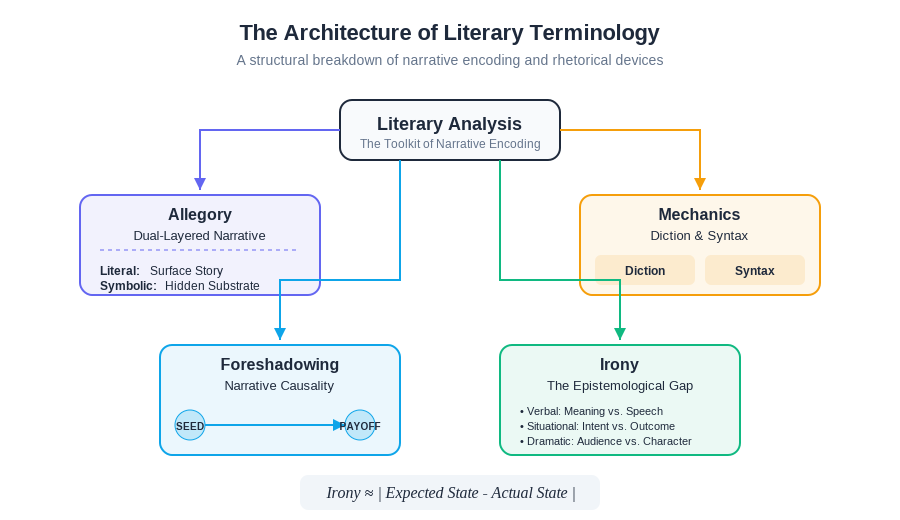
In the professional study of literature, terminology serves as more than a collection of labels; it functions as a high-precision toolkit for deconstructing the architecture of human expression. To move beyond passive consumption and into the realm of Literary Analysis, one must master the "grammar of narrative"—the specific devices authors use to encode meaning, manipulate time, and evoke emotional resonance. This article provides a deep-dive into the foundational concepts of Allegory, Foreshadowing, Irony, Motif, and Hyperbole, situating them within the broader context of active reading and historical literary style.
The Mechanics of Narrative Encoding
Literary devices are not merely "decorations" added to a story. They are functional components of a text's operating system. When an author employs Diction (specific word choice) or Syntax (sentence structure), they are setting the parameters for how a reader processes information.
1. Allegory: The Dual-Layered Narrative
Definition: An Allegory is a narrative in which characters, places, and events carry a symbolic meaning that transcends the literal surface of the story. It functions as an extended metaphor, where the "Literal Surface" (Level A) maps directly onto a "Symbolic Substrate" (Level B).
Why it Matters Allegory allows authors to discuss complex political, moral, or religious ideas under the guise of fiction. By abstracting reality into a controlled narrative environment, the author can critique social structures without the immediate friction of literal polemics.
How it Works: The Mapping Function The efficacy of an allegory depends on the consistency of its mapping. If a character represents "Justice," their actions must consistently reflect the philosophical attributes of justice.
| Component | Literal Level (Surface) | Symbolic Level (Substrate) |
|---|---|---|
| Character | A farm pig named Napoleon | A historical figure (e.g., Joseph Stalin) |
| Setting | A neglected English farm | A failing or transitioning political state |
| Conflict | Animals rebelling against a farmer | The proletariat overthrowing the bourgeoisie |
| Resolution | The pigs becoming indistinguishable from humans | The corruption of revolutionary ideals |
Common Pitfalls
- Over-simplification: Reducing a complex text to a "one-to-one" code where every detail must have a secret meaning.
- Anachronism: Applying modern allegorical interpretations to historical texts where the author could not have intended such a mapping.
2. Foreshadowing: Narrative Causality and Temporal Logic
Foreshadowing is the use of indicative fragments—hints, symbols, or dialogue—to suggest future events. It creates a sense of "narrative inevitability," ensuring that when the climax occurs, it feels earned rather than accidental.
The Algorithm of Foreshadowing In a well-constructed plot, foreshadowing operates like a pre-declaration of variables in a program. If a "variable" (a gun, a secret, a character flaw) is introduced in Act I, it must be "called" or resolved by Act III. This is famously known as Chekhov’s Gun.
Variations of Foreshadowing
- Direct Foreshadowing: Explicitly stating that something bad is coming (e.g., "Little did he know...").
- Atmospheric Foreshadowing: Using the setting or weather (e.g., a gathering storm) to mirror upcoming conflict.
- Prophetic Foreshadowing: Using dreams, omens, or oracles to outline the plot.
3. Irony: The Epistemological Gap
Irony is a rhetorical device, literary technique, or situation in which there is a sharp incongruity between expectation and reality. It is the "gap" between what is said and what is meant, or what is expected and what occurs.
Types of Irony Irony is categorized based on who possesses the knowledge and where the contradiction lies.
| Type | Definition | Example |
|---|---|---|
| Verbal Irony | A speaker says the opposite of what they mean (often Sarcasm). | Saying "What lovely weather!" during a hurricane. |
| Situational Irony | The outcome is the exact opposite of what was intended. | A fire station burning down. |
| Dramatic Irony | The audience knows something that the characters do not. | In Oedipus Rex, the audience knows Oedipus killed his father, but he does not. |
| Cosmic Irony | The idea that fate or the gods are toy with human expectations. | A man survives a war only to trip on his shoelace and die at home. |
Mathematical Representation of Irony Irony can be viewed as the absolute difference between the Expected State ($S_e$) and the Actual State ($S_a$).
$$ Irony \approx | S_e - S_a | $$
Where the intensity of the irony is proportional to the magnitude of the delta between expectation and reality. In Dramatic Irony, this delta is shared with the observer (reader) but hidden from the subject (character), creating a tension defined by the information asymmetry.
4. Motif: The Structural Pattern
A Motif is a recurring element—an image, a sound, a word, or a phrase—that has symbolic significance in a story. Unlike a symbol (which might appear once), a motif must repeat to establish a pattern.
Why it Matters Motifs function as the "connective tissue" of a literary work. They reinforce the Theme (the central idea) by providing a rhythmic return to key concepts. For example, in The Great Gatsby, the motif of "green" (the light, the grass, the money) reinforces the theme of the American Dream and envy.
Motif vs. Symbol
- Symbol: A concrete object representing an abstract idea (e.g., a wedding ring representing commitment).
- Motif: The repetition of symbols or ideas to build a thematic structure (e.g., the recurring mention of jewelry and gold throughout a novel to highlight materialism).
5. Hyperbole: Rhetorical Amplification
Hyperbole is the use of intentional and obvious exaggeration for emphasis or effect. It is not meant to be taken literally but is used to convey the magnitude of a feeling or situation.
Mechanics of Hyperbole Hyperbole works by stretching the "truth" until it reaches a point of absurdity, which paradoxically highlights the underlying emotional truth. In the history of Renaissance Oratory, hyperbole was a vital tool for persuasive speech, allowing the speaker to elevate their subject to heroic proportions.
Example in Poetry Consider Andrew Marvell’s "To His Coy Mistress":
"My vegetable love should grow / Vaster than empires and more slow;"
Here, "vaster than empires" is a hyperbolic expression of the scale of his affection, used to contrast with the "deserts of vast eternity" (death) that follow.
Historical Context: The Evolution of Style
The use of these terms has shifted across literary eras. As noted in The Rough Guide to Literary Style, the "how" of writing is as important as the "what."
| Era | Primary Style Focus | Key Usage of Terminology |
|---|---|---|
| Renaissance | Oratory & Ornamentation | Heavy use of Hyperbole and complex Allegory. |
| Enlightenment | Rationalism & Clarity | Precise Diction; use of Irony for social satire (e.g., Swift). |
| Romanticism | Emotionalism & Nature | Motifs centered on the natural world; Hyperbole of the self. |
| Modernism | Minimalism & Fragmentation | Subtle Foreshadowing; rejection of "obvious" Allegory. |
Active Reading: Strategies for Identification
To identify these concepts in a text, one must employ Active Reading Strategies. This involves moving from a passive recipient of the story to an active investigator of the text's mechanics.
Annotating and Tracing Ideas
As suggested by the Reading to Write Effectively guide, students should use a systematic approach to note-taking:
- Trace the Motif: Every time a specific image recurs, mark it in the margin with a unique symbol (e.g., a star for "light" imagery).
- Identify the Irony: When a character makes a statement that contradicts their situation, label it
[VI](Verbal Irony) or[DI](Dramatic Irony). - Conversing with the Author: Write questions in the margins. "Why is the author using this hyperbole here? Is it to make the character seem unreliable?"
Reading a Play vs. Reading Fiction
When analyzing Dramatic Texts, the application of these terms changes. In a play, Dramatic Irony is the dominant force because the audience sees the entire stage, while characters are often limited by their physical presence in a scene.
Common Pitfalls in Literary Analysis
- Confusing Theme with Motif: A theme is an idea (e.g., "The corrupting nature of power"), while a motif is a recurring element that points to that theme (e.g., a recurring image of a crown being dropped).
- Literalism in Hyperbole: Failing to recognize hyperbole leads to a "flat" reading where the emotional stakes are missed.
- Misidentifying Irony as Coincidence: Irony requires a specific reversal of expectation or a gap in knowledge. A "bad thing happening" is just a misfortune; a "fireman's house burning down" is situational irony.
Conclusion
Mastering literary terminology is the first step toward professional critical analysis. By understanding the mechanics of Allegory, the temporal logic of Foreshadowing, the epistemological gaps of Irony, the structural patterns of Motif, and the rhetorical power of Hyperbole, readers can deconstruct any text—whether it be a Renaissance play, a Modernist novel, or a contemporary poem—to reveal the deeper layers of meaning intended by the author.
- Allegory: A narrative where characters/events represent abstract ideas or historical events.
- Foreshadowing: Hints or clues dropped early in a story to suggest future developments.
- Dramatic Irony: When the audience knows more about a situation than the characters involved.
- Situational Irony: A discrepancy between the expected result and the actual outcome.
- Verbal Irony: When a speaker says the opposite of what they mean, often for humorous or emphatic effect.
- Motif: A recurring element, image, or concept that supports a text's theme.
- Hyperbole: Deliberate exaggeration used for emphasis or rhetorical effect.
- Chekhov's Gun: The principle that every element introduced in a story must be necessary to the plot.
- Diction: The specific choice and use of words and phrases in speech or writing.
-
Which device is primarily defined by an "information asymmetry" between the audience and the characters?
- A) Hyperbole
- B) Dramatic Irony
- C) Motif
- D) Allegory (Correct: B)
-
If a character in a story repeatedly dreams of falling, and this image appears in several chapters to highlight their loss of control, "falling" is a:
- A) Hyperbole
- B) Foreshadowing
- C) Motif
- D) Verbal Irony (Correct: C)
-
What is the primary difference between a Symbol and an Allegory?
- A) Symbols are only used in poetry; allegories are used in prose.
- B) A symbol is a single object/idea; an allegory is a complete narrative system of symbols.
- C) Allegories are always religious; symbols are secular.
- D) There is no difference. (Correct: B)
-
"I've told you a million times to stop using hyperbole!" is an example of:
- A) Foreshadowing
- B) Paradoxical Hyperbole
- C) Situational Irony
- D) All of the above (Correct: B/C - It uses hyperbole to complain about hyperbole)
Key Review Points:
- Allegory Mapping: Practice mapping Animal Farm or Plato's Cave to their real-world counterparts.
- Irony Identification: Watch a scene from a Shakespearean play and identify where the audience knows more than the hero (Dramatic Irony).
- Active Reading: Take a 5-page sample of a novel. Highlight every recurring image (Motif) and underline any hints of future conflict (Foreshadowing).
- Style History: Note how the "ornate" style of the Renaissance differs from the "minimalist" style of Modernism in their use of figurative language.
- Terminology Precision: Ensure you can distinguish between a Simile (comparison using 'like/as') and a Metaphor (direct comparison), and how both differ from the extended system of an Allegory.
Source Materials
Study Introduction to Literature on Lykke
This course page is free to open: signed out, you can read its first two sections, and signing in, on any plan, opens the rest. The free Lykke Chrome extension syncs your own Canvas courses, so ChatGPT, Claude and Muse can answer from your classes and deadlines. It only reads Canvas.
Add the free extensionSign in to open every sectionAll sections of Introduction to Literature · Browse more course pages