From the free course Introduction to Literature on Lykke
Reading and Research Strategies
Key concepts: Reading like a writer · Critical Analysis · Academic Research · Literary Interpretation
Techniques for reading literature critically and conducting academic research.
Reading and Research Strategies
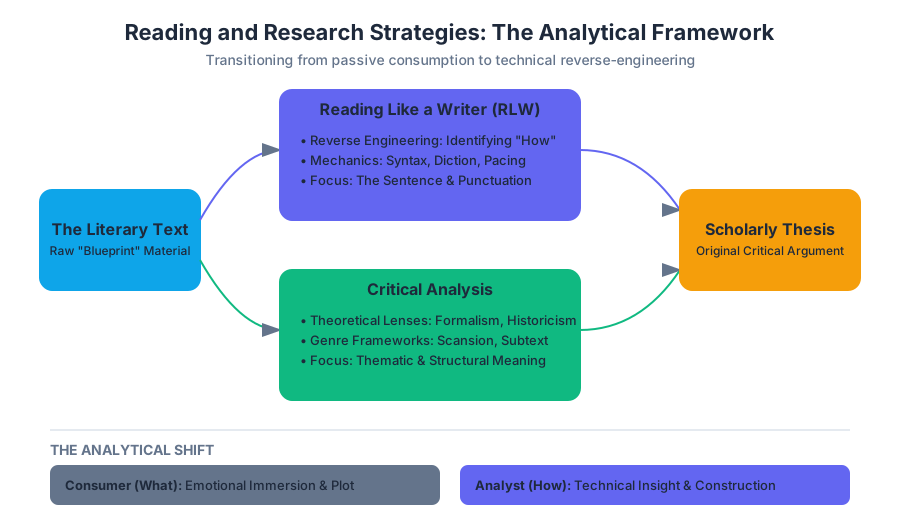
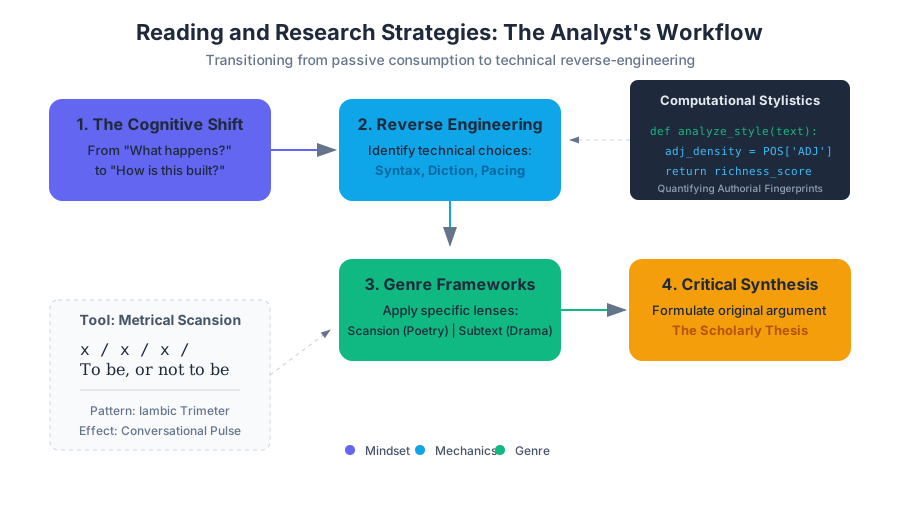
To analyze literature effectively, one must transcend passive consumption and adopt the mindset of an architect or a forensic engineer. This transition—moving from "what happens next" to "how is this effect achieved"—is the core of academic literary study. This article outlines the systematic frameworks required to deconstruct texts, conduct rigorous research, and synthesize original scholarly arguments.
Reading Like a Writer: The Reverse Engineering of Craft
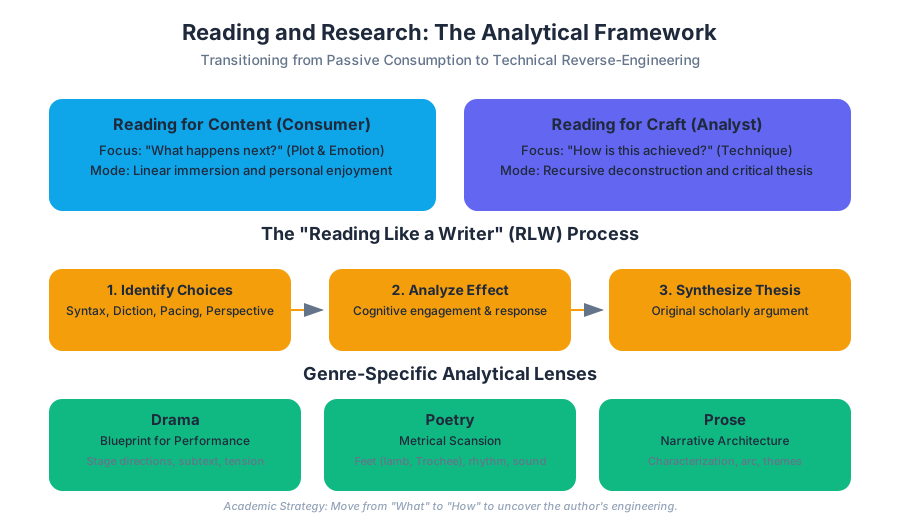
Reading like a writer (RLW) is the practice of examining a text to identify the technical choices made by the author. Instead of focusing solely on the narrative content (the what), the reader focuses on the construction (the how). This involves identifying the "tools" in the author's kit: syntax, diction, pacing, and narrative perspective.
The Mechanics of Choice
Every word in a literary work represents a decision. When an author chooses a periodic sentence—where the main clause is withheld until the end—they are engineering suspense and intellectual weight. Conversely, a minimalist style (common in Modernism) forces the reader to fill in the gaps, creating a different kind of cognitive engagement.
Definition: Reading Like a Writer The analytical process of identifying the specific linguistic and structural techniques an author employs to produce a particular emotional or intellectual response in the reader.
| Feature | Reading for Content (Consumer) | Reading for Craft (Analyst) |
|---|---|---|
| Primary Goal | Emotional immersion / Plot comprehension | Understanding construction / Technique identification |
| Focus Unit | The Scene / The Chapter | The Sentence / The Word / The Punctuation |
| Question Asked | "What happens to the character?" | "Why did the author use this specific metaphor here?" |
| Temporal View | Linear (Forward-moving) | Recursive (Back-and-forth) |
| Outcome | Personal enjoyment | Technical insight / Critical thesis |
Critical Analysis and Literary Interpretation
Critical Analysis is the systematic breakdown of a text into its constituent parts to evaluate how they work together to create meaning. This process is governed by Literary Interpretation, which applies various theoretical lenses (e.g., Formalism, New Historicism, Psychoanalysis) to the evidence gathered during analysis.
The Genre-Specific Framework
Analysis techniques vary significantly across genres. A play, for instance, must be read as a "blueprint for performance" rather than a finished prose product.
- Drama: Focuses on Dramatic Text Analysis, examining stage directions, subtext in dialogue, and the "unspoken" tension between characters.
- Poetry: Requires an understanding of Accentual-syllabic Metre and sound devices.
- Prose: Focuses on characterization, narrative arc, and thematic development.
Metrical Analysis (Scansion)
In poetry, the rhythm is often as important as the literal meaning. We use Scansion to map the stressed (/) and unstressed (x) syllables.
Theorem: The Metrical Unit A foot is the basic unit of measurement in poetry. The most common in English is the Iamb (x /). The combination of the type of foot and the number of feet per line (e.g., Iambic Pentameter) defines the poem's "pulse."
| Foot Type | Pattern | Example | Effect |
|---|---|---|---|
| Iamb | x / | "To be" | Natural, conversational, rising |
| Trochee | / x | "Double" | Urgent, driving, falling |
| Anapest | x x / | "Understand" | Galloping, light, fast |
| Dactyl | / x x | "Poetry" | Grandiose, classical |
| Spondee | / / | "Heartbreak" | Weighty, emphatic, slowing |
Formalizing Scansion Logic
ALGORITHM ScanLine(line_text):
    tokens = TokenizeBySyllable(line_text)
    stress_map = []

    FOR EACH syllable IN tokens:
        IF syllable IN Dictionary.StressedPatterns:
            stress_map.APPEND(STRESSED)
        ELSE IF syllable.IsMonosyllabicContentWord:
            stress_map.APPEND(STRESSED)
        ELSE:
            stress_map.APPEND(UNSTRESSED)

    # Pattern Matching
    IF stress_map MATCHES [x, /, x, /, x, /, x, /, x, /]:
        RETURN "Iambic Pentameter"
    ELSE IF stress_map MATCHES [/, x, /, x, /, x, /, x]:
        RETURN "Trochaic Tetrameter"
    ...
The Evolution of Literary Style
Style is not static; it is a reflection of the philosophical and cultural zeitgeist of its era. Understanding the historical context of a style allows a researcher to interpret why a writer chose a specific mode of expression.
Historical Style Matrix
| Era | Dominant Style | Key Characteristics | Philosophical Driver |
|---|---|---|---|
| Renaissance | Oratory / Ornate | Complex syntax, classical allusions, rhetoric. | Humanism and the revival of Greek/Roman ideals. |
| Enlightenment | Rationalism | Clarity, balance, "Heroic Couplets," precision. | Reason, logic, and the scientific method. |
| Romanticism | Emotionalism | Sensory detail, focus on the "I," nature-centric. | Reaction against industrialization; primacy of feeling. |
| Victorian | Realism | Social detail, moral earnestness, panoramic scope. | Industrial expansion and social reform. |
| Modernism | Minimalism / Stream of Consciousness | Fragmentation, internal monologue, brevity. | Post-WWI disillusionment; breakdown of tradition. |
Academic Research and Synthesis
Research in literature involves moving from the Primary Source (the text itself) to Secondary Sources (peer-reviewed articles, historical documents, and critical essays). The goal is to enter a "scholarly conversation."
Developing the Research Question
A strong research question must be arguable, focused, and evidence-based. It should move beyond simple observation.
- Weak: "How does Shakespeare use imagery in Hamlet?" (Too broad, descriptive).
- Strong: "How does the recurring imagery of disease in Hamlet reflect the Elizabethan anxiety regarding the transition of monarchical power?" (Specific, historical, interpretive).
The Research Pipeline
- Keyword Extraction: Identifying terms like "synecdoche," "liminality," or "post-colonialism" to query databases (JSTOR, Project MUSE).
- Annotation: Using a system of symbols to trace themes across a text.
- Synthesis: Combining your original reading with the insights of other scholars using MLA Style for attribution.
Active Reading Strategies: Conversing with the Author
Effective research begins with Active Reading. This is the process of physically and mentally engaging with the text to prevent "passive skimming."
Annotation Taxonomy
To be efficient, a researcher should use a consistent shorthand for annotations. This allows for quick "tracing" of ideas when it comes time to write.
| Symbol | Meaning | Use Case |
|---|---|---|
| [ ] | Key Passage | Identifying the core thesis or a pivotal plot point. |
| (?) | Ambiguity | Marking sections that require a second look or dictionary check. |
| (CF) | Compare/Contrast | Linking this passage to another part of the text or a different work. |
| (SYM) | Symbolism | Noting recurring objects that carry deeper meaning. |
| (STR) | Structure | Marking shifts in narrative perspective or time. |
Key Insight: Writing Efficiency The most efficient way to write a literary essay is to "write while reading." By generating informal dialogue with the author in the margins, the transition to a formal draft becomes a process of refining existing thoughts rather than generating them from a blank page.
Example: The Annotation Workflow
Imagine reading T.S. Eliot’s The Waste Land. An active reader’s notes might look like this:
- Line 1: "April is the cruelest month..."
- Annotation:
(SYM)Reversal of traditional spring/rebirth tropes.(CF)Chaucer’s Canterbury Tales prologue. - Research Question: Why does Eliot invert the medieval celebration of spring to signal modern decay?
Common Pitfalls in Literary Research
- The Intentional Fallacy: Assuming the author's personal intent is the only "correct" meaning of the text. In modern criticism, the text exists independently of the author's biography.
- Plot Summary vs. Analysis: A common mistake is retelling the story rather than explaining how it works. If you are describing what happened, you are summarizing; if you are describing why it matters, you are analyzing.
- Over-Generalization: Claiming a work represents "all of humanity" or "everyone in the 19th century." Analysis should be grounded in specific textual evidence and historical context.
- Ignoring the "Medium": Analyzing a play as if it were a novel, or a poem as if it were a news report. Each genre has specific conventions (e.g., the soliloquy in drama or enjambment in poetry) that must be addressed.
Source Materials
- Introduction to Literature PDF
- https://www.martineve.com/wp-content/uploads/2011/11/Simon-Davies-Literary-Terms.pdf
- http://www.saylor.org/site/wp-content/uploads/2012/03/ENGL405-2.3-Freeverse-FINAL.pdf
- Wp Login.Php
- Introduction to Literature
- Introduction to Literature
- Introduction to Literature
- Introduction to Literature
Study Introduction to Literature on Lykke
This course page is free to open: signed out, you can read its first two sections, and signing in, on any plan, opens the rest. The free Lykke Chrome extension syncs your own Canvas courses, so ChatGPT, Claude and Muse can answer from your classes and deadlines. It only reads Canvas.
Add the free extensionSign in to open every sectionAll sections of Introduction to Literature · Browse more course pages