From the free course Introduction to Literature on Lykke
Poetry: Fundamentals and Craft
Key concepts: Poetic Analysis · Word Choice and Connotation · Billy Collins · Introduction to Poetry
Introduction to the analytical study of poetry, focusing on craftsmanship, word choice, and the reader-poet relationship.
Poetry: Fundamentals and Craft
Poetry is frequently misunderstood as a purely emotional medium, yet from a technical perspective, it represents the highest density of information per unit of language. While prose functions primarily as a delivery system for narrative or argument, poetry operates as a multi-layered architecture where sound, rhythm, syntax, and semantic weight are processed simultaneously. In this deep-dive, we treat poetic analysis not as a search for "hidden meaning," but as the reverse-engineering of a complex linguistic machine.
The Reader-Poet Relationship: The Collins Framework
The fundamental entry point into modern poetic study is the "invitation." Unlike technical documentation, which aims for zero ambiguity, poetry utilizes controlled ambiguity to engage the reader's cognitive faculties. Billy Collins, a former U.S. Poet Laureate, provides the definitive meta-commentary on this relationship in his work Introduction to Poetry.
What it is
The Reader-Poet Relationship is a communicative contract where the poet provides a set of sensory instructions, and the reader agrees to perform those instructions to "activate" the poem. Collins argues against the "torture" of a poem—the aggressive extraction of a single "meaning"—and instead advocates for an experiential traversal of the text.
Why it matters
In academic and creative contexts, students often approach poetry with "interpretation anxiety." By understanding the Collins framework, the reader shifts from a passive consumer to an active participant. This prevents the "over-analysis" pitfall where the technical components are stripped away, leaving a dry, moralistic summary that ignores the craft.
The Collins Methodology of Engagement
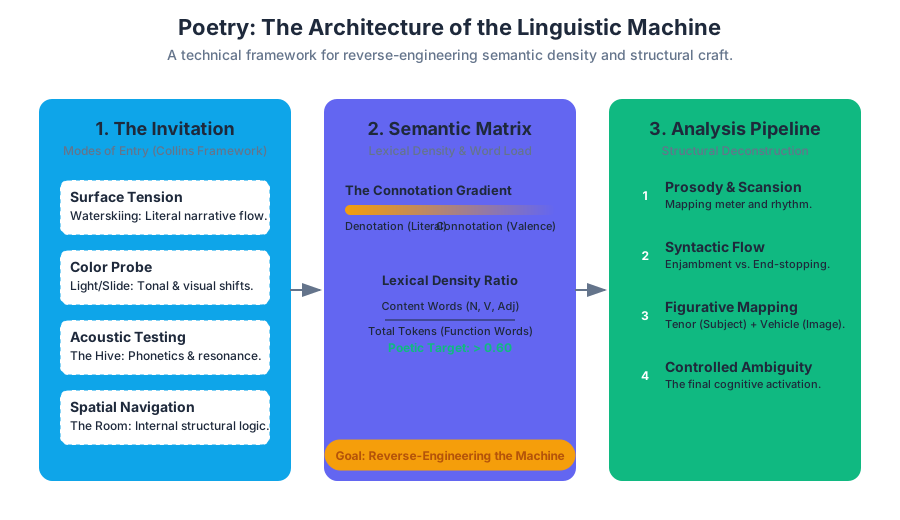
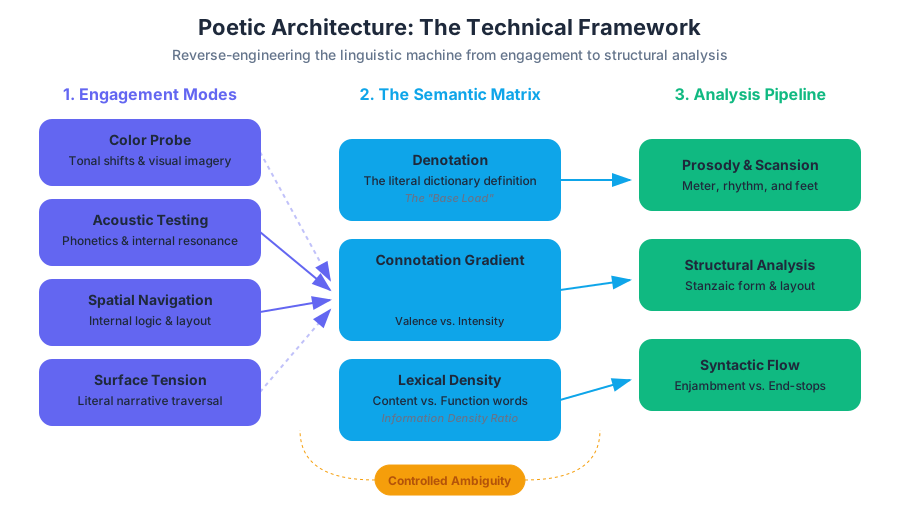
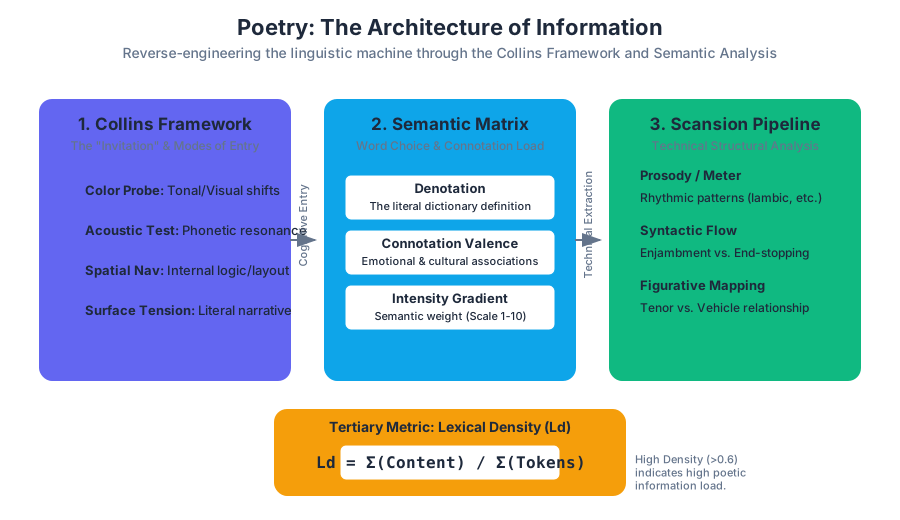
Collins suggests several "modes of entry" for a poem, which we can categorize as follows:
| Mode | Description | Objective |
|---|---|---|
| Color Probe | Holding a poem up to the light like a slide. | Identifying tonal shifts and visual imagery. |
| Acoustic Testing | Pressing an ear against its hive. | Analyzing phonetics, internal rhyme, and resonance. |
| Spatial Navigation | Walking inside the poem's room and feeling for a light switch. | Understanding the poem's internal logic and structural layout. |
| Surface Tension | Waterskiing across the surface. | Appreciating the literal narrative before diving into subtext. |
"I want them to waterski / across the surface of a poem / waving at the author’s name on the shore. / But all they want to do / is tie the poem to a chair with rope / and torture a confession out of it." — Billy Collins
Word Choice and Connotation: The Semantic Matrix
In poetry, the Word is the fundamental unit of execution. Because poems are generally shorter than prose, each word carries a higher "load." This load is comprised of two distinct values: Denotation (the literal, dictionary definition) and Connotation (the emotional, cultural, or historical associations).
How it Works: The Connotation Gradient
A poet selects words based on their position on a "connotation gradient." For example, the words house, home, residence, and shack share a similar denotation (a place where humans live) but occupy vastly different semantic spaces.
The Connotation Matrix
To analyze word choice effectively, we can map words across two axes: Intensity and Valence.
| Term | Denotation | Connotation Valence | Intensity (1-10) | Poetic Impact |
|---|---|---|---|---|
| Fire | Combustion of fuel | Neutral/Destructive | 7 | Primal, cleansing, or dangerous. |
| Blaze | Large/intense fire | Positive/Awe | 9 | Suggests brilliance or unstoppable force. |
| Glimmer | Faint, unsteady light | Positive/Hopeful | 3 | Suggests fragility or distance. |
| Inferno | Uncontrollable fire | Negative/Terror | 10 | Evokes hellish or apocalyptic imagery. |
Poetic Analysis: The Scansion and Structure Pipeline
Poetic Analysis is the systematic deconstruction of a poem's formal elements to understand how they produce a specific effect. This is not a subjective "feeling," but a technical derivation based on the poem's architecture.
The Components of the Pipeline
- Prosody/Scansion: The study of meter and rhythm.
- Structural Analysis: The arrangement of stanzas (couplets, quatrains, sestets).
- Syntactic Flow: The use of Enjambment (lines breaking without punctuation) vs. End-stopped lines.
- Figurative Mapping: Identifying the relationship between the Tenor (the thing being described) and the Vehicle (the figurative language used to describe it).
Mathematical Derivation of Metaphor
We can represent the cognitive load of a metaphor as a mapping function $M$ between two domains: the Source ($S$) and the Target ($T$).
M: S \rightarrow T
Where the "aptness" of the metaphor is defined by the intersection of shared attributes $A$ divided by the total attributes of the source, weighted by the cultural salience $w$.
$$\text{Effectiveness} = \sum \frac{w(A_S \cap A_T)}{|A_S|}$$
If the intersection is too large, the metaphor is a cliché (e.g., "life is a journey"). If the intersection is too small, the metaphor is "obscure" or "surreal." The "sweet spot" for poetic resonance occurs when the intersection is unexpected yet logically sound upon reflection.
Common Pitfalls in Analysis
- The Intentional Fallacy: Assuming the poem's meaning is strictly what the author intended. The poem exists as an independent object once published.
- The Affective Fallacy: Judging a poem solely by the emotional effect it has on the reader, ignoring the technical craft that produced that effect.
- Prose Summary Error: Treating the "paraphrase" of the poem as the poem itself. A poem's "meaning" is inseparable from its form.
Structural Engineering: Enjambment and White Space
In poetry, White Space is as functional as the text itself. It acts as a "silence" or a "buffer" in the execution of the poem's code.
Enjambment vs. End-Stopping
Enjambment occurs when a sentence or phrase continues across a line break without terminal punctuation. This creates a "tug-of-war" between the reader's desire to follow the syntax and the physical break of the line.
| Feature | End-Stopped Line | Enjambed Line |
|---|---|---|
| Visual | Ends with ., ,, ;, or ! |
Ends with no punctuation. |
| Pacing | Slow, deliberate, rhythmic. | Fast, urgent, flowing. |
| Cognitive Effect | Resolution and closure. | Tension and anticipation. |
| Function | Emphasizes the final word. | Emphasizes the relationship between lines. |
The Revision Process: From Raw Input to Refined Verse
Poetry is rarely "inspired" in its final form. It is the result of iterative refinement. A poet begins with a Volta (a turn of thought) or a specific image and subjects it to multiple passes of "compression."
The Compression Algorithm
- Drafting: Expansion of the initial thought (High entropy).
- Pruning: Removal of "clutter" words (adverbs, redundant adjectives).
- Tuning: Replacing generic nouns with specific ones (e.g., "bird" $\rightarrow$ "starling").
- Formatting: Adjusting line breaks to control the "breath" of the reader.
Theorem of Poetic Economy: The power of a poetic image is inversely proportional to the number of words used to describe it, provided the semantic clarity remains above the threshold of comprehension.
Summary of Poetic Devices
To master poetic craft, one must be fluent in the "standard library" of devices. These are not ornaments; they are functional components.
| Device | Type | Function |
|---|---|---|
| Alliteration | Sonic | Repetition of initial consonant sounds to create "texture." |
| Assonance | Sonic | Repetition of vowel sounds to create a "mood" (e.g., long 'o' for gloom). |
| Caesura | Structural | A mid-line pause that breaks the rhythmic flow. |
| Metonymy | Figurative | Replacing a concept with a related object (e.g., "The Crown" for the King). |
| Synecdoche | Figurative | Using a part to represent the whole (e.g., "all hands on deck"). |
Conclusion: The "Introduction to Poetry" as a Technical Manual
When Billy Collins asks us to "walk inside the poem's room," he is describing a spatial-temporal engagement with language. Poetry is the only medium where the physical layout of the words on the page is as critical as their dictionary definitions. By applying the rigors of poetic analysis—understanding connotation, mastering the scansion pipeline, and respecting the reader-poet contract—we move from "reading" to "executing" the text.
The goal of the student is not to solve the poem like a riddle, but to inhabit it like an environment. As you move forward, treat every line break as a command and every metaphor as a pointer to a deeper memory address in the human experience.
Source Materials
Study Introduction to Literature on Lykke
This course page is free to open: signed out, you can read its first two sections, and signing in, on any plan, opens the rest. The free Lykke Chrome extension syncs your own Canvas courses, so ChatGPT, Claude and Muse can answer from your classes and deadlines. It only reads Canvas.
Add the free extensionSign in to open every sectionAll sections of Introduction to Literature · Browse more course pages