From the free course Introduction to Literature on Lykke
Poetic Form: Meter, Rhyme, and Free Verse
Key concepts: Metrical Feet (Iamb, Trochee) · Stanza Structures · Free Verse · Vers Libre · Walt Whitman
Technical study of rhythmic structures, stanzaic forms, and the evolution of free verse.
Poetic Form: Meter, Rhyme, and Free Verse
Poetry is the architectural engineering of language. While prose typically prioritizes the transmission of information through syntax and narrative, poetry leverages the physical properties of speech—rhythm, resonance, and temporal pacing—to encode meaning. This section explores the formal constraints that govern verse, from the rigid "math" of accentual-syllabic meter to the organic, recursive structures of free verse.
The Mechanics of Meter: Accentual-Syllabic Prosody
In the English tradition, meter is primarily accentual-syllabic. This means the rhythm is determined by both the number of syllables and the pattern of accents (stress) within a line. Unlike classical Greek or Latin poetry, which relied on vowel length (quantitative meter), English meter relies on the natural emphasis we place on certain syllables in speech.
The Metrical Foot
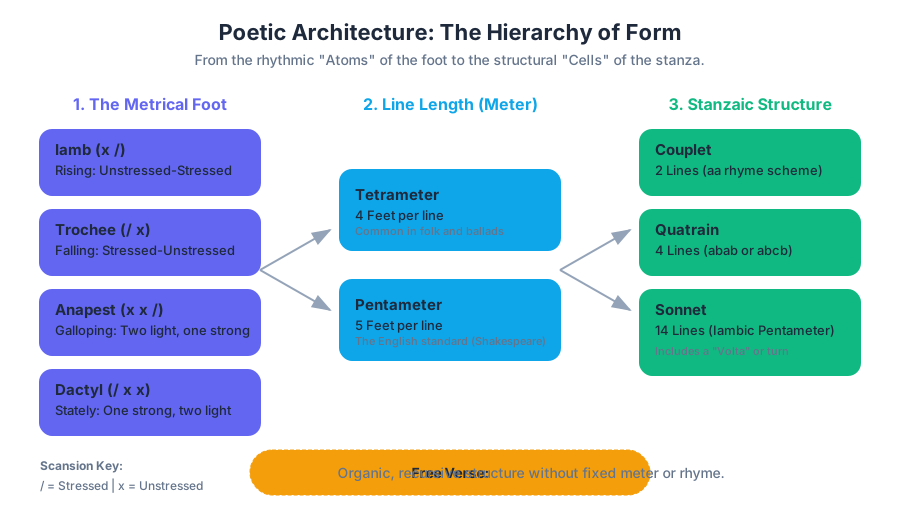
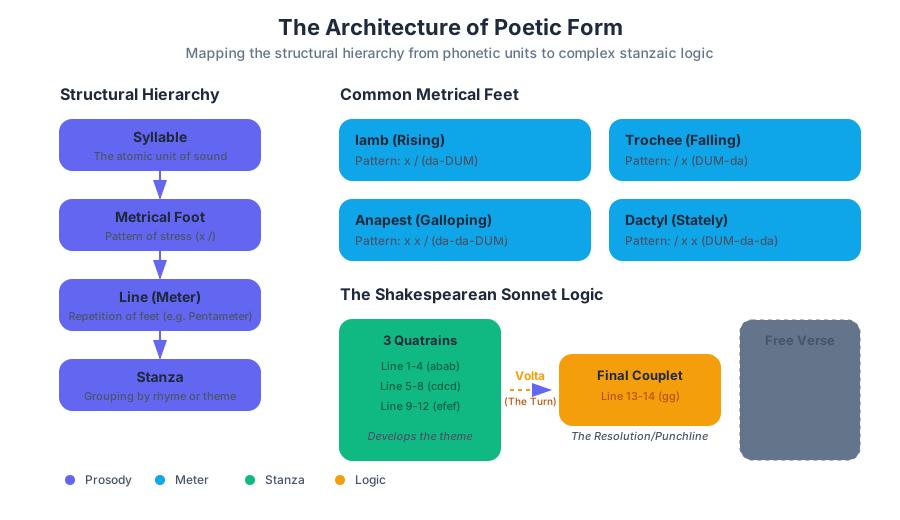
The basic unit of meter is the foot, a specific grouping of stressed (/) and unstressed (x) syllables. The arrangement of these feet creates the "pulse" of the poem.
Definition: Scansion Scansion is the act of "mapping" a poem’s metrical structure by marking the stressed and unstressed syllables to identify the prevailing foot and line length.
| Foot Name | Pattern | Stress Sequence | Rhythmic Effect |
|---|---|---|---|
| Iamb | x / |
Unstressed-Stressed | Rising, natural, mimics the human heartbeat. |
| Trochee | / x |
Stressed-Unstressed | Falling, driving, often feels "incantatory." |
| Anapest | x x / |
Unstressed-Unstressed-Stressed | Galloping, light, fast-paced. |
| Dactyl | / x x |
Stressed-Unstressed-Unstressed | Stately, classical, often used in epics. |
| Spondee | / / |
Stressed-Stressed | Weighty, slow, used for emphasis (rarely a whole line). |
| Pyrrhic | x x |
Unstressed-Unstressed | Rapid, light, used to bridge more complex feet. |
Line Length (Meter)
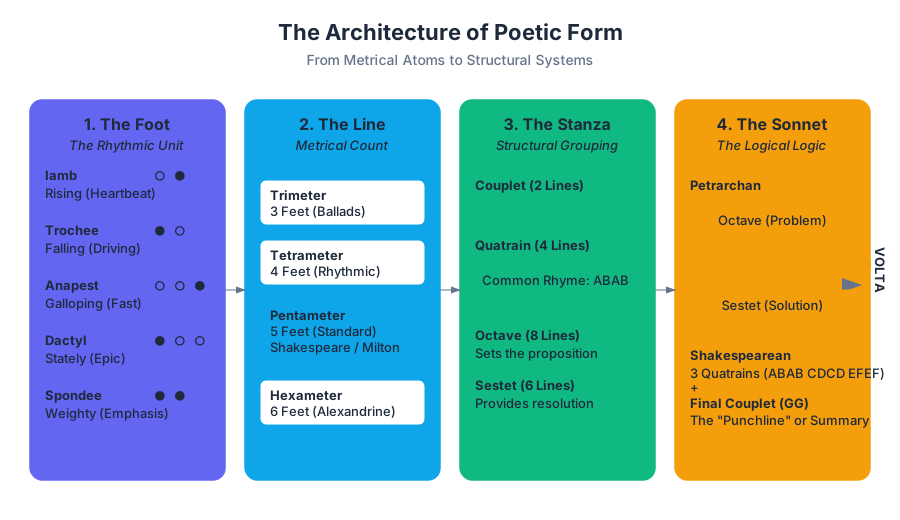
A line's meter is defined by the type of foot and the number of times that foot repeats. For example, Iambic Pentameter consists of five iambs.
| Number of Feet | Metrical Name | Common Usage |
|---|---|---|
| 1 | Monometer | Rare; used for experimental or "staccato" effects. |
| 2 | Dimeter | Often found in nursery rhymes or short lyrics. |
| 3 | Trimeter | Common in ballads and hymns (alternating with tetrameter). |
| 4 | Tetrameter | Highly rhythmic; common in folk poetry and "The Raven." |
| 5 | Pentameter | The "standard" of English verse (Shakespeare, Milton). |
| 6 | Hexameter | Also called an "Alexandrine"; feels elongated and formal. |
Stanzaic Structures: The Architecture of the Page
If feet are the "atoms" and lines are the "molecules," then stanzas are the "cells" of a poem. Stanzas provide visual and thematic grouping, often dictated by rhyme schemes.
Common Stanza Forms
Stanzas are categorized by the number of lines they contain. The transition between stanzas often signals a shift in time, perspective, or argument.
| Lines | Name | Typical Rhyme Scheme | Notes |
|---|---|---|---|
| 2 | Couplet | aa |
Used for epigrams or concluding a sonnet. |
| 3 | Tercet | aba or aaa |
If linked, it becomes Terza Rima (Dante). |
| 4 | Quatrain | abab or abcb |
The most common stanza in English poetry. |
| 5 | Quintain | Variable | Often used in Limericks (aabba). |
| 6 | Sestet | cdcdcd |
The second part of an Italian Sonnet. |
| 8 | Octave | abbaabba |
The first part of an Italian Sonnet; sets the "problem." |
The Sonnet: A Case Study in Formal Logic
The Sonnet is a 14-line poem in iambic pentameter. It is not just a form, but a logical structure.
- Petrarchan (Italian): Divided into an Octave (introduces a problem) and a Sestet (resolves it). The transition is called the Volta (turn).
- Shakespearean (English): Divided into three quatrains and a final couplet. The couplet often provides a witty or dramatic "punchline."
# Formal Grammar for a Shakespearean Sonnet (Backus-Naur Form style)

<sonnet>     ::= <quatrain1> <quatrain2> <quatrain3> <couplet>
<quatrain1>  ::= <line_a> <line_b> <line_a> <line_b>
<quatrain2>  ::= <line_c> <line_d> <line_c> <line_d>
<quatrain3>  ::= <line_e> <line_f> <line_e> <line_f>
<couplet>    ::= <line_g> <line_g>

<line_x>     ::= <iamb> <iamb> <iamb> <iamb> <iamb>
<iamb>       ::= <unstressed_syllable> <stressed_syllable>
The Taxonomy of Rhyme
Rhyme is the repetition of similar sounding words, usually at the end of lines. However, the "quality" of the rhyme can vary significantly, affecting the poem's tone.
Types of Rhyme
- End Rhyme: The most common form, occurring at the end of lines.
- Internal Rhyme: Rhyme occurring within a single line (e.g., "Once upon a midnight dreary, while I pondered, weak and weary").
- Slant Rhyme (Half Rhyme): Words with similar but not identical sounds (e.g., "bridge" and "grudge"). This creates a sense of dissonance or unease.
- Eye Rhyme: Words that look like they should rhyme based on spelling but don't in pronunciation (e.g., "move" and "love").
- Rich Rhyme (Rime Riche): Words that sound identical but have different meanings (homonyms, e.g., "raise" and "rays").
Phonetic Analysis of Rhyme
In computational linguistics, we determine rhyme by comparing the phonemes from the last stressed vowel to the end of the word.
Free Verse: The Liberation of Rhythm
Free Verse (or Vers Libre) is poetry that does not use a consistent meter or rhyme scheme. However, it is a mistake to think of it as "structureless." Instead of using external "scaffolding" (like iambic pentameter), free verse uses organic structure.
Walt Whitman and the American Idiom
Walt Whitman is the progenitor of modern free verse. In Leaves of Grass, he abandoned the "feudal" meters of Europe in favor of a style based on:
- Anaphora: Repetition of a word or phrase at the beginning of successive clauses.
- Epistrophe: Repetition of a word at the end of successive clauses.
- Cataloging: Long lists that create a cumulative, panoramic effect.
- The Rhythm of the Breath: Lines that follow the natural cadence of an orator or a singer.
"The sea whispered me." — Walt Whitman
Comparison: Traditional vs. Free Verse
| Feature | Traditional Verse | Free Verse |
|---|---|---|
| Rhythm | Fixed Metrical Feet (e.g., Iambs) | Variable; based on cadence and syntax. |
| Rhyme | Usually structured (e.g., abab) |
Occasional, internal, or absent. |
| Line Breaks | Often determined by the meter. | Determined by emphasis, breath, or visual impact. |
| Historical Context | Renaissance to Victorian eras. | Modernism to Contemporary. |
| Constraint | External (The "Form"). | Internal (The "Content"). |
Sound Devices: Beyond Meter and Rhyme
The "music" of a poem is also built through smaller-scale phonetic effects. These devices are often used to reinforce the theme (e.g., using harsh sounds for a violent scene).
Alliteration, Assonance, and Consonance
- Alliteration: Repetition of initial consonant sounds ("Seven silver swans").
- Assonance: Repetition of internal vowel sounds ("The rain in Spain stays mainly...").
- Consonance: Repetition of final consonant sounds ("The lumky, bumpy road").
Onomatopoeia and Cacophony
- Onomatopoeia: Words that mimic the sound they describe ("buzz," "hiss," "clatter").
- Cacophony: A harsh, discordant mixture of sounds (using "plosives" like
p,b,t,d,k,g). - Euphony: Successive words that are harmonious and pleasing to the ear (using "liquids" like
l,m,n,r).
Common Pitfalls in Formal Analysis
- The "Syllable Counting" Trap: Students often count syllables without looking for the stress. A 10-syllable line is not necessarily iambic pentameter; it must follow the
x /pattern. - Ignoring the Volta: In a sonnet, failing to identify the "turn" means missing the emotional or intellectual pivot of the poem.
- Assuming Free Verse is "Easy": Writing effective free verse requires a keen ear for syntax. Without the "crutch" of meter, the poet must create rhythm through lineation and word choice alone.
- Over-identifying Rhyme: Not every similar sound is a rhyme. Be careful to distinguish between consonance (shared consonants) and true rhyme (shared vowel + final consonant).
Summary of Poetic Evolution
The history of poetic form is a history of tension between constraint and freedom.
- The Renaissance/Enlightenment: Value was placed on the mastery of difficult forms (Sonnets, Heroic Couplets). Complexity was a sign of intellectual rigor.
- The Romantic Era: Began to prioritize "the spontaneous overflow of powerful feelings," though they still largely used traditional meters.
- Modernism: Poets like T.S. Eliot and Ezra Pound broke the "hegemony of the iamb," seeking new rhythms that reflected the fragmented nature of modern life.
- Post-Modernism/Contemporary: Form is now "modular." A poet might use a sonnet structure but fill it with slant rhymes and irregular meter to subvert expectations.
Source Materials
Study Introduction to Literature on Lykke
This course page is free to open: signed out, you can read its first two sections, and signing in, on any plan, opens the rest. The free Lykke Chrome extension syncs your own Canvas courses, so ChatGPT, Claude and Muse can answer from your classes and deadlines. It only reads Canvas.
Add the free extensionSign in to open every sectionAll sections of Introduction to Literature · Browse more course pages