From the free course Introduction to Literature on Lykke
Narrative Elements: Conflict and Plot
Key concepts: Conflict · Outer Conflict · Inner Conflict · Narrative Structure · Suspense
Introduction to the fundamental building blocks of storytelling, focusing on narrative structure and conflict.
Narrative Elements: Conflict and Plot
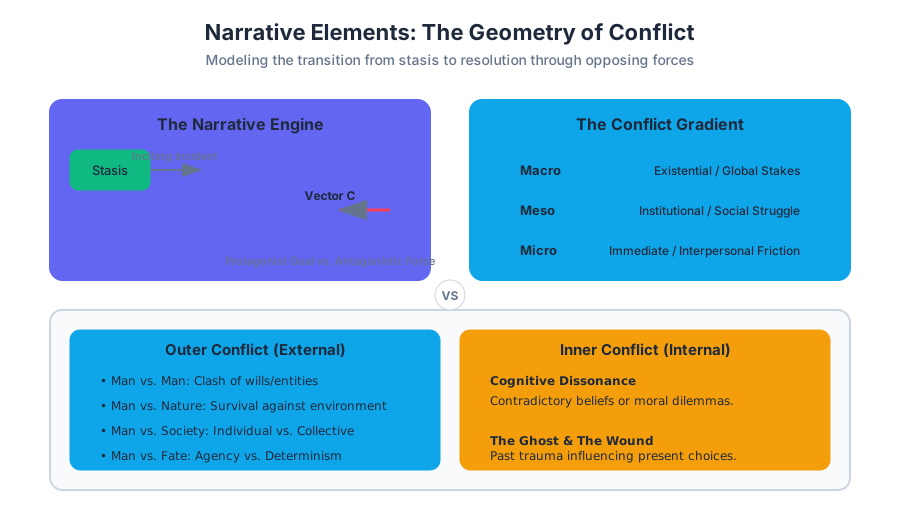
In the study of narratology, a story is not merely a chronological sequence of events (the fabula), but a structured system of tensions and resolutions (the sjuzhet). At the core of this system lies Conflict, the fundamental engine that drives narrative kinetic energy. Without conflict, a narrative remains in a state of stasis—a description of a world without the impetus for change. To understand plot is to understand the geometry of conflict: how it is initiated, how it scales, and how it is eventually resolved or transformed.
The Mechanics of Conflict
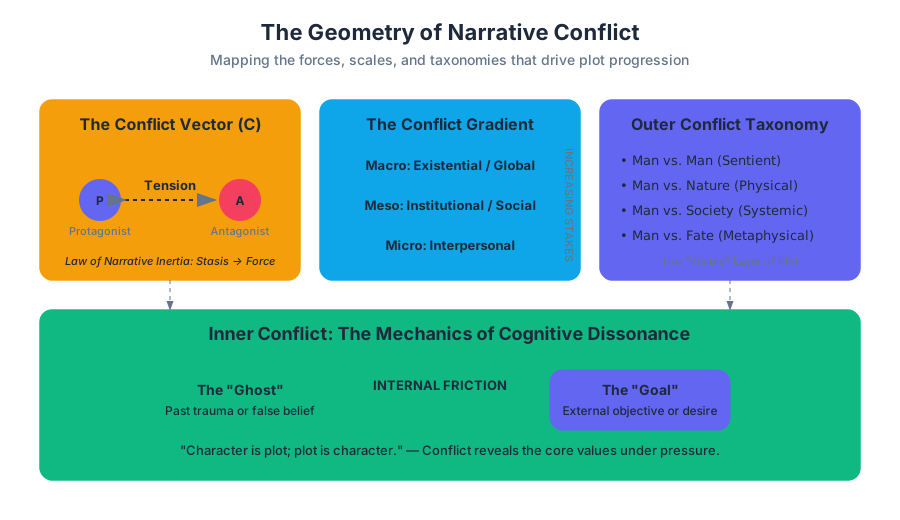
Conflict is defined as the struggle between two or more opposing forces. In a formal sense, it can be modeled as a vector $\vec{C}$, where the magnitude represents the intensity of the struggle and the direction represents the divergent goals of the protagonist and the antagonist (or antagonistic force).
The Law of Narrative Inertia: A narrative in a state of stasis will remain in stasis unless acted upon by an external or internal force (the Inciting Incident).
Why It Matters
Conflict is the primary mechanism for character revelation. As the adage goes, "Character is plot; plot is character." We do not know who a character truly is until they are forced to make a choice under pressure. Conflict provides that pressure, stripping away the character's social mask and revealing their core values.
How It Works: The Conflict Gradient
Conflict operates on a gradient of stakes. For a conflict to be effective, the "Cost of Failure" must be clearly defined. If the protagonist can walk away from the struggle without significant loss, the narrative tension collapses.
| Conflict Level | Scope | Example |
|---|---|---|
| Micro | Immediate, interpersonal | A disagreement over a dinner bill. |
| Meso | Institutional, social | A lawyer fighting a corrupt legal system. |
| Macro | Existential, global | A civilization attempting to avert a planetary collision. |
Outer Conflict: The External Struggle
Outer Conflict (or External Conflict) involves a character’s struggle against forces outside of themselves. This is the "visible" layer of the plot, often manifesting as physical obstacles, societal pressure, or antagonistic characters.
Taxonomy of Outer Conflict
Traditionally, outer conflict is categorized by the nature of the opposing force.
- Man vs. Man: The classic protagonist-antagonist dynamic. This is a clash of wills, where two entities have mutually exclusive goals.
- Man vs. Nature: The struggle for survival against non-sentient forces (storms, predators, disease). The "antagonist" here has no malice; it is simply an indifferent environment.
- Man vs. Society: The character stands in opposition to a collective ideology, a legal system, or social norms. This often explores themes of justice and individual agency.
- Man vs. Technology/Supernatural: A subset of the above, where the character faces forces that transcend human understanding or control.
Comparison of External Forces
| Type | Nature of Antagonist | Primary Theme | Resolution Method |
|---|---|---|---|
| Man vs. Man | Personal / Sentient | Competition / Morality | Defeat or Reconciliation |
| Man vs. Nature | Impersonal / Physical | Survival / Humility | Endurance or Adaptation |
| Man vs. Society | Systemic / Ideological | Justice / Identity | Reform or Exile |
| Man vs. Fate | Metaphysical | Agency / Determinism | Acceptance or Defiance |
Common Pitfalls: The "Passive Protagonist"
A frequent error in constructing outer conflict is the Passive Protagonist. This occurs when the external forces act upon the character, but the character does not act back. For a conflict to drive a plot, the protagonist must make proactive choices to overcome the obstacle, even if those choices lead to further complications.
Inner Conflict: The Internal Friction
Inner Conflict (or Internal Conflict) is the struggle occurring within a character's mind. It is the "invisible" layer of the plot, often involving a choice between two equally desirable (or undesirable) outcomes, or a battle between a character's desires and their moral compass.
The Mechanics of Cognitive Dissonance
In psychological terms, inner conflict is often a form of cognitive dissonance. The character holds two or more contradictory beliefs, values, or ideas simultaneously. The plot forces them to resolve this dissonance.
The "Ghost" and the "Wound": In modern screenwriting theory, inner conflict often stems from a "Ghost"—a past trauma or event that created a "Wound" (a false belief about the world). The narrative arc is the process of the character confronting the Ghost to heal the Wound.
Formalizing Internal Tension
We can express the intensity of inner conflict ($I_c$) as a ratio of the character's internal "Need" vs. their conscious "Want."
I_c = \frac{Want \times External\_Pressure}{Need \times Moral\_Resistance}
- Want: The external goal (e.g., "I want to win the election").
- Need: The internal requirement for growth (e.g., "I need to learn humility").
- External Pressure: The stakes of the outer conflict.
- Moral Resistance: The character's internal barriers to taking the "easy" (but wrong) path.
Concrete Example: The Moral Dilemma
Consider a character who must lie to protect a loved one.
- Outer Conflict: The police are questioning the character (Man vs. Society).
- Inner Conflict: The character values honesty but also values loyalty. The struggle is not with the police, but with their own conscience.
Narrative Structure: The Topology of Plot
Narrative Structure is the framework that determines how the story’s events are organized. If conflict is the fuel, structure is the engine block that contains and directs the resulting energy.
Freytag’s Pyramid and Beyond
While Gustav Freytag’s five-act structure (Exposition, Rising Action, Climax, Falling Action, Denouement) is the most famous model, modern narratology uses more sophisticated "curves" to map tension over time.
- The Fichtean Curve: Skips the long exposition and plunges the reader into a series of crises (rising action) that build toward a climax.
- In Media Res: Starting the narrative in the middle of the action to maximize immediate suspense.
- The Hero's Journey (Monomyth): A circular structure focusing on the character's transformation through a "Departure," "Initiation," and "Return."
Structural Milestones
| Milestone | Technical Function | Narrative Impact |
|---|---|---|
| Inciting Incident | Breaks the initial stasis. | Launches the story; defines the "Story Question." |
| Plot Point 1 | The point of no return. | The protagonist commits to the journey. |
| Midpoint | A major shift in stakes or perspective. | The protagonist moves from reacting to acting. |
| Climax | The highest point of tension. | The central conflict is resolved. |
| Resolution | The establishment of a new stasis. | Shows the "New Normal" for the character. |
Pseudocode: The Structural Sequence
FUNCTION Generate_Plot():
    STATE = Stasis
    CHARACTER = Initialize_Protagonist()

    // ACT I
    INCITING_INCIDENT = Trigger_Event()
    IF CHARACTER.Accepts(INCITING_INCIDENT):
        STATE = Rising_Action
    ELSE:
        REFUSAL_OF_CALL()
        FORCE_CHARACTER_INTO_ACTION()

    // ACT II
    WHILE Tension < MAX_THRESHOLD:
        OBSTACLE = Generate_Obstacle(Outer_Conflict)
        CHARACTER.Attempt_Resolution(OBSTACLE)
        IF SUCCESS:
            Tension -= 10
        ELSE:
            Tension += 20 // Complications
            CHARACTER.Internal_Friction += 5

    // ACT III
    CLIMAX = Resolve_Conflict(CHARACTER, ANTAGONIST)
    RETURN New_Stasis(CHARACTER.Transformed_State)
Suspense: The Management of Information
Suspense is the emotional state of anticipation and anxiety resulting from an "Information Gap." It is not merely about "what happens next," but about the delay between the audience's awareness of a threat and the character's resolution of that threat.
The Zeigarnik Effect
Narrative suspense leverages the Zeigarnik Effect, a psychological phenomenon where people remember uncompleted or interrupted tasks better than completed ones. By opening "narrative loops" (questions) and delaying their closure, a writer maintains the reader's cognitive engagement.
Suspense vs. Surprise
Alfred Hitchcock famously distinguished between the two:
- Surprise: Two people are sitting at a table; a bomb goes off. The audience has 10 seconds of shock.
- Suspense: The audience sees the bomb under the table and knows it will go off in five minutes. The characters are talking about mundane things. The audience experiences five minutes of intense anxiety.
Suspense Parameters in Narrative Design
| Parameter | Description | Effect on Reader |
|---|---|---|
| Pacing | The speed at which events unfold. | Faster pacing increases urgency; slower pacing builds dread. |
| Foreshadowing | Hints about future events. | Creates a sense of inevitability and "fair play." |
| Red Herring | A false clue or distraction. | Misdirects the reader to enhance the eventual payoff. |
| Tick-Tock | A literal or figurative time limit. | Forces immediate action and raises the "Cost of Inaction." |
Synthesis: The Narrative Calculus
The relationship between conflict, plot, and suspense can be summarized as a dynamic system. Conflict is the potential energy; Plot is the kinetic path that energy takes; and Suspense is the friction or resistance that prevents the energy from reaching its destination too quickly.
The "Try-Fail" Cycle
A robust plot is built on the "Try-Fail" cycle. The protagonist attempts to resolve the conflict (Try) but fails, leading to a "Yes, but..." or "No, and..." scenario.
- Yes, but...: The protagonist succeeds in their immediate goal, but creates a new, larger problem.
- No, and...: The protagonist fails to achieve their goal, and their situation gets significantly worse.
This cycle ensures that the tension curve continues to rise until the Climax, where the protagonist must finally use their "Need" (internal growth) to solve the "Want" (external problem).
Common Pitfalls in Narrative Design
- Deus Ex Machina: Resolving a conflict through an external force that has not been previously established. This violates the "fair play" of suspense and renders the protagonist's journey meaningless.
- The "Muddled Middle": A loss of narrative momentum in Act II. This usually happens when the conflict lacks a clear "Midpoint" or when the "Try-Fail" cycles are repetitive rather than escalatory.
- Low Stakes: If the reader doesn't care about the outcome, the conflict is irrelevant. Stakes must be both "Global" (the world) and "Personal" (the character's heart).
- Inconsistent Logic: In speculative fiction, the rules of the conflict (e.g., magic systems, technology) must remain consistent. If the rules change to suit the plot, the suspense evaporates.
Summary of Key Terms
- Stasis: The initial state of the world before the story begins.
- Inciting Incident: The event that disrupts stasis and introduces the central conflict.
- Rising Action: The series of events and complications that build tension.
- Peripeteia: A sudden reversal of fortune or change in circumstances.
- Anagnorisis: A moment in a plot or story, specifically a tragedy, wherein the main character recognizes or identifies his/her true nature or that of the other character's real identity.
- Denouement: The final part of a play, movie, or narrative in which the strands of the plot are drawn together and matters are explained or resolved.
Source Materials
Study Introduction to Literature on Lykke
This course page is free to open: signed out, you can read its first two sections, and signing in, on any plan, opens the rest. The free Lykke Chrome extension syncs your own Canvas courses, so ChatGPT, Claude and Muse can answer from your classes and deadlines. It only reads Canvas.
Add the free extensionSign in to open every sectionAll sections of Introduction to Literature · Browse more course pages