From the free course Introduction to Literature on Lykke
Literary Style and Historical Context
Key concepts: Literary Style · Renaissance Oratory · Enlightenment Rationalism · Romantic Emotionalism · Modernism
An exploration of how literary style has evolved from the Renaissance to the Modernist era.
Literary Style and Historical Context
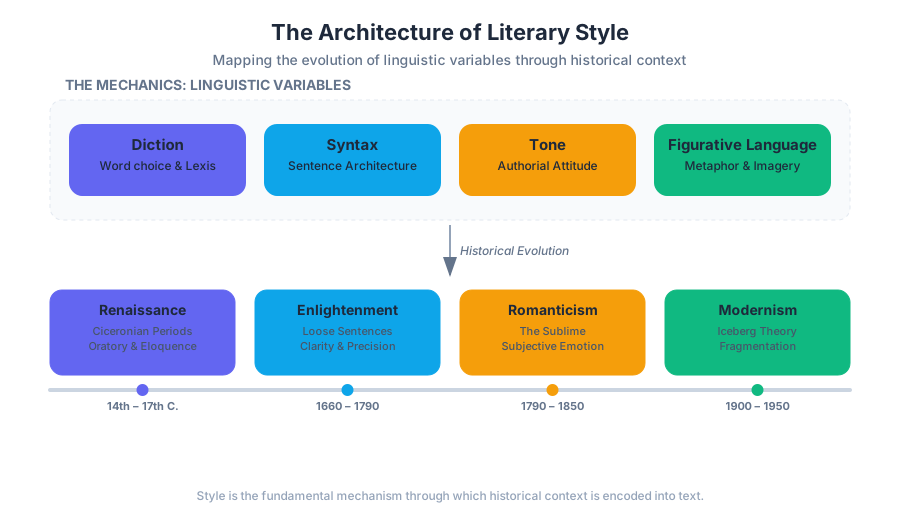
Literary style is the architectural signature of a written work. It is the specific, idiosyncratic manner in which a writer employs language, syntax, and structure to convey meaning. Far from being a mere aesthetic "veneer," style is the fundamental mechanism through which historical context, philosophical shifts, and cultural values are encoded into text. To analyze style is to reverse-engineer the intellectual and social environment of the author.
The Mechanics of Style: Syntax, Diction, and Structure
At its core, style is a function of choice. A writer operates within a multi-dimensional space of linguistic variables. When these choices coalesce into a recognizable pattern, we define it as a "style."
Definition: Literary Style The sum of a writer's choices regarding diction (word choice), syntax (sentence structure), tone (attitude), and figurative language. It is the "how" that shapes the "what" of a narrative or argument.
Syntactic Complexity and Sentence Architecture
The way a sentence is built often reflects the cognitive priorities of an era. Two primary structures dominate historical prose:
- Periodic Sentences: The main clause (and thus the full meaning) is withheld until the very end. This creates suspense and requires a high degree of intellectual "buffering" from the reader. It was the hallmark of Renaissance oratory.
- Loose (Cumulative) Sentences: The main idea is presented immediately, followed by modifying phrases. This mirrors natural speech and became the standard for Enlightenment clarity and Modernist realism.
| Stylistic Variable | High-Complexity (Ornate) | Low-Complexity (Minimalist) |
|---|---|---|
| Diction | Latinate, polysyllabic, archaic | Germanic, monosyllabic, contemporary |
| Syntax | Hypotactic (heavy use of subordination) | Paratactic (short, independent clauses) |
| Punctuation | Semicolons, colons, nested parentheses | Periods, em-dashes, or total omission |
| Imagery | Extended metaphors (conceits) | Literal, sensory details |
Historical Evolution of Style
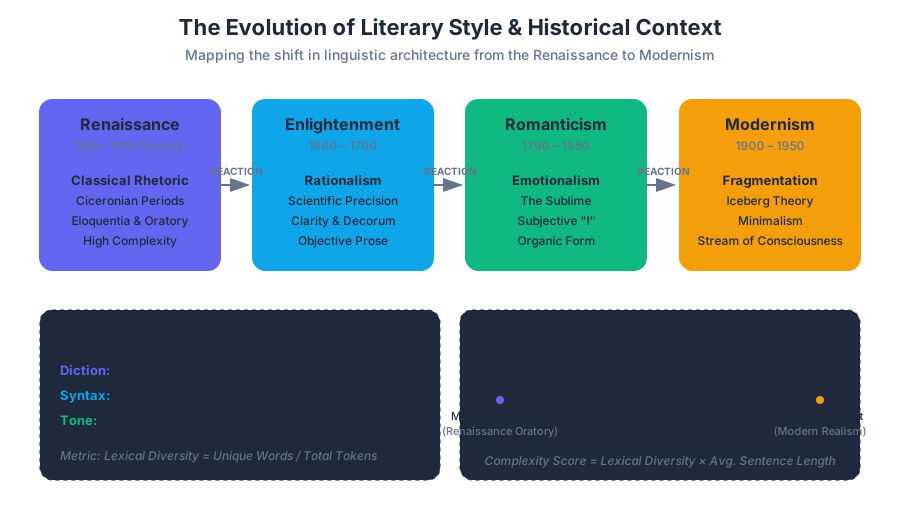
The history of Western literature can be viewed as a series of reactions to the stylistic dominance of the preceding era.
Renaissance Oratory (14th – 17th Century)
During the Renaissance, style was deeply rooted in Classical Rhetoric. Drawing from Cicero and Quintilian, writers viewed prose as a performance. The goal was eloquentia—the union of wisdom and powerful speaking.
- Key Feature: The Ciceronian Period. These were long, balanced sentences designed for oral delivery, using rhythm and cadence to persuade.
- Context: The rise of humanism and the recovery of Greek and Roman texts.
Enlightenment Rationalism (1660 – 1790)
The "Age of Reason" demanded a style that functioned like a scientific instrument: precise, transparent, and objective. The Royal Society in England famously called for a "close, naked, natural way of speaking."
- Key Feature: Clarity and Decorum. Writers avoided "enthusiasm" (excessive emotion) and complex metaphors that might obscure the "truth."
- Context: The Scientific Revolution and the rejection of religious dogma in favor of empirical observation.
Romantic Emotionalism (1790 – 1850)
Romanticism was a violent pivot away from Enlightenment coldness. Style became a vehicle for the Sublime—the overwhelming feeling of awe and terror inspired by nature and the internal psyche.
- Key Feature: Subjectivity. The "I" became the center of the universe. Prose and poetry became more fluid, organic, and emotionally charged.
- Context: The Industrial Revolution (as a counter-movement) and the rise of individualism.
Modernism and the "Iceberg Theory" (1900 – 1950)
Following the trauma of World War I, the ornate styles of the 19th century felt fraudulent. Modernists like Ernest Hemingway and Virginia Woolf experimented with Minimalism and Stream of Consciousness.
- Key Feature: Fragmentation. Modernist style often leaves gaps (the "Iceberg Theory"), where 7/8ths of the meaning lies beneath the surface, requiring the reader to reconstruct the narrative.
- Context: Psychoanalysis (Freud), the collapse of traditional empires, and the "Lost Generation."
The Architecture of Poetry: Metre and Form
Poetry represents the most concentrated form of literary style. Unlike prose, poetry is governed by Prosody—the systematic study of metrical structure.
Accentual-Syllabic Metre
Most English poetry since the 14th century uses accentual-syllabic metre, which counts both the number of syllables and the pattern of stresses. The basic unit of measurement is the Foot.
| Foot Name | Stress Pattern | Rhythm | Example |
|---|---|---|---|
| Iamb | Unstressed + Stressed | da-DUM | be-HOLD |
| Trochee | Stressed + Unstressed | DUM-da | TY-ger |
| Anapest | Unstressed + Unstressed + Stressed | da-da-DUM | un-der-STAND |
| Dactyl | Stressed + Unstressed + Unstressed | DUM-da-da | PO-e-try |
| Spondee | Stressed + Stressed | DUM-DUM | HEART-BEAT |
Mathematical Representation of Metre
We can represent a line of verse as a binary sequence where $0$ is unstressed and $1$ is stressed. An Iambic Pentameter line (5 iambs) follows the formula:
$$L = \sum_{i=1}^{5} (0, 1)_i$$
In string notation, this appears as:
01 | 01 | 01 | 01 | 01
Rhyme and Sound Devices
Style is also auditory. Writers use sound to reinforce meaning or create a specific atmosphere.
- Alliteration: Repetition of initial consonant sounds ("The fair freeze flew").
- Assonance: Repetition of vowel sounds ("The lotus blooms below the flow").
- Slant Rhyme: Near-rhymes (e.g., "bridge" and "grudge") used to create a sense of unease or modern dissonance.
Drama: The Text vs. Performance Paradox
When studying drama as literature, a unique stylistic challenge arises. A play is a Dramatic Text—a blueprint for a performance that may or may not exist at the moment of reading.
Reading a Play vs. Watching a Play
- The Stage Direction: In the text, these are often ignored by casual readers, but they contain the author's stylistic "metadata" (e.g., "Exit, pursued by a bear").
- The Dialogue/Subtext: Because drama lacks a traditional narrator, the "style" is embedded entirely in character voice and the gaps between what is said and what is done.
- Dramatic Irony: A stylistic device where the reader/audience knows more than the characters, creating a tension that is unique to the dramatic form.
Active Reading: Strategies for Stylistic Decoding
To effectively analyze style, one must move from passive consumption to Active Reading. This involves a "conversation" with the text.
The Annotation Pipeline
- Tracing: Identify recurring keywords or motifs. If a writer uses "cold," "stone," and "grey" repeatedly, they are building a stylistic atmosphere of stasis.
- Conversing: Write questions in the margins. "Why did the author use a semicolon here instead of a period?"
- Research Question Development: Use stylistic observations to form a thesis. "How does the fragmented syntax in The Waste Land mirror the post-war disillusionment of 1922?"
| Strategy | Action | Technical Goal |
|---|---|---|
| Annotating | Highlighting and marginalia | Data extraction and pattern recognition |
| Tracing | Following a specific image/word | Identifying thematic consistency |
| Keyword Identification | Isolating 5-10 "load-bearing" words | Defining the work's "semantic core" |
| Rhetorical Analysis | Identifying Simile, Metaphor, Synecdoche | Understanding the figurative layer |
Common Pitfalls in Stylistic Analysis
- The Intentional Fallacy: Assuming that the style perfectly reflects the author's personal feelings. Style is often a conscious craft or a response to market demands, not just a "soul-dump."
- Ignoring the Medium: Analyzing a play's style without considering how it would sound when spoken aloud.
- Historical Anachronism: Judging an Enlightenment text for being "too dry" by Modernist standards. Style must be evaluated within its own historical "operating system."
Advanced Concept: The "Iceberg" and Subtext in Modernism
In Modernist style, what is omitted is often more important than what is included. This is the "Iceberg Theory" popularized by Hemingway.
By understanding the evolution of style from the ornate periods of the Renaissance to the stark, fragmented lines of the Modernists, we gain the ability to "read" history itself through the texture of the written word.
Source Materials
- Introduction to Literature PDF
- http://www.saylor.org/site/wp-content/uploads/2012/03/ENGL405-2.3-Freeverse-FINAL.pdf
- https://www.martineve.com/wp-content/uploads/2011/11/Simon-Davies-Literary-Terms.pdf
- Wp Login.Php
- Introduction to Literature
- Introduction to Literature
- Introduction to Literature
- Introduction to Literature
Study Introduction to Literature on Lykke
This course page is free to open: signed out, you can read its first two sections, and signing in, on any plan, opens the rest. The free Lykke Chrome extension syncs your own Canvas courses, so ChatGPT, Claude and Muse can answer from your classes and deadlines. It only reads Canvas.
Add the free extensionSign in to open every sectionAll sections of Introduction to Literature · Browse more course pages