From the free course Introduction to Literature on Lykke
Literary Elements: Theme and Symbolism
Key concepts: Theme · Symbolism · Universal Truths · Narrative devices
How authors use recurring elements and symbols to convey universal truths and messages.
Literary Elements: Theme and Symbolism
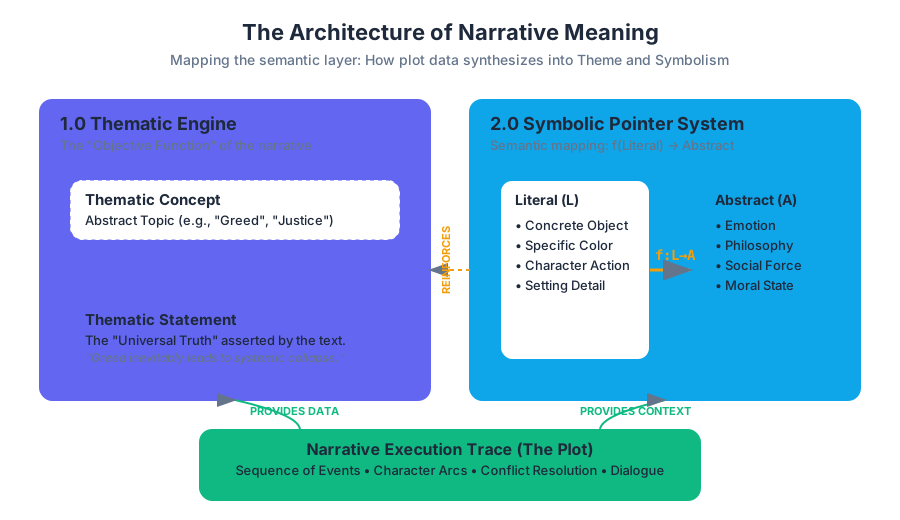
In the architecture of narrative, Theme and Symbolism constitute the semantic layer—the underlying logic and meaning that transcend the literal sequence of events (the plot). While the plot answers the question of what happens, theme and symbolism address the why and the so what. In a technical sense, if the plot is the execution trace of a program, the theme is the high-level algorithm's purpose, and symbols are the pointers and variables that reference abstract memory addresses within the human condition.
1.0 The Mechanics of Theme
1.1 What It Is: The Thematic Statement
A Theme is not merely a subject or a topic; it is a definitive statement or "universal truth" that the text asserts about its subject. While "War" is a topic, "War inevitably deconstructs the moral identity of the individual" is a theme.
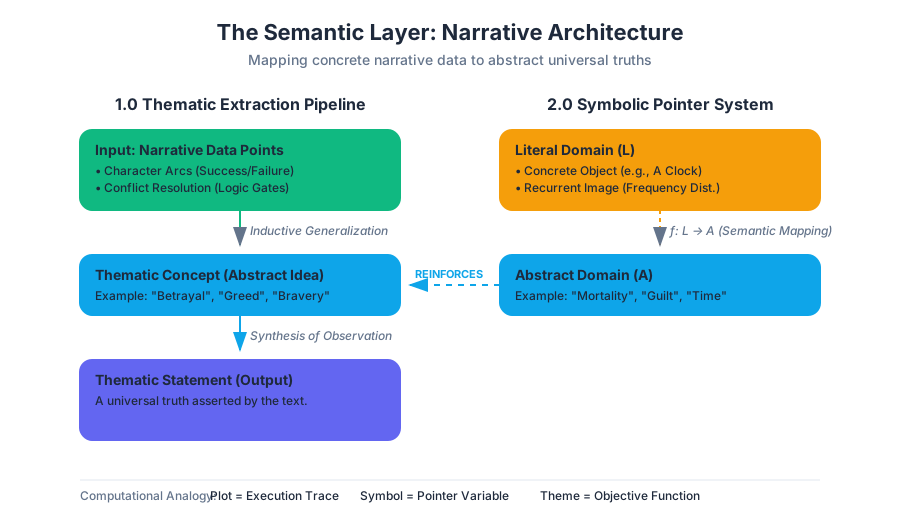
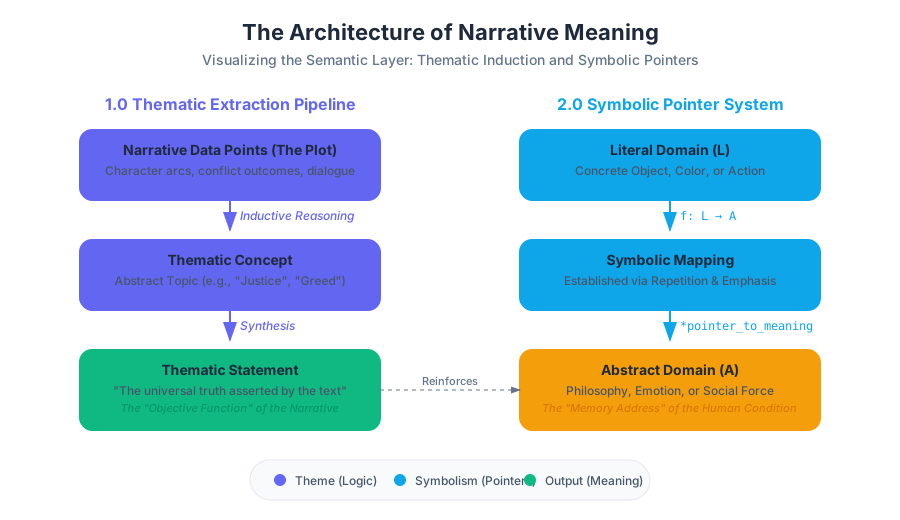
In formal literary analysis, we distinguish between the Thematic Concept (the abstract idea, e.g., Betrayal) and the Thematic Statement (the specific observation the author makes about that idea).
Definition: Thematic Statement A complete sentence that describes a universal observation about human experience, synthesized from the interaction of plot, character development, and conflict resolution within a narrative.
1.2 Why It Matters: The Cohesion Logic
Without a central theme, a narrative becomes a "picaresque" collection of unrelated incidents. Theme provides the objective function for the author’s choices. Every character death, every setting description, and every dialogue exchange should ideally serve to reinforce or complicate the central thematic inquiry. In software terms, the theme is the design pattern that ensures all modules of the story work toward a unified output.
1.3 How It Works: Thematic Extraction
Thematic extraction is a process of induction. A reader observes specific data points (character actions, outcomes) and generalizes them into a broader principle.
| Element | Role in Thematic Construction | Data Type |
|---|---|---|
| Protagonist's Arc | Shows the cost or reward of a specific philosophy. | Boolean (Success/Failure) |
| Conflict Resolution | Indicates which values the "world" of the story rewards. | Logic Gate |
| Recurrent Imagery | Signals the presence of a thematic cluster. | Frequency Distribution |
| Foil Characters | Provide a control group to highlight the protagonist's choices. | Comparative Dataset |
2.0 Symbolism: The Pointer System of Literature
2.1 What It Is: Semantic Mapping
Symbolism is a narrative device where a concrete object, person, or place represents an abstract idea. If we view a story as a system of signs, a symbol is a pointer.
Mathematically, we can represent a symbol $S$ as a mapping function where $L$ is the literal domain and $A$ is the abstract domain:
$$f: L \to A$$
Where $L \in { \text{Object, Color, Character, Action} }$ and $A \in { \text{Emotion, Philosophy, Social Force} }$.
2.2 Types of Symbols
Symbols are generally categorized by their scope of recognition.
| Symbol Category | Definition | Example |
|---|---|---|
| Conventional | Widely recognized within a culture or globally. | A red rose (love), a skull (death). |
| Contextual | Gains meaning only within the specific "runtime" of the text. | The "Green Light" in The Great Gatsby. |
| Archetypal | Deeply embedded in the human psyche (Jungian). | The Hero's Journey, the "Shadow" self. |
| Phallic/Yonic | Representing generative or reproductive forces. | Towers, caves, swords, vessels. |
2.3 The Mechanics of Symbolic Reinforcement
A symbol is established through repetition and emphasis. If a character mentions a clock once, it is a prop. If the clock stops every time a character lies, and the ticking grows louder during moments of guilt, the clock has been promoted to a symbol of Conscience or Temporal Justice.
2.4 Formalizing Symbolic Logic
We can use a pseudo-formal logic to describe how symbols interact within a narrative framework.
% Formalizing the Symbolic Relationship in 'Moby Dick'
\text{Let } Q = \text{Queequeg's Coffin}
\text{Let } D = \text{Death}
\text{Let } L = \text{Life/Resurrection}

\text{Initial State: } Q \implies D \quad \text{(The coffin is built for a dying man)}
\text{Transition: } \text{Ishmael uses } Q \text{ as a buoy.}
\text{Final State: } Q \implies L \quad \text{(The symbol of death becomes the instrument of survival)}

\therefore \text{Theme: Life and death are cyclical and interdependent.}
3.0 The Relationship Between Motif, Symbol, and Theme
It is a common pitfall to confuse these three terms. They exist in a hierarchy of abstraction.
- Motif: A recurring element (image, sound, phrase). It is a pattern.
- Symbol: A motif that has been assigned a specific abstract meaning. It is a variable.
- Theme: The conclusion drawn from the interaction of symbols and motifs. It is the program logic.
3.1 The Thematic Pipeline
The movement from raw text to thematic understanding follows a specific pipeline:
- Observation: Identifying a recurring element (Motif).
- Association: Linking that element to an abstract concept (Symbolism).
- Synthesis: Determining what the text says about that concept (Theme).
3.2 Comparison Table: Narrative Abstraction Layers
| Layer | Component | Purpose | Analogy |
|---|---|---|---|
| Physical | Plot/Action | Movement and sequence. | Machine Code |
| Structural | Motif | Consistency and rhythm. | Syntax/Looping |
| Semantic | Symbol | Reference and depth. | Pointers/Variables |
| Conceptual | Theme | Meaning and purpose. | High-level Algorithm |
4.0 Advanced Concepts: Subversion and Deconstruction
4.1 Thematic Subversion
Great literature often employs Thematic Subversion, where the narrative sets up a conventional theme only to dismantle it. For example, a story might use the symbol of a "White Knight" (representing Purity) but reveal the character to be a nihilist, thereby critiquing the validity of the "Good vs. Evil" binary.
4.2 Symbolic Overloading (Polysemy)
A symbol can represent multiple, even contradictory, ideas simultaneously. In Herman Melville’s Moby Dick, the Whiteness of the Whale represents:
- Purity/Divinity
- Void/Nothingness
- Terror/The Unknown
This is known as Symbolic Polysemy. In a technical context, this is akin to Operator Overloading, where the same symbol performs different functions depending on the context (the "arguments") provided by the scene.
5.0 Common Pitfalls in Analysis
5.1 The "Easter Egg" Fallacy
Many readers treat symbolism like a scavenger hunt—finding the "hidden meaning" and stopping there. A symbol is not a secret to be solved; it is a tool for building a larger argument. Identifying that "the ocean represents the subconscious" is useless unless you explain how the ocean's behavior in the story clarifies the protagonist's mental state.
5.2 Intentional Fallacy
The belief that a theme or symbol is only valid if the author explicitly intended it. In modern criticism (Post-Structuralism), the "Death of the Author" suggests that the text belongs to the reader. If the symbolic evidence exists within the text, the interpretation is valid, regardless of the author's biography.
5.3 Over-Universalization
Assuming that a symbol has a fixed meaning across all cultures. While a "Dragon" might symbolize evil in Western tradition (Greed/Satan), it often symbolizes wisdom and prosperity in Eastern traditions. Context—both internal to the book and external to the culture—is the primary "namespace" for symbolic resolution.
6.0 Worked Example: Analyzing "The Yellow Wallpaper" by Charlotte Perkins Gilman
6.1 The Data Points
- Object: The yellow wallpaper in the bedroom.
- Motif: The pattern of the wallpaper, the "smell" of the paper, the "yellow smooch" on the wall.
- Action: The narrator stripping the paper off the wall.
6.2 The Symbolic Mapping
The wallpaper functions as a symbol of the Domestic Sphere and the Rest Cure (a 19th-century medical treatment for women). The "trapped woman" the narrator sees behind the pattern is a symbol of her own repressed psyche.
6.3 The Thematic Statement
"The systematic suppression of female intellectual and creative autonomy under the guise of medical care leads to the total fragmentation of the self."
7.0 Conclusion: The Resonance of Meaning
Theme and symbolism are the mechanisms through which literature achieves Resonance. A story about a man catching a fish is a story about a man catching a fish. But a story where the fish is a symbol of Unattainable Grace and the struggle represents Human Endurance is a work that survives centuries. By mastering these elements, writers can encode profound truths into their work, and readers can decode the complex signals of the human experience.
Source Materials
Study Introduction to Literature on Lykke
This course page is free to open: signed out, you can read its first two sections, and signing in, on any plan, opens the rest. The free Lykke Chrome extension syncs your own Canvas courses, so ChatGPT, Claude and Muse can answer from your classes and deadlines. It only reads Canvas.
Add the free extensionSign in to open every sectionAll sections of Introduction to Literature · Browse more course pages