From the free course Introduction to Literature on Lykke
Genres: Drama and Film
Key concepts: Plays as Literature · Dramatic Text Analysis · Visual Media · Performance Studies
The study of plays as literary texts and the conventions of visual and performative mediums.
Genres: Drama and Film
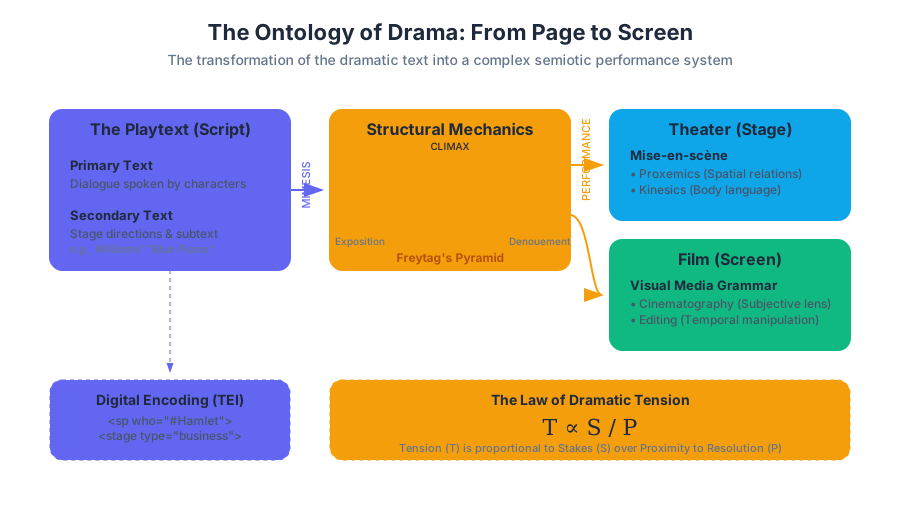
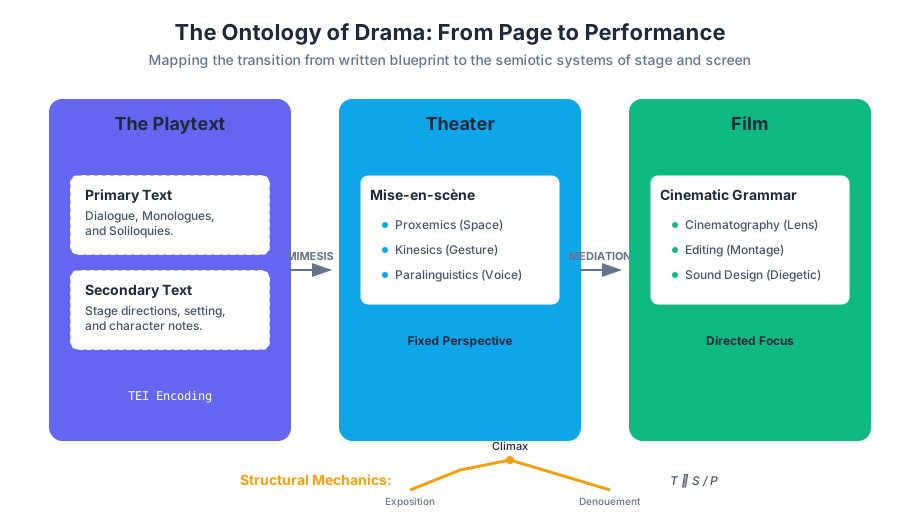
Drama is a unique literary genre defined by its dual existence as both a written text (the script) and a realized performance (theater or film). Unlike fiction, which relies on a narrator to mediate the reader’s experience, drama is primarily driven by mimesis (imitation of action) and dialogue. In the transition from the stage to the screen, the genre incorporates visual media techniques—cinematography, editing, and sound design—to create a complex semiotic system that transcends the printed word.
The Ontology of the Dramatic Text
The dramatic text, often called the playtext, serves as a blueprint for performance. While it can be read as literature, its primary function is to provide the linguistic and structural framework for actors, directors, and designers.
The Dual Nature of the Script
A play consists of two distinct layers of communication:
- The Primary Text: The dialogue spoken by the characters.
- The Secondary Text: The stage directions, character lists, and scene descriptions provided by the playwright.
In literary analysis, the secondary text is often as vital as the primary. For instance, in Tennessee Williams' A Streetcar Named Desire, the stage directions regarding the "blue piano" or the "varsouviana" music provide essential psychological subtext that the dialogue alone might miss.
| Feature | Drama (Stage) | Fiction (Novel) | Film (Screen) |
|---|---|---|---|
| Primary Medium | Dialogue and Physical Action | Narrative Prose | Visual Image and Sound |
| Point of View | Objective/External | Variable (1st, 3rd, Omniscient) | Subjective (Camera Lens) |
| Temporal Constraint | Real-time performance | Internalized reading time | Fixed runtime/Editing |
| Audience Agency | Collective, fixed perspective | Individual, imaginative | Collective, directed focus |
The TEI Standard for Dramatic Encoding
In the digital humanities, dramatic texts are often encoded using the Text Encoding Initiative (TEI) standard. This allows for computational analysis of character interactions, speech lengths, and stage movement.
Structural Mechanics: The Architecture of Action
Dramatic structure is governed by the relationship between story (the chronological sequence of events) and plot (the artistic arrangement of those events).
Freytag’s Pyramid and Beyond
Gustav Freytag’s 1863 analysis of Greek and Shakespearean drama remains the foundational model for understanding dramatic tension. He proposed a five-part structure:
- Exposition: Introduction of setting, characters, and conflict.
- Rising Action: A series of complications leading to the climax.
- Climax: The turning point or point of highest tension.
- Falling Action: The consequences of the climax unfold.
- Denouement/Catastrophe: The resolution of the conflict.
The Law of Dramatic Tension: The intensity of a scene $T$ is a function of the stakes $S$ and the proximity to the resolution $P$, often expressed as $T \propto \frac{S}{P}$. As the play approaches the climax, the "distance" to the resolution decreases, causing tension to spike exponentially.
The Three Unities
Derived from Aristotle’s Poetics, the three unities were long considered the "gold standard" for dramatic construction:
- Unity of Action: A play should have one main plot and minimal subplots.
- Unity of Place: The action should occur in a single physical space.
- Unity of Time: The action should take place over no more than 24 hours.
While modern drama frequently breaks these rules, they remain the baseline against which experimental theater (such as Epic Theater or the Theater of the Absurd) is measured.
Performance Studies: From Page to Stage
Performance studies shifts the focus from the text to the event. It treats the performance as a "text" in its own right, composed of non-verbal signs.
The Semiotics of the Stage
Everything on stage—the lighting, the costumes, the actor's posture—carries meaning. This is known as the mise-en-scène.
- Proxemics: The spatial relationship between characters on stage. A character standing far apart from a group visually signals alienation.
- Kinesics: Body language and gesture.
- Paralinguistics: The tone, pitch, and volume of the spoken word, which can completely alter the meaning of the written dialogue.
Script Analysis for Performance
Actors often use Objective-Obstacle-Action analysis to break down a scene. This can be represented as a logical flow:
FUNCTION analyze_scene(character, scene):
    GOAL = character.get_super_objective()
    SCENE_OBJECTIVE = character.get_immediate_want(scene)

    FOR EACH beat IN scene:
        OBSTACLE = get_opposing_force(beat)
        IF OBSTACLE.intensity > character.resolve:
            character.tactic = "Pivot" (e.g., charm to threat)
        ELSE:
            character.tactic = "Press" (e.g., demand, beg)

        RESULT = apply_tactic(character.tactic, OBSTACLE)
        UPDATE character.emotional_state(RESULT)
The Grammar of Film: Visual Media Analysis
Film is often described as "drama plus the camera." The introduction of the lens changes the viewer's relationship with the text from a fixed, wide-angle perspective to a highly controlled, subjective experience.
The Kuleshov Effect
The fundamental principle of film editing is the Kuleshov Effect, which demonstrates that viewers derive more meaning from the interaction of two sequential shots than from a single shot in isolation.
| Shot A | Shot B | Perceived Emotion |
|---|---|---|
| Neutral Face | Bowl of Soup | Hunger |
| Neutral Face | Dead Child in Coffin | Grief |
| Neutral Face | Woman on a Sofa | Lust |
Cinematography and Perspective
In film, the camera acts as a narrator. The choice of shot size and angle dictates the audience's psychological response.
| Shot Type | Technical Definition | Psychological Effect |
|---|---|---|
| Extreme Long Shot | Subject is small; focus on landscape. | Isolation, insignificance, or scale. |
| Medium Shot | Waist up; mimics social distance. | Neutrality, conversation, standard interaction. |
| Close-Up | Focus on face/object; fills the frame. | Intimacy, intensity, or internal realization. |
| Dutch Angle | Camera is tilted on the X-axis. | Disorientation, unease, or madness. |
Computational Dramaturgy: Analyzing Dialogue and Interaction
One common metric is Dialogue Density or Social Network Centrality within a play. By treating characters as nodes and their interactions as edges, we can mathematically determine the "protagonist" based on network influence rather than just line count.
Adaptation Theory: Page to Screen
When a play or novel is adapted to film, it undergoes a process of transmediation. Analysis of film adaptations focuses on three primary strategies:
- Fidelity: Attempting to replicate the source text as closely as possible (e.g., many BBC Shakespeare productions).
- Intersection: Highlighting the tension between the original text and the new medium, often keeping theatrical elements visible.
- Transformation: Using the source text as a "raw material" to create a distinct work of art (e.g., Akira Kurosawa’s Ran as an adaptation of King Lear).
Common Pitfalls in Adaptation Analysis
- The Fidelity Myth: The mistaken belief that an adaptation is "bad" simply because it deviates from the book. Film is a different language; a literal translation often results in "stagy" or uncinematic results.
- Ignoring the "Third Text": Every adaptation is influenced by the cultural context of its production, creating a "third text" that exists between the original and the new version.
Critical Frameworks in Drama and Film
To analyze drama and film at an expert level, one must apply specific critical lenses:
- Formalism: Focuses on the "how"—the structure, the lighting, the meter of the verse.
- Psychoanalytic Criticism: Analyzes the subtext and the unconscious desires of characters (e.g., the Oedipal readings of Hamlet).
- Marxist Theory: Examines the power dynamics and class struggles represented in the setting and character motivations.
- Feminist Film Theory: Investigates the "Male Gaze" (a term coined by Laura Mulvey), where the camera lens assumes a heterosexual male perspective, objectifying female characters.
Comparison of Dramatic Eras
| Era | Key Philosophies | Notable Playwrights | Structural Innovation |
|---|---|---|---|
| Classical Greek | Catharsis, Fate, Hubris | Sophocles, Euripides | Use of the Chorus, Masks |
| Elizabethan | Humanism, Order vs. Chaos | Shakespeare, Marlowe | Iambic Pentameter, Subplots |
| Realism | Social Critique, Determinism | Ibsen, Chekhov | The "Fourth Wall," Subtext |
| Post-Modern | Meta-fiction, Fragmentation | Beckett, Pinter | Breaking the Fourth Wall, Silence |
Summary of Visual Media Pipelines
The transition from a written script to a finished film involves a rigorous pipeline that mirrors the "compilation" of code:
- Development: Scriptwriting and storyboarding (The Source Code).
- Pre-production: Casting and location scouting (Environment Setup).
- Production: Principal photography (Execution).
- Post-production: Editing, VFX, and Sound Mixing (Optimization and Linking).
- Distribution: Theatrical or streaming release (Deployment).
Key Terms for Review
- Soliloquy: A character speaking their inner thoughts aloud while alone, a convention used to provide direct access to the character's psyche.
- The Fourth Wall: The imaginary barrier between the actors and the audience. "Breaking" it involves characters acknowledging the audience.
- Diegetic Sound: Sound that originates from within the world of the film (e.g., a radio playing in a scene).
- Non-diegetic Sound: Sound that the characters cannot hear (e.g., the film score).
- Subtext: The underlying meaning or "hidden agenda" behind a character's spoken words.
- Montage: A technique in film editing in which a series of short shots are edited into a sequence to condense space, time, and information.
Source Materials
Study Introduction to Literature on Lykke
This course page is free to open: signed out, you can read its first two sections, and signing in, on any plan, opens the rest. The free Lykke Chrome extension syncs your own Canvas courses, so ChatGPT, Claude and Muse can answer from your classes and deadlines. It only reads Canvas.
Add the free extensionSign in to open every sectionAll sections of Introduction to Literature · Browse more course pages