From the free course Introduction to Literature on Lykke
Defining Literature and Academic Standards
Key concepts: Etymology of literature · Literary Merit · Academic Writing and MLA Style · Oral tradition
Exploration of the etymology of literature, its evolving definition, and the academic standards required for literary study.
Defining Literature and Academic Standards
Overview
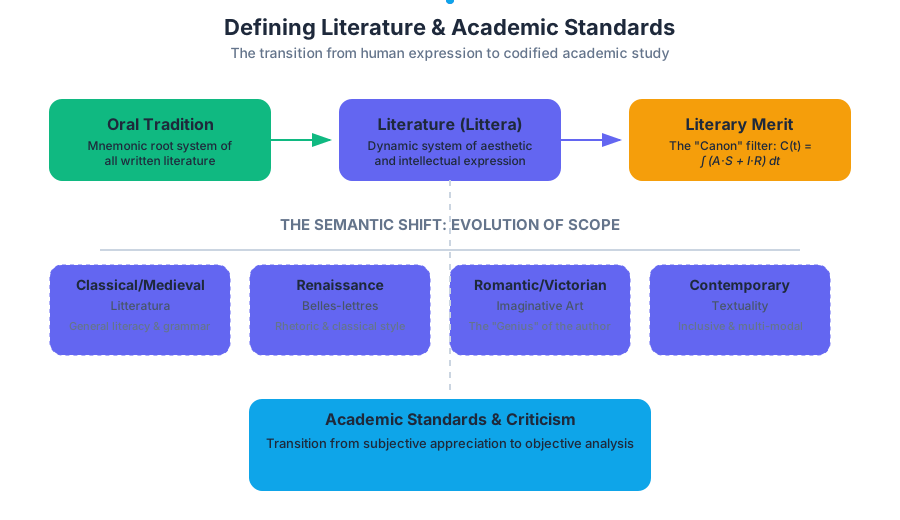
In the contemporary academy, literature is no longer viewed merely as a collection of "great books" but as a dynamic, multifaceted system of human expression. At its most fundamental level, literature encompasses any written, spoken, or performed work that utilizes language to create aesthetic, emotional, or intellectual impact. However, the transition from "writing" to "Literature" (with a capital L) involves a complex negotiation of literary merit, cultural gatekeeping, and historical preservation.
To study literature effectively, one must also master the Academic Standards that govern its analysis. This involves the transition from subjective "appreciation" to objective "criticism," utilizing frameworks like the MLA (Modern Language Association) Style to ensure that scholarly conversations are rigorous, traceable, and standardized.
The Etymology and Evolution of "Literature"
What it is
The word literature derives from the Latin litteratura, which itself stems from littera (letter). Historically, the term did not refer to "creative writing" but rather to "acquaintance with letters" or the condition of being an educated person.
Why it matters
Understanding the etymology reveals the inherent link between literature and literacy/power. For centuries, "literature" was synonymous with "erudition." It was only in the 18th and 19th centuries, during the Romantic period, that the definition narrowed to focus on "imaginative" or "creative" works (poetry, prose, drama).
How it works: The Semantic Shift
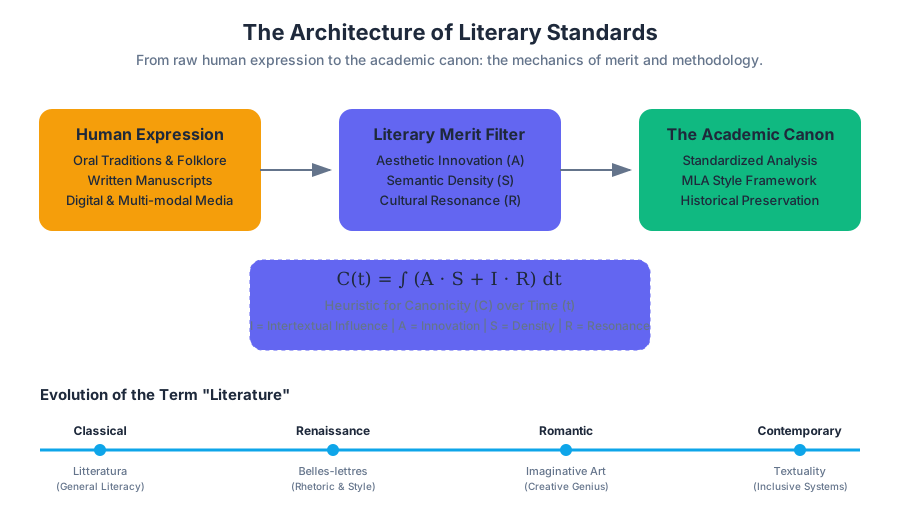
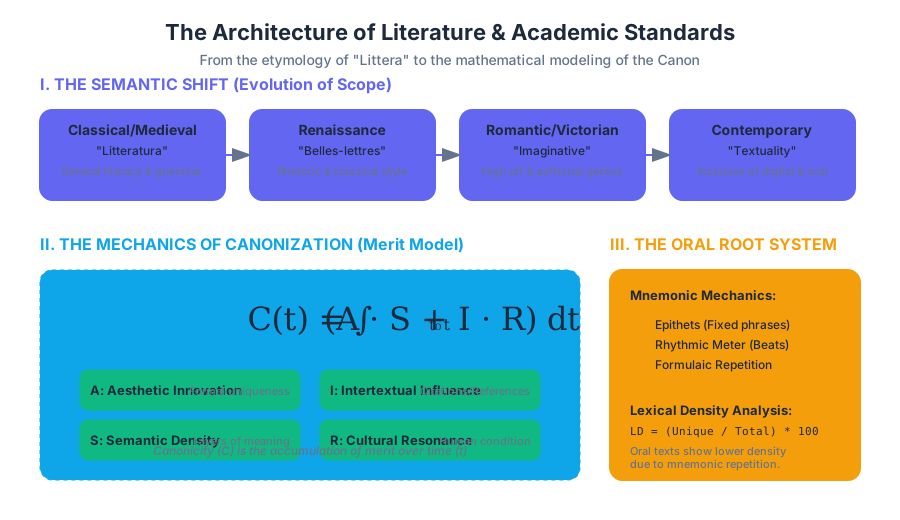
The evolution of the term can be mapped through four distinct historical phases:
| Era | Primary Definition | Scope |
|---|---|---|
| Classical/Medieval | Litteratura | General learning, grammar, and the ability to read/write. |
| Renaissance | Belles-lettres | "Beautiful letters"; focus on rhetoric, style, and classical imitation. |
| Romantic/Victorian | Imaginative Literature | High art; focus on the "Genius" of the author and emotional truth. |
| Post-Modern/Contemporary | Textuality | Inclusive of oral traditions, digital media, and cultural artifacts. |
Key Insight: The modern definition of literature is increasingly functional rather than formal. If a text is treated as literature (analyzed for deeper meaning), it effectively becomes literature within that context.
Literary Merit: The Mechanics of the Canon
What it is
Literary Merit is the perceived quality or value of a work that entitles it to be preserved, studied, and included in the Canon—the unofficial collection of "essential" texts that define a culture or academic discipline.
How it works: The Criteria of Merit
Determining merit is notoriously subjective, yet scholars generally look for several "signals" of high-value textuality. We can model the "Merit Score" ($M$) of a text as a function of its complexity, influence, and longevity.
Mathematical Representation of Canonization
While literature is qualitative, we can conceptualize the process of "Canonicity" ($C$) over time ($t$) through a heuristic formula:
C(t) = \int_{t_0}^{t} (A \cdot S + I \cdot R) dt
Where:
- $A$ = Aesthetic Innovation (formal uniqueness)
- $S$ = Semantic Density (layers of meaning)
- $I$ = Intertextual Influence (how much other writers cite/reference it)
- $R$ = Cultural Resonance (relevance to the human condition)
Comparative Standards of Merit
The following table compares the traditional "High-Culture" view of merit against the modern "Cultural Studies" approach.
| Criterion | Traditional (Canonical) | Modern (Inclusive) |
|---|---|---|
| Authorship | The "Great Man" / Individual Genius | Collective voice / Marginalized perspectives |
| Complexity | High linguistic difficulty; Allusion | Cultural impact; Authenticity of experience |
| Medium | Written (The Printed Book) | Multi-modal (Oral, Digital, Visual) |
| Purpose | Universal "Truth" | Specific social or political critique |
The Oral Tradition: Literature Before the Letter
What it is
The Oral Tradition refers to the transmission of cultural material (stories, poems, histories) through spoken word, chant, or song. It is the "root system" of all written literature.
Why it matters
Many of the world's most foundational "literary" works—the Iliad, the Odyssey, the Epic of Gilgamesh, and the Beowulf—existed for centuries as oral performances before being codified into text. Ignoring oral tradition excludes vast swaths of indigenous and non-Western history.
Mechanics of Orality
Because human memory is fallible, oral literature relies on mnemonic devices and formulaic structures to ensure stability across generations.
- Epithets: Fixed phrases (e.g., "Grey-eyed Athena" or "Wine-dark sea").
- Rhythmic Meter: Beats that act as a "metronome" for the speaker.
- Repetition: Reinforcing key themes and allowing the speaker to "buffer" the next section of the story.
Academic Writing and MLA Style
What it is
Academic Writing in literature is a specialized form of discourse that prioritizes evidence-based argumentation. The MLA (Modern Language Association) Style is the standard formatting and citation system used in the humanities to provide a consistent "syntax" for this discourse.
Why it matters
In science, reproducibility is key. In literature, traceability is key. MLA style allows a reader to follow the "breadcrumb trail" from a critic's claim back to the specific line in a specific edition of a poem. This prevents plagiarism and builds a "web of scholarship."
How it works: The "Container" System (MLA 9th Edition)
The current MLA standard uses a "container" logic. Rather than memorizing different rules for books, websites, and Netflix shows, you follow a fixed sequence of elements.
MLA Core Elements Table
When citing any source, you fill in as many of these "slots" as possible:
| Order | Element | Example |
|---|---|---|
| 1 | Author. | Morrison, Toni. |
| 2 | Title of Source. | Beloved. |
| 3 | Title of Container, | (Not applicable for a standalone book) |
| 4 | Other Contributors, | Edited by Jane Doe, |
| 5 | Version, | Deluxe Edition, |
| 6 | Number, | vol. 2, |
| 7 | Publisher, | Alfred A. Knopf, |
| 8 | Publication Date, | 2004. |
| 9 | Location. | pp. 45-50. |
The Major Genres: Taxonomy of Literature
Literature is traditionally divided into four "super-groups," each with its own set of conventions and "contracts" with the reader.
1. Fiction (Prose)
Narratives based on the imagination.
- Sub-genres: Novel, Novella, Short Story.
- Key Metric: Narrative Arc (Exposition → Rising Action → Climax → Resolution).
2. Poetry
Language used for its aesthetic and evocative qualities, often utilizing meter and metaphor.
- Sub-genres: Lyric, Narrative, Dramatic, Epic.
- Key Metric: Prosody (The patterns of rhythm and sound).
3. Drama
Works intended for performance by actors on a stage or screen.
- Sub-genres: Tragedy, Comedy, Farce, Melodrama.
- Key Metric: Dialogue and Stage Directions.
4. Creative Nonfiction
Factual writing that employs literary techniques usually associated with fiction or poetry.
- Sub-genres: Memoir, Personal Essay, Literary Journalism.
- Key Metric: Veracity + Subjective Reflection.
Genre Comparison Matrix
| Feature | Poetry | Fiction | Drama | Creative Nonfiction |
|---|---|---|---|---|
| Primary Unit | The Line / Stanza | The Sentence / Paragraph | The Act / Scene | The Essay / Chapter |
| Driving Force | Imagery / Rhythm | Plot / Character | Conflict / Dialogue | Fact / Reflection |
| Audience Role | Interpretive | Immersive | Spectator | Witness |
Common Pitfalls in Defining Literature
- The "Intentional Fallacy": Assuming that the "correct" meaning of a work is simply what the author intended. In academic standards, the text is the primary evidence, not the author's biography.
- Confusing "Literature" with "Fiction": Many students assume literature must be "made up." This ignores the massive field of creative nonfiction and historical documents that possess literary merit.
- Formatting Laziness: Treating MLA style as an "extra" rather than the foundation. A paper with incorrect citations is technically considered "unverifiable" in a professional academic context.
- The "Universal" Trap: Claiming a work is "universal" often ignores the specific cultural and historical contexts that make it unique. Good analysis balances the "universal" with the "particular."
Summary of the Analytical Pipeline
To move from a casual reader to a literary scholar, one follows this pipeline:
- Observation: Identify the formal elements (meter, genre, diction).
- Contextualization: Place the work within its historical and etymological framework.
- Theorization: Apply a critical lens (e.g., Feminist, Post-colonial, Formalist).
- Documentation: Codify the findings using MLA standards to join the scholarly conversation.
Source Materials
Study Introduction to Literature on Lykke
This course page is free to open: signed out, you can read its first two sections, and signing in, on any plan, opens the rest. The free Lykke Chrome extension syncs your own Canvas courses, so ChatGPT, Claude and Muse can answer from your classes and deadlines. It only reads Canvas.
Add the free extensionSign in to open every sectionAll sections of Introduction to Literature · Browse more course pages