From the free course Introduction to Literature on Lykke
Assignments and Applied Analysis
Key concepts: Character Analysis · Close Reading · Symbolism Essay · Comparative Essay
Practical application of literary concepts through character analysis, close reading, and comparative essays.
Assignments and Applied Analysis
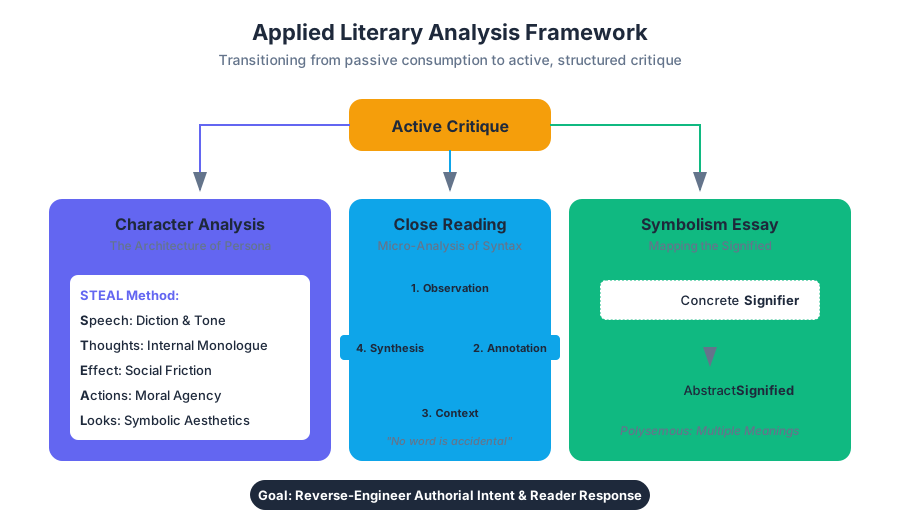
In the field of literary studies, the transition from passive consumption to active critique is mediated through structured assignments. These are not merely "homework" but are rigorous analytical frameworks designed to deconstruct the mechanics of narrative, syntax, and cultural resonance. By treating a text as a complex system of variables—historical context, linguistic choice, and psychological depth—students can reverse-engineer the author’s intent and the reader’s response.
Character Analysis: The Architecture of Persona
Character Analysis is the systematic examination of a fictional individual’s traits, motivations, and development throughout a narrative. It moves beyond simple description to investigate how a character functions as a vehicle for the story’s themes.
What it is
At its core, character analysis is the extraction of data points from a text to build a psychological profile. This involves distinguishing between Static characters (who remain unchanged) and Dynamic characters (who undergo significant internal transformation).
Why it matters
Characters are the primary interface through which readers experience a narrative. Understanding characterization allows us to decode the "moral logic" of a story. If a character succeeds or fails, their traits provide the causal link to that outcome, revealing the author’s underlying worldview.
How it works: The STEAL Method
To perform a high-level character analysis, analysts often use the STEAL framework to categorize indirect characterization:
| Category | Description | Analytical Focus |
|---|---|---|
| Speech | What the character says and how they say it. | Diction, tone, dialect, and subtext. |
| Thoughts | What is revealed through internal monologue. | Discrepancies between private thought and public action. |
| Effect | How other characters react to the individual. | Social standing, influence, and interpersonal friction. |
| Actions | What the character does in moments of crisis. | Moral agency and behavioral consistency. |
| Looks | Physical appearance and dress. | Symbolic value of aesthetics and physical flaws. |
Worked Example: Pythonic Character Mapping
In modern digital humanities, character analysis can be augmented by computational tools to track interaction frequency and sentiment.
Common Pitfalls
- The "Resume" Mistake: Listing traits without explaining their significance. (e.g., "The protagonist is brave.")
- Ignoring the Foil: Failing to see how a secondary character exists specifically to highlight a trait in the protagonist.
- Confusing Narrator with Author: Attributing the narrator’s biases directly to the writer.
Close Reading: The Micro-Analysis of Syntax
Close Reading (or explication de texte) is the foundational skill of literary analysis. It requires the reader to slow down and examine the specific linguistic choices—word order, rhythm, and imagery—within a short passage.
What it is
Close reading is the practice of "zooming in" on a text to see how the "how" (style) informs the "what" (content). It assumes that in a great work of literature, no word is accidental.
The Mechanics of the "Deep Dive"
The process follows a recursive loop of observation and interpretation:
- Observation: Identify a pattern (e.g., a recurring color, a specific meter).
- Annotation: Mark the text for linguistic features (alliteration, enjambment).
- Contextualization: Relate the feature to the immediate scene.
- Synthesis: Formulate a thesis on how this micro-detail supports the macro-theme.
Mathematical Representation of Textual Density
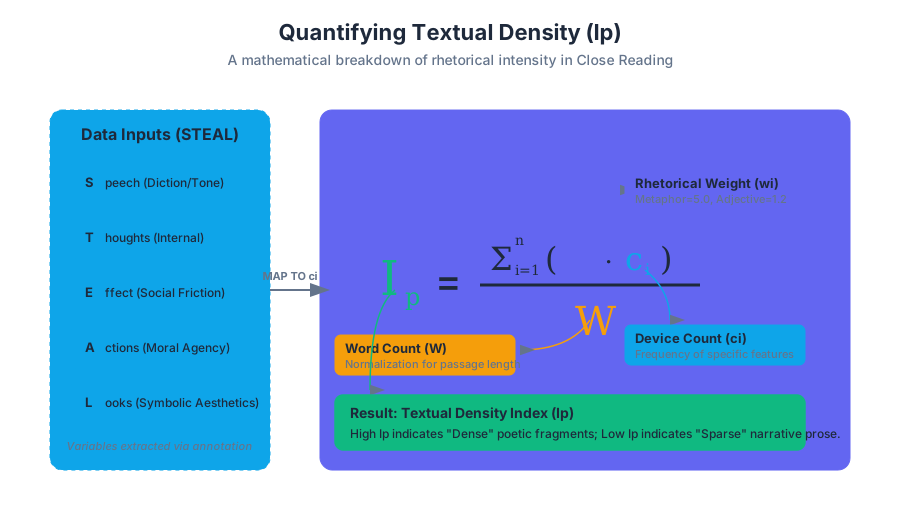
We can conceptualize the "intensity" of a passage ($I_p$) as a function of its rhetorical devices ($D$) over its word count ($W$):
I_p = \frac{\sum_{i=1}^{n} (w_i \cdot c_i)}{W}
Where:
- $w_i$ is the weight of the $i$-th rhetorical device (e.g., a metaphor might weigh more than a simple adjective).
- $c_i$ is the count of that device.
- $W$ is the total word count of the passage.
Worked Example: Analyzing a Poetic Fragment
"The apparition of these faces in the crowd; / Petals on a wet, black bough." — Ezra Pound
Analysis:
- Punctuation: The semicolon creates a "paratactic" jump, forcing the reader to equate the faces with the petals without an explicit "like" or "as."
- Diction: "Apparition" suggests something ghostly or fleeting, contrasting with the physical "wet, black bough."
The Symbolism Essay: Mapping the Signified
A Symbolism Essay explores how concrete objects, characters, or colors represent abstract ideas. It is an exercise in semiotics—the study of signs and symbols.
What it is
A symbol is a physical entity that stands for something larger than itself. In literature, symbols are rarely one-to-one equations (e.g., Red = Anger); they are often "polysemous," meaning they carry multiple, sometimes conflicting, meanings.
Types of Symbols
| Type | Definition | Example |
|---|---|---|
| Universal (Archetypal) | Symbols that carry meaning across cultures. | Water as rebirth; Fire as destruction/purification. |
| Contextual (Private) | Symbols that gain meaning only within a specific text. | The "Green Light" in The Great Gatsby. |
| Cultural | Symbols specific to a time or place. | A white whale in 19th-century maritime lore. |
A Logic-Based Approach to Symbolism
To write an effective symbolism essay, one must move from the Signifier (the object) to the Signified (the concept) through Evidence.
Common Pitfalls
- Symbol Hunting: Seeing symbols where none exist (sometimes a cigar is just a cigar).
- Fixed Definitions: Assuming a symbol always means the same thing (e.g., "White always means purity"). In Moby Dick, white represents a terrifying void.
The Comparative Essay: Structural Alignment
The Comparative Essay (or "Compare and Contrast") requires the analyst to look at two or more texts simultaneously to identify shared patterns or divergent philosophies.
What it is
Comparison is not just about finding similarities; it is about using one text to illuminate the other. By placing two works in conversation, we can see the boundaries of a genre or the evolution of an idea.
Structuring the Analysis
There are two primary architectural patterns for a comparative essay:
- The Lens Method: Using Text A as a theoretical framework to analyze Text B.
- The Point-by-Point Method: Alternating between texts for every sub-topic (Theme 1: Text A vs Text B; Theme 2: Text A vs Text B).
- The Block Method: Discussing Text A entirely, then Text B entirely, then synthesizing them in the conclusion.
Comparison Matrix for Two Texts
| Feature | Text A (e.g., 1984) | Text B (e.g., Brave New World) |
|---|---|---|
| Mechanism of Control | Pain and Fear (The Whip) | Pleasure and Distraction (The Carrot) |
| Role of Information | Censorship (Books are banned) | Overload (Books are irrelevant) |
| The Resistance | Internal thought/rebellion | External "Savage" perspective |
LMS Integration and Technical Deployment
For educators, these assignments are often deployed via a Learning Management System (LMS) like Canvas, Blackboard, or Moodle. These systems treat assignments as structured objects with specific metadata.
Summary of Applied Analysis
Literary analysis is a discipline of pattern recognition. Whether one is performing a character analysis or a comparative essay, the goal is to move from the chaotic surface of the text to the underlying structural logic.
The Axiom of Analysis: A text is not a static object but a dynamic system. The reader's job is to map the inputs (words, history, culture) to the outputs (emotion, theme, meaning).
- Characterization: The process by which an author reveals a character's personality.
- Close Reading: A careful, sustained interpretation of a brief passage of a text.
- Symbolism: The use of concrete objects to represent abstract ideas.
- Comparative Analysis: Examining two or more texts to identify similarities, differences, and thematic intersections.
- STEAL: An acronym for Speech, Thoughts, Effect, Actions, and Looks—methods of indirect characterization.
- Signifier vs. Signified: The physical form of a sign (word/object) vs. the concept it represents.
- Explication: A line-by-line commentary on a text, often used in close reading.
- Intertextuality: The relationship between texts and how they influence or reference each other.
-
Which method is most appropriate for analyzing the specific rhythm and meter of a poem?
- A) Character Analysis
- B) Close Reading
- C) Comparative Essay
- D) Symbolism Essay Correct: B
-
In the STEAL method, what does the 'E' stand for?
- A) Evidence
- B) Emotion
- C) Effect on others
- D) Environment Correct: C
-
What is the primary risk of the 'Block Method' in a comparative essay?
- A) It focuses too much on symbols.
- B) It can lead to two separate essays with no actual comparison.
- C) It requires too much Python code.
- D) it is only used for poetry. Correct: B
-
A 'Contextual Symbol' is defined as:
- A) A symbol that means the same thing in every book.
- B) A symbol that only has meaning within a specific story.
- C) A character that acts as a foil.
- D) A grammatical error. Correct: B
-
True or False: Close reading assumes that every word in a text is potentially significant.
- A) True
- B) False Correct: A
Core Objectives
- Master the STEAL method for character profiling.
- Develop the ability to perform Close Reading by identifying rhetorical devices in isolation.
- Learn to map Symbols from concrete signifiers to abstract signifieds.
- Construct Comparative Essays using either Point-by-Point or Lens methodologies.
Key Formulas & Frameworks
- The Analysis Loop: Observation → Annotation → Contextualization → Synthesis.
- The Symbolism Logic: Object + Context + Character Action = Thematic Meaning.
Practical Application
- When reading, always ask: Why this word and not another?
- In essays, avoid the "Summary Trap"—if you are telling the reader what happened rather than why it matters, you are summarizing, not analyzing.
Source Materials
Study Introduction to Literature on Lykke
This course page is free to open: signed out, you can read its first two sections, and signing in, on any plan, opens the rest. The free Lykke Chrome extension syncs your own Canvas courses, so ChatGPT, Claude and Muse can answer from your classes and deadlines. It only reads Canvas.
Add the free extensionSign in to open every sectionAll sections of Introduction to Literature · Browse more course pages