Introduction to Literature
Institution: MIT
46 study materials · 12 sections
This course provides a comprehensive introduction to the study of literature, covering major genres including fiction, poetry, drama, and creative nonfiction. Students explore literary conventions, critical analysis techniques, and academic writing standards while engaging with a diverse range of historical and contemporary texts. The curriculum emphasizes the use of Open Educational Resources (OER) and interactive digital courseware to develop subject mastery and research skills.
Course Sections
Course Introduction and Open Educational Resources
Key concepts: Open Educational Resources (OER) · Lumen Learning support · Digital Courseware · Accessibility · Continuous improvement
An overview of the course goals, the use of Open Educational Resources (OER), and the technical support available through Lumen Learning.
Course Introduction and Open Educational Resources
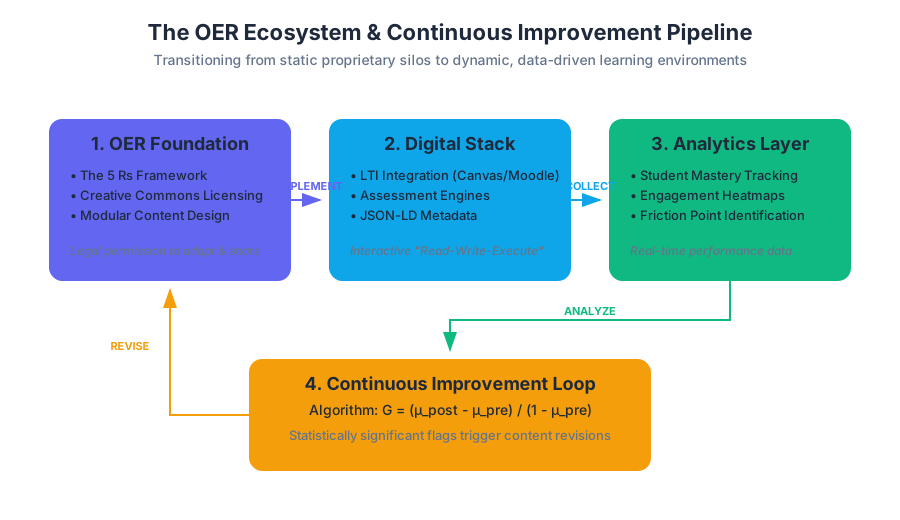
The landscape of higher education is undergoing a fundamental shift from proprietary, static knowledge silos to dynamic, Open Educational Resources (OER). This transition is not merely an economic adjustment to reduce student costs; it represents a pedagogical evolution. In this course, we move beyond the traditional "anthology" model—a heavy, expensive, and unchangeable tome—toward a modular, digitally-native ecosystem. This ecosystem is designed for continuous improvement, high accessibility, and deep integration with modern digital courseware standards.
By utilizing OER, we leverage the collective intelligence of the global academic community. Unlike traditional textbooks, which are updated in multi-year cycles by a handful of editors, OER allows for real-time revisions based on student performance data and emerging literary scholarship. This section serves as a technical and conceptual roadmap for navigating this environment, understanding the licensing that makes it possible, and utilizing the support structures provided by Lumen Learning.
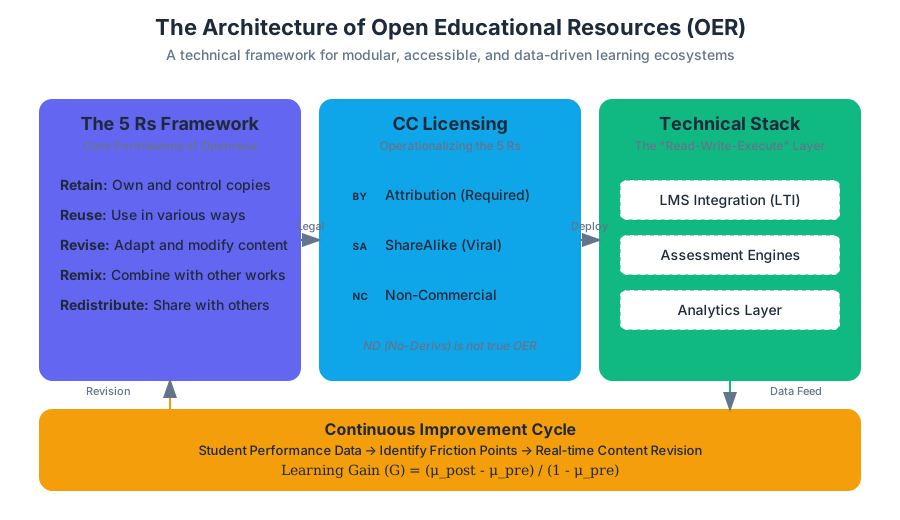
The Architecture of Open Educational Resources (OER)
At its core, an Open Educational Resource is defined by its legal permission to be modified and shared. While "free" is a common byproduct, the technical definition hinges on the 5 Rs of Openness. These permissions allow instructors to tailor the "Introduction to Literature" curriculum to specific cultural contexts, historical periods, or student needs without infringing on copyright.
The 5 Rs Framework
| Permission | Technical Definition | Application in Literature |
|---|---|---|
| Retain | The right to make, own, and control copies of the content. | Students keep the digital text forever; no expiring access codes. |
| Reuse | The right to use the content in a wide range of ways. | Using a poem in a lecture, a video, or a printed handout. |
| Revise | The right to adapt, adjust, modify, or alter the content. | Modernizing the language of a 19th-century analysis for clarity. |
| Remix | The right to combine the original or revised content with other material. | Merging a lesson on Hamlet with a contemporary feminist critique. |
| Redistribute | The right to share copies of the original content or revisions. | Sharing a custom-built literature module with other universities. |
Creative Commons (CC) Licensing
To operationalize the 5 Rs, OER utilizes Creative Commons licenses. These are legal tools that sit on top of traditional copyright, telling the user exactly what they can and cannot do. Understanding these licenses is critical for maintaining academic integrity and legal compliance.
Definition: Creative Commons (CC) A set of public copyright licenses that enable the free distribution of an otherwise copyrighted "work." A CC license is used when an author wants to give other people the right to share, use, and build upon a work that they (the author) have created.
| License Component | Symbol | Requirement |
|---|---|---|
| Attribution (BY) | BY |
Credit must be given to the original creator. |
| ShareAlike (SA) | SA |
Adaptations must be shared under the same license. |
| Non-Commercial (NC) | NC |
The work cannot be used for primary commercial gain. |
| No-Derivatives (ND) | ND |
The work can be shared but not modified (Not true OER). |
Digital Courseware vs. Static Content
A common misconception is that OER is simply a "free PDF." While a PDF version of this course is available for offline reading, the Digital Courseware environment is a sophisticated software layer that facilitates learning through interactivity.
The Technical Stack of Modern Courseware
Traditional textbooks are "read-only." Modern OER courseware is "read-write-execute." It utilizes a stack that includes:
- LMS Integration (LTI): Seamlessly connecting content to platforms like Canvas, Blackboard, or Moodle.
- Assessment Engines: Real-time quiz generation with randomized variables.
- Analytics Layer: Tracking student engagement and mastery levels to provide "early warnings" to instructors.
Implementation: Metadata and Resource Discovery
To manage thousands of OER objects, we use structured metadata. Below is a conceptual representation of how an OER literary module might be defined in a JSON-LD (Linked Data) format for machine readability and searchability.
{
  "@context": "http://schema.org/",
  "@type": "CreativeWork",
  "name": "Introduction to Literary Theory",
  "author": "Lumen Learning",
  "license": "https://creativecommons.org/licenses/by/4.0/",
  "educationalUse": "Higher Education",
  "interactivityType": "active",
  "learningResourceType": "Module",
  "about": [
    {"@type": "Thing", "name": "Formalism"},
    {"@type": "Thing", "name": "Structuralism"},
    {"@type": "Thing", "name": "Post-Colonialism"}
  ],
  "accessibilityControl": ["fullKeyboardControl", "readingOrder"],
  "hasPart": [
    {"@type": "Quiz", "name": "Module 1 Formative Assessment"},
    {"@type": "VideoObject", "name": "The Hero's Journey Explained"}
  ]
}
Continuous Improvement and Data-Driven Learning
One of the most powerful features of the Lumen Learning OER platform is Continuous Improvement. In a traditional publishing model, if a paragraph in a chapter on "Poetic Meter" is confusing, it might take five years for a new edition to fix it. In an OER environment, we use Learning Data Analytics to identify "friction points."
The Improvement Algorithm
If a statistically significant number of students miss a specific quiz question, the system flags the associated content. The "Learning Gain" can be modeled as:
$$G = \frac{\mu_{post} - \mu_{pre}}{1 - \mu_{pre}}$$
Where:
- $G$ is the normalized learning gain.
- $\mu_{pre}$ is the mean score on a pre-test.
- $\mu_{post}$ is the mean score on a post-test.
If $G$ falls below a certain threshold for a specific concept (e.g., iambic pentameter), the content is targeted for a Remediated Revision Cycle.
def identify_content_friction(quiz_data, threshold=0.6):
    """
    Analyzes student performance to find content modules
    that require pedagogical revision.
    """
    friction_points = []

    for module in quiz_data:
        avg_score = sum(module['scores']) / len(module['scores'])
        difficulty_index = module['difficulty_rating'] # 0 to 1

        # Calculate weighted performance
        # High difficulty + Low score = Normal
        # Low difficulty + Low score = Content Friction
        performance_metric = avg_score * (1 + difficulty_index)

        if performance_metric < threshold:
            friction_points.append({
                'module_id': module['id'],
                'metric': performance_metric,
                'recommendation': 'Rewrite explanatory text/add visual aids'
            })

    return sorted(friction_points, key=lambda x: x['metric'])

# Example output: [{'module_id': 'lit_101_poetry_meter', 'metric': 0.42, ...}]
Accessibility and Universal Design for Learning (UDL)
Accessibility is not an "add-on" feature; it is a core technical requirement. This course adheres to WCAG 2.1 (Web Content Accessibility Guidelines) at the AA level. This ensures that all students, regardless of physical or cognitive ability, can interact with the material.
Technical Accessibility Standards
| Feature | Technical Implementation | UDL Principle |
|---|---|---|
| Screen Reader Support | Semantic HTML5 (e.g., <nav>, <article>, aria-labels). |
Perception |
| Keyboard Navigation | Logical tabindex and focus visible states. |
Physical Action |
| Alt-Text | Descriptive strings for all non-textual content. | Comprehension |
| Color Contrast | Minimum 4.5:1 ratio for text against background. | Perception |
| Closed Captioning | VTT/SRT files for all embedded video content. | Language & Symbols |
Implementation Example: Accessible Image
When presenting a complex diagram of a "Plot Pyramid" (Freytag's Pyramid), a simple alt="pyramid" is insufficient. We use a combination of longdesc or an off-screen description.
<figure role="group" aria-labelledby="fig1-caption">
  <img src="freytags-pyramid.png"
       alt="Diagram of Freytag's Pyramid showing the five stages of dramatic structure.">
  <figcaption id="fig1-caption">
    Figure 1: Freytag's Pyramid.
    <details>
      <summary>View Text Description</summary>
      <p>The pyramid starts with Exposition, rises through Rising Action to the Climax,
         falls through Falling Action, and ends at the Denouement/Resolution.</p>
    </details>
  </figcaption>
</figure>
Support Systems: Lumen Learning and Faculty Resources
Navigating a digital-first course requires robust support. Lumen Learning provides a multi-tiered support structure for both students and faculty.
Support Tiers
- Self-Service: The Lumen Support Portal contains a knowledge base of articles covering common issues like browser compatibility, LTI login errors, and quiz resets.
- Technical Tickets: For bugs or system outages, users can submit tickets that are routed to senior systems engineers.
- Faculty Office Hours: Live sessions where instructors can discuss pedagogical strategies and course customization.
Common Troubleshooting Workflow
If a student cannot access a module, the following diagnostic path is typically followed:
# 1. Verify LTI Handshake (Server-side)
curl -X POST "https://lumenlearning.com/api/lti/v1/verify" \
     -H "Authorization: Bearer $OAUTH_TOKEN" \
     -d "user_id=12345&context_id=lit_intro_01"

# 2. Check Browser Cache/Cookies (Client-side)
# Recommendation: Clear local storage for domain 'lumenlearning.com'

# 3. Validate Enrollment Status
# Ensure student is 'active' in the LMS roster synchronized with Lumen Waymaker.
Literary Genres and Modular Content
The "Introduction to Literature" OER is organized into distinct modules based on genre and convention. This modularity allows the course to be non-linear; an instructor can choose to begin with Poetry or Creative Nonfiction depending on the syllabus goals.
Genre Frameworks
| Genre | Key Conventions | OER Focus |
|---|---|---|
| Fiction | Narrative, Character, Setting, Theme. | Short stories and novellas with public domain status. |
| Poetry | Meter, Rhyme, Imagery, Form (Sonnet, Haiku). | Interactive audio recordings of poems to emphasize rhythm. |
| Drama | Dialogue, Stage Directions, Conflict. | Video clips of performances alongside the script. |
| Creative Nonfiction | Truth-telling, Personal Narrative, Essay. | Contemporary essays licensed under CC-BY. |
Academic Writing and MLA Style
A critical component of this course is the transition from reading to Literary Analysis. The OER provides integrated guides on MLA (Modern Language Association) Style, ensuring students can cite both traditional print sources and digital-native OER materials correctly.
Key Insight: The "Open" Citation When citing OER, the "Version" or "Last Modified" date becomes as important as the author, because the content is subject to continuous improvement.
Common Pitfalls in OER Usage
- Assuming "Free" means "Public Domain": Most OER requires attribution (CC-BY). You cannot claim the work as your own.
- The "Print-Only" Trap: Students who only use the PDF version miss out on interactive self-checks and videos that are essential for mastering complex concepts like Critical Theory.
- Ignoring the "Help" Button: Many technical issues are known browser-side conflicts (like blocked third-party cookies) that can be solved in seconds via the support documentation.
Conclusion
This course is more than a collection of readings; it is a living document. By engaging with these Open Educational Resources, you are participating in a global movement toward equitable, accessible, and high-quality education. The modular nature of the content, backed by the technical infrastructure of Lumen Learning, ensures that the material you study today is the most refined and effective version available. As you progress through the modules on Fiction, Poetry, and Drama, remember that the digital tools at your disposal—the interactive quizzes, the accessibility features, and the support systems—are designed to facilitate a deeper, more resilient understanding of literature.
Defining Literature and Academic Standards
Key concepts: Etymology of literature · Literary Merit · Academic Writing and MLA Style · Oral tradition
Exploration of the etymology of literature, its evolving definition, and the academic standards required for literary study.
Defining Literature and Academic Standards
Overview
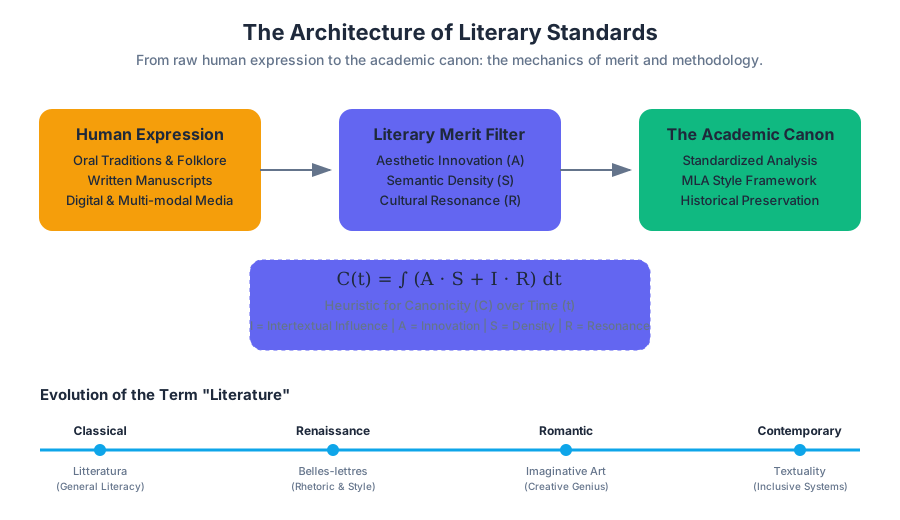
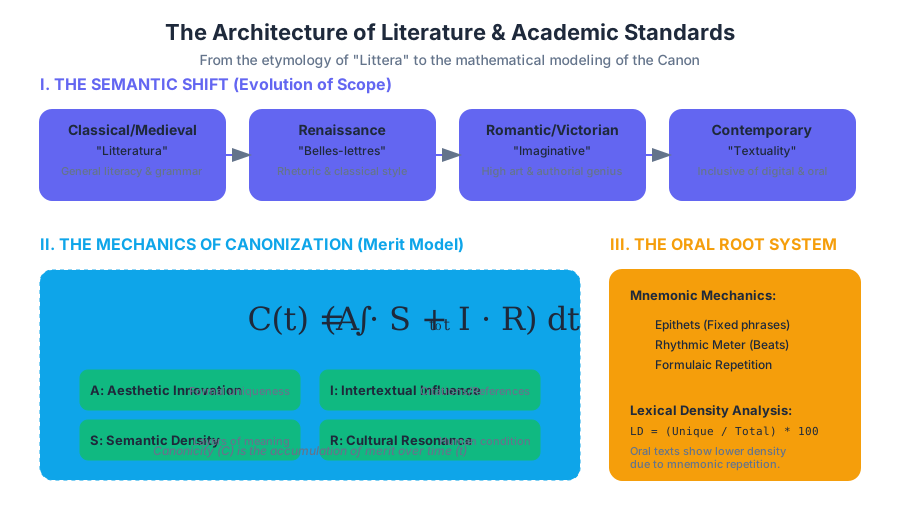
In the contemporary academy, literature is no longer viewed merely as a collection of "great books" but as a dynamic, multifaceted system of human expression. At its most fundamental level, literature encompasses any written, spoken, or performed work that utilizes language to create aesthetic, emotional, or intellectual impact. However, the transition from "writing" to "Literature" (with a capital L) involves a complex negotiation of literary merit, cultural gatekeeping, and historical preservation.
To study literature effectively, one must also master the Academic Standards that govern its analysis. This involves the transition from subjective "appreciation" to objective "criticism," utilizing frameworks like the MLA (Modern Language Association) Style to ensure that scholarly conversations are rigorous, traceable, and standardized.
The Etymology and Evolution of "Literature"
What it is
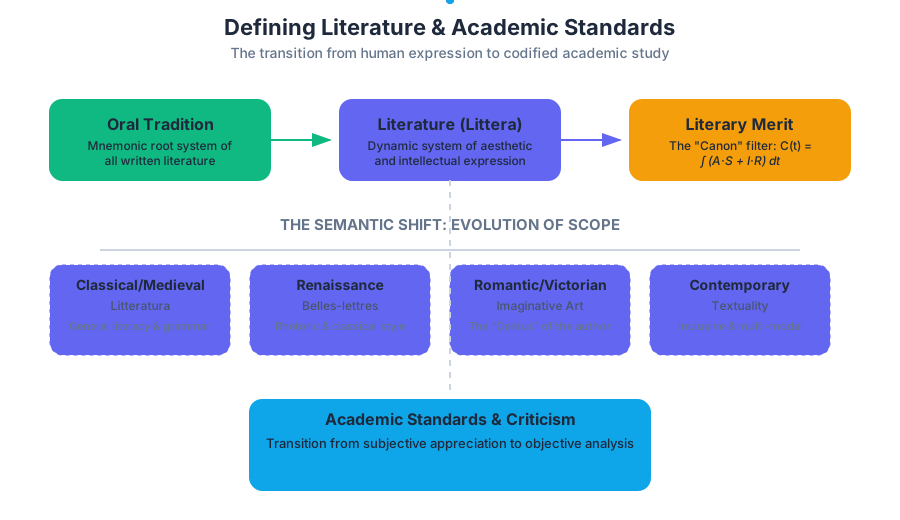
The word literature derives from the Latin litteratura, which itself stems from littera (letter). Historically, the term did not refer to "creative writing" but rather to "acquaintance with letters" or the condition of being an educated person.
Why it matters
Understanding the etymology reveals the inherent link between literature and literacy/power. For centuries, "literature" was synonymous with "erudition." It was only in the 18th and 19th centuries, during the Romantic period, that the definition narrowed to focus on "imaginative" or "creative" works (poetry, prose, drama).
How it works: The Semantic Shift
The evolution of the term can be mapped through four distinct historical phases:
| Era | Primary Definition | Scope |
|---|---|---|
| Classical/Medieval | Litteratura | General learning, grammar, and the ability to read/write. |
| Renaissance | Belles-lettres | "Beautiful letters"; focus on rhetoric, style, and classical imitation. |
| Romantic/Victorian | Imaginative Literature | High art; focus on the "Genius" of the author and emotional truth. |
| Post-Modern/Contemporary | Textuality | Inclusive of oral traditions, digital media, and cultural artifacts. |
Key Insight: The modern definition of literature is increasingly functional rather than formal. If a text is treated as literature (analyzed for deeper meaning), it effectively becomes literature within that context.
Literary Merit: The Mechanics of the Canon
What it is
Literary Merit is the perceived quality or value of a work that entitles it to be preserved, studied, and included in the Canon—the unofficial collection of "essential" texts that define a culture or academic discipline.
How it works: The Criteria of Merit
Determining merit is notoriously subjective, yet scholars generally look for several "signals" of high-value textuality. We can model the "Merit Score" ($M$) of a text as a function of its complexity, influence, and longevity.
Mathematical Representation of Canonization
While literature is qualitative, we can conceptualize the process of "Canonicity" ($C$) over time ($t$) through a heuristic formula:
C(t) = \int_{t_0}^{t} (A \cdot S + I \cdot R) dt
Where:
- $A$ = Aesthetic Innovation (formal uniqueness)
- $S$ = Semantic Density (layers of meaning)
- $I$ = Intertextual Influence (how much other writers cite/reference it)
- $R$ = Cultural Resonance (relevance to the human condition)
Comparative Standards of Merit
The following table compares the traditional "High-Culture" view of merit against the modern "Cultural Studies" approach.
| Criterion | Traditional (Canonical) | Modern (Inclusive) |
|---|---|---|
| Authorship | The "Great Man" / Individual Genius | Collective voice / Marginalized perspectives |
| Complexity | High linguistic difficulty; Allusion | Cultural impact; Authenticity of experience |
| Medium | Written (The Printed Book) | Multi-modal (Oral, Digital, Visual) |
| Purpose | Universal "Truth" | Specific social or political critique |
The Oral Tradition: Literature Before the Letter
What it is
The Oral Tradition refers to the transmission of cultural material (stories, poems, histories) through spoken word, chant, or song. It is the "root system" of all written literature.
Why it matters
Many of the world's most foundational "literary" works—the Iliad, the Odyssey, the Epic of Gilgamesh, and the Beowulf—existed for centuries as oral performances before being codified into text. Ignoring oral tradition excludes vast swaths of indigenous and non-Western history.
Mechanics of Orality
Because human memory is fallible, oral literature relies on mnemonic devices and formulaic structures to ensure stability across generations.
- Epithets: Fixed phrases (e.g., "Grey-eyed Athena" or "Wine-dark sea").
- Rhythmic Meter: Beats that act as a "metronome" for the speaker.
- Repetition: Reinforcing key themes and allowing the speaker to "buffer" the next section of the story.
Low-Level Implementation: Lexical Density Analysis
To distinguish between oral-derived texts and purely "literary" (written) texts, scholars often use computational linguistics to measure Lexical Density. Oral texts tend to have higher repetition and lower unique word counts per 1000 words.
import nltk
from nltk.tokenize import word_tokenize

def calculate_lexical_density(text):
    """
    Calculates the ratio of unique content words to total words.
    Oral traditions typically show lower density due to mnemonic repetition.
    """
    tokens = word_tokenize(text.lower())
    # Filter for alphanumeric to remove punctuation
    words = [word for word in tokens if word.isalnum()]

    total_word_count = len(words)
    unique_words = set(words)

    if total_word_count == 0:
        return 0

    density = (len(unique_words) / total_word_count) * 100
    return round(density, 2)

# Example: A passage from an oral epic vs. a modern novel
epic_text = "Sing, Goddess, of the rage of Achilles, the rage that brought pain..."
modern_text = "The post-structuralist paradigm shifted the ontological certainty of the text..."

print(f"Oral Lexical Density: {calculate_lexical_density(epic_text)}%")
print(f"Modern Lexical Density: {calculate_lexical_density(modern_text)}%")
Academic Writing and MLA Style
What it is
Academic Writing in literature is a specialized form of discourse that prioritizes evidence-based argumentation. The MLA (Modern Language Association) Style is the standard formatting and citation system used in the humanities to provide a consistent "syntax" for this discourse.
Why it matters
In science, reproducibility is key. In literature, traceability is key. MLA style allows a reader to follow the "breadcrumb trail" from a critic's claim back to the specific line in a specific edition of a poem. This prevents plagiarism and builds a "web of scholarship."
How it works: The "Container" System (MLA 9th Edition)
The current MLA standard uses a "container" logic. Rather than memorizing different rules for books, websites, and Netflix shows, you follow a fixed sequence of elements.
MLA Core Elements Table
When citing any source, you fill in as many of these "slots" as possible:
| Order | Element | Example |
|---|---|---|
| 1 | Author. | Morrison, Toni. |
| 2 | Title of Source. | Beloved. |
| 3 | Title of Container, | (Not applicable for a standalone book) |
| 4 | Other Contributors, | Edited by Jane Doe, |
| 5 | Version, | Deluxe Edition, |
| 6 | Number, | vol. 2, |
| 7 | Publisher, | Alfred A. Knopf, |
| 8 | Publication Date, | 2004. |
| 9 | Location. | pp. 45-50. |
Real-World Usage: The Pandoc Workflow
Senior scholars often use Markdown and BibTeX to automate MLA formatting. Below is a shell command using pandoc to convert a research paper into a perfectly formatted MLA PDF using a .bib file.
# Convert a Markdown draft to an MLA-formatted PDF
# --citeproc handles the citations based on the bibliography file
# --csl specifies the Modern Language Association 9th edition style

pandoc "literary_analysis_draft.md" \
    --citeproc \
    --bibliography="references.bib" \
    --csl="mla-9th-edition.csl" \
    -o "Final_Paper_MLA.pdf"
The Major Genres: Taxonomy of Literature
Literature is traditionally divided into four "super-groups," each with its own set of conventions and "contracts" with the reader.
1. Fiction (Prose)
Narratives based on the imagination.
- Sub-genres: Novel, Novella, Short Story.
- Key Metric: Narrative Arc (Exposition → Rising Action → Climax → Resolution).
2. Poetry
Language used for its aesthetic and evocative qualities, often utilizing meter and metaphor.
- Sub-genres: Lyric, Narrative, Dramatic, Epic.
- Key Metric: Prosody (The patterns of rhythm and sound).
3. Drama
Works intended for performance by actors on a stage or screen.
- Sub-genres: Tragedy, Comedy, Farce, Melodrama.
- Key Metric: Dialogue and Stage Directions.
4. Creative Nonfiction
Factual writing that employs literary techniques usually associated with fiction or poetry.
- Sub-genres: Memoir, Personal Essay, Literary Journalism.
- Key Metric: Veracity + Subjective Reflection.
Genre Comparison Matrix
| Feature | Poetry | Fiction | Drama | Creative Nonfiction |
|---|---|---|---|---|
| Primary Unit | The Line / Stanza | The Sentence / Paragraph | The Act / Scene | The Essay / Chapter |
| Driving Force | Imagery / Rhythm | Plot / Character | Conflict / Dialogue | Fact / Reflection |
| Audience Role | Interpretive | Immersive | Spectator | Witness |
Common Pitfalls in Defining Literature
- The "Intentional Fallacy": Assuming that the "correct" meaning of a work is simply what the author intended. In academic standards, the text is the primary evidence, not the author's biography.
- Confusing "Literature" with "Fiction": Many students assume literature must be "made up." This ignores the massive field of creative nonfiction and historical documents that possess literary merit.
- Formatting Laziness: Treating MLA style as an "extra" rather than the foundation. A paper with incorrect citations is technically considered "unverifiable" in a professional academic context.
- The "Universal" Trap: Claiming a work is "universal" often ignores the specific cultural and historical contexts that make it unique. Good analysis balances the "universal" with the "particular."
Summary of the Analytical Pipeline
To move from a casual reader to a literary scholar, one follows this pipeline:
- Observation: Identify the formal elements (meter, genre, diction).
- Contextualization: Place the work within its historical and etymological framework.
- Theorization: Apply a critical lens (e.g., Feminist, Post-colonial, Formalist).
- Documentation: Codify the findings using MLA standards to join the scholarly conversation.
Reading and Research Strategies
Key concepts: Reading like a writer · Critical Analysis · Academic Research · Literary Interpretation
Techniques for reading literature critically and conducting academic research.
Reading and Research Strategies
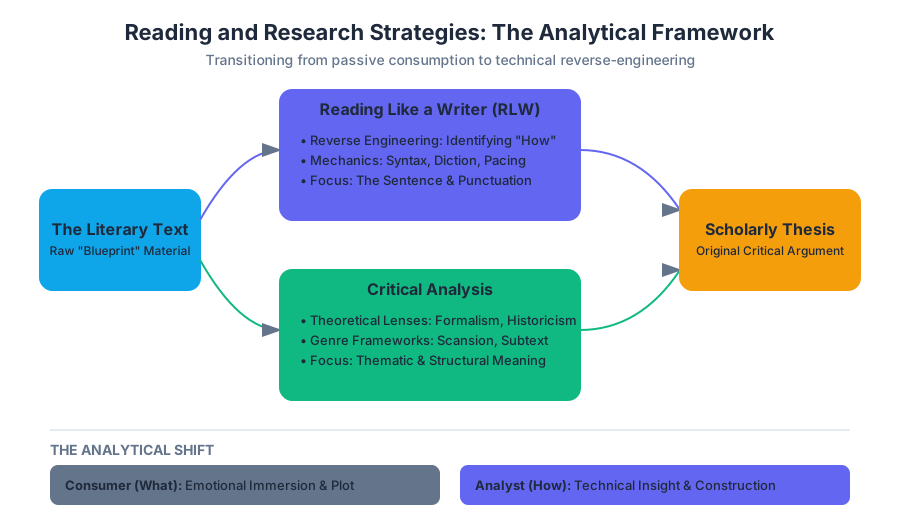
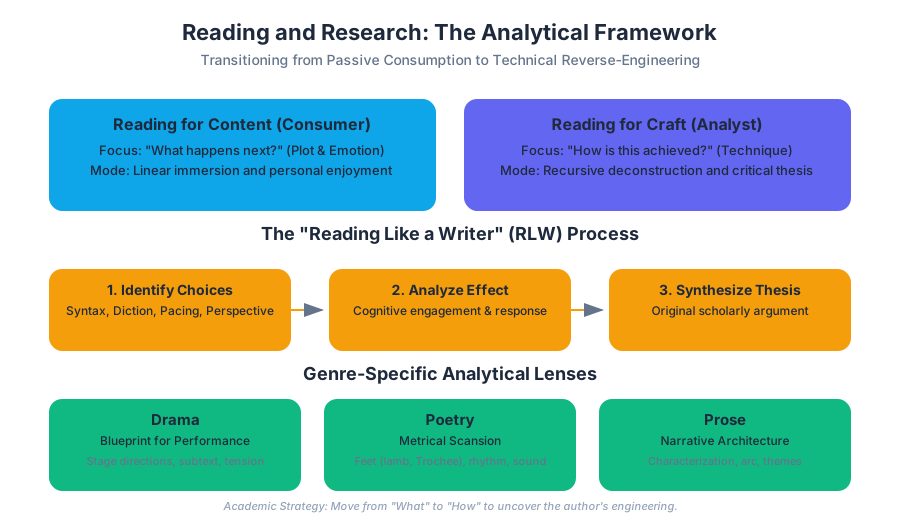
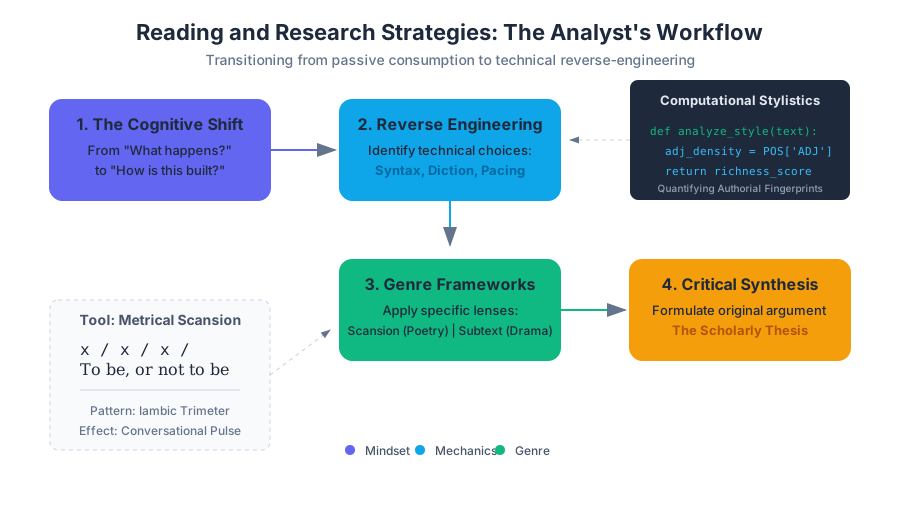
To analyze literature effectively, one must transcend passive consumption and adopt the mindset of an architect or a forensic engineer. This transition—moving from "what happens next" to "how is this effect achieved"—is the core of academic literary study. This article outlines the systematic frameworks required to deconstruct texts, conduct rigorous research, and synthesize original scholarly arguments.
Reading Like a Writer: The Reverse Engineering of Craft
Reading like a writer (RLW) is the practice of examining a text to identify the technical choices made by the author. Instead of focusing solely on the narrative content (the what), the reader focuses on the construction (the how). This involves identifying the "tools" in the author's kit: syntax, diction, pacing, and narrative perspective.
The Mechanics of Choice
Every word in a literary work represents a decision. When an author chooses a periodic sentence—where the main clause is withheld until the end—they are engineering suspense and intellectual weight. Conversely, a minimalist style (common in Modernism) forces the reader to fill in the gaps, creating a different kind of cognitive engagement.
Definition: Reading Like a Writer The analytical process of identifying the specific linguistic and structural techniques an author employs to produce a particular emotional or intellectual response in the reader.
| Feature | Reading for Content (Consumer) | Reading for Craft (Analyst) |
|---|---|---|
| Primary Goal | Emotional immersion / Plot comprehension | Understanding construction / Technique identification |
| Focus Unit | The Scene / The Chapter | The Sentence / The Word / The Punctuation |
| Question Asked | "What happens to the character?" | "Why did the author use this specific metaphor here?" |
| Temporal View | Linear (Forward-moving) | Recursive (Back-and-forth) |
| Outcome | Personal enjoyment | Technical insight / Critical thesis |
Implementation: Stylistic Decomposition
To perform RLW at scale, one can use computational linguistics to identify patterns that the naked eye might miss. Below is a low-level implementation using Python and the spaCy library to analyze the "density" of figurative language or specific syntactic structures.
import spacy
from collections import Counter

# Load a high-accuracy English model
nlp = spacy.load("en_core_web_trf")

def analyze_author_style(text):
    """
    Deconstructs a text block to identify syntactic patterns
    indicative of specific literary styles.
    """
    doc = nlp(text)

    # Analyze Part-of-Speech (POS) distribution
    pos_counts = Counter([token.pos_ for token in doc])
    total_tokens = len(doc)

    # Calculate 'Adjective Density' - often a marker of Romantic vs. Modernist style
    adj_density = pos_counts.get("ADJ", 0) / total_tokens

    # Identify 'Periodic' tendencies: Average distance of main verb from start of sentence
    verb_positions = []
    for sent in doc.sents:
        root = [token for token in sent if token.dep_ == "ROOT"]
        if root:
            # Normalized position of the root verb (0.0 to 1.0)
            verb_positions.append(root[0].i - sent.start)

    avg_verb_idx = sum(verb_positions) / len(verb_positions) if verb_positions else 0

    return {
        "adjective_density": round(adj_density, 4),
        "avg_verb_offset": round(avg_verb_idx, 2),
        "vocabulary_richness": len(set([t.lemma_ for t in doc])) / total_tokens
    }

# Example usage with a complex sentence
sample_text = "Deep into that darkness peering, long I stood there wondering, fearing, doubting, dreaming dreams no mortal ever dared to dream before."
print(analyze_author_style(sample_text))
Critical Analysis and Literary Interpretation
Critical Analysis is the systematic breakdown of a text into its constituent parts to evaluate how they work together to create meaning. This process is governed by Literary Interpretation, which applies various theoretical lenses (e.g., Formalism, New Historicism, Psychoanalysis) to the evidence gathered during analysis.
The Genre-Specific Framework
Analysis techniques vary significantly across genres. A play, for instance, must be read as a "blueprint for performance" rather than a finished prose product.
- Drama: Focuses on Dramatic Text Analysis, examining stage directions, subtext in dialogue, and the "unspoken" tension between characters.
- Poetry: Requires an understanding of Accentual-syllabic Metre and sound devices.
- Prose: Focuses on characterization, narrative arc, and thematic development.
Metrical Analysis (Scansion)
In poetry, the rhythm is often as important as the literal meaning. We use Scansion to map the stressed (/) and unstressed (x) syllables.
Theorem: The Metrical Unit A foot is the basic unit of measurement in poetry. The most common in English is the Iamb (x /). The combination of the type of foot and the number of feet per line (e.g., Iambic Pentameter) defines the poem's "pulse."
| Foot Type | Pattern | Example | Effect |
|---|---|---|---|
| Iamb | x / | "To be" | Natural, conversational, rising |
| Trochee | / x | "Double" | Urgent, driving, falling |
| Anapest | x x / | "Understand" | Galloping, light, fast |
| Dactyl | / x x | "Poetry" | Grandiose, classical |
| Spondee | / / | "Heartbreak" | Weighty, emphatic, slowing |
Formalizing Scansion Logic
The following pseudocode represents the logical flow of a scansion algorithm used to determine the metre of a line of verse.
ALGORITHM ScanLine(line_text):
    tokens = TokenizeBySyllable(line_text)
    stress_map = []

    FOR EACH syllable IN tokens:
        IF syllable IN Dictionary.StressedPatterns:
            stress_map.APPEND(STRESSED)
        ELSE IF syllable.IsMonosyllabicContentWord:
            stress_map.APPEND(STRESSED)
        ELSE:
            stress_map.APPEND(UNSTRESSED)

    # Pattern Matching
    IF stress_map MATCHES [x, /, x, /, x, /, x, /, x, /]:
        RETURN "Iambic Pentameter"
    ELSE IF stress_map MATCHES [/, x, /, x, /, x, /, x]:
        RETURN "Trochaic Tetrameter"
    ...
The Evolution of Literary Style
Style is not static; it is a reflection of the philosophical and cultural zeitgeist of its era. Understanding the historical context of a style allows a researcher to interpret why a writer chose a specific mode of expression.
Historical Style Matrix
| Era | Dominant Style | Key Characteristics | Philosophical Driver |
|---|---|---|---|
| Renaissance | Oratory / Ornate | Complex syntax, classical allusions, rhetoric. | Humanism and the revival of Greek/Roman ideals. |
| Enlightenment | Rationalism | Clarity, balance, "Heroic Couplets," precision. | Reason, logic, and the scientific method. |
| Romanticism | Emotionalism | Sensory detail, focus on the "I," nature-centric. | Reaction against industrialization; primacy of feeling. |
| Victorian | Realism | Social detail, moral earnestness, panoramic scope. | Industrial expansion and social reform. |
| Modernism | Minimalism / Stream of Consciousness | Fragmentation, internal monologue, brevity. | Post-WWI disillusionment; breakdown of tradition. |
Academic Research and Synthesis
Research in literature involves moving from the Primary Source (the text itself) to Secondary Sources (peer-reviewed articles, historical documents, and critical essays). The goal is to enter a "scholarly conversation."
Developing the Research Question
A strong research question must be arguable, focused, and evidence-based. It should move beyond simple observation.
- Weak: "How does Shakespeare use imagery in Hamlet?" (Too broad, descriptive).
- Strong: "How does the recurring imagery of disease in Hamlet reflect the Elizabethan anxiety regarding the transition of monarchical power?" (Specific, historical, interpretive).
The Research Pipeline
- Keyword Extraction: Identifying terms like "synecdoche," "liminality," or "post-colonialism" to query databases (JSTOR, Project MUSE).
- Annotation: Using a system of symbols to trace themes across a text.
- Synthesis: Combining your original reading with the insights of other scholars using MLA Style for attribution.
Structured Research Data
When managing a large volume of sources, researchers often use structured formats like BibTeX or SQL-based reference managers.
-- Example: Querying a research database for sources on
-- "Modernist Style" published between 2010 and 2023.

SELECT
    title,
    author,
    publication_year,
    journal_name,
    doi_link
FROM
    literary_database
WHERE
    (keywords LIKE '%Modernism%' OR keywords LIKE '%Minimalism%')
    AND publication_year BETWEEN 2010 AND 2023
    AND peer_reviewed = TRUE
ORDER BY
    citation_count DESC;
Active Reading Strategies: Conversing with the Author
Effective research begins with Active Reading. This is the process of physically and mentally engaging with the text to prevent "passive skimming."
Annotation Taxonomy
To be efficient, a researcher should use a consistent shorthand for annotations. This allows for quick "tracing" of ideas when it comes time to write.
| Symbol | Meaning | Use Case |
|---|---|---|
| [ ] | Key Passage | Identifying the core thesis or a pivotal plot point. |
| (?) | Ambiguity | Marking sections that require a second look or dictionary check. |
| (CF) | Compare/Contrast | Linking this passage to another part of the text or a different work. |
| (SYM) | Symbolism | Noting recurring objects that carry deeper meaning. |
| (STR) | Structure | Marking shifts in narrative perspective or time. |
Key Insight: Writing Efficiency The most efficient way to write a literary essay is to "write while reading." By generating informal dialogue with the author in the margins, the transition to a formal draft becomes a process of refining existing thoughts rather than generating them from a blank page.
Example: The Annotation Workflow
Imagine reading T.S. Eliot’s The Waste Land. An active reader’s notes might look like this:
- Line 1: "April is the cruelest month..."
- Annotation:
(SYM)Reversal of traditional spring/rebirth tropes.(CF)Chaucer’s Canterbury Tales prologue. - Research Question: Why does Eliot invert the medieval celebration of spring to signal modern decay?
Common Pitfalls in Literary Research
- The Intentional Fallacy: Assuming the author's personal intent is the only "correct" meaning of the text. In modern criticism, the text exists independently of the author's biography.
- Plot Summary vs. Analysis: A common mistake is retelling the story rather than explaining how it works. If you are describing what happened, you are summarizing; if you are describing why it matters, you are analyzing.
- Over-Generalization: Claiming a work represents "all of humanity" or "everyone in the 19th century." Analysis should be grounded in specific textual evidence and historical context.
- Ignoring the "Medium": Analyzing a play as if it were a novel, or a poem as if it were a news report. Each genre has specific conventions (e.g., the soliloquy in drama or enjambment in poetry) that must be addressed.
Narrative Elements: Conflict and Plot
Key concepts: Conflict · Outer Conflict · Inner Conflict · Narrative Structure · Suspense
Introduction to the fundamental building blocks of storytelling, focusing on narrative structure and conflict.
Narrative Elements: Conflict and Plot
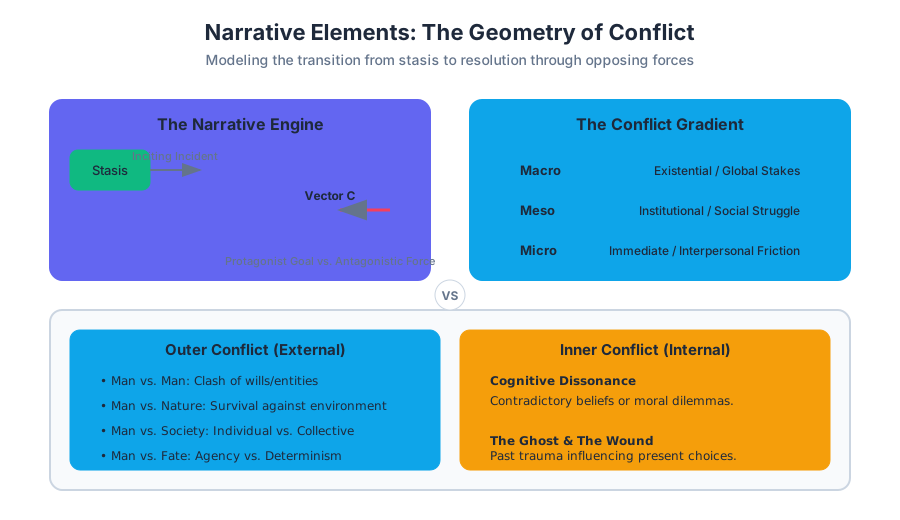
In the study of narratology, a story is not merely a chronological sequence of events (the fabula), but a structured system of tensions and resolutions (the sjuzhet). At the core of this system lies Conflict, the fundamental engine that drives narrative kinetic energy. Without conflict, a narrative remains in a state of stasis—a description of a world without the impetus for change. To understand plot is to understand the geometry of conflict: how it is initiated, how it scales, and how it is eventually resolved or transformed.
The Mechanics of Conflict
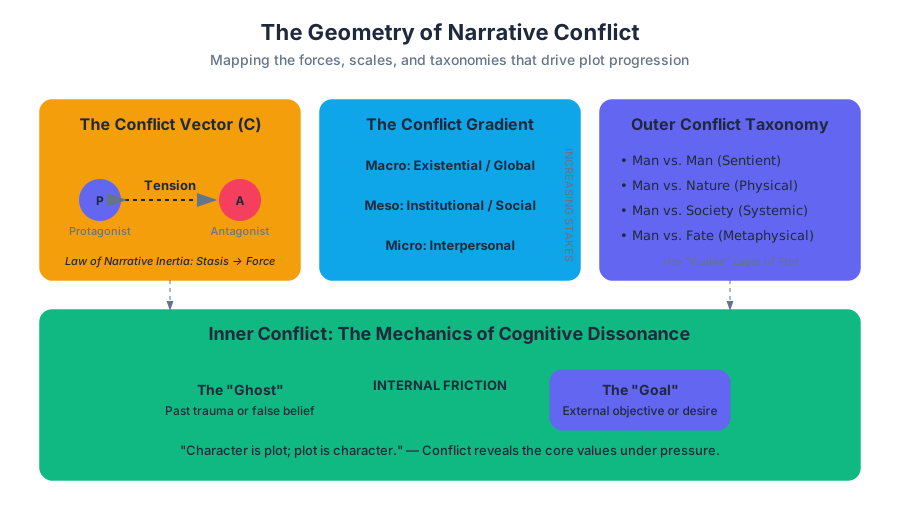
Conflict is defined as the struggle between two or more opposing forces. In a formal sense, it can be modeled as a vector $\vec{C}$, where the magnitude represents the intensity of the struggle and the direction represents the divergent goals of the protagonist and the antagonist (or antagonistic force).
The Law of Narrative Inertia: A narrative in a state of stasis will remain in stasis unless acted upon by an external or internal force (the Inciting Incident).
Why It Matters
Conflict is the primary mechanism for character revelation. As the adage goes, "Character is plot; plot is character." We do not know who a character truly is until they are forced to make a choice under pressure. Conflict provides that pressure, stripping away the character's social mask and revealing their core values.
How It Works: The Conflict Gradient
Conflict operates on a gradient of stakes. For a conflict to be effective, the "Cost of Failure" must be clearly defined. If the protagonist can walk away from the struggle without significant loss, the narrative tension collapses.
| Conflict Level | Scope | Example |
|---|---|---|
| Micro | Immediate, interpersonal | A disagreement over a dinner bill. |
| Meso | Institutional, social | A lawyer fighting a corrupt legal system. |
| Macro | Existential, global | A civilization attempting to avert a planetary collision. |
Implementation: The Narrative Engine
In computational narratology, conflict can be represented as a state-machine where transitions are triggered by "Conflict Events."
class NarrativeEngine:
    """
    A low-level implementation of a conflict-tracking system.
    Monitors the delta between Character Goals and Environmental Constraints.
    """
    def __init__(self, protagonist, antagonist_force):
        self.protagonist = protagonist
        self.antagonist = antagonist_force
        self.tension_level = 0.0
        self.is_resolved = False

    def calculate_tension(self):
        # Tension is a function of the distance between current state and goal state
        # multiplied by the resistance factor of the antagonist.
        distance_to_goal = abs(self.protagonist.goal_value - self.protagonist.current_state)
        resistance = self.antagonist.resistance_power

        self.tension_level = (distance_to_goal * resistance) / self.protagonist.resources
        return self.tension_level

    def trigger_inciting_incident(self, event_magnitude):
        self.tension_level += event_magnitude
        print(f"Stasis broken. Initial Tension: {self.tension_level}")

# Example usage:
# engine = NarrativeEngine(hero, villain)
# engine.trigger_inciting_incident(50)
Outer Conflict: The External Struggle
Outer Conflict (or External Conflict) involves a character’s struggle against forces outside of themselves. This is the "visible" layer of the plot, often manifesting as physical obstacles, societal pressure, or antagonistic characters.
Taxonomy of Outer Conflict
Traditionally, outer conflict is categorized by the nature of the opposing force.
- Man vs. Man: The classic protagonist-antagonist dynamic. This is a clash of wills, where two entities have mutually exclusive goals.
- Man vs. Nature: The struggle for survival against non-sentient forces (storms, predators, disease). The "antagonist" here has no malice; it is simply an indifferent environment.
- Man vs. Society: The character stands in opposition to a collective ideology, a legal system, or social norms. This often explores themes of justice and individual agency.
- Man vs. Technology/Supernatural: A subset of the above, where the character faces forces that transcend human understanding or control.
Comparison of External Forces
| Type | Nature of Antagonist | Primary Theme | Resolution Method |
|---|---|---|---|
| Man vs. Man | Personal / Sentient | Competition / Morality | Defeat or Reconciliation |
| Man vs. Nature | Impersonal / Physical | Survival / Humility | Endurance or Adaptation |
| Man vs. Society | Systemic / Ideological | Justice / Identity | Reform or Exile |
| Man vs. Fate | Metaphysical | Agency / Determinism | Acceptance or Defiance |
Common Pitfalls: The "Passive Protagonist"
A frequent error in constructing outer conflict is the Passive Protagonist. This occurs when the external forces act upon the character, but the character does not act back. For a conflict to drive a plot, the protagonist must make proactive choices to overcome the obstacle, even if those choices lead to further complications.
Inner Conflict: The Internal Friction
Inner Conflict (or Internal Conflict) is the struggle occurring within a character's mind. It is the "invisible" layer of the plot, often involving a choice between two equally desirable (or undesirable) outcomes, or a battle between a character's desires and their moral compass.
The Mechanics of Cognitive Dissonance
In psychological terms, inner conflict is often a form of cognitive dissonance. The character holds two or more contradictory beliefs, values, or ideas simultaneously. The plot forces them to resolve this dissonance.
The "Ghost" and the "Wound": In modern screenwriting theory, inner conflict often stems from a "Ghost"—a past trauma or event that created a "Wound" (a false belief about the world). The narrative arc is the process of the character confronting the Ghost to heal the Wound.
Formalizing Internal Tension
We can express the intensity of inner conflict ($I_c$) as a ratio of the character's internal "Need" vs. their conscious "Want."
I_c = \frac{Want \times External\_Pressure}{Need \times Moral\_Resistance}
- Want: The external goal (e.g., "I want to win the election").
- Need: The internal requirement for growth (e.g., "I need to learn humility").
- External Pressure: The stakes of the outer conflict.
- Moral Resistance: The character's internal barriers to taking the "easy" (but wrong) path.
Concrete Example: The Moral Dilemma
Consider a character who must lie to protect a loved one.
- Outer Conflict: The police are questioning the character (Man vs. Society).
- Inner Conflict: The character values honesty but also values loyalty. The struggle is not with the police, but with their own conscience.
Narrative Structure: The Topology of Plot
Narrative Structure is the framework that determines how the story’s events are organized. If conflict is the fuel, structure is the engine block that contains and directs the resulting energy.
Freytag’s Pyramid and Beyond
While Gustav Freytag’s five-act structure (Exposition, Rising Action, Climax, Falling Action, Denouement) is the most famous model, modern narratology uses more sophisticated "curves" to map tension over time.
- The Fichtean Curve: Skips the long exposition and plunges the reader into a series of crises (rising action) that build toward a climax.
- In Media Res: Starting the narrative in the middle of the action to maximize immediate suspense.
- The Hero's Journey (Monomyth): A circular structure focusing on the character's transformation through a "Departure," "Initiation," and "Return."
Structural Milestones
| Milestone | Technical Function | Narrative Impact |
|---|---|---|
| Inciting Incident | Breaks the initial stasis. | Launches the story; defines the "Story Question." |
| Plot Point 1 | The point of no return. | The protagonist commits to the journey. |
| Midpoint | A major shift in stakes or perspective. | The protagonist moves from reacting to acting. |
| Climax | The highest point of tension. | The central conflict is resolved. |
| Resolution | The establishment of a new stasis. | Shows the "New Normal" for the character. |
Pseudocode: The Structural Sequence
The following pseudocode represents the logical flow of a standard three-act structure.
FUNCTION Generate_Plot():
    STATE = Stasis
    CHARACTER = Initialize_Protagonist()

    // ACT I
    INCITING_INCIDENT = Trigger_Event()
    IF CHARACTER.Accepts(INCITING_INCIDENT):
        STATE = Rising_Action
    ELSE:
        REFUSAL_OF_CALL()
        FORCE_CHARACTER_INTO_ACTION()

    // ACT II
    WHILE Tension < MAX_THRESHOLD:
        OBSTACLE = Generate_Obstacle(Outer_Conflict)
        CHARACTER.Attempt_Resolution(OBSTACLE)
        IF SUCCESS:
            Tension -= 10
        ELSE:
            Tension += 20 // Complications
            CHARACTER.Internal_Friction += 5

    // ACT III
    CLIMAX = Resolve_Conflict(CHARACTER, ANTAGONIST)
    RETURN New_Stasis(CHARACTER.Transformed_State)
Suspense: The Management of Information
Suspense is the emotional state of anticipation and anxiety resulting from an "Information Gap." It is not merely about "what happens next," but about the delay between the audience's awareness of a threat and the character's resolution of that threat.
The Zeigarnik Effect
Narrative suspense leverages the Zeigarnik Effect, a psychological phenomenon where people remember uncompleted or interrupted tasks better than completed ones. By opening "narrative loops" (questions) and delaying their closure, a writer maintains the reader's cognitive engagement.
Suspense vs. Surprise
Alfred Hitchcock famously distinguished between the two:
- Surprise: Two people are sitting at a table; a bomb goes off. The audience has 10 seconds of shock.
- Suspense: The audience sees the bomb under the table and knows it will go off in five minutes. The characters are talking about mundane things. The audience experiences five minutes of intense anxiety.
Suspense Parameters in Narrative Design
| Parameter | Description | Effect on Reader |
|---|---|---|
| Pacing | The speed at which events unfold. | Faster pacing increases urgency; slower pacing builds dread. |
| Foreshadowing | Hints about future events. | Creates a sense of inevitability and "fair play." |
| Red Herring | A false clue or distraction. | Misdirects the reader to enhance the eventual payoff. |
| Tick-Tock | A literal or figurative time limit. | Forces immediate action and raises the "Cost of Inaction." |
Implementation: Database Schema for Plot Tracking
In a complex narrative (like a long-running TV series or a massive RPG), suspense and plot threads must be tracked systematically.
CREATE TABLE PlotThreads (
    thread_id INT PRIMARY KEY,
    description TEXT,
    status VARCHAR(20), -- 'Open', 'Developing', 'Resolved'
    inciting_incident_id INT,
    tension_score INT DEFAULT 0,
    foreshadowing_count INT DEFAULT 0,
    expected_resolution_act INT
);

-- Query to find "Dangling" plot threads that haven't been resolved by Act 3
SELECT description
FROM PlotThreads
WHERE status != 'Resolved'
AND expected_resolution_act < 3;
Synthesis: The Narrative Calculus
The relationship between conflict, plot, and suspense can be summarized as a dynamic system. Conflict is the potential energy; Plot is the kinetic path that energy takes; and Suspense is the friction or resistance that prevents the energy from reaching its destination too quickly.
The "Try-Fail" Cycle
A robust plot is built on the "Try-Fail" cycle. The protagonist attempts to resolve the conflict (Try) but fails, leading to a "Yes, but..." or "No, and..." scenario.
- Yes, but...: The protagonist succeeds in their immediate goal, but creates a new, larger problem.
- No, and...: The protagonist fails to achieve their goal, and their situation gets significantly worse.
This cycle ensures that the tension curve continues to rise until the Climax, where the protagonist must finally use their "Need" (internal growth) to solve the "Want" (external problem).
Common Pitfalls in Narrative Design
- Deus Ex Machina: Resolving a conflict through an external force that has not been previously established. This violates the "fair play" of suspense and renders the protagonist's journey meaningless.
- The "Muddled Middle": A loss of narrative momentum in Act II. This usually happens when the conflict lacks a clear "Midpoint" or when the "Try-Fail" cycles are repetitive rather than escalatory.
- Low Stakes: If the reader doesn't care about the outcome, the conflict is irrelevant. Stakes must be both "Global" (the world) and "Personal" (the character's heart).
- Inconsistent Logic: In speculative fiction, the rules of the conflict (e.g., magic systems, technology) must remain consistent. If the rules change to suit the plot, the suspense evaporates.
Summary of Key Terms
- Stasis: The initial state of the world before the story begins.
- Inciting Incident: The event that disrupts stasis and introduces the central conflict.
- Rising Action: The series of events and complications that build tension.
- Peripeteia: A sudden reversal of fortune or change in circumstances.
- Anagnorisis: A moment in a plot or story, specifically a tragedy, wherein the main character recognizes or identifies his/her true nature or that of the other character's real identity.
- Denouement: The final part of a play, movie, or narrative in which the strands of the plot are drawn together and matters are explained or resolved.
Literary Elements: Theme and Symbolism
Key concepts: Theme · Symbolism · Universal Truths · Narrative devices
How authors use recurring elements and symbols to convey universal truths and messages.
Literary Elements: Theme and Symbolism
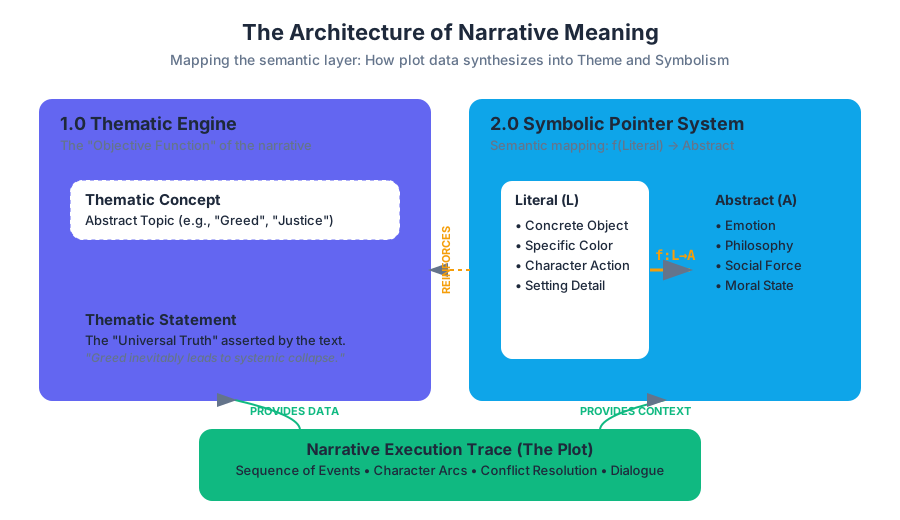
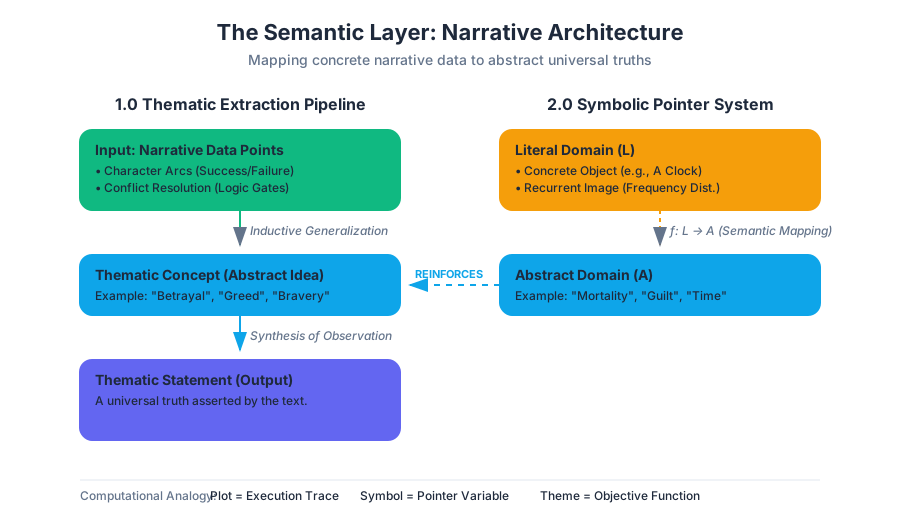
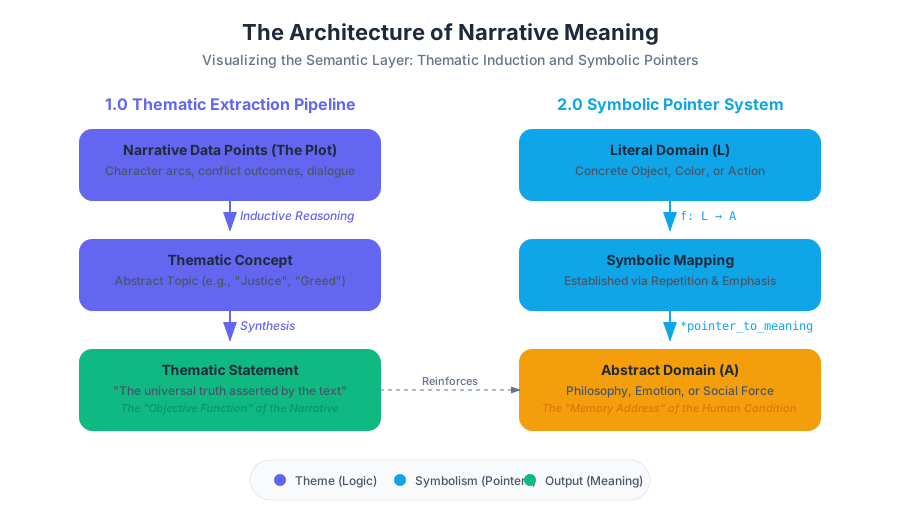
In the architecture of narrative, Theme and Symbolism constitute the semantic layer—the underlying logic and meaning that transcend the literal sequence of events (the plot). While the plot answers the question of what happens, theme and symbolism address the why and the so what. In a technical sense, if the plot is the execution trace of a program, the theme is the high-level algorithm's purpose, and symbols are the pointers and variables that reference abstract memory addresses within the human condition.
1.0 The Mechanics of Theme
1.1 What It Is: The Thematic Statement
A Theme is not merely a subject or a topic; it is a definitive statement or "universal truth" that the text asserts about its subject. While "War" is a topic, "War inevitably deconstructs the moral identity of the individual" is a theme.
In formal literary analysis, we distinguish between the Thematic Concept (the abstract idea, e.g., Betrayal) and the Thematic Statement (the specific observation the author makes about that idea).
Definition: Thematic Statement A complete sentence that describes a universal observation about human experience, synthesized from the interaction of plot, character development, and conflict resolution within a narrative.
1.2 Why It Matters: The Cohesion Logic
Without a central theme, a narrative becomes a "picaresque" collection of unrelated incidents. Theme provides the objective function for the author’s choices. Every character death, every setting description, and every dialogue exchange should ideally serve to reinforce or complicate the central thematic inquiry. In software terms, the theme is the design pattern that ensures all modules of the story work toward a unified output.
1.3 How It Works: Thematic Extraction
Thematic extraction is a process of induction. A reader observes specific data points (character actions, outcomes) and generalizes them into a broader principle.
| Element | Role in Thematic Construction | Data Type |
|---|---|---|
| Protagonist's Arc | Shows the cost or reward of a specific philosophy. | Boolean (Success/Failure) |
| Conflict Resolution | Indicates which values the "world" of the story rewards. | Logic Gate |
| Recurrent Imagery | Signals the presence of a thematic cluster. | Frequency Distribution |
| Foil Characters | Provide a control group to highlight the protagonist's choices. | Comparative Dataset |
1.4 Implementation: Computational Thematic Analysis
In modern digital humanities, we can use Natural Language Processing (NLP) to identify thematic clusters. The following Python example demonstrates how one might use Latent Dirichlet Allocation (LDA) to extract latent themes from a corpus of text.
import spacy
from gensim import corpora, models
from nltk.corpus import stopwords

# Load NLP model and define preprocessing pipeline
nlp = spacy.load("en_core_web_sm")
stop_words = set(stopwords.words('english'))

def preprocess_narrative(text):
    """Tokenize, remove stops, and lemmatize for thematic extraction."""
    doc = nlp(text.lower())
    return [token.lemma_ for token in doc if token.is_alpha and token.lemma_ not in stop_words]

# Dataset: A collection of short story summaries
narratives = [
    "The soldier returned from war only to find his home destroyed by greed.",
    "A young girl learns that honesty is more valuable than gold in the forest.",
    "The king's greed led to the downfall of his entire empire and family.",
    "True bravery is not the absence of fear, but the triumph over it."
]

processed_docs = [preprocess_narrative(n) for n in narratives]
dictionary = corpora.Dictionary(processed_docs)
corpus = [dictionary.doc2bow(doc) for doc in processed_docs]

# Apply LDA to find 2 latent thematic clusters
lda_model = models.LdaModel(corpus, num_topics=2, id2word=dictionary, passes=15)

for idx, topic in lda_model.print_topics(-1):
    print(f"Thematic Cluster {idx}: {topic}")
2.0 Symbolism: The Pointer System of Literature
2.1 What It Is: Semantic Mapping
Symbolism is a narrative device where a concrete object, person, or place represents an abstract idea. If we view a story as a system of signs, a symbol is a pointer.
Mathematically, we can represent a symbol $S$ as a mapping function where $L$ is the literal domain and $A$ is the abstract domain:
$$f: L \to A$$
Where $L \in { \text{Object, Color, Character, Action} }$ and $A \in { \text{Emotion, Philosophy, Social Force} }$.
2.2 Types of Symbols
Symbols are generally categorized by their scope of recognition.
| Symbol Category | Definition | Example |
|---|---|---|
| Conventional | Widely recognized within a culture or globally. | A red rose (love), a skull (death). |
| Contextual | Gains meaning only within the specific "runtime" of the text. | The "Green Light" in The Great Gatsby. |
| Archetypal | Deeply embedded in the human psyche (Jungian). | The Hero's Journey, the "Shadow" self. |
| Phallic/Yonic | Representing generative or reproductive forces. | Towers, caves, swords, vessels. |
2.3 The Mechanics of Symbolic Reinforcement
A symbol is established through repetition and emphasis. If a character mentions a clock once, it is a prop. If the clock stops every time a character lies, and the ticking grows louder during moments of guilt, the clock has been promoted to a symbol of Conscience or Temporal Justice.
2.4 Formalizing Symbolic Logic
We can use a pseudo-formal logic to describe how symbols interact within a narrative framework.
% Formalizing the Symbolic Relationship in 'Moby Dick'
\text{Let } Q = \text{Queequeg's Coffin}
\text{Let } D = \text{Death}
\text{Let } L = \text{Life/Resurrection}

\text{Initial State: } Q \implies D \quad \text{(The coffin is built for a dying man)}
\text{Transition: } \text{Ishmael uses } Q \text{ as a buoy.}
\text{Final State: } Q \implies L \quad \text{(The symbol of death becomes the instrument of survival)}

\therefore \text{Theme: Life and death are cyclical and interdependent.}
3.0 The Relationship Between Motif, Symbol, and Theme
It is a common pitfall to confuse these three terms. They exist in a hierarchy of abstraction.
- Motif: A recurring element (image, sound, phrase). It is a pattern.
- Symbol: A motif that has been assigned a specific abstract meaning. It is a variable.
- Theme: The conclusion drawn from the interaction of symbols and motifs. It is the program logic.
3.1 The Thematic Pipeline
The movement from raw text to thematic understanding follows a specific pipeline:
- Observation: Identifying a recurring element (Motif).
- Association: Linking that element to an abstract concept (Symbolism).
- Synthesis: Determining what the text says about that concept (Theme).
3.2 Comparison Table: Narrative Abstraction Layers
| Layer | Component | Purpose | Analogy |
|---|---|---|---|
| Physical | Plot/Action | Movement and sequence. | Machine Code |
| Structural | Motif | Consistency and rhythm. | Syntax/Looping |
| Semantic | Symbol | Reference and depth. | Pointers/Variables |
| Conceptual | Theme | Meaning and purpose. | High-level Algorithm |
4.0 Advanced Concepts: Subversion and Deconstruction
4.1 Thematic Subversion
Great literature often employs Thematic Subversion, where the narrative sets up a conventional theme only to dismantle it. For example, a story might use the symbol of a "White Knight" (representing Purity) but reveal the character to be a nihilist, thereby critiquing the validity of the "Good vs. Evil" binary.
4.2 Symbolic Overloading (Polysemy)
A symbol can represent multiple, even contradictory, ideas simultaneously. In Herman Melville’s Moby Dick, the Whiteness of the Whale represents:
- Purity/Divinity
- Void/Nothingness
- Terror/The Unknown
This is known as Symbolic Polysemy. In a technical context, this is akin to Operator Overloading, where the same symbol performs different functions depending on the context (the "arguments") provided by the scene.
4.3 Real-World Usage: Narrative Design in Systems
In game design and interactive fiction, symbols are often hard-coded into the environment to guide player behavior without explicit instruction.
# Narrative Engine Configuration for "The Ruined Kingdom"
symbols:
  - id: "withered_rose"
    base_meaning: "decay"
    state_triggers:
      on_pickup: "increment_despair_counter"
      on_burn: "trigger_rebirth_ending"
    visual_cues:
      particle_effect: "grey_dust"
      audio_loop: "low_cello_minor"

  - id: "golden_throne"
    base_meaning: "corrupt_power"
    interaction_logic:
      if: "player.greed > 50"
      then: "display_prompt('Claim your birthright')"
      else: "display_prompt('A heavy burden sits here')"
5.0 Common Pitfalls in Analysis
5.1 The "Easter Egg" Fallacy
Many readers treat symbolism like a scavenger hunt—finding the "hidden meaning" and stopping there. A symbol is not a secret to be solved; it is a tool for building a larger argument. Identifying that "the ocean represents the subconscious" is useless unless you explain how the ocean's behavior in the story clarifies the protagonist's mental state.
5.2 Intentional Fallacy
The belief that a theme or symbol is only valid if the author explicitly intended it. In modern criticism (Post-Structuralism), the "Death of the Author" suggests that the text belongs to the reader. If the symbolic evidence exists within the text, the interpretation is valid, regardless of the author's biography.
5.3 Over-Universalization
Assuming that a symbol has a fixed meaning across all cultures. While a "Dragon" might symbolize evil in Western tradition (Greed/Satan), it often symbolizes wisdom and prosperity in Eastern traditions. Context—both internal to the book and external to the culture—is the primary "namespace" for symbolic resolution.
6.0 Worked Example: Analyzing "The Yellow Wallpaper" by Charlotte Perkins Gilman
6.1 The Data Points
- Object: The yellow wallpaper in the bedroom.
- Motif: The pattern of the wallpaper, the "smell" of the paper, the "yellow smooch" on the wall.
- Action: The narrator stripping the paper off the wall.
6.2 The Symbolic Mapping
The wallpaper functions as a symbol of the Domestic Sphere and the Rest Cure (a 19th-century medical treatment for women). The "trapped woman" the narrator sees behind the pattern is a symbol of her own repressed psyche.
6.3 The Thematic Statement
"The systematic suppression of female intellectual and creative autonomy under the guise of medical care leads to the total fragmentation of the self."
6.4 Implementation in C++ (State Machine)
To model the narrator's psychological descent through symbolic interaction:
#include <iostream>
#include <string>

enum class MentalState { STABLE, REPRESSED, FRAGMENTED, LIBERATED_INSANE };

class Narrator {
public:
    MentalState state = MentalState::STABLE;
    int wallpaper_stripped_percent = 0;

    void interactWithSymbol(std::string symbol) {
        if (symbol == "Yellow Wallpaper") {
            processWallpaper();
        }
    }

private:
    void processWallpaper() {
        wallpaper_stripped_percent += 25;
        if (wallpaper_stripped_percent >= 75) {
            state = MentalState::LIBERATED_INSANE;
            std::cout << "The pattern is gone. I am free at last." << std::endl;
        } else if (wallpaper_stripped_percent > 0) {
            state = MentalState::FRAGMENTED;
            std::cout << "I see the woman creeping behind the bars." << std::endl;
        }
    }
};

int main() {
    Narrator narrator;
    // The narrative loop
    for(int i=0; i<4; i++) {
        narrator.interactWithSymbol("Yellow Wallpaper");
    }
    return 0;
}
7.0 Conclusion: The Resonance of Meaning
Theme and symbolism are the mechanisms through which literature achieves Resonance. A story about a man catching a fish is a story about a man catching a fish. But a story where the fish is a symbol of Unattainable Grace and the struggle represents Human Endurance is a work that survives centuries. By mastering these elements, writers can encode profound truths into their work, and readers can decode the complex signals of the human experience.
Literary Style and Historical Context
Key concepts: Literary Style · Renaissance Oratory · Enlightenment Rationalism · Romantic Emotionalism · Modernism
An exploration of how literary style has evolved from the Renaissance to the Modernist era.
Literary Style and Historical Context
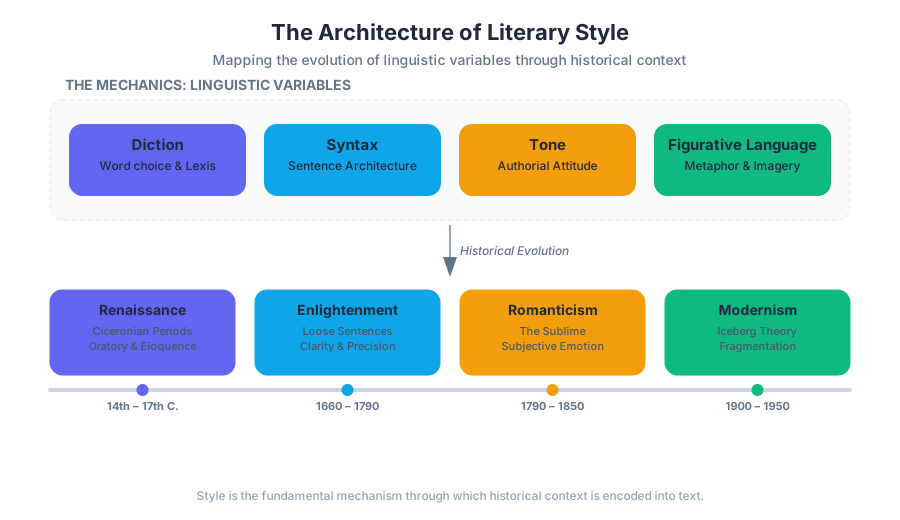
Literary style is the architectural signature of a written work. It is the specific, idiosyncratic manner in which a writer employs language, syntax, and structure to convey meaning. Far from being a mere aesthetic "veneer," style is the fundamental mechanism through which historical context, philosophical shifts, and cultural values are encoded into text. To analyze style is to reverse-engineer the intellectual and social environment of the author.
The Mechanics of Style: Syntax, Diction, and Structure
At its core, style is a function of choice. A writer operates within a multi-dimensional space of linguistic variables. When these choices coalesce into a recognizable pattern, we define it as a "style."
Definition: Literary Style The sum of a writer's choices regarding diction (word choice), syntax (sentence structure), tone (attitude), and figurative language. It is the "how" that shapes the "what" of a narrative or argument.
Syntactic Complexity and Sentence Architecture
The way a sentence is built often reflects the cognitive priorities of an era. Two primary structures dominate historical prose:
- Periodic Sentences: The main clause (and thus the full meaning) is withheld until the very end. This creates suspense and requires a high degree of intellectual "buffering" from the reader. It was the hallmark of Renaissance oratory.
- Loose (Cumulative) Sentences: The main idea is presented immediately, followed by modifying phrases. This mirrors natural speech and became the standard for Enlightenment clarity and Modernist realism.
| Stylistic Variable | High-Complexity (Ornate) | Low-Complexity (Minimalist) |
|---|---|---|
| Diction | Latinate, polysyllabic, archaic | Germanic, monosyllabic, contemporary |
| Syntax | Hypotactic (heavy use of subordination) | Paratactic (short, independent clauses) |
| Punctuation | Semicolons, colons, nested parentheses | Periods, em-dashes, or total omission |
| Imagery | Extended metaphors (conceits) | Literal, sensory details |
Historical Evolution of Style
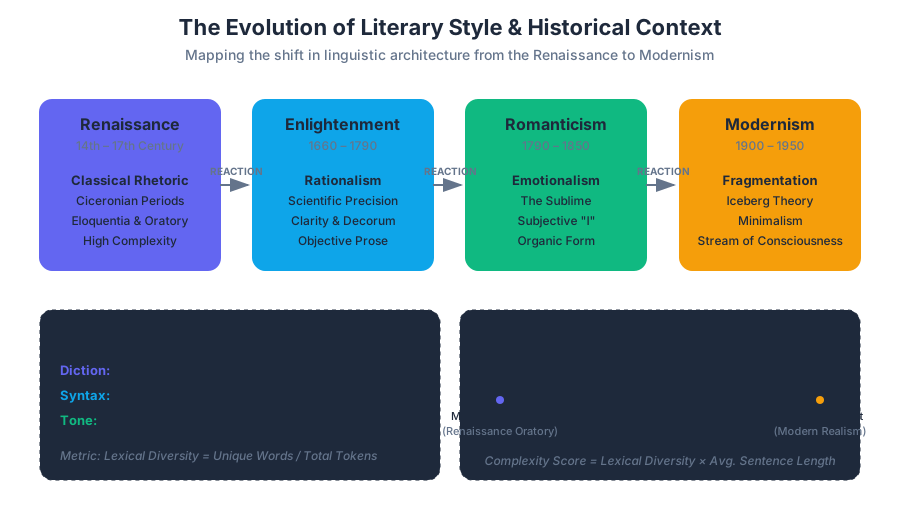
The history of Western literature can be viewed as a series of reactions to the stylistic dominance of the preceding era.
Renaissance Oratory (14th – 17th Century)
During the Renaissance, style was deeply rooted in Classical Rhetoric. Drawing from Cicero and Quintilian, writers viewed prose as a performance. The goal was eloquentia—the union of wisdom and powerful speaking.
- Key Feature: The Ciceronian Period. These were long, balanced sentences designed for oral delivery, using rhythm and cadence to persuade.
- Context: The rise of humanism and the recovery of Greek and Roman texts.
Enlightenment Rationalism (1660 – 1790)
The "Age of Reason" demanded a style that functioned like a scientific instrument: precise, transparent, and objective. The Royal Society in England famously called for a "close, naked, natural way of speaking."
- Key Feature: Clarity and Decorum. Writers avoided "enthusiasm" (excessive emotion) and complex metaphors that might obscure the "truth."
- Context: The Scientific Revolution and the rejection of religious dogma in favor of empirical observation.
Romantic Emotionalism (1790 – 1850)
Romanticism was a violent pivot away from Enlightenment coldness. Style became a vehicle for the Sublime—the overwhelming feeling of awe and terror inspired by nature and the internal psyche.
- Key Feature: Subjectivity. The "I" became the center of the universe. Prose and poetry became more fluid, organic, and emotionally charged.
- Context: The Industrial Revolution (as a counter-movement) and the rise of individualism.
Modernism and the "Iceberg Theory" (1900 – 1950)
Following the trauma of World War I, the ornate styles of the 19th century felt fraudulent. Modernists like Ernest Hemingway and Virginia Woolf experimented with Minimalism and Stream of Consciousness.
- Key Feature: Fragmentation. Modernist style often leaves gaps (the "Iceberg Theory"), where 7/8ths of the meaning lies beneath the surface, requiring the reader to reconstruct the narrative.
- Context: Psychoanalysis (Freud), the collapse of traditional empires, and the "Lost Generation."
Technical Implementation: Analyzing Stylistic Fingerprints
In the digital humanities, we can quantify style using computational linguistics. One common metric is Lexical Diversity (the ratio of unique words to total words) and Syntactic Complexity.
import nltk
from nltk.tokenize import word_tokenize, sent_tokenize

def analyze_stylistic_density(text):
    """
    Calculates the Lexical Diversity and Average Sentence Length
    to determine the 'weight' of a literary style.
    """
    tokens = [w.lower() for w in word_tokenize(text) if w.isalpha()]
    sentences = sent_tokenize(text)

    # Type-Token Ratio (TTR)
    lexical_diversity = len(set(tokens)) / len(tokens)

    # Average Sentence Length (ASL)
    avg_sentence_length = len(tokens) / len(sentences)

    return {
        "lexical_diversity": round(lexical_diversity, 4),
        "avg_sentence_length": round(avg_sentence_length, 2),
        "complexity_score": round(lexical_diversity * avg_sentence_length, 2)
    }

# Example: Comparing Hemingway (Modernist) vs. Milton (Renaissance)
hemingway_sample = "The hills across the valley of the Ebro were long and white."
milton_sample = "Of Mans First Disobedience, and the Fruit of that Forbidden Tree..."

print(f"Modernist Metrics: {analyze_stylistic_density(hemingway_sample)}")
The Architecture of Poetry: Metre and Form
Poetry represents the most concentrated form of literary style. Unlike prose, poetry is governed by Prosody—the systematic study of metrical structure.
Accentual-Syllabic Metre
Most English poetry since the 14th century uses accentual-syllabic metre, which counts both the number of syllables and the pattern of stresses. The basic unit of measurement is the Foot.
| Foot Name | Stress Pattern | Rhythm | Example |
|---|---|---|---|
| Iamb | Unstressed + Stressed | da-DUM | be-HOLD |
| Trochee | Stressed + Unstressed | DUM-da | TY-ger |
| Anapest | Unstressed + Unstressed + Stressed | da-da-DUM | un-der-STAND |
| Dactyl | Stressed + Unstressed + Unstressed | DUM-da-da | PO-e-try |
| Spondee | Stressed + Stressed | DUM-DUM | HEART-BEAT |
Mathematical Representation of Metre
We can represent a line of verse as a binary sequence where $0$ is unstressed and $1$ is stressed. An Iambic Pentameter line (5 iambs) follows the formula:
$$L = \sum_{i=1}^{5} (0, 1)_i$$
In string notation, this appears as:
01 | 01 | 01 | 01 | 01
Rhyme and Sound Devices
Style is also auditory. Writers use sound to reinforce meaning or create a specific atmosphere.
- Alliteration: Repetition of initial consonant sounds ("The fair freeze flew").
- Assonance: Repetition of vowel sounds ("The lotus blooms below the flow").
- Slant Rhyme: Near-rhymes (e.g., "bridge" and "grudge") used to create a sense of unease or modern dissonance.
Drama: The Text vs. Performance Paradox
When studying drama as literature, a unique stylistic challenge arises. A play is a Dramatic Text—a blueprint for a performance that may or may not exist at the moment of reading.
Reading a Play vs. Watching a Play
- The Stage Direction: In the text, these are often ignored by casual readers, but they contain the author's stylistic "metadata" (e.g., "Exit, pursued by a bear").
- The Dialogue/Subtext: Because drama lacks a traditional narrator, the "style" is embedded entirely in character voice and the gaps between what is said and what is done.
- Dramatic Irony: A stylistic device where the reader/audience knows more than the characters, creating a tension that is unique to the dramatic form.
SQL Schema for Literary Analysis
To manage a large-scale analysis of literary styles across centuries, a relational database can track the metadata of various "texts" and their stylistic attributes.
CREATE TABLE LiteraryWorks (
    work_id INT PRIMARY KEY,
    title VARCHAR(255),
    author VARCHAR(255),
    publication_year INT,
    era ENUM('Renaissance', 'Enlightenment', 'Romantic', 'Victorian', 'Modernist'),
    genre ENUM('Poetry', 'Drama', 'Prose')
);

CREATE TABLE StylisticFeatures (
    feature_id INT PRIMARY KEY,
    work_id INT,
    metre_type VARCHAR(50), -- e.g., 'Iambic Pentameter'
    dominant_syntax VARCHAR(50), -- e.g., 'Periodic'
    lexical_density FLOAT,
    FOREIGN KEY (work_id) REFERENCES LiteraryWorks(work_id)
);

-- Querying for Modernist works with high lexical density
SELECT title, author
FROM LiteraryWorks
JOIN StylisticFeatures ON LiteraryWorks.work_id = StylisticFeatures.work_id
WHERE era = 'Modernist' AND lexical_density > 0.75;
Active Reading: Strategies for Stylistic Decoding
To effectively analyze style, one must move from passive consumption to Active Reading. This involves a "conversation" with the text.
The Annotation Pipeline
- Tracing: Identify recurring keywords or motifs. If a writer uses "cold," "stone," and "grey" repeatedly, they are building a stylistic atmosphere of stasis.
- Conversing: Write questions in the margins. "Why did the author use a semicolon here instead of a period?"
- Research Question Development: Use stylistic observations to form a thesis. "How does the fragmented syntax in The Waste Land mirror the post-war disillusionment of 1922?"
| Strategy | Action | Technical Goal |
|---|---|---|
| Annotating | Highlighting and marginalia | Data extraction and pattern recognition |
| Tracing | Following a specific image/word | Identifying thematic consistency |
| Keyword Identification | Isolating 5-10 "load-bearing" words | Defining the work's "semantic core" |
| Rhetorical Analysis | Identifying Simile, Metaphor, Synecdoche | Understanding the figurative layer |
Common Pitfalls in Stylistic Analysis
- The Intentional Fallacy: Assuming that the style perfectly reflects the author's personal feelings. Style is often a conscious craft or a response to market demands, not just a "soul-dump."
- Ignoring the Medium: Analyzing a play's style without considering how it would sound when spoken aloud.
- Historical Anachronism: Judging an Enlightenment text for being "too dry" by Modernist standards. Style must be evaluated within its own historical "operating system."
Advanced Concept: The "Iceberg" and Subtext in Modernism
In Modernist style, what is omitted is often more important than what is included. This is the "Iceberg Theory" popularized by Hemingway.
# A bash-style conceptual breakdown of the Iceberg Theory
# 1. Surface Text (The 1/8th)
echo "He looked at the hills. They were white."

# 2. Hidden Subtext (The 7/8ths)
# - The character's internal trauma
# - The unspoken tension between the couple
# - The metaphorical weight of the 'white' landscape
# - The historical context of the Spanish Civil War

# 3. Reader's Task: Reconstruction
grep -i "white" story.txt | wc -l
# The reader must count the recurrences to find the pattern the author refused to explain.
By understanding the evolution of style from the ornate periods of the Renaissance to the stark, fragmented lines of the Modernists, we gain the ability to "read" history itself through the texture of the written word.
Comprehensive Literary Terminology
Key concepts: Allegory · Foreshadowing · Irony · Motif · Hyperbole
A deep dive into the specific terms used to discuss and analyze narrative and poetic works.
Comprehensive Literary Terminology
Overview
In the professional study of literature, terminology serves as more than a collection of labels; it functions as a high-precision toolkit for deconstructing the architecture of human expression. To move beyond passive consumption and into the realm of Literary Analysis, one must master the "grammar of narrative"—the specific devices authors use to encode meaning, manipulate time, and evoke emotional resonance. This article provides a deep-dive into the foundational concepts of Allegory, Foreshadowing, Irony, Motif, and Hyperbole, situating them within the broader context of active reading and historical literary style.
The Mechanics of Narrative Encoding
Literary devices are not merely "decorations" added to a story. They are functional components of a text's operating system. When an author employs Diction (specific word choice) or Syntax (sentence structure), they are setting the parameters for how a reader processes information.
1. Allegory: The Dual-Layered Narrative
Definition: An Allegory is a narrative in which characters, places, and events carry a symbolic meaning that transcends the literal surface of the story. It functions as an extended metaphor, where the "Literal Surface" (Level A) maps directly onto a "Symbolic Substrate" (Level B).
Why it Matters Allegory allows authors to discuss complex political, moral, or religious ideas under the guise of fiction. By abstracting reality into a controlled narrative environment, the author can critique social structures without the immediate friction of literal polemics.
How it Works: The Mapping Function The efficacy of an allegory depends on the consistency of its mapping. If a character represents "Justice," their actions must consistently reflect the philosophical attributes of justice.
| Component | Literal Level (Surface) | Symbolic Level (Substrate) |
|---|---|---|
| Character | A farm pig named Napoleon | A historical figure (e.g., Joseph Stalin) |
| Setting | A neglected English farm | A failing or transitioning political state |
| Conflict | Animals rebelling against a farmer | The proletariat overthrowing the bourgeoisie |
| Resolution | The pigs becoming indistinguishable from humans | The corruption of revolutionary ideals |
Common Pitfalls
- Over-simplification: Reducing a complex text to a "one-to-one" code where every detail must have a secret meaning.
- Anachronism: Applying modern allegorical interpretations to historical texts where the author could not have intended such a mapping.
2. Foreshadowing: Narrative Causality and Temporal Logic
Foreshadowing is the use of indicative fragments—hints, symbols, or dialogue—to suggest future events. It creates a sense of "narrative inevitability," ensuring that when the climax occurs, it feels earned rather than accidental.
The Algorithm of Foreshadowing In a well-constructed plot, foreshadowing operates like a pre-declaration of variables in a program. If a "variable" (a gun, a secret, a character flaw) is introduced in Act I, it must be "called" or resolved by Act III. This is famously known as Chekhov’s Gun.
# A simplified Pythonic representation of Narrative Foreshadowing Logic
class NarrativeEngine:
    def __init__(self):
        self.foreshadowed_events = []
        self.plot_resolved = False

    def plant_seed(self, clue, target_event):
        """Register a hint for a future payoff."""
        self.foreshadowed_events.append({"hint": clue, "event": target_event})
        print(f"DEBUG: Seed planted: '{clue}' linked to '{target_event}'")

    def trigger_climax(self, current_event):
        """Check if the climax was properly foreshadowed."""
        for seed in self.foreshadowed_events:
            if seed["event"] == current_event:
                print(f"SUCCESS: Event '{current_event}' feels earned due to '{seed['hint']}'.")
                return True
        print("CRITICAL ERROR: Deus Ex Machina detected. No foreshadowing found.")
        return False

# Example Usage
story = NarrativeEngine()
story.plant_seed("The protagonist notices the floorboards are rotting", "The floor collapses during the chase")
story.trigger_climax("The floor collapses during the chase")
Variations of Foreshadowing
- Direct Foreshadowing: Explicitly stating that something bad is coming (e.g., "Little did he know...").
- Atmospheric Foreshadowing: Using the setting or weather (e.g., a gathering storm) to mirror upcoming conflict.
- Prophetic Foreshadowing: Using dreams, omens, or oracles to outline the plot.
3. Irony: The Epistemological Gap
Irony is a rhetorical device, literary technique, or situation in which there is a sharp incongruity between expectation and reality. It is the "gap" between what is said and what is meant, or what is expected and what occurs.
Types of Irony Irony is categorized based on who possesses the knowledge and where the contradiction lies.
| Type | Definition | Example |
|---|---|---|
| Verbal Irony | A speaker says the opposite of what they mean (often Sarcasm). | Saying "What lovely weather!" during a hurricane. |
| Situational Irony | The outcome is the exact opposite of what was intended. | A fire station burning down. |
| Dramatic Irony | The audience knows something that the characters do not. | In Oedipus Rex, the audience knows Oedipus killed his father, but he does not. |
| Cosmic Irony | The idea that fate or the gods are toy with human expectations. | A man survives a war only to trip on his shoelace and die at home. |
Mathematical Representation of Irony Irony can be viewed as the absolute difference between the Expected State ($S_e$) and the Actual State ($S_a$).
$$ Irony \approx | S_e - S_a | $$
Where the intensity of the irony is proportional to the magnitude of the delta between expectation and reality. In Dramatic Irony, this delta is shared with the observer (reader) but hidden from the subject (character), creating a tension defined by the information asymmetry.
4. Motif: The Structural Pattern
A Motif is a recurring element—an image, a sound, a word, or a phrase—that has symbolic significance in a story. Unlike a symbol (which might appear once), a motif must repeat to establish a pattern.
Why it Matters Motifs function as the "connective tissue" of a literary work. They reinforce the Theme (the central idea) by providing a rhythmic return to key concepts. For example, in The Great Gatsby, the motif of "green" (the light, the grass, the money) reinforces the theme of the American Dream and envy.
Motif vs. Symbol
- Symbol: A concrete object representing an abstract idea (e.g., a wedding ring representing commitment).
- Motif: The repetition of symbols or ideas to build a thematic structure (e.g., the recurring mention of jewelry and gold throughout a novel to highlight materialism).
5. Hyperbole: Rhetorical Amplification
Hyperbole is the use of intentional and obvious exaggeration for emphasis or effect. It is not meant to be taken literally but is used to convey the magnitude of a feeling or situation.
Mechanics of Hyperbole Hyperbole works by stretching the "truth" until it reaches a point of absurdity, which paradoxically highlights the underlying emotional truth. In the history of Renaissance Oratory, hyperbole was a vital tool for persuasive speech, allowing the speaker to elevate their subject to heroic proportions.
Example in Poetry Consider Andrew Marvell’s "To His Coy Mistress":
"My vegetable love should grow / Vaster than empires and more slow;"
Here, "vaster than empires" is a hyperbolic expression of the scale of his affection, used to contrast with the "deserts of vast eternity" (death) that follow.
Historical Context: The Evolution of Style
The use of these terms has shifted across literary eras. As noted in The Rough Guide to Literary Style, the "how" of writing is as important as the "what."
| Era | Primary Style Focus | Key Usage of Terminology |
|---|---|---|
| Renaissance | Oratory & Ornamentation | Heavy use of Hyperbole and complex Allegory. |
| Enlightenment | Rationalism & Clarity | Precise Diction; use of Irony for social satire (e.g., Swift). |
| Romanticism | Emotionalism & Nature | Motifs centered on the natural world; Hyperbole of the self. |
| Modernism | Minimalism & Fragmentation | Subtle Foreshadowing; rejection of "obvious" Allegory. |
Active Reading: Strategies for Identification
To identify these concepts in a text, one must employ Active Reading Strategies. This involves moving from a passive recipient of the story to an active investigator of the text's mechanics.
Annotating and Tracing Ideas
As suggested by the Reading to Write Effectively guide, students should use a systematic approach to note-taking:
- Trace the Motif: Every time a specific image recurs, mark it in the margin with a unique symbol (e.g., a star for "light" imagery).
- Identify the Irony: When a character makes a statement that contradicts their situation, label it
[VI](Verbal Irony) or[DI](Dramatic Irony). - Conversing with the Author: Write questions in the margins. "Why is the author using this hyperbole here? Is it to make the character seem unreliable?"
Reading a Play vs. Reading Fiction
When analyzing Dramatic Texts, the application of these terms changes. In a play, Dramatic Irony is the dominant force because the audience sees the entire stage, while characters are often limited by their physical presence in a scene.
# A metadata structure for analyzing a dramatic scene
scene_analysis:
  id: "ACT_1_SCENE_2"
  primary_device: "Dramatic Irony"
  character_knowledge:
    protagonist: "Unaware of the poison"
    antagonist: "Placed the poison"
    audience: "Watched the antagonist place the poison"
  motif_count:
    water_imagery: 4
    decay_imagery: 2
  foreshadowing_score: 0.85 # High probability of future payoff
Common Pitfalls in Literary Analysis
- Confusing Theme with Motif: A theme is an idea (e.g., "The corrupting nature of power"), while a motif is a recurring element that points to that theme (e.g., a recurring image of a crown being dropped).
- Literalism in Hyperbole: Failing to recognize hyperbole leads to a "flat" reading where the emotional stakes are missed.
- Misidentifying Irony as Coincidence: Irony requires a specific reversal of expectation or a gap in knowledge. A "bad thing happening" is just a misfortune; a "fireman's house burning down" is situational irony.
Conclusion
Mastering literary terminology is the first step toward professional critical analysis. By understanding the mechanics of Allegory, the temporal logic of Foreshadowing, the epistemological gaps of Irony, the structural patterns of Motif, and the rhetorical power of Hyperbole, readers can deconstruct any text—whether it be a Renaissance play, a Modernist novel, or a contemporary poem—to reveal the deeper layers of meaning intended by the author.
- Allegory: A narrative where characters/events represent abstract ideas or historical events.
- Foreshadowing: Hints or clues dropped early in a story to suggest future developments.
- Dramatic Irony: When the audience knows more about a situation than the characters involved.
- Situational Irony: A discrepancy between the expected result and the actual outcome.
- Verbal Irony: When a speaker says the opposite of what they mean, often for humorous or emphatic effect.
- Motif: A recurring element, image, or concept that supports a text's theme.
- Hyperbole: Deliberate exaggeration used for emphasis or rhetorical effect.
- Chekhov's Gun: The principle that every element introduced in a story must be necessary to the plot.
- Diction: The specific choice and use of words and phrases in speech or writing.
-
Which device is primarily defined by an "information asymmetry" between the audience and the characters?
- A) Hyperbole
- B) Dramatic Irony
- C) Motif
- D) Allegory (Correct: B)
-
If a character in a story repeatedly dreams of falling, and this image appears in several chapters to highlight their loss of control, "falling" is a:
- A) Hyperbole
- B) Foreshadowing
- C) Motif
- D) Verbal Irony (Correct: C)
-
What is the primary difference between a Symbol and an Allegory?
- A) Symbols are only used in poetry; allegories are used in prose.
- B) A symbol is a single object/idea; an allegory is a complete narrative system of symbols.
- C) Allegories are always religious; symbols are secular.
- D) There is no difference. (Correct: B)
-
"I've told you a million times to stop using hyperbole!" is an example of:
- A) Foreshadowing
- B) Paradoxical Hyperbole
- C) Situational Irony
- D) All of the above (Correct: B/C - It uses hyperbole to complain about hyperbole)
Key Review Points:
- Allegory Mapping: Practice mapping Animal Farm or Plato's Cave to their real-world counterparts.
- Irony Identification: Watch a scene from a Shakespearean play and identify where the audience knows more than the hero (Dramatic Irony).
- Active Reading: Take a 5-page sample of a novel. Highlight every recurring image (Motif) and underline any hints of future conflict (Foreshadowing).
- Style History: Note how the "ornate" style of the Renaissance differs from the "minimalist" style of Modernism in their use of figurative language.
- Terminology Precision: Ensure you can distinguish between a Simile (comparison using 'like/as') and a Metaphor (direct comparison), and how both differ from the extended system of an Allegory.
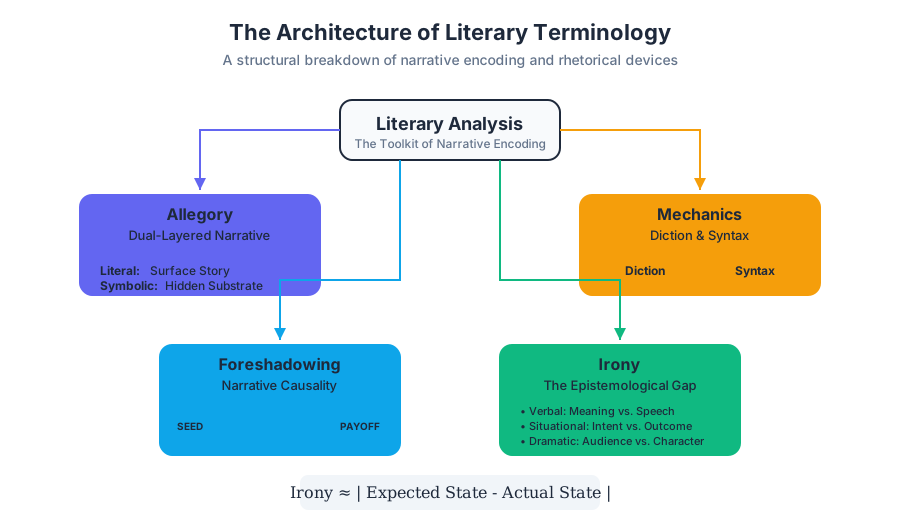
Genres: Fiction and Creative Nonfiction
Key concepts: Literary Fiction · Literary Nonfiction · Truth Claims · Narrative Elements
Distinguishing between fictional narratives and the literary techniques used in factual reporting.
Genres: Fiction and Creative Nonfiction
The distinction between Fiction and Creative Nonfiction (CNF) is often misunderstood as a binary between "lies" and "truth." In literary theory and academic analysis, however, these genres are defined not by the objective accuracy of their content, but by the Truth Claim established between the author and the reader. Both genres utilize a shared toolkit of narrative elements—characterization, pacing, imagery, and structure—to achieve their ends. This section explores the formal mechanics of these genres, the philosophical implications of the "Authorial Contract," and the technical frameworks used to analyze narrative prose.
The Taxonomy of Narrative Prose
In the context of Open Educational Resources (OER) and literary study, prose is categorized based on its relationship to the "real world." While Fiction creates a self-contained universe governed by its own internal logic, Creative Nonfiction seeks to interpret the actual world through a subjective, artistic lens.
| Feature | Fiction | Creative Nonfiction |
|---|---|---|
| Primary Goal | Aesthetic experience, thematic exploration, or entertainment via imagination. | Aesthetic exploration of factual events, personal reflection, or reportage. |
| Truth Claim | Implicitly "untrue" or "imagined" (The Fictional Pact). | Explicitly "true" or "factually grounded" (The Referential Pact). |
| Source Material | Imagination, archetypes, and synthesized experience. | Memory, research, interviews, and historical records. |
| Ethical Constraint | Minimal; restricted primarily by internal consistency. | High; restricted by the obligation to represent "what happened." |
| Structural Basis | Plot (causal sequences). | Narrative (thematic or chronological arrangement of facts). |
The Authorial Contract: A theoretical agreement where the reader adopts a specific cognitive stance based on the genre label. In fiction, the reader engages in the willing suspension of disbelief. In nonfiction, the reader grants the author epistemic trust, assuming the events described have a basis in shared reality.
Truth Claims and the Referentiality Index
The defining characteristic of a genre is its Truth Claim. This is not a guarantee of 100% accuracy—human memory is fallible, and perspectives are biased—but rather a declaration of intent.
The Mechanics of the Claim
A truth claim functions as a metadata tag for the text. If a book is labeled "A Novel," the author is permitted to invent dialogue and compress time. If labeled "A Memoir," the same inventions may be viewed as a breach of ethics or "literary fraud."
Formalizing the Truth Claim
We can represent the relationship between the text ($T$) and the world ($W$) as a function of Referentiality ($R$).
R(T) = \frac{\sum_{i=1}^{n} V(e_i)}{n}
Where:
- $e_i$ is a narrative event.
- $V(e_i)$ is the verifiability of that event against external records or shared experience.
- In Fiction, $R(T)$ may approach 0 (pure fantasy) or be high (historical fiction), but the claim remains $R \approx 0$.
- In Creative Nonfiction, the claim is $R \rightarrow 1$.
Narrative Elements: The Shared Toolkit
Regardless of the truth claim, both genres rely on Narrative Elements to function. These are the "variables" that an author manipulates to create meaning.
1. Plot and Arc
Plot is the sequence of events, while the Arc is the emotional or thematic trajectory. In fiction, the plot is engineered for maximum tension. In CNF, the author must find the plot within the chaos of real events, a process known as Narrative Shaping.
2. Characterization
In fiction, characters are Constructs built from scratch to serve the theme. In CNF, "characters" are Personas—versions of real people (including the author) who are curated to fit the narrative's focus.
3. Point of View (POV)
POV determines the "camera angle" and the "filter" of the story.
| POV Type | Fiction Usage | CNF Usage |
|---|---|---|
| First Person (I) | Used for intimacy or "unreliable narrators." | The standard "I" of the memoirist or essayist. |
| Third Person Limited | Focuses on one character's internal state. | Rare; used in "Literary Journalism" to reconstruct someone else's experience. |
| Third Person Omniscient | The "God-like" narrator; common in 19th-century novels. | Extremely rare; implies a level of knowledge a real human cannot have. |
4. Setting and World-Building
In fiction, the setting can be a character itself (e.g., the moors in Wuthering Heights). In CNF, setting is established through Sensory Detail and Atmospheric Research to ground the reader in a specific time and place.
Implementation: Analyzing Narrative Structure
To analyze these genres technically, we can look at the Structural Implementation. Below is a Python representation of a basic narrative parser that identifies the "beats" of a story based on tension levels—a method applicable to both a short story and a personal essay.
import numpy as np

class NarrativeAnalyzer:
    """
    A technical tool for mapping the 'Tension Curve' of a prose work.
    Applicable to both Fiction (Freytag's Pyramid) and CNF (Thematic Arcs).
    """
    def __init__(self, text_segments):
        self.segments = text_segments
        self.tension_scores = []

    def calculate_tension(self, segment):
        # Heuristic: Tension = (Action Verbs + Sensory Details) / Sentence Length
        # In a real model, this would use NLP sentiment and intensity analysis
        action_density = len([word for word in segment if self.is_action_verb(word)])
        sensory_density = len([word for word in segment if self.is_sensory_term(word)])
        return (action_density * 1.5) + (sensory_density * 1.2)

    def is_action_verb(self, word):
        # Placeholder for POS tagging logic
        return word.endswith(('ed', 'ing'))

    def is_sensory_term(self, word):
        # Placeholder for lexicon-based lookup
        sensory_lexicon = {'cold', 'shriek', 'crimson', 'bitter', 'stench'}
        return word.lower() in sensory_lexicon

    def map_structure(self):
        for seg in self.segments:
            self.tension_scores.append(self.calculate_tension(seg))

        # Identify the Climax (max tension)
        climax_index = np.argmax(self.tension_scores)
        return {
            "climax_segment": climax_index,
            "tension_profile": self.tension_scores
        }

# Usage Example
story_data = [["The", "wind", "shrieked"], ["He", "ran", "fast"], ["Silence", "fell"]]
analyzer = NarrativeAnalyzer(story_data)
print(analyzer.map_structure())
Creative Nonfiction: The "Fourth Genre"
Creative Nonfiction (also called Literary Nonfiction) is often defined as "true stories well told." It distinguishes itself from standard journalism or technical writing through its use of Subjectivity and Aesthetic Style.
Subgenres of CNF
- The Memoir: A focus on a specific period or theme in the author's life (unlike an autobiography, which is chronological and exhaustive).
- The Personal Essay: A meditative journey where the author "essays" (tries out) an idea.
- Literary Journalism: Using the techniques of fiction (scene-building, dialogue) to report on real-world events (e.g., Truman Capote’s In Cold Blood).
- The Lyric Essay: A hybrid form that leans toward poetry, using fragmentation and imagery rather than linear narrative.
The Ethics of "Creative" Truth
The "Creative" in CNF refers to the form, not the facts. However, certain technical "deviations" are generally accepted in the field:
- Compression: Combining two minor real-life figures into one "character" to simplify the narrative.
- Dialogue Reconstruction: Writing dialogue that "sounds like" what was said, as few people remember exact quotes from years ago.
- Internal Monologue: Speculating on the thoughts of others (highly controversial and must be signaled to the reader).
\text{The Ethics of CNF (E)} = \frac{\text{Aesthetic Quality (A)} \times \text{Emotional Truth (T)}}{\text{Fact Distortion (D)}}
\text{Where } D \to 0 \implies E \to \infty
Literary Fiction vs. Genre Fiction
Within the realm of fiction, a major technical distinction exists between Literary Fiction and Genre (Commercial) Fiction. This is not a value judgment but a difference in Structural Priority.
| Aspect | Literary Fiction | Genre Fiction (Mystery, Sci-Fi, Romance) |
|---|---|---|
| Primary Driver | Character and Theme. | Plot and Trope. |
| Language | Often experimental, lyrical, or "dense." | Transparent, "window-pane" prose focused on clarity. |
| Resolution | Often ambiguous; focuses on internal change. | Usually provides "closure" (the killer is caught, the couple weds). |
| Market Logic | Defined by critical reception and "permanence." | Defined by reader expectations and category conventions. |
Technical Analysis: The Narrative Data Model
When managing literary assets in an OER database or a library system, we define these works using structured metadata. This allows for the cross-referencing of themes across genres.
{
  "work_id": "LIT-99283",
  "title": "The Art of the Personal Essay",
  "author": "Phillip Lopate",
  "genre": {
    "primary": "Creative Nonfiction",
    "subgenre": ["Personal Essay", "Anthology"],
    "referentiality_index": 1.0
  },
  "narrative_features": {
    "pov": "First Person",
    "structure": "Non-linear",
    "tense": "Present/Past Mix"
  },
  "license": "Creative Commons BY-NC-SA 4.0",
  "oer_compatible": true
}
Common Pitfalls in Genre Classification
- The "Based on a True Story" Trap: Movies and books often use this disclaimer. Technically, if the author changes names and invents scenes for dramatic effect, it is Fiction (specifically Historical or Biographical Fiction), not CNF.
- Confusing "Truth" with "Fact": A poem can be "true" in its emotional resonance while being entirely "fictional" in its events. CNF aims for both; Fiction aims for the former.
- Assuming Nonfiction is Objective: All nonfiction is filtered through a human brain. The "Creative" in CNF acknowledges this bias, whereas "Standard Journalism" attempts to minimize it.
Querying the Literary Corpus
In a digital humanities context, we might use SQL to analyze the distribution of genres within a collection of OER materials to ensure a balanced curriculum.
-- Query to identify the balance of Fiction vs. Nonfiction in a syllabus
SELECT
    genre_category,
    COUNT(*) as work_count,
    AVG(complexity_score) as avg_difficulty
FROM
    oer_literature_repository
WHERE
    target_level = 'Undergraduate'
GROUP BY
    genre_category
ORDER BY
    work_count DESC;
Summary of Narrative Mechanics
The study of fiction and creative nonfiction is the study of how humans encode meaning into sequences of events. Whether the events are "found" (nonfiction) or "made" (fiction), the success of the work depends on the author's mastery of the Narrative Elements and their adherence to the Truth Claim established at the outset. For the student of literature, recognizing these frameworks is the first step toward deep critical analysis.
- Truth Claim: The author's explicit or implicit declaration of the text's relationship to reality.
- Referential Pact: The agreement that a nonfiction work is based on verifiable facts.
- Willing Suspension of Disbelief: The reader's decision to accept the internal logic of a fictional world.
- Persona: The "version" of the self presented by the author in creative nonfiction.
- Narrative Shaping: The process of selecting and arranging real-world facts to create a cohesive story arc.
- Freytag’s Pyramid: A common structural model for fiction involving exposition, rising action, climax, falling action, and denouement.
- Literary Journalism: A subgenre of CNF that applies fictional techniques to factual reporting.
-
What is the primary difference between an autobiography and a memoir?
- A) An autobiography is fiction; a memoir is nonfiction.
- B) An autobiography is an exhaustive life story; a memoir is themed or focused on a specific period.
- C) A memoir uses characters, while an autobiography does not.
- D) There is no difference.
-
If an author changes the names of people in a factual account to protect their privacy, is the work still Creative Nonfiction?
- A) No, it becomes fiction immediately.
- B) Yes, this is an accepted convention of the "Creative" aspect of CNF.
- C) Only if the author provides a legal disclaimer.
- D) No, it is classified as "False Nonfiction."
-
Which narrative element is most likely to be "unreliable" in a first-person fictional story?
- A) The Setting.
- B) The Plot.
- C) The Point of View (The Narrator).
- D) The Theme.
-
In the "Referentiality Index," a score of 1.0 would most likely belong to:
- A) A high-fantasy novel.
- B) A historical fiction novel.
- C) A peer-reviewed scientific paper or a strict biography.
- D) A lyric essay.
Core Learning Objectives
- Distinguish between the "Referential Pact" of nonfiction and the "Fictional Pact" of literature.
- Identify the five key narrative elements (Plot, Character, Setting, POV, Theme) in any prose text.
- Analyze the ethical boundaries of Creative Nonfiction, specifically regarding dialogue reconstruction and compression.
- Compare the structural priorities of Literary Fiction versus Genre Fiction.
Deep-Dive Questions
- How does the "Truth Claim" of a text change your emotional response to a character's suffering?
- If a memoir is later discovered to be entirely fabricated (e.g., the James Frey scandal), why does it lose its value as a "literary" work even if the prose remains the same?
- In what ways can "Narrative Shaping" be seen as a form of bias in journalism?
- Can a work of fiction be "truer" than a work of nonfiction? Defend your answer using the concept of "Emotional Truth."
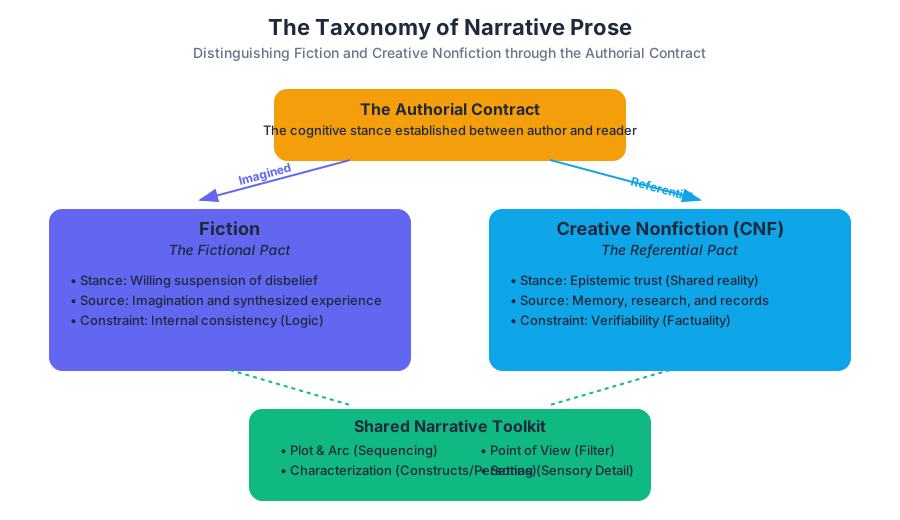
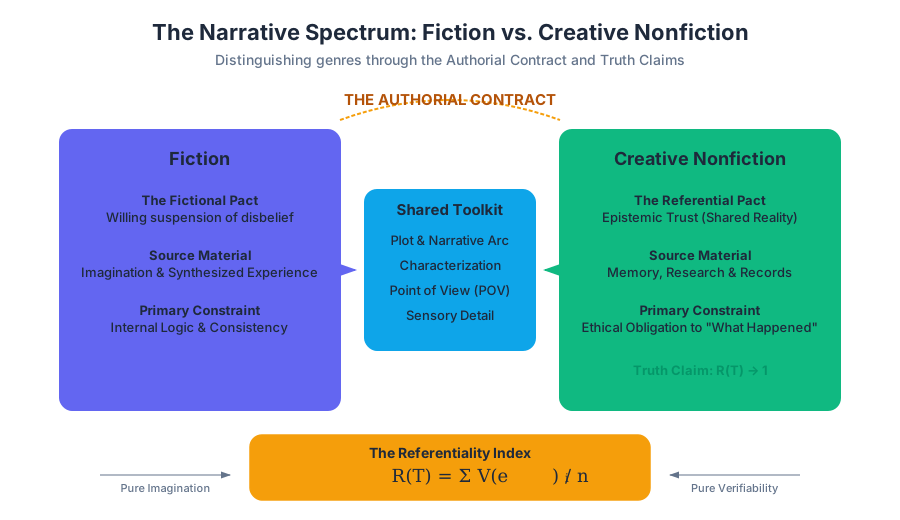
Poetry: Fundamentals and Craft
Key concepts: Poetic Analysis · Word Choice and Connotation · Billy Collins · Introduction to Poetry
Introduction to the analytical study of poetry, focusing on craftsmanship, word choice, and the reader-poet relationship.
Poetry: Fundamentals and Craft
Poetry is frequently misunderstood as a purely emotional medium, yet from a technical perspective, it represents the highest density of information per unit of language. While prose functions primarily as a delivery system for narrative or argument, poetry operates as a multi-layered architecture where sound, rhythm, syntax, and semantic weight are processed simultaneously. In this deep-dive, we treat poetic analysis not as a search for "hidden meaning," but as the reverse-engineering of a complex linguistic machine.
The Reader-Poet Relationship: The Collins Framework
The fundamental entry point into modern poetic study is the "invitation." Unlike technical documentation, which aims for zero ambiguity, poetry utilizes controlled ambiguity to engage the reader's cognitive faculties. Billy Collins, a former U.S. Poet Laureate, provides the definitive meta-commentary on this relationship in his work Introduction to Poetry.
What it is
The Reader-Poet Relationship is a communicative contract where the poet provides a set of sensory instructions, and the reader agrees to perform those instructions to "activate" the poem. Collins argues against the "torture" of a poem—the aggressive extraction of a single "meaning"—and instead advocates for an experiential traversal of the text.
Why it matters
In academic and creative contexts, students often approach poetry with "interpretation anxiety." By understanding the Collins framework, the reader shifts from a passive consumer to an active participant. This prevents the "over-analysis" pitfall where the technical components are stripped away, leaving a dry, moralistic summary that ignores the craft.
The Collins Methodology of Engagement
Collins suggests several "modes of entry" for a poem, which we can categorize as follows:
| Mode | Description | Objective |
|---|---|---|
| Color Probe | Holding a poem up to the light like a slide. | Identifying tonal shifts and visual imagery. |
| Acoustic Testing | Pressing an ear against its hive. | Analyzing phonetics, internal rhyme, and resonance. |
| Spatial Navigation | Walking inside the poem's room and feeling for a light switch. | Understanding the poem's internal logic and structural layout. |
| Surface Tension | Waterskiing across the surface. | Appreciating the literal narrative before diving into subtext. |
"I want them to waterski / across the surface of a poem / waving at the author’s name on the shore. / But all they want to do / is tie the poem to a chair with rope / and torture a confession out of it." — Billy Collins
Word Choice and Connotation: The Semantic Matrix
In poetry, the Word is the fundamental unit of execution. Because poems are generally shorter than prose, each word carries a higher "load." This load is comprised of two distinct values: Denotation (the literal, dictionary definition) and Connotation (the emotional, cultural, or historical associations).
How it Works: The Connotation Gradient
A poet selects words based on their position on a "connotation gradient." For example, the words house, home, residence, and shack share a similar denotation (a place where humans live) but occupy vastly different semantic spaces.
The Connotation Matrix
To analyze word choice effectively, we can map words across two axes: Intensity and Valence.
| Term | Denotation | Connotation Valence | Intensity (1-10) | Poetic Impact |
|---|---|---|---|---|
| Fire | Combustion of fuel | Neutral/Destructive | 7 | Primal, cleansing, or dangerous. |
| Blaze | Large/intense fire | Positive/Awe | 9 | Suggests brilliance or unstoppable force. |
| Glimmer | Faint, unsteady light | Positive/Hopeful | 3 | Suggests fragility or distance. |
| Inferno | Uncontrollable fire | Negative/Terror | 10 | Evokes hellish or apocalyptic imagery. |
Implementation: Lexical Density Analysis
In a computational sense, we can analyze the "weight" of a poem by calculating its lexical density—the ratio of content words (nouns, verbs, adjectives) to function words (articles, prepositions). Poetry typically exhibits a much higher lexical density than spoken English.
import nltk
from nltk.tokenize import word_tokenize

def calculate_lexical_density(text):
    """
    Calculates the ratio of content words to total words.
    High density ( > 0.6 ) often indicates poetic or academic text.
    """
    tokens = word_tokenize(text.lower())
    # Define function words (stop words)
    stop_words = set(nltk.corpus.stopwords.words('english'))

    content_words = [word for word in tokens if word.isalpha() and word not in stop_words]

    density = len(content_words) / len(tokens)
    return {
        "total_tokens": len(tokens),
        "content_tokens": len(content_words),
        "lexical_density": round(density, 4)
    }

# Example usage with a snippet of Collins-esque verse
poem_snippet = "The light slides across the mahogany desk, a silent ghost of morning."
print(calculate_lexical_density(poem_snippet))
Poetic Analysis: The Scansion and Structure Pipeline
Poetic Analysis is the systematic deconstruction of a poem's formal elements to understand how they produce a specific effect. This is not a subjective "feeling," but a technical derivation based on the poem's architecture.
The Components of the Pipeline
- Prosody/Scansion: The study of meter and rhythm.
- Structural Analysis: The arrangement of stanzas (couplets, quatrains, sestets).
- Syntactic Flow: The use of Enjambment (lines breaking without punctuation) vs. End-stopped lines.
- Figurative Mapping: Identifying the relationship between the Tenor (the thing being described) and the Vehicle (the figurative language used to describe it).
Mathematical Derivation of Metaphor
We can represent the cognitive load of a metaphor as a mapping function $M$ between two domains: the Source ($S$) and the Target ($T$).
M: S \rightarrow T
Where the "aptness" of the metaphor is defined by the intersection of shared attributes $A$ divided by the total attributes of the source, weighted by the cultural salience $w$.
$$\text{Effectiveness} = \sum \frac{w(A_S \cap A_T)}{|A_S|}$$
If the intersection is too large, the metaphor is a cliché (e.g., "life is a journey"). If the intersection is too small, the metaphor is "obscure" or "surreal." The "sweet spot" for poetic resonance occurs when the intersection is unexpected yet logically sound upon reflection.
Common Pitfalls in Analysis
- The Intentional Fallacy: Assuming the poem's meaning is strictly what the author intended. The poem exists as an independent object once published.
- The Affective Fallacy: Judging a poem solely by the emotional effect it has on the reader, ignoring the technical craft that produced that effect.
- Prose Summary Error: Treating the "paraphrase" of the poem as the poem itself. A poem's "meaning" is inseparable from its form.
Structural Engineering: Enjambment and White Space
In poetry, White Space is as functional as the text itself. It acts as a "silence" or a "buffer" in the execution of the poem's code.
Enjambment vs. End-Stopping
Enjambment occurs when a sentence or phrase continues across a line break without terminal punctuation. This creates a "tug-of-war" between the reader's desire to follow the syntax and the physical break of the line.
| Feature | End-Stopped Line | Enjambed Line |
|---|---|---|
| Visual | Ends with ., ,, ;, or ! |
Ends with no punctuation. |
| Pacing | Slow, deliberate, rhythmic. | Fast, urgent, flowing. |
| Cognitive Effect | Resolution and closure. | Tension and anticipation. |
| Function | Emphasizes the final word. | Emphasizes the relationship between lines. |
Real-World Usage: The CLI Approach to Poetry
For a modern researcher, poetic analysis can be augmented by command-line tools to check for frequency, rhyme schemes, or even sentiment shifts across a corpus.
# A simple pipeline to find the most frequent 'weighty' words in a poem file
# 1. Convert to lowercase
# 2. Remove punctuation
# 3. Sort and count occurrences
# 4. Filter for words longer than 3 characters (to ignore most function words)

cat poem.txt | \
tr '[:upper:]' '[:lower:]' | \
tr -d '[:punct:]' | \
xargs -n1 | \
awk 'length($0) > 3' | \
sort | uniq -c | sort -nr | head -n 10
The Revision Process: From Raw Input to Refined Verse
Poetry is rarely "inspired" in its final form. It is the result of iterative refinement. A poet begins with a Volta (a turn of thought) or a specific image and subjects it to multiple passes of "compression."
The Compression Algorithm
- Drafting: Expansion of the initial thought (High entropy).
- Pruning: Removal of "clutter" words (adverbs, redundant adjectives).
- Tuning: Replacing generic nouns with specific ones (e.g., "bird" $\rightarrow$ "starling").
- Formatting: Adjusting line breaks to control the "breath" of the reader.
Theorem of Poetic Economy: The power of a poetic image is inversely proportional to the number of words used to describe it, provided the semantic clarity remains above the threshold of comprehension.
Summary of Poetic Devices
To master poetic craft, one must be fluent in the "standard library" of devices. These are not ornaments; they are functional components.
| Device | Type | Function |
|---|---|---|
| Alliteration | Sonic | Repetition of initial consonant sounds to create "texture." |
| Assonance | Sonic | Repetition of vowel sounds to create a "mood" (e.g., long 'o' for gloom). |
| Caesura | Structural | A mid-line pause that breaks the rhythmic flow. |
| Metonymy | Figurative | Replacing a concept with a related object (e.g., "The Crown" for the King). |
| Synecdoche | Figurative | Using a part to represent the whole (e.g., "all hands on deck"). |
Conclusion: The "Introduction to Poetry" as a Technical Manual
When Billy Collins asks us to "walk inside the poem's room," he is describing a spatial-temporal engagement with language. Poetry is the only medium where the physical layout of the words on the page is as critical as their dictionary definitions. By applying the rigors of poetic analysis—understanding connotation, mastering the scansion pipeline, and respecting the reader-poet contract—we move from "reading" to "executing" the text.
The goal of the student is not to solve the poem like a riddle, but to inhabit it like an environment. As you move forward, treat every line break as a command and every metaphor as a pointer to a deeper memory address in the human experience.
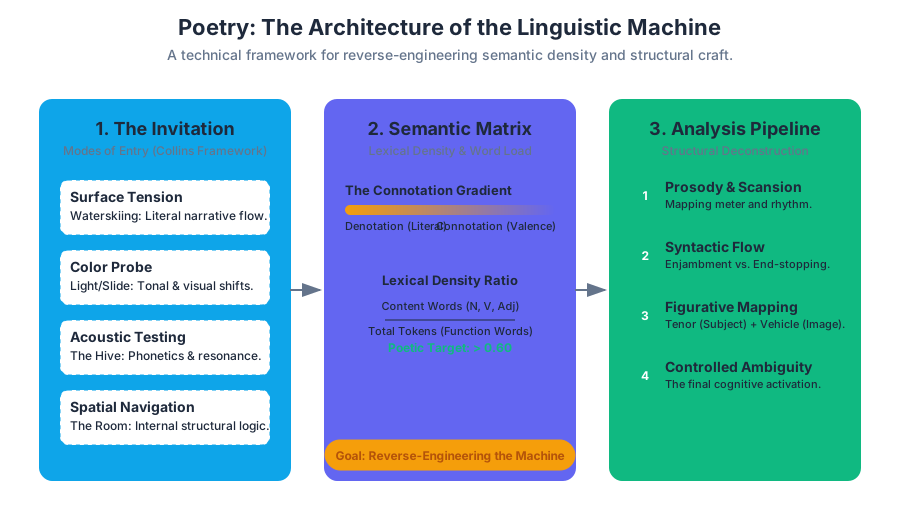
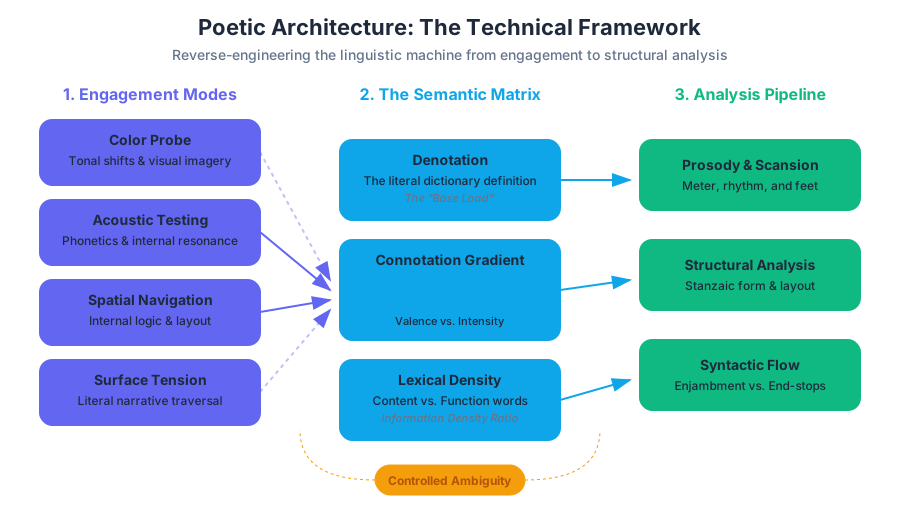
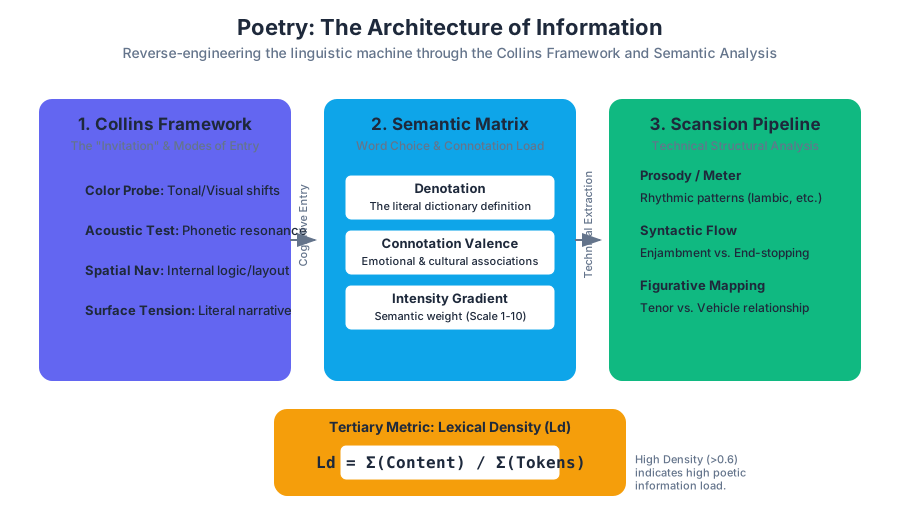
Poetic Form: Meter, Rhyme, and Free Verse
Key concepts: Metrical Feet (Iamb, Trochee) · Stanza Structures · Free Verse · Vers Libre · Walt Whitman
Technical study of rhythmic structures, stanzaic forms, and the evolution of free verse.
Poetic Form: Meter, Rhyme, and Free Verse
Poetry is the architectural engineering of language. While prose typically prioritizes the transmission of information through syntax and narrative, poetry leverages the physical properties of speech—rhythm, resonance, and temporal pacing—to encode meaning. This section explores the formal constraints that govern verse, from the rigid "math" of accentual-syllabic meter to the organic, recursive structures of free verse.
The Mechanics of Meter: Accentual-Syllabic Prosody
In the English tradition, meter is primarily accentual-syllabic. This means the rhythm is determined by both the number of syllables and the pattern of accents (stress) within a line. Unlike classical Greek or Latin poetry, which relied on vowel length (quantitative meter), English meter relies on the natural emphasis we place on certain syllables in speech.
The Metrical Foot
The basic unit of meter is the foot, a specific grouping of stressed (/) and unstressed (x) syllables. The arrangement of these feet creates the "pulse" of the poem.
Definition: Scansion Scansion is the act of "mapping" a poem’s metrical structure by marking the stressed and unstressed syllables to identify the prevailing foot and line length.
| Foot Name | Pattern | Stress Sequence | Rhythmic Effect |
|---|---|---|---|
| Iamb | x / |
Unstressed-Stressed | Rising, natural, mimics the human heartbeat. |
| Trochee | / x |
Stressed-Unstressed | Falling, driving, often feels "incantatory." |
| Anapest | x x / |
Unstressed-Unstressed-Stressed | Galloping, light, fast-paced. |
| Dactyl | / x x |
Stressed-Unstressed-Unstressed | Stately, classical, often used in epics. |
| Spondee | / / |
Stressed-Stressed | Weighty, slow, used for emphasis (rarely a whole line). |
| Pyrrhic | x x |
Unstressed-Unstressed | Rapid, light, used to bridge more complex feet. |
Line Length (Meter)
A line's meter is defined by the type of foot and the number of times that foot repeats. For example, Iambic Pentameter consists of five iambs.
| Number of Feet | Metrical Name | Common Usage |
|---|---|---|
| 1 | Monometer | Rare; used for experimental or "staccato" effects. |
| 2 | Dimeter | Often found in nursery rhymes or short lyrics. |
| 3 | Trimeter | Common in ballads and hymns (alternating with tetrameter). |
| 4 | Tetrameter | Highly rhythmic; common in folk poetry and "The Raven." |
| 5 | Pentameter | The "standard" of English verse (Shakespeare, Milton). |
| 6 | Hexameter | Also called an "Alexandrine"; feels elongated and formal. |
Implementation: Algorithmic Scansion
To understand meter technically, we can view it as a pattern-matching problem. In the following Python example, we simulate a basic dictionary-based scanner that identifies the metrical structure of a line.
import curses.ascii

class ProsodyAnalyzer:
    """
    A low-level implementation of a metrical scanner using a
    simplified CMU Pronouncing Dictionary approach.
    """
    def __init__(self):
        # Simplified stress map: 1 = stressed, 0 = unstressed
        self.stress_db = {
            "the": "0", "way": "1", "was": "0", "long": "1",
            "and": "0", "wind": "1", "ing": "0", "road": "1"
        }

    def scan_line(self, text: str) -> str:
        words = text.lower().split()
        pattern = ""
        for word in words:
            # In a real system, we would handle multi-syllable word decomposition
            pattern += self.stress_db.get(word, "?")
        return pattern

    def identify_foot(self, pattern: str):
        if pattern == "01": return "Iamb"
        if pattern == "10": return "Trochee"
        if pattern == "001": return "Anapest"
        if pattern == "100": return "Dactyl"
        return "Unknown"

# Example Usage
analyzer = ProsodyAnalyzer()
line = "the way was long"
pattern = analyzer.scan_line(line) # Result: "0101"
print(f"Pattern: {pattern} -> Iambic Dimeter")
Stanzaic Structures: The Architecture of the Page
If feet are the "atoms" and lines are the "molecules," then stanzas are the "cells" of a poem. Stanzas provide visual and thematic grouping, often dictated by rhyme schemes.
Common Stanza Forms
Stanzas are categorized by the number of lines they contain. The transition between stanzas often signals a shift in time, perspective, or argument.
| Lines | Name | Typical Rhyme Scheme | Notes |
|---|---|---|---|
| 2 | Couplet | aa |
Used for epigrams or concluding a sonnet. |
| 3 | Tercet | aba or aaa |
If linked, it becomes Terza Rima (Dante). |
| 4 | Quatrain | abab or abcb |
The most common stanza in English poetry. |
| 5 | Quintain | Variable | Often used in Limericks (aabba). |
| 6 | Sestet | cdcdcd |
The second part of an Italian Sonnet. |
| 8 | Octave | abbaabba |
The first part of an Italian Sonnet; sets the "problem." |
The Sonnet: A Case Study in Formal Logic
The Sonnet is a 14-line poem in iambic pentameter. It is not just a form, but a logical structure.
- Petrarchan (Italian): Divided into an Octave (introduces a problem) and a Sestet (resolves it). The transition is called the Volta (turn).
- Shakespearean (English): Divided into three quatrains and a final couplet. The couplet often provides a witty or dramatic "punchline."
# Formal Grammar for a Shakespearean Sonnet (Backus-Naur Form style)

<sonnet>     ::= <quatrain1> <quatrain2> <quatrain3> <couplet>
<quatrain1>  ::= <line_a> <line_b> <line_a> <line_b>
<quatrain2>  ::= <line_c> <line_d> <line_c> <line_d>
<quatrain3>  ::= <line_e> <line_f> <line_e> <line_f>
<couplet>    ::= <line_g> <line_g>

<line_x>     ::= <iamb> <iamb> <iamb> <iamb> <iamb>
<iamb>       ::= <unstressed_syllable> <stressed_syllable>
The Taxonomy of Rhyme
Rhyme is the repetition of similar sounding words, usually at the end of lines. However, the "quality" of the rhyme can vary significantly, affecting the poem's tone.
Types of Rhyme
- End Rhyme: The most common form, occurring at the end of lines.
- Internal Rhyme: Rhyme occurring within a single line (e.g., "Once upon a midnight dreary, while I pondered, weak and weary").
- Slant Rhyme (Half Rhyme): Words with similar but not identical sounds (e.g., "bridge" and "grudge"). This creates a sense of dissonance or unease.
- Eye Rhyme: Words that look like they should rhyme based on spelling but don't in pronunciation (e.g., "move" and "love").
- Rich Rhyme (Rime Riche): Words that sound identical but have different meanings (homonyms, e.g., "raise" and "rays").
Phonetic Analysis of Rhyme
In computational linguistics, we determine rhyme by comparing the phonemes from the last stressed vowel to the end of the word.
# Using a hypothetical 'rhyme-cli' tool to find slant rhymes in a corpus
$ rhyme-cli search --word "soul" --type slant --limit 5

1. all (Similarity: 0.72)
2. bell (Similarity: 0.65)
3. tall (Similarity: 0.70)
4. cool (Similarity: 0.81)
5. foul (Similarity: 0.88)
Free Verse: The Liberation of Rhythm
Free Verse (or Vers Libre) is poetry that does not use a consistent meter or rhyme scheme. However, it is a mistake to think of it as "structureless." Instead of using external "scaffolding" (like iambic pentameter), free verse uses organic structure.
Walt Whitman and the American Idiom
Walt Whitman is the progenitor of modern free verse. In Leaves of Grass, he abandoned the "feudal" meters of Europe in favor of a style based on:
- Anaphora: Repetition of a word or phrase at the beginning of successive clauses.
- Epistrophe: Repetition of a word at the end of successive clauses.
- Cataloging: Long lists that create a cumulative, panoramic effect.
- The Rhythm of the Breath: Lines that follow the natural cadence of an orator or a singer.
"The sea whispered me." — Walt Whitman
Comparison: Traditional vs. Free Verse
| Feature | Traditional Verse | Free Verse |
|---|---|---|
| Rhythm | Fixed Metrical Feet (e.g., Iambs) | Variable; based on cadence and syntax. |
| Rhyme | Usually structured (e.g., abab) |
Occasional, internal, or absent. |
| Line Breaks | Often determined by the meter. | Determined by emphasis, breath, or visual impact. |
| Historical Context | Renaissance to Victorian eras. | Modernism to Contemporary. |
| Constraint | External (The "Form"). | Internal (The "Content"). |
Sound Devices: Beyond Meter and Rhyme
The "music" of a poem is also built through smaller-scale phonetic effects. These devices are often used to reinforce the theme (e.g., using harsh sounds for a violent scene).
Alliteration, Assonance, and Consonance
- Alliteration: Repetition of initial consonant sounds ("Seven silver swans").
- Assonance: Repetition of internal vowel sounds ("The rain in Spain stays mainly...").
- Consonance: Repetition of final consonant sounds ("The lumky, bumpy road").
Onomatopoeia and Cacophony
- Onomatopoeia: Words that mimic the sound they describe ("buzz," "hiss," "clatter").
- Cacophony: A harsh, discordant mixture of sounds (using "plosives" like
p,b,t,d,k,g). - Euphony: Successive words that are harmonious and pleasing to the ear (using "liquids" like
l,m,n,r).
Common Pitfalls in Formal Analysis
- The "Syllable Counting" Trap: Students often count syllables without looking for the stress. A 10-syllable line is not necessarily iambic pentameter; it must follow the
x /pattern. - Ignoring the Volta: In a sonnet, failing to identify the "turn" means missing the emotional or intellectual pivot of the poem.
- Assuming Free Verse is "Easy": Writing effective free verse requires a keen ear for syntax. Without the "crutch" of meter, the poet must create rhythm through lineation and word choice alone.
- Over-identifying Rhyme: Not every similar sound is a rhyme. Be careful to distinguish between consonance (shared consonants) and true rhyme (shared vowel + final consonant).
Summary of Poetic Evolution
The history of poetic form is a history of tension between constraint and freedom.
- The Renaissance/Enlightenment: Value was placed on the mastery of difficult forms (Sonnets, Heroic Couplets). Complexity was a sign of intellectual rigor.
- The Romantic Era: Began to prioritize "the spontaneous overflow of powerful feelings," though they still largely used traditional meters.
- Modernism: Poets like T.S. Eliot and Ezra Pound broke the "hegemony of the iamb," seeking new rhythms that reflected the fragmented nature of modern life.
- Post-Modernism/Contemporary: Form is now "modular." A poet might use a sonnet structure but fill it with slant rhymes and irregular meter to subvert expectations.
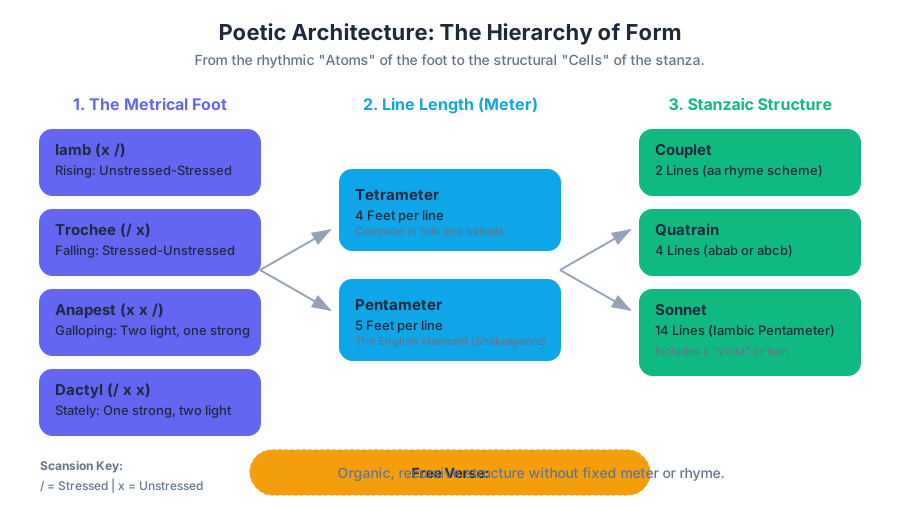
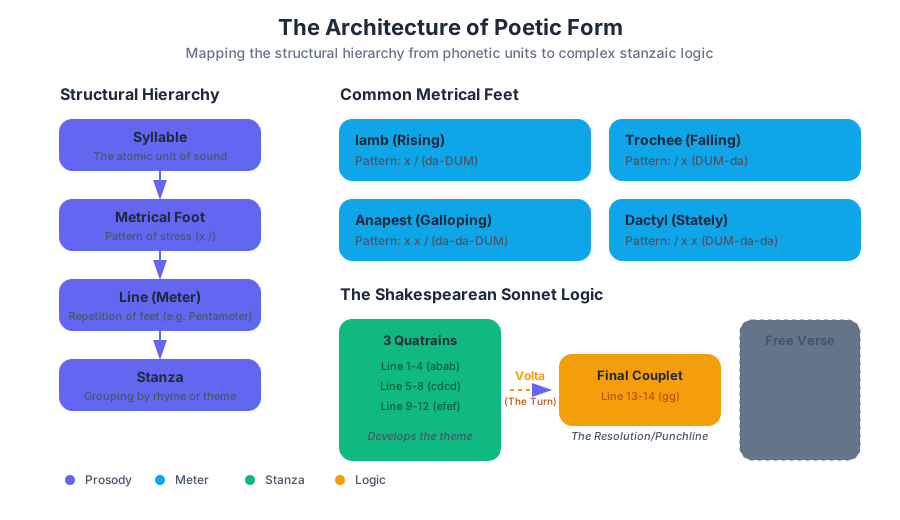
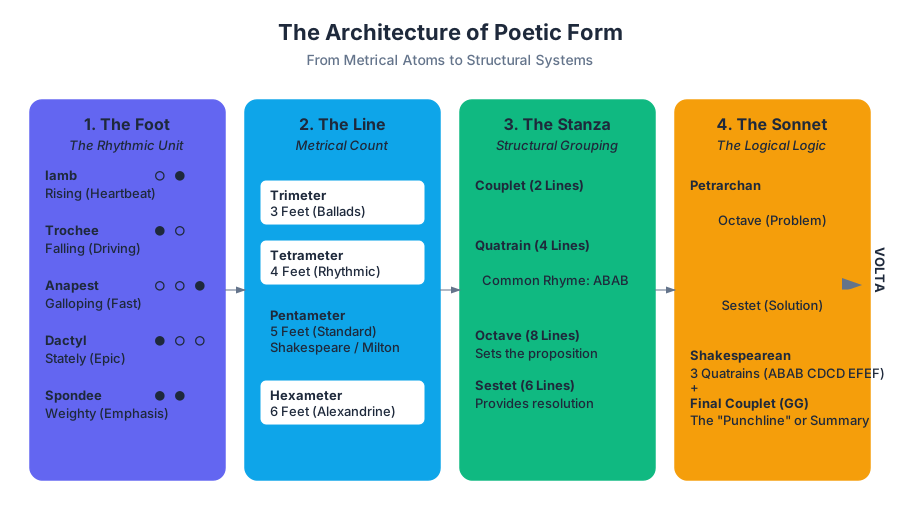
Genres: Drama and Film
Key concepts: Plays as Literature · Dramatic Text Analysis · Visual Media · Performance Studies
The study of plays as literary texts and the conventions of visual and performative mediums.
Genres: Drama and Film
Drama is a unique literary genre defined by its dual existence as both a written text (the script) and a realized performance (theater or film). Unlike fiction, which relies on a narrator to mediate the reader’s experience, drama is primarily driven by mimesis (imitation of action) and dialogue. In the transition from the stage to the screen, the genre incorporates visual media techniques—cinematography, editing, and sound design—to create a complex semiotic system that transcends the printed word.
The Ontology of the Dramatic Text
The dramatic text, often called the playtext, serves as a blueprint for performance. While it can be read as literature, its primary function is to provide the linguistic and structural framework for actors, directors, and designers.
The Dual Nature of the Script
A play consists of two distinct layers of communication:
- The Primary Text: The dialogue spoken by the characters.
- The Secondary Text: The stage directions, character lists, and scene descriptions provided by the playwright.
In literary analysis, the secondary text is often as vital as the primary. For instance, in Tennessee Williams' A Streetcar Named Desire, the stage directions regarding the "blue piano" or the "varsouviana" music provide essential psychological subtext that the dialogue alone might miss.
| Feature | Drama (Stage) | Fiction (Novel) | Film (Screen) |
|---|---|---|---|
| Primary Medium | Dialogue and Physical Action | Narrative Prose | Visual Image and Sound |
| Point of View | Objective/External | Variable (1st, 3rd, Omniscient) | Subjective (Camera Lens) |
| Temporal Constraint | Real-time performance | Internalized reading time | Fixed runtime/Editing |
| Audience Agency | Collective, fixed perspective | Individual, imaginative | Collective, directed focus |
The TEI Standard for Dramatic Encoding
In the digital humanities, dramatic texts are often encoded using the Text Encoding Initiative (TEI) standard. This allows for computational analysis of character interactions, speech lengths, and stage movement.
<TEI xmlns="http://www.tei-c.org/ns/1.0">
  <teiHeader>
    <fileDesc>
      <titleStmt>
        <title>Hamlet, Prince of Denmark</title>
        <author>William Shakespeare</author>
      </titleStmt>
    </fileDesc>
  </teiHeader>
  <text>
    <body>
      <div type="act" n="3">
        <div type="scene" n="1">
          <sp who="#Hamlet">
            <speaker>HAMLET</speaker>
            <p>To be, or not to be: that is the question:</p>
          </sp>
          <stage type="business">Enter OPHELIA reading a book.</stage>
        </div>
      </div>
    </body>
  </text>
</TEI>
Structural Mechanics: The Architecture of Action
Dramatic structure is governed by the relationship between story (the chronological sequence of events) and plot (the artistic arrangement of those events).
Freytag’s Pyramid and Beyond
Gustav Freytag’s 1863 analysis of Greek and Shakespearean drama remains the foundational model for understanding dramatic tension. He proposed a five-part structure:
- Exposition: Introduction of setting, characters, and conflict.
- Rising Action: A series of complications leading to the climax.
- Climax: The turning point or point of highest tension.
- Falling Action: The consequences of the climax unfold.
- Denouement/Catastrophe: The resolution of the conflict.
The Law of Dramatic Tension: The intensity of a scene $T$ is a function of the stakes $S$ and the proximity to the resolution $P$, often expressed as $T \propto \frac{S}{P}$. As the play approaches the climax, the "distance" to the resolution decreases, causing tension to spike exponentially.
The Three Unities
Derived from Aristotle’s Poetics, the three unities were long considered the "gold standard" for dramatic construction:
- Unity of Action: A play should have one main plot and minimal subplots.
- Unity of Place: The action should occur in a single physical space.
- Unity of Time: The action should take place over no more than 24 hours.
While modern drama frequently breaks these rules, they remain the baseline against which experimental theater (such as Epic Theater or the Theater of the Absurd) is measured.
Performance Studies: From Page to Stage
Performance studies shifts the focus from the text to the event. It treats the performance as a "text" in its own right, composed of non-verbal signs.
The Semiotics of the Stage
Everything on stage—the lighting, the costumes, the actor's posture—carries meaning. This is known as the mise-en-scène.
- Proxemics: The spatial relationship between characters on stage. A character standing far apart from a group visually signals alienation.
- Kinesics: Body language and gesture.
- Paralinguistics: The tone, pitch, and volume of the spoken word, which can completely alter the meaning of the written dialogue.
Script Analysis for Performance
Actors often use Objective-Obstacle-Action analysis to break down a scene. This can be represented as a logical flow:
FUNCTION analyze_scene(character, scene):
    GOAL = character.get_super_objective()
    SCENE_OBJECTIVE = character.get_immediate_want(scene)

    FOR EACH beat IN scene:
        OBSTACLE = get_opposing_force(beat)
        IF OBSTACLE.intensity > character.resolve:
            character.tactic = "Pivot" (e.g., charm to threat)
        ELSE:
            character.tactic = "Press" (e.g., demand, beg)

        RESULT = apply_tactic(character.tactic, OBSTACLE)
        UPDATE character.emotional_state(RESULT)
The Grammar of Film: Visual Media Analysis
Film is often described as "drama plus the camera." The introduction of the lens changes the viewer's relationship with the text from a fixed, wide-angle perspective to a highly controlled, subjective experience.
The Kuleshov Effect
The fundamental principle of film editing is the Kuleshov Effect, which demonstrates that viewers derive more meaning from the interaction of two sequential shots than from a single shot in isolation.
| Shot A | Shot B | Perceived Emotion |
|---|---|---|
| Neutral Face | Bowl of Soup | Hunger |
| Neutral Face | Dead Child in Coffin | Grief |
| Neutral Face | Woman on a Sofa | Lust |
Cinematography and Perspective
In film, the camera acts as a narrator. The choice of shot size and angle dictates the audience's psychological response.
| Shot Type | Technical Definition | Psychological Effect |
|---|---|---|
| Extreme Long Shot | Subject is small; focus on landscape. | Isolation, insignificance, or scale. |
| Medium Shot | Waist up; mimics social distance. | Neutrality, conversation, standard interaction. |
| Close-Up | Focus on face/object; fills the frame. | Intimacy, intensity, or internal realization. |
| Dutch Angle | Camera is tilted on the X-axis. | Disorientation, unease, or madness. |
Computational Dramaturgy: Analyzing Dialogue and Interaction
Modern literary analysis often employs Python to quantify character dynamics. One common metric is Dialogue Density or Social Network Centrality within a play. By treating characters as nodes and their interactions as edges, we can mathematically determine the "protagonist" based on network influence rather than just line count.
import networkx as nx
import matplotlib.pyplot as plt

def generate_character_network(play_data):
    """
    play_data: List of tuples (Character_A, Character_B)
    representing a shared scene.
    """
    G = nx.Graph()

    # Add weights based on frequency of interaction
    for interaction in play_data:
        if G.has_edge(*interaction):
            G[interaction[0]][interaction[1]]['weight'] += 1
        else:
            G.add_edge(interaction[0], interaction[1], weight=1)

    # Calculate Eigenvector Centrality (Influence)
    centrality = nx.eigenvector_centrality(G, weight='weight')

    return G, centrality

# Example: Simplified 'Hamlet' interactions
hamlet_interactions = [
    ("Hamlet", "Horatio"), ("Hamlet", "Claudius"), ("Hamlet", "Gertrude"),
    ("Claudius", "Gertrude"), ("Polonius", "Ophelia"), ("Hamlet", "Ophelia")
]

graph, scores = generate_character_network(hamlet_interactions)
print(f"Influence Scores: {scores}")
Adaptation Theory: Page to Screen
When a play or novel is adapted to film, it undergoes a process of transmediation. Analysis of film adaptations focuses on three primary strategies:
- Fidelity: Attempting to replicate the source text as closely as possible (e.g., many BBC Shakespeare productions).
- Intersection: Highlighting the tension between the original text and the new medium, often keeping theatrical elements visible.
- Transformation: Using the source text as a "raw material" to create a distinct work of art (e.g., Akira Kurosawa’s Ran as an adaptation of King Lear).
Common Pitfalls in Adaptation Analysis
- The Fidelity Myth: The mistaken belief that an adaptation is "bad" simply because it deviates from the book. Film is a different language; a literal translation often results in "stagy" or uncinematic results.
- Ignoring the "Third Text": Every adaptation is influenced by the cultural context of its production, creating a "third text" that exists between the original and the new version.
Critical Frameworks in Drama and Film
To analyze drama and film at an expert level, one must apply specific critical lenses:
- Formalism: Focuses on the "how"—the structure, the lighting, the meter of the verse.
- Psychoanalytic Criticism: Analyzes the subtext and the unconscious desires of characters (e.g., the Oedipal readings of Hamlet).
- Marxist Theory: Examines the power dynamics and class struggles represented in the setting and character motivations.
- Feminist Film Theory: Investigates the "Male Gaze" (a term coined by Laura Mulvey), where the camera lens assumes a heterosexual male perspective, objectifying female characters.
Comparison of Dramatic Eras
| Era | Key Philosophies | Notable Playwrights | Structural Innovation |
|---|---|---|---|
| Classical Greek | Catharsis, Fate, Hubris | Sophocles, Euripides | Use of the Chorus, Masks |
| Elizabethan | Humanism, Order vs. Chaos | Shakespeare, Marlowe | Iambic Pentameter, Subplots |
| Realism | Social Critique, Determinism | Ibsen, Chekhov | The "Fourth Wall," Subtext |
| Post-Modern | Meta-fiction, Fragmentation | Beckett, Pinter | Breaking the Fourth Wall, Silence |
Summary of Visual Media Pipelines
The transition from a written script to a finished film involves a rigorous pipeline that mirrors the "compilation" of code:
- Development: Scriptwriting and storyboarding (The Source Code).
- Pre-production: Casting and location scouting (Environment Setup).
- Production: Principal photography (Execution).
- Post-production: Editing, VFX, and Sound Mixing (Optimization and Linking).
- Distribution: Theatrical or streaming release (Deployment).
Key Terms for Review
- Soliloquy: A character speaking their inner thoughts aloud while alone, a convention used to provide direct access to the character's psyche.
- The Fourth Wall: The imaginary barrier between the actors and the audience. "Breaking" it involves characters acknowledging the audience.
- Diegetic Sound: Sound that originates from within the world of the film (e.g., a radio playing in a scene).
- Non-diegetic Sound: Sound that the characters cannot hear (e.g., the film score).
- Subtext: The underlying meaning or "hidden agenda" behind a character's spoken words.
- Montage: A technique in film editing in which a series of short shots are edited into a sequence to condense space, time, and information.
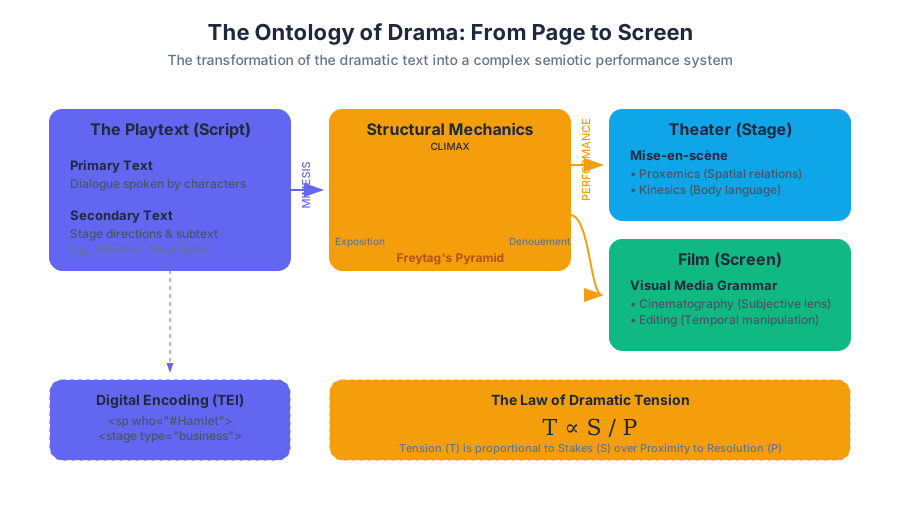
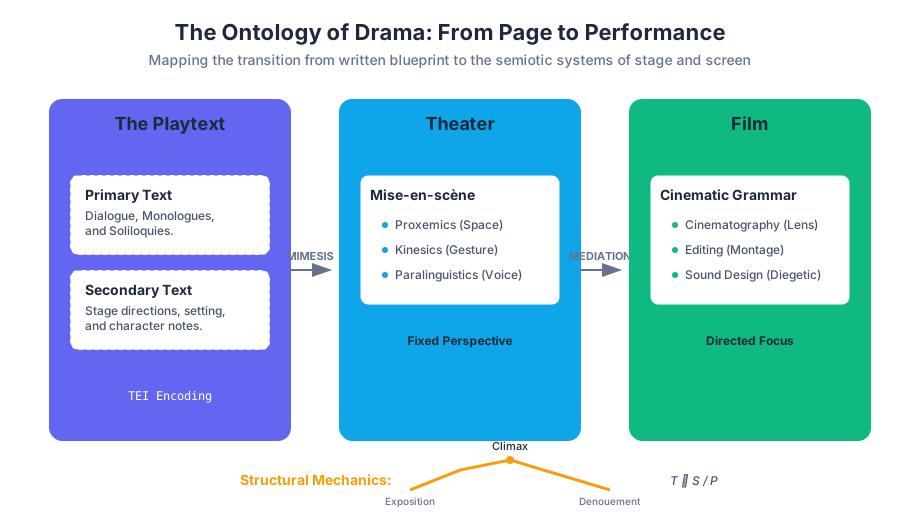
Assignments and Applied Analysis
Key concepts: Character Analysis · Close Reading · Symbolism Essay · Comparative Essay
Practical application of literary concepts through character analysis, close reading, and comparative essays.
Assignments and Applied Analysis
In the field of literary studies, the transition from passive consumption to active critique is mediated through structured assignments. These are not merely "homework" but are rigorous analytical frameworks designed to deconstruct the mechanics of narrative, syntax, and cultural resonance. By treating a text as a complex system of variables—historical context, linguistic choice, and psychological depth—students can reverse-engineer the author’s intent and the reader’s response.
Character Analysis: The Architecture of Persona
Character Analysis is the systematic examination of a fictional individual’s traits, motivations, and development throughout a narrative. It moves beyond simple description to investigate how a character functions as a vehicle for the story’s themes.
What it is
At its core, character analysis is the extraction of data points from a text to build a psychological profile. This involves distinguishing between Static characters (who remain unchanged) and Dynamic characters (who undergo significant internal transformation).
Why it matters
Characters are the primary interface through which readers experience a narrative. Understanding characterization allows us to decode the "moral logic" of a story. If a character succeeds or fails, their traits provide the causal link to that outcome, revealing the author’s underlying worldview.
How it works: The STEAL Method
To perform a high-level character analysis, analysts often use the STEAL framework to categorize indirect characterization:
| Category | Description | Analytical Focus |
|---|---|---|
| Speech | What the character says and how they say it. | Diction, tone, dialect, and subtext. |
| Thoughts | What is revealed through internal monologue. | Discrepancies between private thought and public action. |
| Effect | How other characters react to the individual. | Social standing, influence, and interpersonal friction. |
| Actions | What the character does in moments of crisis. | Moral agency and behavioral consistency. |
| Looks | Physical appearance and dress. | Symbolic value of aesthetics and physical flaws. |
Worked Example: Pythonic Character Mapping
In modern digital humanities, character analysis can be augmented by computational tools to track interaction frequency and sentiment.
import spacy
from collections import Counter

# Low-level implementation of a Character Interaction Extractor
nlp = spacy.load("en_core_web_sm")

def extract_character_interactions(text, target_char):
    doc = nlp(text)
    interactions = []

    for sent in doc.sents:
        if target_char in sent.text:
            # Extract other entities in the same sentence
            entities = [ent.text for ent in sent.ents if ent.label_ == "PERSON" and ent.text != target_char]
            interactions.extend(entities)

    return Counter(interactions)

# Example Usage: Analyzing 'The Great Gatsby'
text_data = "Gatsby looked at Daisy. Tom entered the room and ignored Gatsby."
print(extract_character_interactions(text_data, "Gatsby"))
# Output: Counter({'Daisy': 1, 'Tom': 1})
Common Pitfalls
- The "Resume" Mistake: Listing traits without explaining their significance. (e.g., "The protagonist is brave.")
- Ignoring the Foil: Failing to see how a secondary character exists specifically to highlight a trait in the protagonist.
- Confusing Narrator with Author: Attributing the narrator’s biases directly to the writer.
Close Reading: The Micro-Analysis of Syntax
Close Reading (or explication de texte) is the foundational skill of literary analysis. It requires the reader to slow down and examine the specific linguistic choices—word order, rhythm, and imagery—within a short passage.
What it is
Close reading is the practice of "zooming in" on a text to see how the "how" (style) informs the "what" (content). It assumes that in a great work of literature, no word is accidental.
The Mechanics of the "Deep Dive"
The process follows a recursive loop of observation and interpretation:
- Observation: Identify a pattern (e.g., a recurring color, a specific meter).
- Annotation: Mark the text for linguistic features (alliteration, enjambment).
- Contextualization: Relate the feature to the immediate scene.
- Synthesis: Formulate a thesis on how this micro-detail supports the macro-theme.
Mathematical Representation of Textual Density
We can conceptualize the "intensity" of a passage ($I_p$) as a function of its rhetorical devices ($D$) over its word count ($W$):
I_p = \frac{\sum_{i=1}^{n} (w_i \cdot c_i)}{W}
Where:
- $w_i$ is the weight of the $i$-th rhetorical device (e.g., a metaphor might weigh more than a simple adjective).
- $c_i$ is the count of that device.
- $W$ is the total word count of the passage.
Worked Example: Analyzing a Poetic Fragment
"The apparition of these faces in the crowd; / Petals on a wet, black bough." — Ezra Pound
Analysis:
- Punctuation: The semicolon creates a "paratactic" jump, forcing the reader to equate the faces with the petals without an explicit "like" or "as."
- Diction: "Apparition" suggests something ghostly or fleeting, contrasting with the physical "wet, black bough."
The Symbolism Essay: Mapping the Signified
A Symbolism Essay explores how concrete objects, characters, or colors represent abstract ideas. It is an exercise in semiotics—the study of signs and symbols.
What it is
A symbol is a physical entity that stands for something larger than itself. In literature, symbols are rarely one-to-one equations (e.g., Red = Anger); they are often "polysemous," meaning they carry multiple, sometimes conflicting, meanings.
Types of Symbols
| Type | Definition | Example |
|---|---|---|
| Universal (Archetypal) | Symbols that carry meaning across cultures. | Water as rebirth; Fire as destruction/purification. |
| Contextual (Private) | Symbols that gain meaning only within a specific text. | The "Green Light" in The Great Gatsby. |
| Cultural | Symbols specific to a time or place. | A white whale in 19th-century maritime lore. |
Implementation: A Logic-Based Approach to Symbolism
To write an effective symbolism essay, one must move from the Signifier (the object) to the Signified (the concept) through Evidence.
IF (Object X appears in Context Y)
AND (Object X is associated with Character Z)
AND (Character Z undergoes Change A)
THEN (Object X likely represents Concept B)
Common Pitfalls
- Symbol Hunting: Seeing symbols where none exist (sometimes a cigar is just a cigar).
- Fixed Definitions: Assuming a symbol always means the same thing (e.g., "White always means purity"). In Moby Dick, white represents a terrifying void.
The Comparative Essay: Structural Alignment
The Comparative Essay (or "Compare and Contrast") requires the analyst to look at two or more texts simultaneously to identify shared patterns or divergent philosophies.
What it is
Comparison is not just about finding similarities; it is about using one text to illuminate the other. By placing two works in conversation, we can see the boundaries of a genre or the evolution of an idea.
Structuring the Analysis
There are two primary architectural patterns for a comparative essay:
- The Lens Method: Using Text A as a theoretical framework to analyze Text B.
- The Point-by-Point Method: Alternating between texts for every sub-topic (Theme 1: Text A vs Text B; Theme 2: Text A vs Text B).
- The Block Method: Discussing Text A entirely, then Text B entirely, then synthesizing them in the conclusion.
Comparison Matrix for Two Texts
| Feature | Text A (e.g., 1984) | Text B (e.g., Brave New World) |
|---|---|---|
| Mechanism of Control | Pain and Fear (The Whip) | Pleasure and Distraction (The Carrot) |
| Role of Information | Censorship (Books are banned) | Overload (Books are irrelevant) |
| The Resistance | Internal thought/rebellion | External "Savage" perspective |
Worked Example: Shell Script for Document Comparison
While human analysis is qualitative, we can use CLI tools to find quantitative overlaps in vocabulary between two source texts.
#!/bin/bash
# Compare the most frequent words in two text files, excluding common stop words

FILE1=$1
FILE2=$2

echo "Top 10 shared significant words between $FILE1 and $FILE2:"

comm -12 <(tr '[:upper:]' '[:lower:]' < "$FILE1" | tr -d '[:punct:]' | xargs -n1 | sort | uniq -c | sort -nr | awk '{print $2}' | head -n 50 | sort) \
         <(tr '[:upper:]' '[:lower:]' < "$FILE2" | tr -d '[:punct:]' | xargs -n1 | sort | uniq -c | sort -nr | awk '{print $2}' | head -n 50 | sort)
LMS Integration and Technical Deployment
For educators, these assignments are often deployed via a Learning Management System (LMS) like Canvas, Blackboard, or Moodle. These systems treat assignments as structured objects with specific metadata.
Assignment Schema (YAML)
The following is a representation of how a "Close Reading" assignment might be structured in a course configuration file.
assignment_id: LIT-201-CR-01
title: "Close Reading: The Raven"
type: "essay_submission"
points_possible: 100
grading_rubric:
  - criterion: "Textual Evidence"
    weight: 40%
    description: "Selection of specific quotes and linguistic markers."
  - criterion: "Analytical Depth"
    weight: 40%
    description: "Moving beyond summary to interpretation."
  - criterion: "Grammar and Style"
    weight: 20%
    description: "Clarity of prose and adherence to MLA format."
submission_types:
  - file_upload
  - text_entry
allowed_extensions: [".pdf", ".doc", ".docx"]
Database Schema for Student Progress
In a large-scale educational environment, tracking the mastery of these analytical skills requires a relational database.
CREATE TABLE student_mastery (
    student_id INT,
    assignment_type ENUM('Character', 'CloseReading', 'Symbolism', 'Comparative'),
    score DECIMAL(5,2),
    feedback_sentiment SCORE, -- -1.0 to 1.0
    submission_date TIMESTAMP,
    PRIMARY KEY (student_id, assignment_type)
);

-- Query to find students struggling with Close Reading
SELECT student_id, AVG(score) as avg_score
FROM student_mastery
WHERE assignment_type = 'CloseReading'
GROUP BY student_id
HAVING avg_score < 70.0;
Summary of Applied Analysis
Literary analysis is a discipline of pattern recognition. Whether one is performing a character analysis or a comparative essay, the goal is to move from the chaotic surface of the text to the underlying structural logic.
The Axiom of Analysis: A text is not a static object but a dynamic system. The reader's job is to map the inputs (words, history, culture) to the outputs (emotion, theme, meaning).
- Characterization: The process by which an author reveals a character's personality.
- Close Reading: A careful, sustained interpretation of a brief passage of a text.
- Symbolism: The use of concrete objects to represent abstract ideas.
- Comparative Analysis: Examining two or more texts to identify similarities, differences, and thematic intersections.
- STEAL: An acronym for Speech, Thoughts, Effect, Actions, and Looks—methods of indirect characterization.
- Signifier vs. Signified: The physical form of a sign (word/object) vs. the concept it represents.
- Explication: A line-by-line commentary on a text, often used in close reading.
- Intertextuality: The relationship between texts and how they influence or reference each other.
-
Which method is most appropriate for analyzing the specific rhythm and meter of a poem?
- A) Character Analysis
- B) Close Reading
- C) Comparative Essay
- D) Symbolism Essay Correct: B
-
In the STEAL method, what does the 'E' stand for?
- A) Evidence
- B) Emotion
- C) Effect on others
- D) Environment Correct: C
-
What is the primary risk of the 'Block Method' in a comparative essay?
- A) It focuses too much on symbols.
- B) It can lead to two separate essays with no actual comparison.
- C) It requires too much Python code.
- D) it is only used for poetry. Correct: B
-
A 'Contextual Symbol' is defined as:
- A) A symbol that means the same thing in every book.
- B) A symbol that only has meaning within a specific story.
- C) A character that acts as a foil.
- D) A grammatical error. Correct: B
-
True or False: Close reading assumes that every word in a text is potentially significant.
- A) True
- B) False Correct: A
Core Objectives
- Master the STEAL method for character profiling.
- Develop the ability to perform Close Reading by identifying rhetorical devices in isolation.
- Learn to map Symbols from concrete signifiers to abstract signifieds.
- Construct Comparative Essays using either Point-by-Point or Lens methodologies.
Key Formulas & Frameworks
- The Analysis Loop: Observation → Annotation → Contextualization → Synthesis.
- The Symbolism Logic: Object + Context + Character Action = Thematic Meaning.
Practical Application
- When reading, always ask: Why this word and not another?
- In essays, avoid the "Summary Trap"—if you are telling the reader what happened rather than why it matters, you are summarizing, not analyzing.
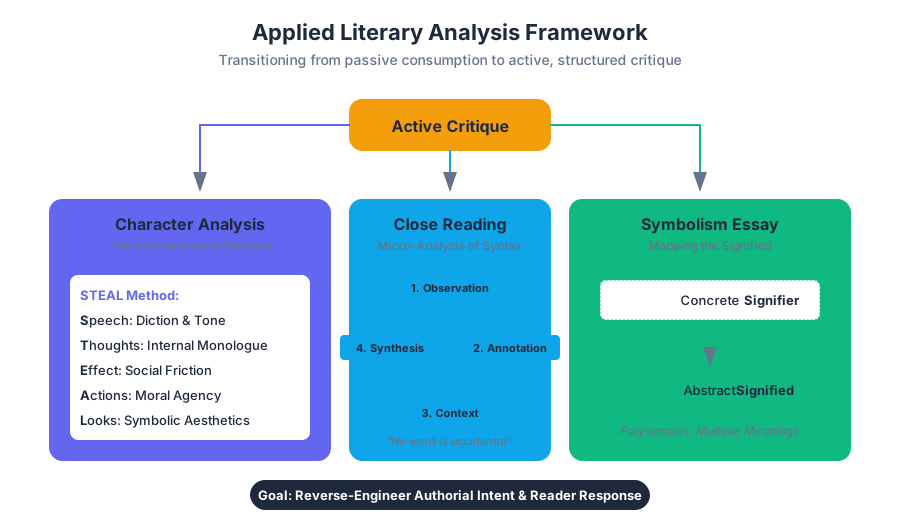
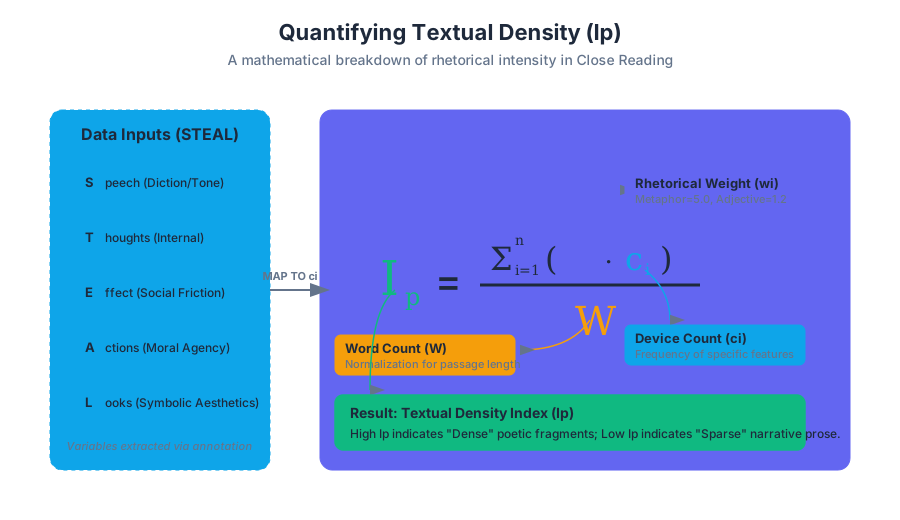
Source Materials
- Introduction to Literature
- Introduction to Literature
- Wp Login.Php
- Introduction to Literature PDF
- Introduction to Literature
- Introduction to Literature
- Introduction to Literature
- Introduction to Literature
- https://www.martineve.com/wp-content/uploads/2011/11/Simon-Davies-Literary-Terms.pdf
- http://www.saylor.org/site/wp-content/uploads/2012/03/ENGL405-2.3-Freeverse-FINAL.pdf
- Introduction to Literature
- Introduction to Literature
Study Introduction to Literature with AI — Free on Lykke
Sign up for free to generate personalized flashcards, quizzes, and study guides from this course. Chat with an AI tutor that knows the material.
Get Started FreeView this course wiki on Lykke · Browse all public course wikis