From the free course Advanced Principles of Biological Systems and Inquiry on Lykke
Molecular and Cellular Biology
Key concepts: Chemistry of Life · Properties of Water · Macromolecules · Cell Structure · Organelles · Membrane Permeability
Covers the chemical foundations of life and the structural components of the cell (Units 1 and 2).
Molecular and Cellular Biology
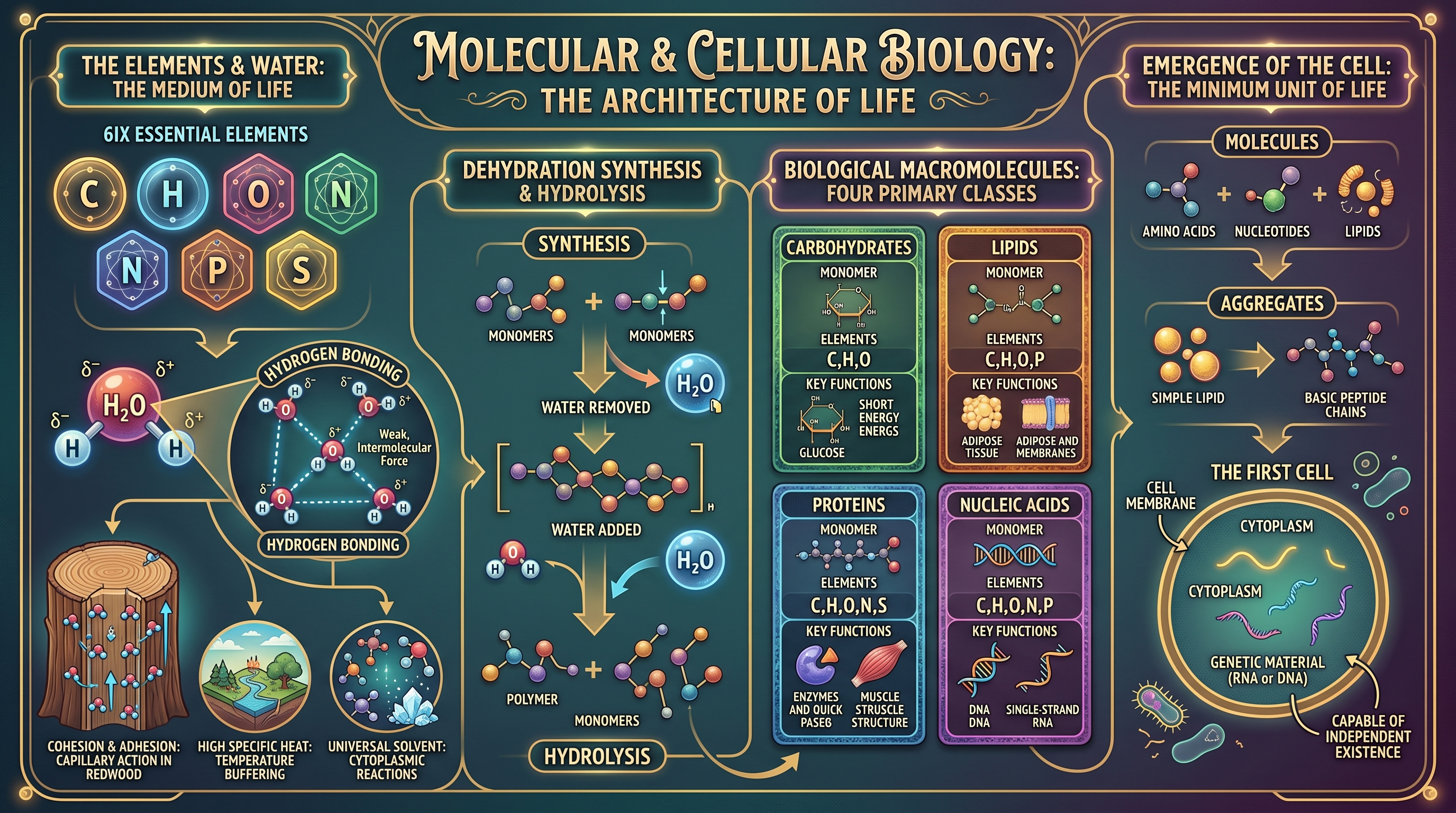
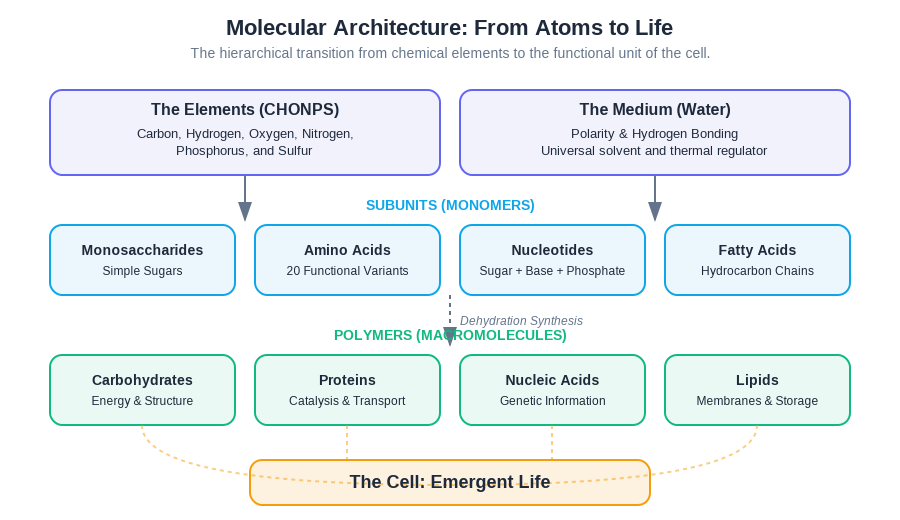
Molecular and cellular biology serves as the "low-level architecture" of biological systems. To understand how complex organisms function, one must first deconstruct the system into its fundamental chemical components and the specialized compartments that house them. This section explores the transition from inorganic chemistry to organic macromolecules, and finally to the emergence of the cell—the smallest unit of life capable of independent existence.
The Chemistry of Life: Water and the Elements of Biological Systems
What it is
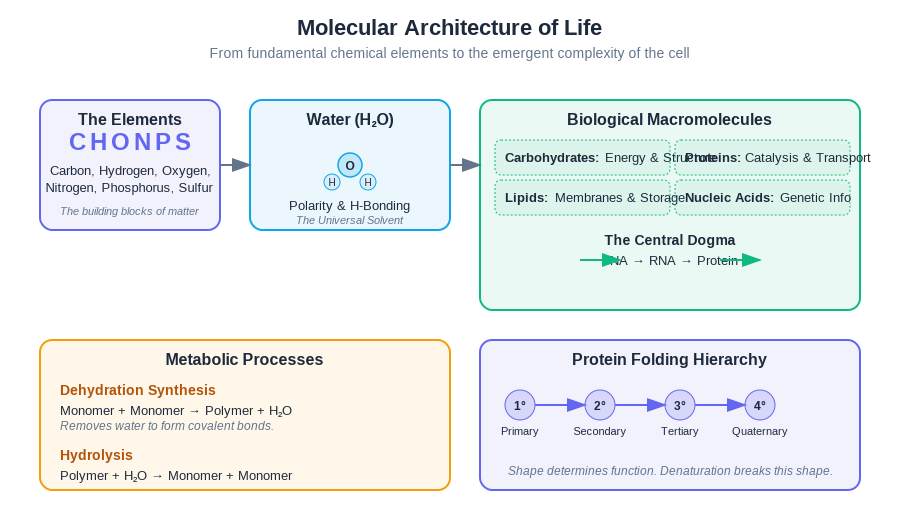
The chemistry of life is governed by the interaction of specific elements—primarily carbon (C), hydrogen (H), oxygen (O), nitrogen (N), phosphorus (P), and sulfur (S). These elements form the basis of all biological molecules. However, the medium in which these interactions occur is water ($H_2O$), a polar molecule characterized by its ability to form hydrogen bonds.
Why it matters
Life as we know it is impossible without water. Its unique physical properties allow for temperature regulation, nutrient transport, and the maintenance of cellular structure. From an engineering perspective, water is the universal solvent and the primary thermal regulator for the "biological engine."
How it works: The Physics of Water
Water is a polar molecule because oxygen is more electronegative than hydrogen. This creates a partial negative charge ($\delta^-$) near the oxygen atom and a partial positive charge ($\delta^+$) near the hydrogen atoms. This dipole moment allows water molecules to attract one another through hydrogen bonding.
| Property | Description | Biological Significance |
|---|---|---|
| Cohesion | Water molecules stick to each other via H-bonds. | Creates surface tension and allows for the transport of water in plants. |
| Adhesion | Water molecules stick to other polar surfaces. | Facilitates capillary action in xylem vessels. |
| High Specific Heat | Water resists changes in temperature. | Buffers organisms and ecosystems against rapid temperature fluctuations. |
| Evaporative Cooling | High heat of vaporization. | Allows organisms to dissipate excess body heat (e.g., sweating). |
| Density Anomaly | Ice is less dense than liquid water. | Prevents lakes from freezing solid, preserving aquatic life in winter. |
| Universal Solvent | Dissolves polar and ionic substances. | Facilitates chemical reactions and nutrient transport within the cytoplasm. |
Concrete Example: Capillary Action
In a 100-meter tall redwood tree, water must move from the roots to the leaves against gravity. This is achieved through a combination of cohesion (water molecules pulling each other up) and adhesion (water molecules clinging to the cellulose walls of the xylem). This "transpiration pull" is a passive process driven entirely by the chemical properties of water.
Common Pitfalls
- Confusing Hydrogen Bonds with Covalent Bonds: Hydrogen bonds are intermolecular forces (between molecules), whereas covalent bonds are intramolecular (within a single molecule). H-bonds are much weaker but collectively powerful.
- Hydrophobic vs. Hydrophilic: Nonpolar molecules (like oils) cannot form H-bonds and are "pushed" away by water. This is the hydrophobic effect, which is the primary driver behind cell membrane formation and protein folding.
Biological Macromolecules: The Polymers of Life
What it is
Biological macromolecules are large, complex molecules built from smaller subunits called monomers. There are four primary classes: Carbohydrates, Lipids, Proteins, and Nucleic Acids.
How it works: Synthesis and Breakdown
All macromolecules (except lipids) are formed through dehydration synthesis and broken down through hydrolysis.
- Dehydration Synthesis: A hydrogen atom (H) is removed from one monomer and a hydroxyl group (OH) is removed from another, forming a covalent bond and releasing a water molecule.
- Hydrolysis: A water molecule is added to break a covalent bond, effectively reversing the synthesis process.
The Four Classes of Macromolecules
| Macromolecule | Monomer | Elements | Key Functions |
|---|---|---|---|
| Carbohydrates | Monosaccharides | C, H, O | Short-term energy (glucose), structural support (cellulose, chitin). |
| Lipids | N/A (Glycerol/Fatty Acids) | C, H, O (P in phospholipids) | Long-term energy storage, membrane structure, signaling (hormones). |
| Proteins | Amino Acids | C, H, O, N, S | Catalysis (enzymes), transport, structure, immune defense. |
| Nucleic Acids | Nucleotides | C, H, O, N, P | Information storage (DNA) and transmission (RNA). |
Variations: Protein Folding
Proteins are the most functionally diverse macromolecules. Their function is strictly determined by their 3D shape, which occurs in four stages:
- Primary ($1^\circ$): The linear sequence of amino acids held by peptide bonds.
- Secondary ($2^\circ$): Local folding into $\alpha$-helices or $\beta$-pleated sheets via H-bonding in the backbone.
- Tertiary ($3^\circ$): The overall 3D shape determined by R-group interactions (hydrophobic interactions, disulfide bridges, ionic bonds).
- Quaternary ($4^\circ$): The interaction between multiple polypeptide chains (e.g., Hemoglobin).
The Central Dogma of Molecular Biology: Information flows from DNA (storage) $\rightarrow$ RNA (messenger) $\rightarrow$ Protein (functional product).
Common Pitfalls
- Lipids as Polymers: Strictly speaking, lipids are not polymers because they are not made of repeating monomeric units in the same way proteins or nucleic acids are.
- Denaturation: When a protein loses its shape due to pH or temperature changes, it loses its function. This is usually irreversible for complex proteins.
Cell Structure and Subcellular Organelles
What it is
The cell is the fundamental unit of life. It can be categorized into two main types: Prokaryotic (lacking a nucleus and membrane-bound organelles) and Eukaryotic (containing a nucleus and specialized compartments).
Why it matters
Compartmentalization is the key to eukaryotic efficiency. By isolating specific chemical reactions within organelles, the cell can maintain different pH levels or concentrations of enzymes, preventing interference between metabolic pathways.
How it works: The Organelle Network
The eukaryotic cell functions like a highly automated factory.
| Organelle | Structure | Function (The "Factory" Analogy) |
|---|---|---|
| Nucleus | Double membrane with pores. | Administrative Office: Stores genetic blueprints (DNA). |
| Ribosomes | rRNA and protein complexes. | Assembly Line: Synthesizes proteins. |
| Rough ER | Network of tubules with ribosomes. | Manufacturing Plant: Modifies and packages proteins. |
| Smooth ER | Tubule network (no ribosomes). | Chemical Lab: Lipid synthesis and detoxification. |
| Golgi Apparatus | Flattened membrane sacs (cisternae). | Shipping/Receiving: Sorts and tags proteins for export. |
| Mitochondria | Double membrane; inner folds (cristae). | Power Plant: Produces ATP via cellular respiration. |
| Chloroplasts | Thylakoid stacks (grana) in stroma. | Solar Panels: Converts light to chemical energy (sugar). |
| Lysosomes | Sacs of hydrolytic enzymes. | Waste Management: Digests old organelles and debris. |
| Vacuoles | Large membrane-bound sacs. | Warehouse: Stores water, nutrients, or waste. |
Concrete Example: The Endomembrane System
Consider the production of insulin (a protein).
- The instructions are transcribed in the nucleus.
- The protein is synthesized by a ribosome on the Rough ER.
- It is transported via a vesicle to the Golgi Apparatus.
- The Golgi "tags" the insulin for secretion.
- A secretory vesicle fuses with the plasma membrane, releasing insulin into the bloodstream.
Variations: Endosymbiosis Theory
The Endosymbiosis Theory posits that mitochondria and chloroplasts were once free-living prokaryotes that were engulfed by a larger host cell.
- Evidence: Both have their own circular DNA, their own ribosomes (similar to prokaryotic ribosomes), and double membranes. They also reproduce independently via binary fission.
Cell Size and the Surface Area-to-Volume Ratio
What it is
The physical size of a cell is limited by the laws of diffusion. As a cell grows, its volume increases much faster than its surface area.
Why it matters
Cells rely on their surface area (the plasma membrane) to exchange nutrients and waste with the environment. If a cell becomes too large, its surface area cannot support the metabolic demands of its internal volume.
How it works: The Math of Efficiency
For a cuboidal cell with side length $s$:
- Surface Area ($SA$) = $6s^2$
- Volume ($V$) = $s^3$
- Ratio = $6/s$
As $s$ increases, the ratio $6/s$ decreases. A higher $SA:V$ ratio is more efficient.
| Side Length ($s$) | Surface Area ($6s^2$) | Volume ($s^3$) | $SA:V$ Ratio |
|---|---|---|---|
| 1 $\mu m$ | 6 | 1 | 6:1 |
| 2 $\mu m$ | 24 | 8 | 3:1 |
| 10 $\mu m$ | 600 | 1000 | 0.6:1 |
Variations: Specialized Structures
To overcome size limitations, cells evolve specialized shapes:
- Root hairs in plants increase surface area for water absorption.
- Microvilli in the human small intestine increase surface area for nutrient absorption.
- Flattened shapes (like red blood cells) minimize the distance oxygen must travel to reach the center.
Membrane Permeability and Transport
What it is
The Plasma Membrane is a selectively permeable barrier described by the Fluid Mosaic Model. It consists of a phospholipid bilayer with embedded proteins, cholesterol, and carbohydrates.
How it works: The Phospholipid Bilayer
Phospholipids are amphipathic, meaning they have a hydrophilic (polar) phosphate head and two hydrophobic (nonpolar) fatty acid tails. In water, they spontaneously form a bilayer where the tails face inward, away from the water.
Membrane Permeability Rules
- Small, nonpolar molecules ($N_2$, $O_2$, $CO_2$) pass freely through the bilayer.
- Small, uncharged polar molecules ($H_2O$) pass in small amounts.
- Large polar molecules (glucose) and Ions ($Na^+$, $K^+$, $Cl^-$) cannot pass through the lipid core and require transport proteins.
Mechanisms of Transport
| Type | Energy Required? | Direction | Mechanism |
|---|---|---|---|
| Simple Diffusion | No (Passive) | High $\rightarrow$ Low | Molecules move directly through the bilayer. |
| Facilitated Diffusion | No (Passive) | High $\rightarrow$ Low | Uses channel proteins (e.g., aquaporins) or carrier proteins. |
| Osmosis | No (Passive) | High $\Psi$ $\rightarrow$ Low $\Psi$ | Diffusion of water across a membrane. |
| Active Transport | Yes (ATP) | Low $\rightarrow$ High | Uses pumps (e.g., $Na^+/K^+$ ATPase) to create gradients. |
| Endocytosis | Yes (ATP) | Into Cell | Membrane folds inward to bring in large particles. |
| Exocytosis | Yes (ATP) | Out of Cell | Vesicles fuse with the membrane to release contents. |
Water Potential ($\Psi$)
Water moves from areas of high water potential to low water potential. $$\Psi = \Psi_s + \Psi_p$$ Where:
- $\Psi_s$ = Solute Potential (Always $\le 0$). Adding solute lowers water potential.
- $\Psi_p$ = Pressure Potential (Can be positive or negative). In plant cells, this is turgor pressure.
Solute Potential Formula: $$\Psi_s = -iCRT$$
- $i$ = Ionization constant (e.g., 1 for sucrose, 2 for $NaCl$)
- $C$ = Molar concentration
- $R$ = Pressure constant ($0.0831 \frac{L \cdot bars}{mol \cdot K}$)
- $T$ = Temperature in Kelvin ($273 + ^\circ C$)
Common Pitfalls
-
Active vs. Passive: Students often think "facilitated diffusion" is active because it uses a protein. It is passive because it follows the concentration gradient.
-
Hypotonic vs. Hypertonic:
- Hypotonic: Lower solute concentration outside. Water enters the cell (cell may burst/lyse).
- Hypertonic: Higher solute concentration outside. Water leaves the cell (cell shrivels/plasmolyzes).
- Isotonic: Equal concentration. No net movement.
-
Amphipathic: A molecule possessing both hydrophilic and hydrophobic regions (e.g., phospholipids).
-
Aquaporin: A specialized channel protein that facilitates the rapid transport of water across the membrane.
-
Chemiosmosis: The movement of ions across a semipermeable membrane, down their electrochemical gradient (essential for ATP production).
-
Denaturation: The process where a protein loses its native shape due to external stress, rendering it non-functional.
-
Endosymbiosis: A symbiotic relationship where one organism lives inside another; the origin of mitochondria and chloroplasts.
-
Turgor Pressure: The pressure exerted by water inside the central vacuole against the plant cell wall, providing structural support.
-
Water Potential: A measure of the free energy of water, determining the direction of osmosis.
- Question: Why is the surface area-to-volume ratio a limiting factor for cell size?
- Answer: As volume increases, metabolic demand grows cubically, while the surface area available for nutrient/waste exchange only grows quadratically. Eventually, the membrane cannot support the internal volume.
- Question: A plant cell is placed in a solution with a lower water potential than the cell's interior. What happens?
- Answer: Water will move out of the cell (from high $\Psi$ to low $\Psi$), causing the plasma membrane to pull away from the cell wall, a process known as plasmolysis.
- Question: How does the structure of a phospholipid contribute to the "fluidity" of the membrane?
- Answer: The hydrophobic tails are composed of fatty acids. If these tails are unsaturated (containing double bonds), they create "kinks" that prevent tight packing, increasing fluidity.
- Question: Which organelle would be most abundant in a cell specialized for secreting digestive enzymes?
- Answer: The Rough Endoplasmic Reticulum and Golgi Apparatus, as they are responsible for protein synthesis and packaging for secretion.
- Question: Calculate the solute potential ($\Psi_s$) of a 0.5M sucrose solution at $20^\circ C$ in an open beaker.
- Answer: $\Psi_s = -(1)(0.5)(0.0831)(293) \approx -12.17$ bars.
Unit 1: Chemistry of Life
- Master the properties of water (H-bonding is the root cause of all).
- Be able to identify the four macromolecules by their chemical structure (look for N in proteins, P in nucleic acids).
- Understand directionality: Nucleic acids are $5' \rightarrow 3'$; Proteins are $N \rightarrow C$.
Unit 2: Cell Structure and Function
- Focus on the relationship between structure and function. If an organelle has folds (cristae, thylakoids), it's to increase surface area for reactions.
- Know the endomembrane system pathway perfectly.
- Practice $SA:V$ math. If given a choice between several cell shapes, choose the one with the highest ratio for efficiency.
- Membrane transport: Always ask "Does it need energy?" and "Is it going with or against the gradient?"
- Water Potential: Remember that water always moves toward the more negative $\Psi$ value.
Source Materials
Study Advanced Principles of Biological Systems and Inquiry on Lykke
This course page is free to open: signed out, you can read its first two sections, and signing in, on any plan, opens the rest. The free Lykke Chrome extension syncs your own Canvas courses, so ChatGPT, Claude and Muse can answer from your classes and deadlines. It only reads Canvas.
Add the free extensionSign in to open every sectionAll sections of Advanced Principles of Biological Systems and Inquiry · Browse more course pages