From the free course Advanced Principles of Biological Systems and Inquiry on Lykke
Genetics and Information Transmission
Key concepts: Meiosis · Mendelian Genetics · Non-Mendelian Inheritance · DNA Replication · Transcription · Translation · Biotechnology
Explores the mechanisms of inheritance and the molecular basis of gene expression (Units 5 and 6).
Genetics and Information Transmission
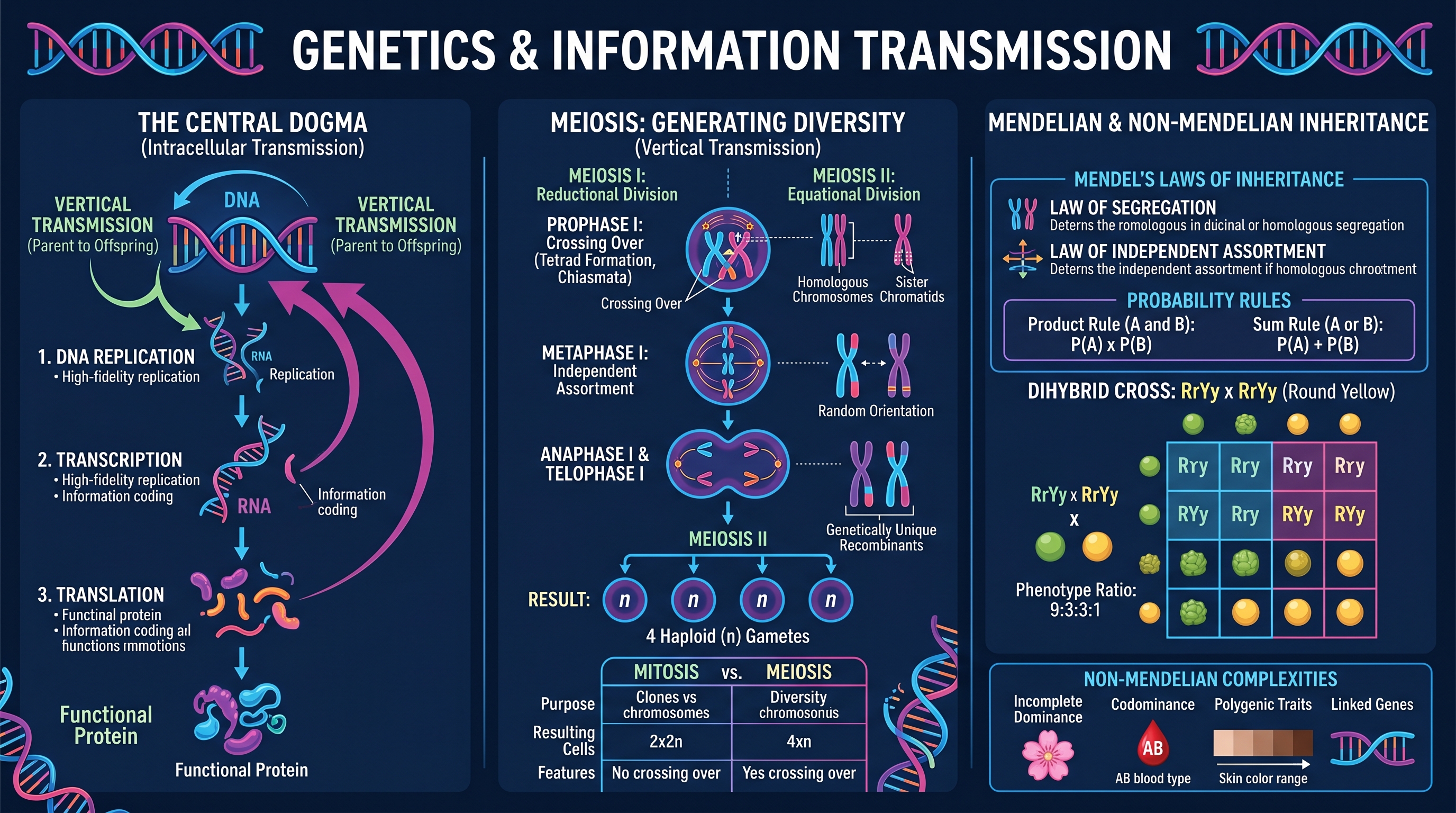
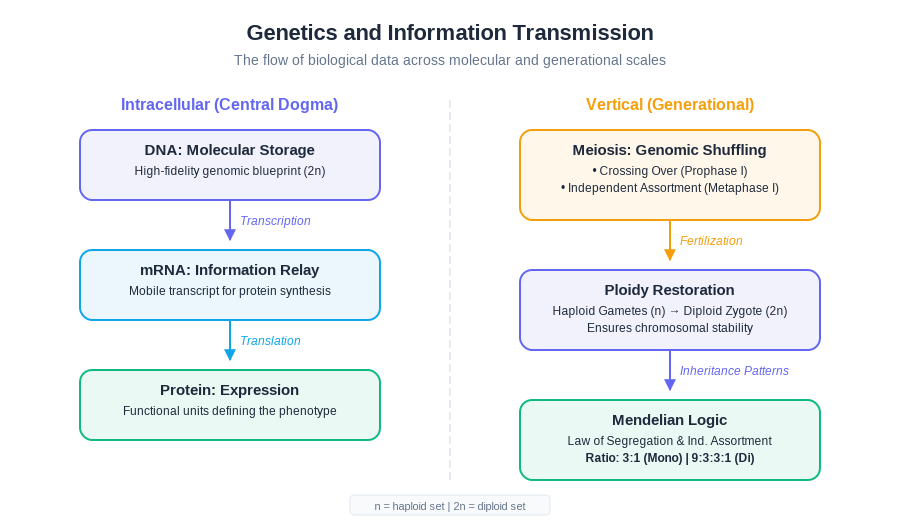
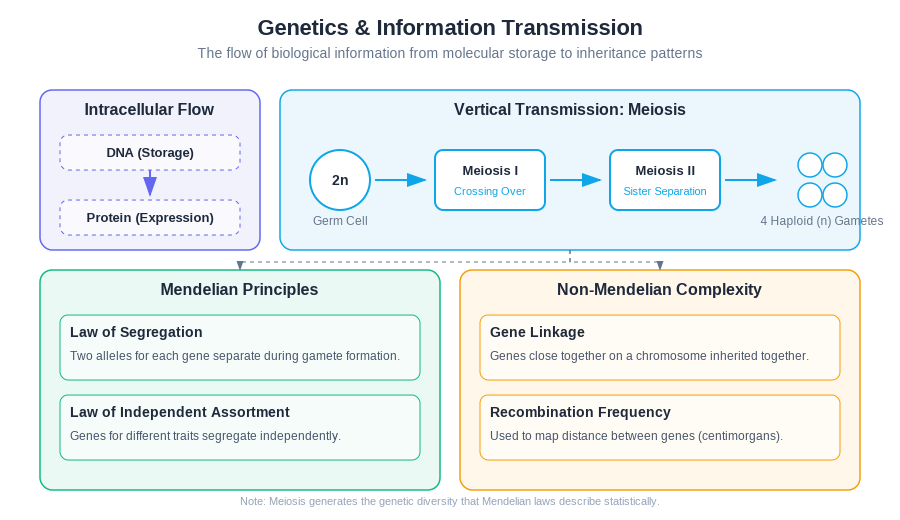
Biological systems are defined by their ability to store, retrieve, transmit, and respond to information. At the core of this capability lies the genetic code—a high-fidelity, molecular storage system that governs the development, functioning, and reproduction of all known life. Information transmission occurs across two distinct scales: vertical transmission (from parent to offspring via meiosis and fertilization) and intracellular transmission (from DNA to protein via the Central Dogma).
Meiosis: The Engine of Genetic Diversity
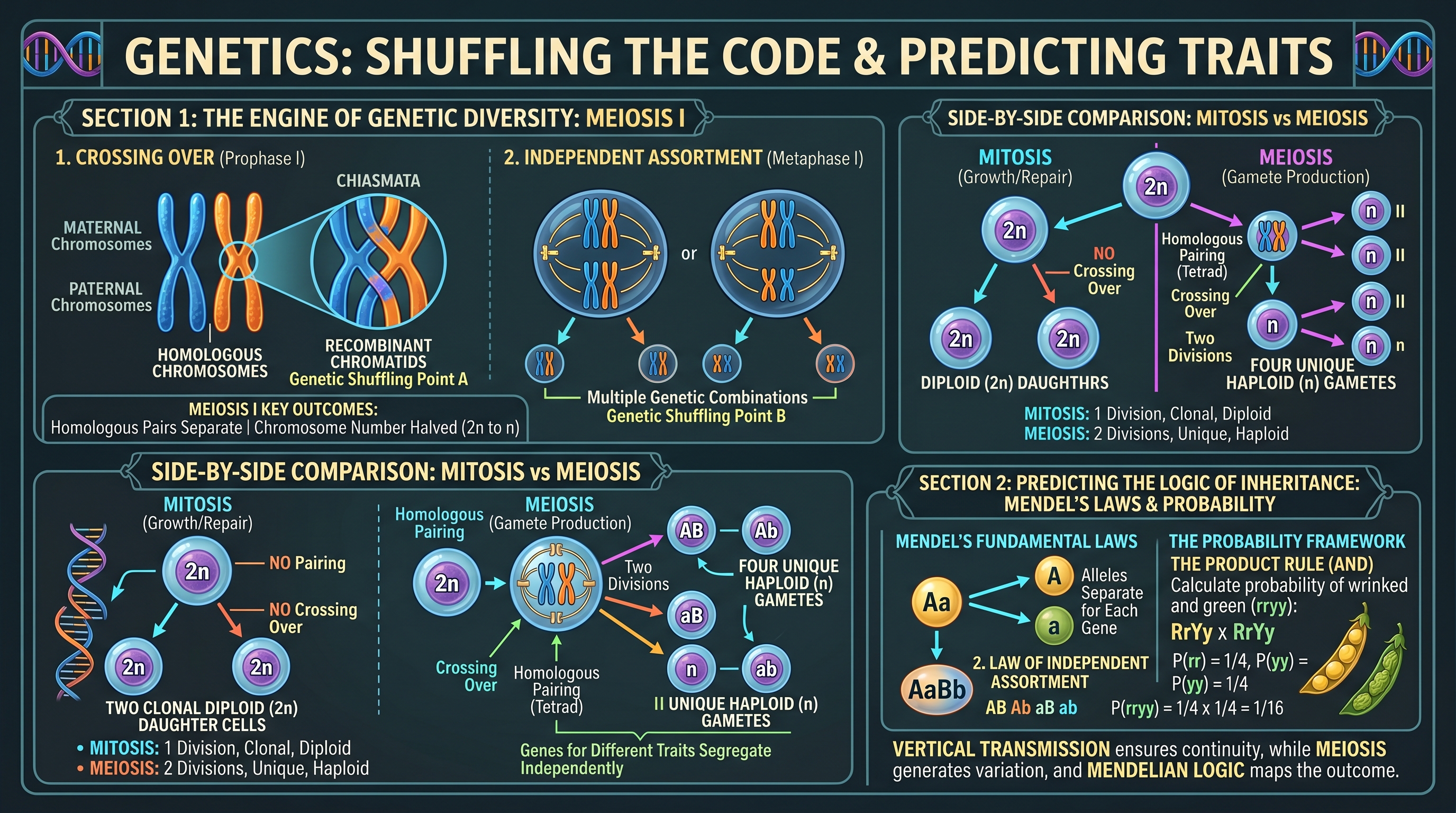
Meiosis is a specialized form of cell division that reduces the chromosome number by half, resulting in the production of four haploid (n) gametes from a single diploid (2n) germ cell. Unlike mitosis, which aims for clonal identity, meiosis is architected to maximize genomic shuffling.
Why it matters
Without meiosis, sexual reproduction would lead to a catastrophic doubling of the genome every generation. Beyond maintaining ploidy stability, meiosis provides the raw material for evolution by generating novel combinations of alleles. This "shuffling" ensures that offspring are genetically distinct from their parents and siblings, increasing the adaptability of a population to changing environments.
How it works: The Two-Stage Reduction
Meiosis is divided into two rounds of division: Meiosis I (the reductional division) and Meiosis II (the equational division).
- Meiosis I: Homologous chromosomes (one from each parent) pair up and then separate.
- Prophase I: The most critical phase. Homologous chromosomes undergo synapsis to form tetrads. Here, crossing over occurs at the chiasmata, where non-sister chromatids exchange DNA segments.
- Metaphase I: Homologous pairs align at the metaphase plate. The orientation is random (Independent Assortment).
- Anaphase I: Homologous chromosomes move to opposite poles, but sister chromatids remain attached.
- Meiosis II: Similar to mitosis, sister chromatids are finally separated into individual gametes.
| Feature | Mitosis | Meiosis |
|---|---|---|
| Purpose | Growth, tissue repair, asexual reproduction | Production of gametes for sexual reproduction |
| Resulting Cells | Two diploid (2n) somatic cells | Four haploid (n) gametes |
| Genetic Composition | Genetically identical to parent | Genetically unique; recombinant |
| Homologous Pairing | No | Yes (Prophase I) |
| Crossing Over | No | Yes |
| Divisions | One | Two |
Common Pitfalls
- Nondisjunction: A failure of chromosomes to separate properly during Anaphase I or II. This leads to aneuploidy (e.g., Trisomy 21).
- Chromatid vs. Chromosome: Students often confuse sister chromatids (identical copies) with homologous chromosomes (similar but non-identical copies from different parents).
Mendelian Genetics: The Logic of Inheritance
Mendelian genetics describes the statistical patterns by which traits are passed from parents to offspring. Gregor Mendel’s work shifted biology from a "blending inheritance" model to a "particulate inheritance" model, where discrete units (genes) retain their identity across generations.
The Fundamental Laws
The Law of Segregation: During gamete formation, the two alleles for each gene separate so that each gamete receives only one allele.
The Law of Independent Assortment: Genes for different traits can segregate independently during the formation of gametes, provided they are on different chromosomes.
Mathematical Framework
Mendelian inheritance is governed by the laws of probability.
- The Product Rule: The probability of two independent events occurring together (A and B) is the product of their individual probabilities: $P(A \cap B) = P(A) \times P(B)$.
- The Sum Rule: The probability of any one of several mutually exclusive events occurring (A or B) is the sum of their individual probabilities: $P(A \cup B) = P(A) + P(B)$.
Concrete Example: The Dihybrid Cross
In a cross between two heterozygous pea plants (RrYy x RrYy), where R is round, r is wrinkled, Y is yellow, and y is green:
- The probability of an offspring being
rris $1/4$. - The probability of an offspring being
yyis $1/4$. - The probability of an offspring being wrinkled and green (
rryy) is $1/4 \times 1/4 = 1/16$.
| Genotype Ratio (Monohybrid) | Phenotype Ratio (Monohybrid) | Dihybrid Phenotype Ratio (Independent) |
|---|---|---|
| 1:2:1 (AA:Aa:aa) | 3:1 (Dominant:Recessive) | 9:3:3:1 |
Non-Mendelian Inheritance: Complexity and Linkage
While Mendel’s laws provide a foundation, many traits do not follow simple dominant/recessive patterns. These complexities arise from gene interactions, chromosomal location, and non-nuclear DNA.
Variations in Dominance and Gene Interaction
- Incomplete Dominance: Neither allele is fully dominant; the heterozygote shows a "blended" phenotype (e.g., Red x White = Pink flowers).
- Codominance: Both alleles are expressed equally in the phenotype (e.g., AB blood type).
- Polygenic Inheritance: Traits controlled by multiple genes, resulting in a continuous phenotypic spectrum (e.g., human skin color or height).
- Epistasis: One gene masks or interferes with the expression of another (e.g., coat color in Labradors).
Gene Linkage and Mapping
Genes located close together on the same chromosome tend to be inherited together, violating the Law of Independent Assortment. The "distance" between linked genes can be calculated using the Recombination Frequency:
$$\text{Recombination Frequency} = \frac{\text{Number of Recombinant Offspring}}{\text{Total Number of Offspring}} \times 100$$
Key Insight: A recombination frequency of 1% is defined as 1 centimorgan (cM) or map unit. If the frequency is 50%, the genes are effectively unlinked (either on different chromosomes or very far apart on the same one).
Sex-Linked and Mitochondrial Inheritance
- Sex-Linked Traits: Genes located on the X or Y chromosomes. X-linked recessive traits (like color blindness) appear more frequently in males because they only possess one X chromosome (hemizygous).
- Non-Nuclear Inheritance: Mitochondria and chloroplasts contain their own DNA. In most animals, mitochondria are inherited exclusively from the mother (maternal inheritance).
DNA Replication: High-Fidelity Information Copying
Before a cell can divide, it must replicate its entire genome. This process is semi-conservative, meaning each new DNA molecule consists of one original strand and one newly synthesized strand.
The Enzymatic Machinery
DNA replication is an asymmetrical process due to the antiparallel nature of DNA (5' to 3' vs. 3' to 5') and the fact that DNA polymerase can only add nucleotides to the 3' end.
| Enzyme | Function |
|---|---|
| Helicase | Unwinds the DNA double helix by breaking hydrogen bonds. |
| Topoisomerase | Relieves torsional strain (supercoiling) ahead of the replication fork. |
| Primase | Synthesizes short RNA primers required to start DNA synthesis. |
| DNA Polymerase III | Main enzyme that adds DNA nucleotides in the 5' $\rightarrow$ 3' direction. |
| DNA Polymerase I | Removes RNA primers and replaces them with DNA. |
| DNA Ligase | Joins Okazaki fragments on the lagging strand. |
Mechanics: Leading vs. Lagging Strands
- Leading Strand: Synthesized continuously toward the replication fork.
- Lagging Strand: Synthesized discontinuously away from the fork in short segments called Okazaki fragments.
Common Pitfall: Directionality
A common error is assuming DNA can be synthesized in the 3' $\rightarrow$ 5' direction. It cannot. The 3' hydroxyl (-OH) group is chemically necessary for the dehydration synthesis reaction that attaches the next nucleotide.
Transcription: Synthesizing the Messenger
Transcription is the process of "reading" a DNA template to produce a complementary RNA strand. This is the first step of gene expression.
The Process
- Initiation: RNA Polymerase binds to a promoter region (e.g., the TATA box in eukaryotes).
- Elongation: RNA Polymerase moves along the template strand (3' $\rightarrow$ 5'), synthesizing mRNA in the 5' $\rightarrow$ 3' direction.
- Termination: The polymerase reaches a terminator sequence and releases the RNA transcript.
Eukaryotic RNA Processing
Unlike prokaryotes, eukaryotic pre-mRNA must be modified before it can leave the nucleus:
- 5' Cap: A modified guanine nucleotide is added to protect the mRNA from degradation and help ribosome attachment.
- Poly-A Tail: A string of adenine nucleotides is added to the 3' end for stability and nuclear export.
- RNA Splicing: Introns (non-coding regions) are removed by spliceosomes, and exons (coding regions) are joined together.
Alternative Splicing: A single gene can code for multiple proteins depending on which exons are included in the final mRNA. This significantly increases the proteomic complexity of eukaryotes.
Translation: The Molecular Assembly Line
Translation is the process where the "digital" information in mRNA is converted into a "physical" chain of amino acids (a polypeptide).
The Genetic Code
The code is read in three-letter "words" called codons.
- Redundant: Multiple codons can code for the same amino acid (e.g., GAA and GAG both code for Glutamate).
- Unambiguous: No codon codes for more than one amino acid.
- Universal: Almost all organisms use the same code, which is strong evidence for common ancestry.
The Mechanism: Ribosomes and tRNA
The ribosome acts as the catalytic site, while tRNA (transfer RNA) molecules act as adapters. Each tRNA has an anticodon that base-pairs with the mRNA codon and carries a specific amino acid.
| Ribosome Site | Function |
|---|---|
| A Site (Aminoacyl) | Holds the tRNA carrying the next amino acid to be added. |
| P Site (Peptidyl) | Holds the tRNA carrying the growing polypeptide chain. |
| E Site (Exit) | Where discharged tRNAs leave the ribosome. |
Steps of Translation
- Initiation: The small ribosomal subunit binds to the mRNA; the initiator tRNA (carrying Methionine) binds to the Start Codon (AUG).
- Elongation: tRNAs enter the A site, a peptide bond forms between amino acids, and the ribosome translocates forward.
- Termination: A Stop Codon (UAA, UAG, or UGA) enters the A site. A release factor breaks the bond, and the polypeptide is freed.
Summary of Information Flow
The "Central Dogma" describes the unidirectional flow of information: DNA $\rightarrow$ RNA $\rightarrow$ Protein
However, exceptions exist, such as Reverse Transcription in retroviruses (RNA $\rightarrow$ DNA), which uses the enzyme reverse transcriptase to integrate viral logic into a host genome.
Statistical Analysis in Genetics: Chi-Square ($\chi^2$)
To determine if observed inheritance patterns deviate significantly from Mendelian expectations, biologists use the Chi-Square test:
$$\chi^2 = \sum \frac{(o - e)^2}{e}$$
Where:
- $o$ = observed frequency
- $e$ = expected frequency (based on Mendelian ratios)
If the calculated $\chi^2$ value is greater than the critical value (based on degrees of freedom, $df = n - 1$), we reject the null hypothesis that the data follows Mendelian inheritance, suggesting linkage or other factors are at play.
Source Materials
Study Advanced Principles of Biological Systems and Inquiry on Lykke
This course page is free to open: signed out, you can read its first two sections, and signing in, on any plan, opens the rest. The free Lykke Chrome extension syncs your own Canvas courses, so ChatGPT, Claude and Muse can answer from your classes and deadlines. It only reads Canvas.
Add the free extensionSign in to open every sectionAll sections of Advanced Principles of Biological Systems and Inquiry · Browse more course pages