From the free course Advanced Principles of Biological Systems and Inquiry on Lykke
Cellular Energetics and Communication
Key concepts: Enzyme Catalysis · Photosynthesis · Cellular Respiration · Signal Transduction · Cell Cycle · Mitosis
Focuses on how cells capture energy and communicate with one another (Units 3 and 4).
Cellular Energetics and Communication
Life is an emergent property of complex molecular interactions governed by the laws of thermodynamics and the necessity of information flow. At the cellular level, this manifests as two primary pillars: Energetics—the capture, storage, and utilization of free energy—and Communication—the sensing and processing of internal and external stimuli to coordinate biological activity.
In this deep dive, we explore the mechanisms that allow biological systems to resist entropy through enzyme-mediated catalysis, the bioenergetic pathways of photosynthesis and respiration, and the sophisticated signaling networks that regulate the cell cycle and mitosis.
Enzyme Catalysis
What it is
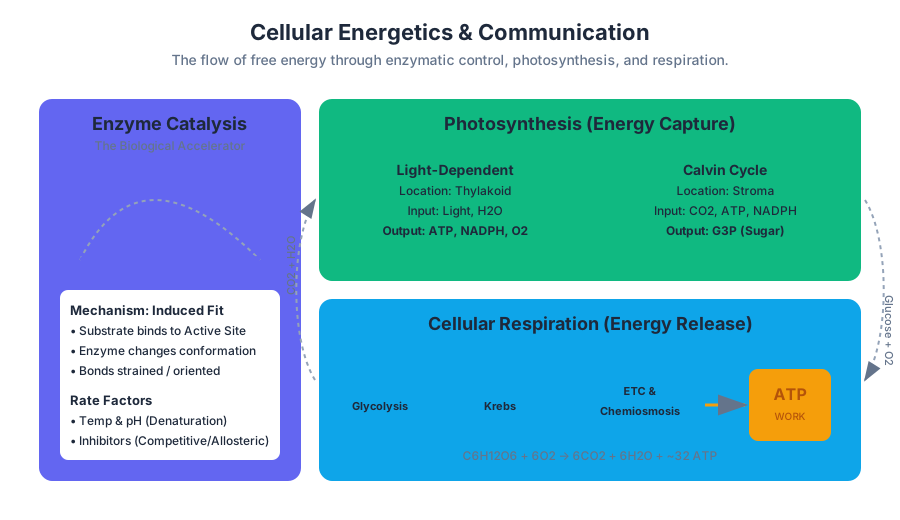
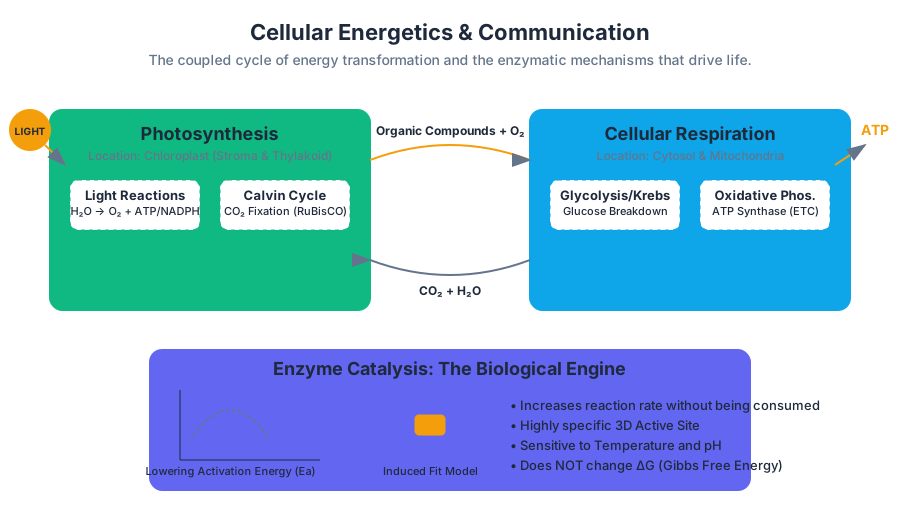
Enzymes are biological catalysts, typically proteins (though some are RNA-based ribozymes), that increase the rate of chemical reactions without being consumed in the process. They function by lowering the Activation Energy ($E_a$), the initial investment of energy required to reach the transition state of a reaction.
Why it matters
Most biological reactions are thermodynamically favorable ($\Delta G < 0$) but kinetically "locked" because the ambient thermal energy is insufficient to break existing chemical bonds. Without enzymes, the metabolic processes required for life would occur at rates too slow to sustain even the simplest organism.
How it works: The Mechanism of Action
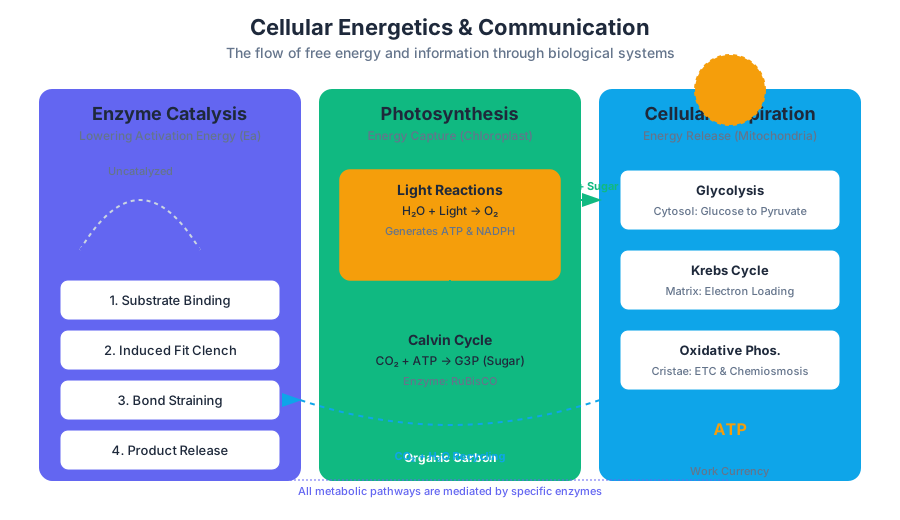
Enzymes operate via the Induced Fit Model. The enzyme possesses an Active Site, a specific 3D cleft formed by the folding of the polypeptide chain.
- Substrate Binding: The substrate binds to the active site via weak interactions (hydrogen bonds, ionic bonds).
- Induced Fit: The enzyme undergoes a conformational change to "clench" the substrate, orienting it optimally for the reaction.
- Catalysis: The enzyme lowers $E_a$ through several strategies:
- Orienting substrates correctly.
- Straining substrate bonds.
- Providing a favorable microenvironment (e.g., acidic or basic residues).
- Covalent participation (briefly forming a bond with the substrate).
- Product Release: The products have a lower affinity for the active site and are released, returning the enzyme to its original state.
Factors Influencing Catalytic Rate
The efficiency of an enzyme is highly sensitive to its environment.
| Parameter | Impact on Rate | Mechanism |
|---|---|---|
| Temperature | Increases to a point, then crashes | Increased kinetic energy boosts collisions; excessive heat causes denaturation (unfolding). |
| pH | Bell-shaped curve | H+ or OH- ions disrupt ionic bonds and H-bonds, altering the enzyme's 3D shape. |
| Substrate Conc. | Hyperbolic increase | Rate increases until saturation (all active sites are occupied). |
| Inhibitors | Decrease rate | Competitive inhibitors block the active site; non-competitive inhibitors bind elsewhere (allosteric site). |
Common Pitfalls
Crucial Insight: A common misconception is that enzymes change the $\Delta G$ (Gibbs Free Energy) of a reaction. They do not. An enzyme cannot make an endergonic reaction ($\Delta G > 0$) occur spontaneously; it only accelerates reactions that are already thermodynamically possible.
Photosynthesis
What it is
Photosynthesis is the process by which autotrophic organisms convert light energy into chemical energy stored in the bonds of sugars. It is the primary entry point of energy into the biosphere.
Why it matters
Photosynthesis provides the molecular building blocks (carbon skeletons) and the energy source for nearly all life on Earth. Furthermore, the byproduct—molecular oxygen ($O_2$)—is essential for aerobic respiration.
How it works: The Two-Stage Process
Photosynthesis occurs in the chloroplast and is divided into the Light-Dependent Reactions and the Light-Independent Reactions (Calvin Cycle).
The Net Equation:
6CO_2 + 6H_2O + \text{light energy} \rightarrow C_6H_{12}O_6 + 6O_2
1. Light-Dependent Reactions (Thylakoid Membrane)
Light energy is captured by Photosystems (PS II and PS I).
- Photolysis: Water is split ($H_2O \rightarrow 2H^+ + 2e^- + \frac{1}{2}O_2$), providing electrons to replace those lost by PS II.
- Electron Transport Chain (ETC): Electrons move through a series of proteins, pumping $H^+$ into the thylakoid lumen, creating a Proton Motive Force.
- Chemiosmosis: $H^+$ flows back through ATP Synthase, generating ATP.
- Reduction: Electrons are finally transferred to $NADP^+$ to form $NADPH$.
2. The Calvin Cycle (Stroma)
The Calvin Cycle uses the ATP and NADPH from the light reactions to fix carbon.
- Carbon Fixation: $CO_2$ is attached to RuBP by the enzyme RuBisCO.
- Reduction: ATP and NADPH are used to convert the fixed carbon into G3P (Glyceraldehyde-3-phosphate).
- Regeneration: Some G3P is used to rebuild RuBP, while the rest exits to form glucose.
| Feature | Light-Dependent Reactions | Calvin Cycle |
|---|---|---|
| Location | Thylakoid Membrane | Stroma |
| Input | Light, $H_2O$, $ADP$, $NADP^+$ | $CO_2$, $ATP$, $NADPH$ |
| Output | $O_2$, $ATP$, $NADPH$ | $G3P$ (Sugar), $ADP$, $NADP^+$ |
| Primary Enzyme | ATP Synthase | RuBisCO |
Cellular Respiration
What it is
Cellular Respiration is the catabolic pathway of aerobic and anaerobic systems that breaks down organic molecules (primarily glucose) to produce Adenosine Triphosphate (ATP), the universal energy currency of the cell.
Why it matters
ATP is required for mechanical work (muscle contraction), transport work (pumping ions), and chemical work (synthesizing polymers). Respiration is the mechanism by which cells extract the energy stored in the "high-energy" C-H bonds of glucose.
How it works: The Metabolic Pipeline
Aerobic respiration occurs in four distinct stages:
- Glycolysis (Cytosol):
- Glucose (6C) is broken into two Pyruvate (3C) molecules.
- Net yield: $2 ATP$ (via substrate-level phosphorylation) and $2 NADH$.
- Pyruvate Oxidation (Mitochondrial Matrix):
- Pyruvate is converted to Acetyl-CoA.
- Releases $CO_2$ and generates $NADH$.
- Krebs Cycle / Citric Acid Cycle (Matrix):
- Acetyl-CoA is fully oxidized to $CO_2$.
- Yields $2 ATP$, $6 NADH$, and $2 FADH_2$ per glucose.
- Oxidative Phosphorylation (Inner Membrane):
- ETC: $NADH$ and $FADH_2$ donate electrons to the chain. As electrons drop in energy, $H^+$ ions are pumped into the intermembrane space.
- Chemiosmosis: The $H^+$ gradient drives ATP Synthase.
- Final Electron Acceptor: Oxygen ($O_2$) accepts electrons and $H^+$ to form $H_2O$.
Worked Example: The ATP Accounting
Calculating the theoretical maximum yield of ATP from one molecule of glucose:
- Glycolysis: 2 ATP
- Krebs Cycle: 2 ATP
- Oxidative Phosphorylation:
- 10 NADH $\times$ ~2.5 ATP/NADH = 25 ATP
- 2 FADH2 $\times$ ~1.5 ATP/FADH2 = 3 ATP
- Total: ~30–32 ATP
Note: The actual yield is often lower due to the cost of transporting pyruvate into the mitochondria and the use of the proton gradient for other purposes.
Variations: Anaerobic Respiration and Fermentation
In the absence of oxygen, the ETC stalls. To keep glycolysis running, cells must regenerate $NAD^+$.
- Lactic Acid Fermentation: Pyruvate is reduced to Lactate (occurs in muscle cells).
- Alcohol Fermentation: Pyruvate is converted to Ethanol and $CO_2$ (occurs in yeast).
Cell Communication and Signal Transduction
What it is
Signal Transduction is the process by which a chemical or physical signal is transmitted through a cell as a series of molecular events, most commonly protein phosphorylation, which ultimately results in a cellular response.
Why it matters
Multicellularity requires coordination. Cells must "know" when to grow, when to die (apoptosis), and how to respond to environmental changes (e.g., glucose levels in the blood).
How it works: The Three Stages
- Reception: A signaling molecule (Ligand) binds to a specific Receptor (e.g., G-Protein Coupled Receptors or Receptor Tyrosine Kinases). The ligand does not usually enter the cell.
- Transduction: The signal is converted into a form that can bring about a response. This often involves:
- Phosphorylation Cascades: Enzymes called Kinases add phosphate groups to proteins to activate them.
- Second Messengers: Small, non-protein molecules like cAMP or $Ca^{2+}$ that spread rapidly through the cytosol.
- Response: The final activity, such as turning on a gene (transcription), opening an ion channel, or activating an enzyme.
Signal Amplification
One of the most critical aspects of transduction is amplification. A single ligand binding to a receptor can trigger the activation of dozens of G-proteins, which each activate an adenylyl cyclase, which each produce hundreds of cAMP molecules, leading to the activation of thousands of target proteins.
| Component | Role | Example |
|---|---|---|
| Ligand | Primary Messenger | Epinephrine, Insulin |
| Receptor | Signal Detector | GPCR, Ion Channel |
| Kinase | Signal Propagator | Protein Kinase A (PKA) |
| Phosphatase | Signal Terminator | Protein Phosphatase 1 |
| Second Messenger | Intracellular Relay | cAMP, $IP_3$, $Ca^{2+}$ |
Common Pitfalls
- Receptor Specificity: Students often assume any ligand can bind to any receptor. In reality, binding is highly specific based on the molecular geometry and charge of the active site.
- Signal Termination: Forgetting that signals must be turned off. Without phosphatases or the hydrolysis of GTP, the cell would remain in a permanent state of "on," which is a hallmark of many cancers.
The Cell Cycle and Mitosis
What it is
The Cell Cycle is an ordered series of events involving cell growth and nuclear division that produces two identical daughter cells. Mitosis is the specific phase of nuclear division.
Why it matters
The cell cycle is fundamental for growth, tissue repair, and asexual reproduction. Precise regulation is mandatory; failure to control the cycle leads to uncontrolled cell proliferation—Cancer.
How it works: Phases of the Cycle
- Interphase (90% of the cycle):
- $G_1$ (Gap 1): Cell growth and metabolic activity.
- $S$ (Synthesis): DNA replication occurs. The chromosome number stays the same, but each chromosome now consists of two sister chromatids.
- $G_2$ (Gap 2): Final preparations for division; organelle duplication.
- M Phase (Mitotic Phase):
- Mitosis: Division of the nucleus.
- Cytokinesis: Division of the cytoplasm.
The Mechanics of Mitosis
Mitosis is a continuous process divided into five sub-phases:
| Phase | Key Events |
|---|---|
| Prophase | Chromatin condenses into visible chromosomes; spindle fibers emerge from centrosomes. |
| Prometaphase | Nuclear envelope breaks down; microtubules attach to kinetochores. |
| Metaphase | Chromosomes align at the metaphase plate (equator). |
| Anaphase | Sister chromatids are pulled apart toward opposite poles. |
| Telophase | Nuclear envelopes reform; chromosomes de-condense. |
Regulation: Checkpoints and Cyclins
The cell cycle is governed by an internal control system.
- Checkpoints: Critical points ($G_1, G_2, M$) where "stop" and "go-ahead" signals regulate the cycle. The $G_1$ checkpoint (the "Restriction Point") is the most important; if a cell passes $G_1$, it usually completes the entire cycle.
- Cyclins and CDKs: Cyclins are proteins whose concentration fluctuates. They bind to Cyclin-Dependent Kinases (CDKs). The resulting complex (e.g., MPF - Maturation Promoting Factor) triggers the transition into the next phase.
Common Pitfalls
- Chromosome vs. Chromatid: A chromosome is a single DNA molecule. After the S phase, it consists of two sister chromatids, but it is still considered one chromosome until the chromatids separate during anaphase.
- Centromere vs. Centrosome: The centromere is the region of the chromosome where sister chromatids join; the centrosome is the microtubule-organizing center at the poles of the cell.
Source Materials
Study Advanced Principles of Biological Systems and Inquiry on Lykke
This course page is free to open: signed out, you can read its first two sections, and signing in, on any plan, opens the rest. The free Lykke Chrome extension syncs your own Canvas courses, so ChatGPT, Claude and Muse can answer from your classes and deadlines. It only reads Canvas.
Add the free extensionSign in to open every sectionAll sections of Advanced Principles of Biological Systems and Inquiry · Browse more course pages