From the free course TPW: Technical & Professional Writing on Lykke
Ethics and Legal Obligations
Key concepts: Ethical Responsibility · Plagiarism and Intellectual Property · Misrepresentation of Data · Persuasive Manipulation
Covers the ethical responsibilities of technical writers, including honesty, data integrity, and intellectual property.
Ethics and Legal Obligations
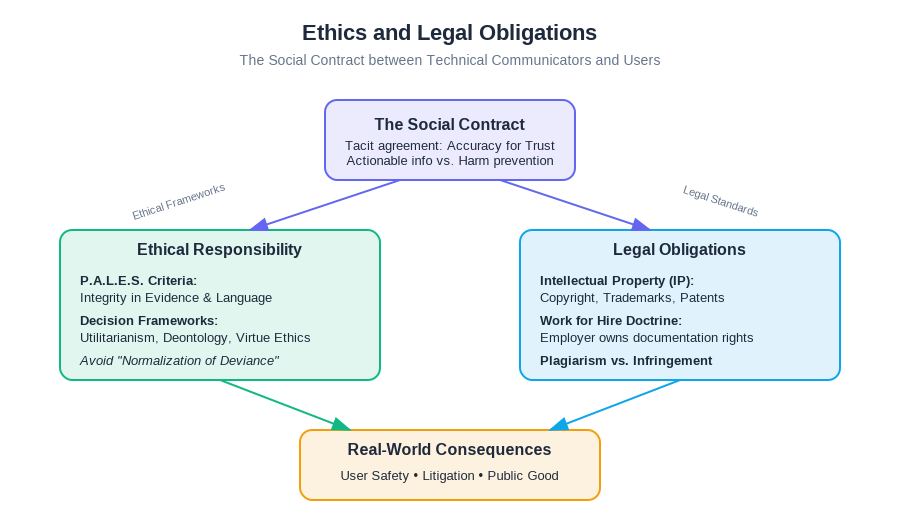
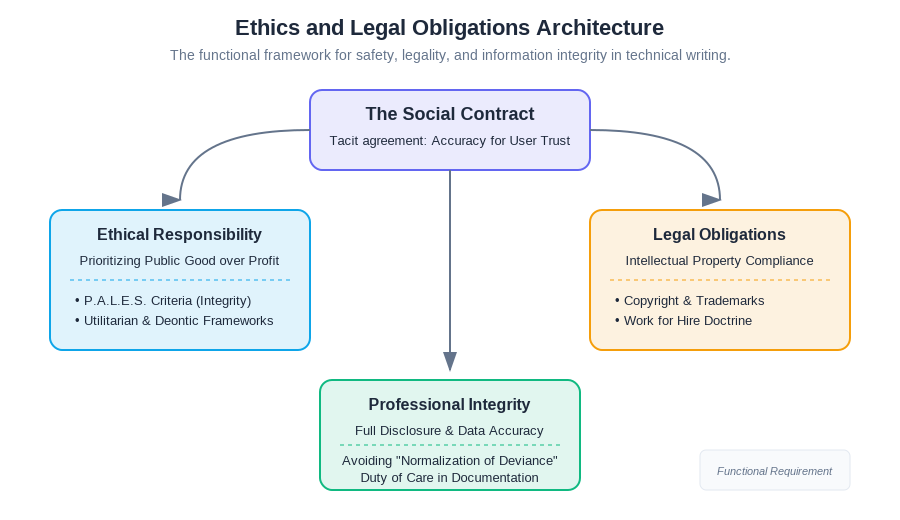
In the realm of technical and professional writing, ethics is not merely a philosophical abstraction; it is a functional requirement for the safety, legality, and efficacy of information systems. While academic writing often focuses on the pursuit of truth or the expression of an argument, technical communication operates within a Social Contract between the creator and the user. The user relies on the documentation to operate machinery, administer medicine, or manage financial assets. Consequently, any breach in ethical standards—whether through omission, obfuscation, or outright deception—carries real-world consequences ranging from litigation to the loss of human life.
Ethical Responsibility: The Professional Ethos
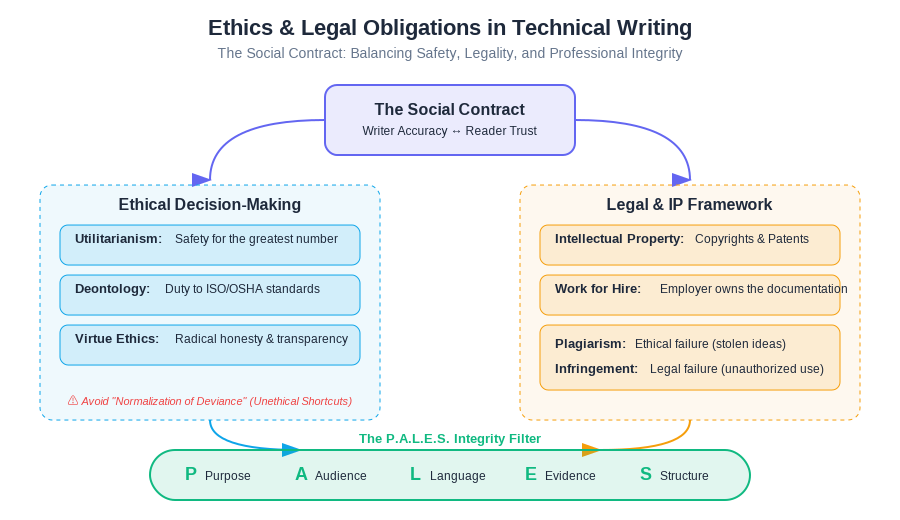
Ethical Responsibility in technical communication is defined as the obligation to prioritize the user's safety and the public good over organizational convenience or profit motives. This concept is rooted in the P.A.L.E.S. Criteria (Purpose, Audience, Language, Evidence, and Structure), where the "Evidence" and "Language" components must be handled with extreme integrity.
The Mechanics of Ethical Decision-Making
Technical writers often face the "Normalization of Deviance"—a term coined by sociologist Diane Vaughan—where small, unethical shortcuts become standard practice until a catastrophe occurs. To combat this, professionals use structured ethical frameworks to evaluate their work.
Definition: The Social Contract of Technical Writing A tacit agreement where the writer provides accurate, accessible, and actionable information, and the reader provides their trust and time, assuming that following the instructions will not result in harm.
| Framework | Core Principle | Application in Technical Writing |
|---|---|---|
| Utilitarianism | The greatest good for the greatest number. | Prioritizing clear safety warnings that protect the majority of users. |
| Deontology | Duty-based ethics; follow the rules regardless of outcome. | Adhering strictly to ISO or OSHA documentation standards. |
| Virtue Ethics | Focus on the character of the writer. | Cultivating a reputation for honesty and "radical transparency" in reporting. |
| Contractarianism | Ethics based on social agreements. | Fulfilling the specific requirements of a Service Level Agreement (SLA). |
Worked Example: The "Silence as Deception" Case
Consider a software engineer writing documentation for a new API. They discover a race condition that occurs in 0.1% of cases. The marketing department asks them to omit this from the "Known Issues" section to ensure a "clean launch."
Ethical Analysis:
- Exigence: The need for a stable launch.
- Audience: Developers who will build critical infrastructure on this API.
- Outcome: If the 0.1% failure occurs in a medical device, the omission is a violation of the "Duty of Care."
- Action: The writer must include the race condition and provide a "Workaround" block, fulfilling the ethical obligation of Full Disclosure.
Plagiarism and Intellectual Property
In a professional context, Intellectual Property (IP) refers to creations of the mind—inventions, literary and artistic works, designs, and symbols—used in commerce. For the technical writer, IP is a legal minefield involving Copyright, Trademarks, and Patents.
Plagiarism vs. Copyright Infringement
While often used interchangeably, they are distinct:
- Plagiarism is an ethical failure: claiming someone else's ideas or words as your own.
- Copyright Infringement is a legal failure: using someone else's protected work without permission, regardless of whether you give them credit.
The "Work for Hire" Doctrine
Under the U.S. Copyright Act, if a professional writer creates a document as part of their employment, the employer is considered the legal author. This is the Work for Hire doctrine. The writer cannot take that documentation to a new company without violating IP laws.
Misrepresentation of Data
Data Integrity is the cornerstone of technical communication. Misrepresentation occurs when a writer manipulates data—either through visual distortion or statistical cherry-picking—to lead the reader to a false conclusion.
The "Lie Factor" in Visuals
Edward Tufte, a pioneer in data visualization, defined the Lie Factor as a way to quantify how much a graphic misrepresents the underlying numbers.
The Lie Factor Formula $$LF = \frac{\text{Size of effect shown in graphic}}{\text{Size of effect in data}}$$
- If $LF = 1$, the graphic is accurate.
- If $LF > 1.05$ or $LF < 0.95$, the graphic is considered misleading.
Common Data Fallacies in Technical Reports
| Fallacy | Description | Impact |
|---|---|---|
| Truncated Y-Axis | Starting the vertical axis at a non-zero value. | Exaggerates small differences between data points. |
| Cherry-Picking | Selecting only data that supports a specific claim. | Hides systemic failures or negative trends. |
| Correlation as Causation | Implying a causal link because two variables move together. | Leads to incorrect engineering or policy decisions. |
| The "Omitted Variable" | Failing to mention a factor that significantly impacts the data. | Provides an incomplete and dangerous picture of reality. |
Mathematical Derivation of Skewness via Omission
If a writer omits "outliers" (e.g., system crashes) from a performance report to show a better "average" uptime, they are manipulating the Mean ($\mu$) and Standard Deviation ($\sigma$).
Let $X$ be the set of all data points. If the writer removes the subset $O$ (outliers), the new mean $\mu'$ is: $$\mu' = \frac{\sum X - \sum O}{N - |O|}$$
If $\sum O$ contains values significantly lower than $\mu$ (crashes), then $\mu' > \mu$, creating a false impression of higher performance. This is a direct violation of the Ethical Responsibility to provide accurate evidence.
Persuasive Manipulation
Technical writing is inherently persuasive—it seeks to persuade the reader to follow a process or adopt a solution. However, there is a sharp line between Persuasion (using logic and evidence to guide a user) and Manipulation (using psychological triggers to deceive or coerce).
Dark Patterns in Documentation and UI
In modern technical communication, manipulation often takes the form of Dark Patterns. These are user interface designs or instructional flows intended to trick users into doing something they didn't intend to do (e.g., signing up for a recurring subscription while trying to download a manual).
Rhetorical Analysis of Manipulative Language
Technical writers must avoid "weasel words" and "loaded language" that obscure the truth.
| Manipulative Technique | Example | Ethical Alternative |
|---|---|---|
| Passive Voice Obfuscation | "Mistakes were made in the calculation." | "The engineering team used an incorrect variable in the calculation." |
| Euphemisms | "Rapid unscheduled disassembly" | "The rocket exploded." |
| False Urgency | "Update now or your data is at risk!" (when it isn't). | "This update contains security patches for known vulnerabilities." |
| The "Wall of Text" | Hiding a critical warning inside a 50-page EULA. | Using a DANGER or WARNING callout box. |
Legal Obligations and Liability
Beyond ethics, technical writers operate under specific legal frameworks. Failure to adhere to these can result in Professional Negligence or Strict Liability.
- Failure to Warn: If a product is dangerous and the manual does not provide a clear, prominent warning, the manufacturer (and by extension, the writer) can be held liable for damages.
- Breach of Warranty: If the documentation claims a product can perform a specific task and it fails, the documentation serves as a legal "Express Warranty."
- Accessibility (Section 508): In many jurisdictions, technical documentation for government or public use must be accessible to people with disabilities (e.g., providing Alt-text for images, screen-reader compatibility).
The "Clear and Conspicuous" Standard
Courts often use the "Clear and Conspicuous" standard to judge warnings. A warning is not legally sufficient if it is:
- Printed in a tiny font.
- Placed in an illogical location.
- Written in overly technical jargon that the target audience cannot understand.
Summary of Ethical and Legal Integration
The professional writer must act as a bridge between the technical reality of a product and the human reality of the user. This requires a constant balancing act:
- Accuracy vs. Simplicity
- Company Loyalty vs. User Safety
- Persuasion vs. Transparency
By adhering to the principles of intellectual property, data integrity, and ethical language, the technical communicator ensures that their work is not only useful but also honorable.
Source Materials
Study TPW: Technical & Professional Writing on Lykke
This course page is free to open: signed out, you can read its first two sections, and signing in, on any plan, opens the rest. The free Lykke Chrome extension syncs your own Canvas courses, so ChatGPT, Claude and Muse can answer from your classes and deadlines. It only reads Canvas.
Add the free extensionSign in to open every sectionAll sections of TPW: Technical & Professional Writing · Browse more course pages