From the free course TPW: Technical & Professional Writing on Lykke
The Rhetorical Situation: Purpose and Audience
Key concepts: Rhetorical Situation · Exigence · General vs. Specific Purpose · Communicating vs. Convincing
Introduces the framework for analyzing the interplay between writer, audience, purpose, and context.
The Rhetorical Situation: Purpose and Audience
In the field of technical and professional writing (TPW), a document never exists in a vacuum. Every piece of communication—from a high-level architectural decision record (ADR) to a simple "Reset Password" email—is born from a specific set of circumstances known as the Rhetorical Situation.
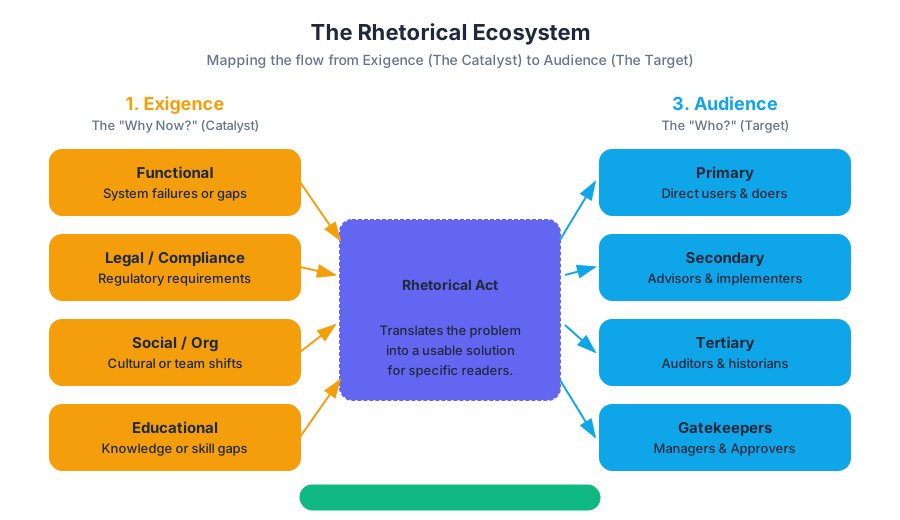
The rhetorical situation is the ecosystem in which a message is created, transmitted, and received. It is the fundamental framework that dictates the "shape" of the content. Without a rigorous analysis of this situation, a writer risks producing "noise" rather than "signal." In technical domains, where the cost of misunderstanding can range from minor user frustration to catastrophic system failure, mastering the rhetorical situation is not a soft skill; it is a core engineering requirement.
The Genesis of Communication: Exigence
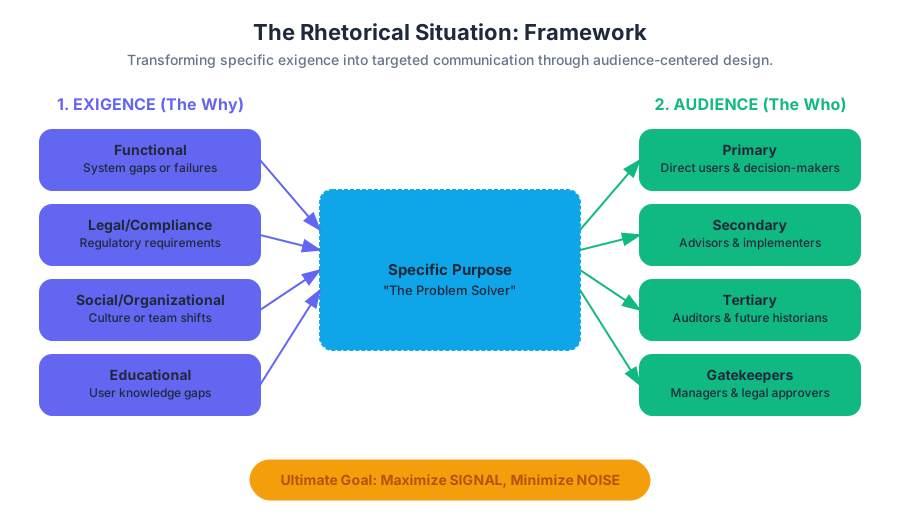
The first component of any rhetorical situation is Exigence. Coined by rhetorical theorist Lloyd Bitzer, exigence is defined as "an imperfection marked by urgency; it is a defect, an obstacle, something waiting to be done, a thing which is other than it should be."
In technical writing, exigence is the "Why now?" of a document. It is the catalyst that transforms a silent state into a communicative act. If there is no exigence, there is no need for the document.
Categorizing Exigence
Exigence can be broadly categorized into two types: Natural and Rhetorical. A natural exigence (like a hurricane) cannot be modified by talk. A rhetorical exigence is one that can be positively modified through the intervention of a message.
| Exigence Type | Source | Example in Technical Context | Resolution Strategy |
|---|---|---|---|
| Functional | System failure or gap | A critical API endpoint is deprecated. | Update documentation and issue a migration guide. |
| Legal/Compliance | Regulatory requirements | GDPR or CCPA mandates new data handling disclosures. | Draft a Privacy Impact Assessment or updated Terms of Service. |
| Social/Organizational | Cultural or team shifts | A team is moving from Waterfall to Agile. | Create a "Ways of Working" handbook or Wiki. |
| Educational | Knowledge gap | Users are consistently failing to complete a specific onboarding step. | Design a troubleshooting FAQ or an interactive tutorial. |
The Imperative of "The Problem"
To identify the exigence, the writer must ask: What is the problem that this document is intended to solve? If the writer cannot name the problem, the document will lack focus. For example, the exigence for a README.md file isn't "I need to describe my code"; it is "Users cannot run this software without knowing the dependencies and build commands."
The Target: Audience Analysis
The Audience is the most critical variable in the rhetorical equation. In technical communication, we move away from the "general public" and toward specific personas with varying levels of expertise, interest, and authority.
Definition: Audience-Centered Design A methodology where the writer prioritizes the reader's needs, background, and environment over the writer's own preferences. The goal is to minimize the cognitive load required for the reader to extract and use information.
The Audience Hierarchy
Most technical documents serve multiple audiences simultaneously. We categorize them based on their proximity to the information and their role in the decision-making process.
| Audience Tier | Description | Typical Knowledge Level | Goal |
|---|---|---|---|
| Primary | The direct users or decision-makers. | High (Technical) or Low (End-user) | To perform a task or make a choice. |
| Secondary | Advisors or implementers (e.g., Legal, HR, Finance). | Specialized but non-domain | To verify compliance or feasibility. |
| Tertiary | External observers, auditors, or future historians. | Variable | To ensure long-term record-keeping or safety. |
| Gatekeepers | Managers or editors who must approve the text. | High (Managerial) | To ensure the document meets brand/safety standards. |
Quantifying Audience Knowledge: The Readability Implementation
To objectively assess if a document matches its audience, we often use readability metrics.
The Objective: General vs. Specific Purpose
Every document has a Purpose, but technical writers distinguish between the broad intent and the granular outcome.
General Purpose
The general purpose is the high-level rhetorical mode. In TPW, we rarely "entertain" or "express" ourselves. We primarily:
- Inform: Provide facts and data (e.g., a status report).
- Instruct: Guide a user through a process (e.g., a user manual).
- Persuade: Convince a reader to take a specific action (e.g., a proposal).
Specific Purpose
The specific purpose is a concrete statement of what the document should achieve for both the writer and the reader. It is often written as a "Purpose Statement" at the beginning of a project.
The Purpose Formula: "The purpose of this [Document Type] is to [Action Verb] [Target Audience] so that they can [Result/Outcome]."
Mathematical Representation of Purpose Alignment
We can model the "Purpose Gap" ($\Delta P$) as the difference between the Information Provided ($I_p$) and the Information Required ($I_r$) by the audience to achieve the specific goal.
\Delta P = \int_{t_0}^{t_f} |I_r(t) - I_p(t)| dt
Where:
- $I_r(t)$ is the information the user needs at time $t$ to complete a task.
- $I_p(t)$ is the information provided by the document.
- The goal of the technical writer is to minimize $\Delta P$ such that $\Delta P \to 0$.
Communicating vs. Convincing: The Spectrum of Rhetoric
A common misconception in technical writing is that it is "objective" and therefore non-persuasive. In reality, all communication involves a degree of persuasion.
Communicating (Information Transfer)
The primary goal here is fidelity. The writer acts as a conduit, moving data from a source to a receiver with minimal distortion. This is the "What" and the "How."
Convincing (Persuasion)
The goal here is adherence. The writer must convince the reader that:
- The information is credible (Ethos).
- The logic is sound (Logos).
- The recommended action is urgent (Pathos/Exigence).
Comparison of Informative vs. Persuasive Rhetoric
| Feature | Informative (Communicating) | Persuasive (Convincing) |
|---|---|---|
| Primary Goal | Understanding | Agreement/Action |
| Tone | Neutral, detached | Professional, authoritative |
| Structure | Sequential or hierarchical | Problem-Solution or Comparative |
| Evidence | Raw data, specifications | Benefits, ROI, case studies |
| Example | API Reference Library | Project Proposal for a new API |
Structuring for Audience and Purpose
This ensures that the purpose and audience are explicitly tracked.
The Rhetorical Triangle and Constraints
To synthesize these concepts, we look at the Rhetorical Triangle (Writer, Audience, Message) situated within a Context.
- The Writer (Ethos): What is your relationship to the audience? Are you an expert, a peer, or a subordinate? Your persona dictates the tone.
- The Message (Logos): Is the information accurate, complete, and logically organized?
- The Audience (Pathos): What are their biases, fears, or motivations?
- The Context: This includes the Constraints. Constraints are the "rules of the game"—deadlines, page limits, software requirements, or cultural norms.
Worked Example: The "Server Down" Incident Report
- Exigence: The production server crashed for 4 hours on a Tuesday.
- Audience:
- Primary: The Client (Angry, non-technical).
- Secondary: The Engineering Manager (Needs to know the root cause).
- Purpose: To inform the manager of the technical fix and to persuade the client that the company is still reliable.
- Constraint: Must be delivered within 24 hours of the incident.
Common Pitfalls in Rhetorical Analysis
- The "Expert Blindness" Trap: Writing for yourself rather than the audience. Using jargon that the primary audience doesn't understand.
- Misidentifying Exigence: Writing a 50-page manual when the user just needs a 1-page "Quick Start" guide.
- Vague Purpose: Using "To inform" as a specific purpose. (Correct: "To inform the user how to calibrate the sensor.")
- Ignoring Constraints: Writing a long, beautiful report that is ignored because the manager only reads emails on their phone.
Summary of the Rhetorical Workflow
To implement this in a professional setting, follow this pipeline:
- Identify Exigence: What triggered this? What is the "imperfection"?
- Define Purpose: Draft the "Purpose Formula" statement.
- Profile Audience: Map out primary and secondary readers. Use a table to list their knowledge levels and concerns.
- Assess Constraints: What are the hard limits (time, format, tools)?
- Select Strategy: Based on the above, choose a tone (Communicating vs. Convincing) and a structure.
Source Materials
Study TPW: Technical & Professional Writing on Lykke
This course page is free to open: signed out, you can read its first two sections, and signing in, on any plan, opens the rest. The free Lykke Chrome extension syncs your own Canvas courses, so ChatGPT, Claude and Muse can answer from your classes and deadlines. It only reads Canvas.
Add the free extensionSign in to open every sectionAll sections of TPW: Technical & Professional Writing · Browse more course pages