From the free course TPW: Technical & Professional Writing on Lykke
Professionalism and Workplace Success
Key concepts: Professionalism and Self-Concept · Employer-Desired Skills · Active Listening and Reading · Problem-Solving Activity
Explores how mastering communication skills enhances professional image, self-concept, and overall employability.
Professionalism and Workplace Success
In the modern knowledge economy, professionalism is often mischaracterized as a mere adherence to dress codes or punctuality. In the context of technical and professional writing (TPW), professionalism is more accurately defined as the consistent application of high-level communication standards, ethical responsibility, and the strategic management of one's Self-Concept. It is the bridge between raw technical competence and organizational impact.
Professionalism and Self-Concept
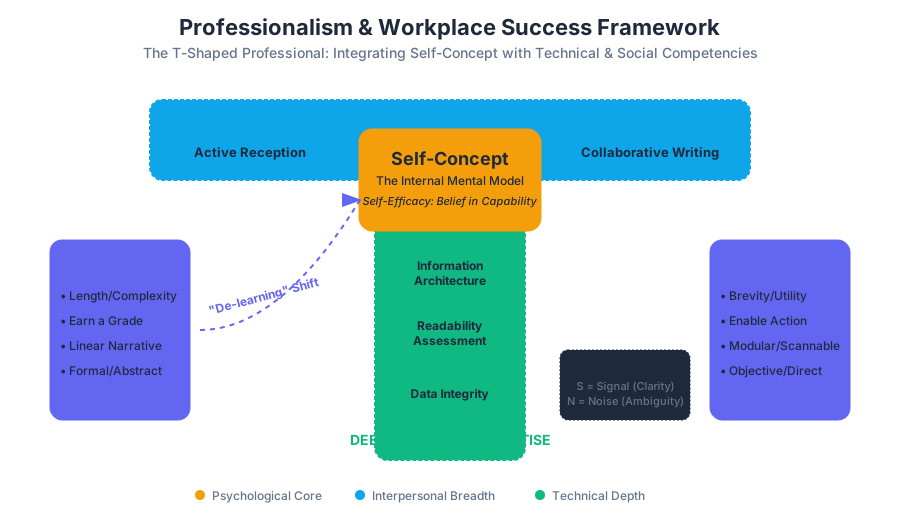
At the core of professional success lies the Self-Concept: the internal mental model an individual holds regarding their own abilities, identity, and value within a professional ecosystem. In technical communication, your self-concept dictates how you approach complex documentation tasks and how you interact with subject matter experts (SMEs).
The Psychology of Professional Identity
A writer’s self-concept is not static; it is a dynamic feedback loop between their perceived competence and the external validation of their work. High Self-Efficacy—a subset of self-concept—is the belief in one’s capability to organize and execute the courses of action required to manage prospective situations.
Definition: Self-Efficacy in TPW The measure of a communicator's belief in their ability to translate high-entropy technical data into low-entropy, actionable information for a specific audience.
The Academic-to-Professional Transition
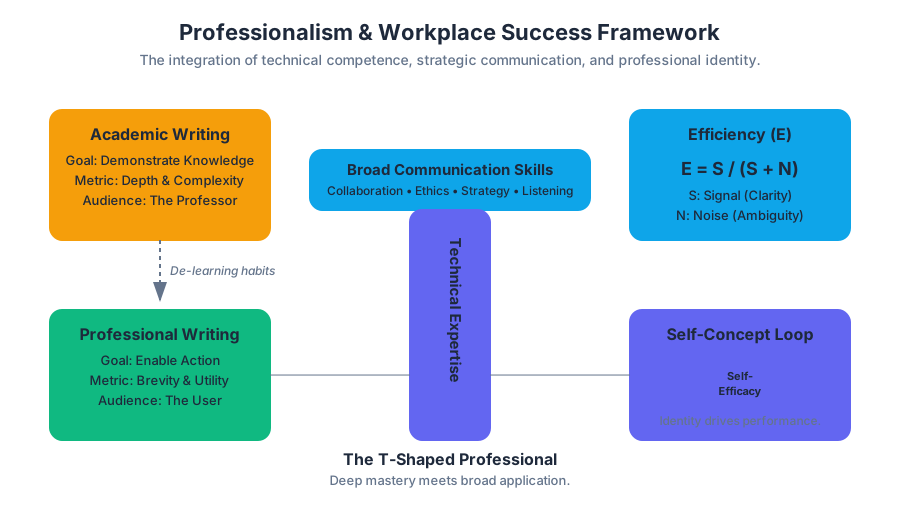
One of the primary challenges in developing a professional self-concept is the "de-learning" of academic habits. Academic writing often rewards length and complexity (to prove the writer's knowledge), whereas professional writing rewards brevity and utility (to respect the reader's time).
| Feature | Academic Writing | Professional/Technical Writing |
|---|---|---|
| Primary Goal | Demonstrate knowledge/earn a grade | Enable action/solve a problem |
| Audience | The Professor (Subject Expert) | The User (Varied expertise) |
| Structure | Linear, narrative-driven | Modular, non-linear, scannable |
| Tone | Formal, often abstract | Objective, concrete, and direct |
| Success Metric | Depth of analysis | Speed of information retrieval |
Employer-Desired Skills: The Competency Matrix
Employers in technical fields do not just hire for "coding" or "engineering" skills; they hire for the ability to integrate those skills into a social and organizational framework. This is often visualized as the T-Shaped Professional, where the vertical bar represents deep technical expertise and the horizontal bar represents broad communication and collaboration skills.
The Hierarchy of Workplace Competencies
To quantify "employability," we can look at the intersection of hard technical skills and "soft" communicative skills. In a 2023 survey of Fortune 500 hiring managers, "Communication Clarity" and "Problem-Solving" consistently outranked specific software proficiencies.
| Skill Category | Specific Competency | Workplace Application |
|---|---|---|
| Cognitive | Critical Thinking | Evaluating the validity of data sources before inclusion in a report. |
| Interpersonal | Collaborative Writing | Using version control (Git) to co-author documentation with engineers. |
| Technical | Information Architecture | Designing a documentation hierarchy that minimizes "click-depth." |
| Ethical | Data Integrity | Ensuring visual representations (charts) do not mislead the audience. |
Active Listening and Reading
Professionalism is as much about reception as it is about production. In a technical environment, the cost of a "misread" or a "misheard" instruction can be measured in lost revenue or compromised safety.
The Mechanics of Active Reception
Active listening and reading involve a conscious effort to perceive not just the words, but the intent and context (the rhetorical situation). This is modeled by the Shannon-Weaver Model of Communication, which accounts for "noise"—anything that interferes with the message.
Mathematical Representation of Information Transfer
We can model the effectiveness of communication ($E$) as a function of the Signal ($S$) and the Noise ($N$):
E = \lim_{N \to 0} \frac{S}{S + N}
Where:
- $S$ = The clarity and relevance of the technical content.
- $N$ = Semantic ambiguity, poor formatting, or psychological bias in the reader.
Strategies for Active Reading (SQ3R)
Professional readers do not read documents like novels. They use the SQ3R method:
- Survey: Scan headings and visuals.
- Question: Turn headings into questions (e.g., "How do I reset the API?").
- Read: Search specifically for the answers to those questions.
- Recite: Summarize the answer in your own words.
- Review: Re-read to confirm accuracy.
| Active Listening Technique | Professional Purpose |
|---|---|
| Paraphrasing | "So, if I understand correctly, the main bottleneck is the SQL query latency?" |
| Non-Verbal Cues | Maintaining eye contact and nodding to signal engagement during a sprint planning. |
| Clarifying Questions | "Could you define what 'high load' means in terms of requests per second?" |
| Summarizing | "To recap, our action items are X, Y, and Z by Friday." |
Problem-Solving Activity
Technical communication is fundamentally a problem-solving activity. A document exists because there is a "gap" between what a user knows and what they need to know to achieve a goal.
The P.A.L.E.S. Criteria for Problem Solving
When approaching a workplace communication task, professionals use the P.A.L.E.S. framework to analyze the problem:
- Purpose: What is the specific "Exigence" (the urgent need) for this document?
- Audience: Who are the stakeholders? What is their "Knowledge Delta"?
- Layout: Which design pattern (Grid, F-Pattern, Z-Pattern) best serves the goal?
- Ethics: Are there legal requirements or safety warnings (e.g., OSHA standards) to consider?
- Style: Does the tone match the organizational culture and the urgency of the task?
Case Study: The "Broken Build" Notification
Imagine a CI/CD pipeline fails. The "problem" is the broken build. The "communication solution" is the notification sent to the engineering team.
Ineffective Communication (Passive): "The build failed. Please check the logs when you have time. It might be the database."
Professional Communication (Problem-Solving Oriented):
"CRITICAL: Build #402 failed on main branch. Error: NullPointerException in AuthService.java:42. Impact: Deployment blocked. Assigned to: @DevTeam."
Configuration as Documentation
In modern DevOps, "Professionalism" includes how we configure our tools to prevent errors. Below is a .vale.ini configuration file. Vale is a "linter for prose" used by professional technical writers to enforce style guides automatically.
Common Pitfalls and Professional Recovery
Even the most seasoned professionals encounter friction. The hallmark of workplace success is not the absence of errors, but the systematic recovery from them.
- The Expert's Blind Spot: Assuming the reader knows as much as the writer.
- Fix: Use "User Personas" to map out the audience's actual skill level.
- Scope Creep: Trying to solve every problem in one document.
- Fix: Use a "Modular Documentation" approach where each page solves exactly one user goal.
- Tone Mismatch: Being too informal in a high-stakes report or too rigid in a collaborative Slack channel.
- Fix: Conduct a "Rhetorical Analysis" of the medium before hitting send.
Conclusion
Professionalism in the workplace is a multifaceted discipline that integrates Self-Concept, Active Reception, and Analytical Problem-Solving. By viewing every document, email, and meeting as a technical challenge to be optimized, you transition from a "writer" to a "strategic communicator." Success is not measured by the number of words produced, but by the efficiency with which those words move an organization toward its goals.
Source Materials
Study TPW: Technical & Professional Writing on Lykke
This course page is free to open: signed out, you can read its first two sections, and signing in, on any plan, opens the rest. The free Lykke Chrome extension syncs your own Canvas courses, so ChatGPT, Claude and Muse can answer from your classes and deadlines. It only reads Canvas.
Add the free extensionSign in to open every sectionAll sections of TPW: Technical & Professional Writing · Browse more course pages