From the free course TPW: Technical & Professional Writing on Lykke
Intercultural Communication and Sensitivity
Key concepts: Ethnocentrism vs. Ethnorelativism · High-context vs. Low-context Cultures · Developmental Model of Intercultural Sensitivity (DMIS) · Gender-neutral and Inclusive Language
Explores how cultural dimensions influence communication and provides guidelines for inclusive, global writing.
Intercultural Communication and Sensitivity
In the contemporary landscape of technical and professional writing (TPW), the "audience" is rarely a monolithic entity residing within a single geographic or linguistic border. As digital infrastructure collapses physical distances, the technical communicator must operate as a cultural mediator. Intercultural communication is the study and practice of how individuals from different cultural backgrounds interact, perceive information, and negotiate meaning. For the technical writer, this is not merely a matter of "politeness" but a critical requirement for usability, safety, and rhetorical effectiveness.
Sensitivity in this context refers to the ability to decode the cultural variables that influence how a document is received. When we ignore these variables, we risk ethnocentrism—the assumption that our own cultural norms are the "correct" or "default" way of communicating. Moving toward ethnorelativism allows a writer to design information that respects the cognitive load and cultural expectations of a global user base.
Ethnocentrism vs. Ethnorelativism
The transition from an ethnocentric mindset to an ethnorelative one is the foundational journey of a professional communicator. These are not binary states but poles on a developmental spectrum.
The Ethnocentric Phase
Ethnocentrism is the tendency to view the world through the lens of one’s own culture, often leading to the belief that one's own group is centrally important and all others are measured in relation to it. In technical writing, this manifests as:
- Using localized metaphors (e.g., "hit a home run" in a software manual).
- Assuming a specific reading direction (Left-to-Right) is universal.
- Defaulting to Western-centric naming conventions (First Name, Last Name) in database schemas.
The Ethnorelative Phase
Ethnorelativism is the acquired ability to see many values and behaviors as cultural rather than universal. An ethnorelative writer understands that "clarity" is a culturally defined concept. For example, while a North American audience might find a direct, "bottom-line-up-front" (BLUF) approach clear, a high-context audience might find it abrasive or even confusing.
| Feature | Ethnocentrism | Ethnorelativism |
|---|---|---|
| Perspective | My culture is the standard. | My culture is one of many equally valid systems. |
| Communication Goal | Efficiency based on local norms. | Effectiveness based on audience norms. |
| Handling Difference | Difference is a problem to be corrected. | Difference is a variable to be integrated. |
| Design Approach | One-size-fits-all. | Localization and culturalization. |
The Developmental Model of Intercultural Sensitivity (DMIS)
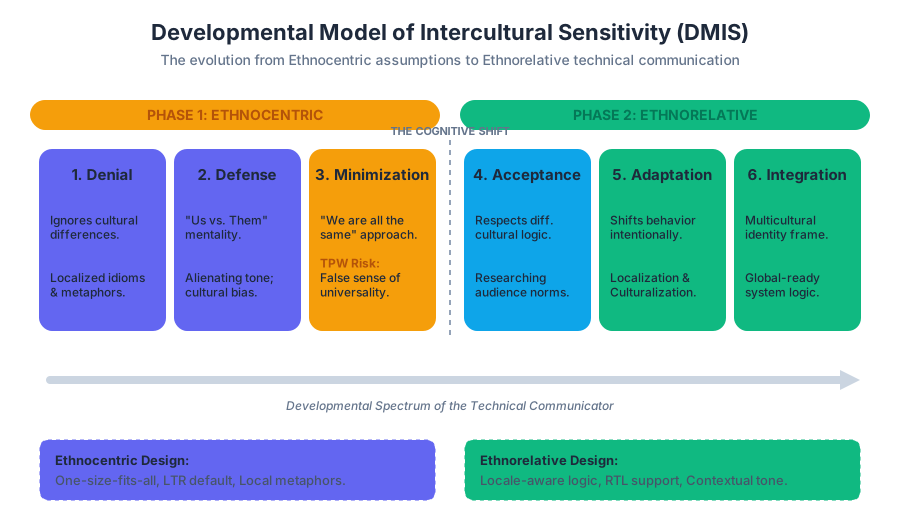
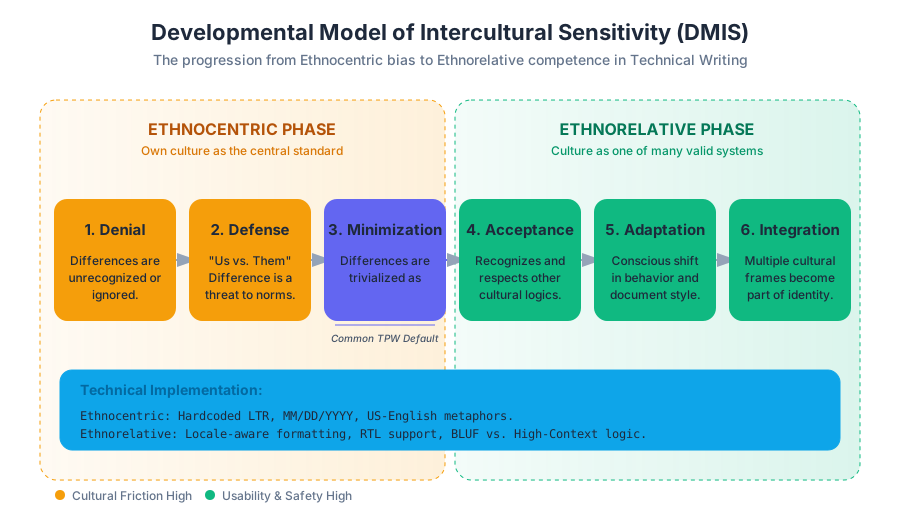
Developed by Milton Bennett, the Developmental Model of Intercultural Sensitivity (DMIS) provides a framework for understanding how people experience and engage with cultural difference. For technical writers, the DMIS serves as a diagnostic tool to assess both their own biases and the potential "cultural friction" of their documents.
The Six Stages of DMIS
The model moves from three "ethnocentric" stages to three "ethnorelative" stages:
- Denial: The individual does not recognize cultural differences or views them in very broad, simplistic terms.
- Defense: Cultural difference is perceived as a threat. The individual may believe their culture is superior ("Us vs. Them").
- Minimization: Differences are acknowledged but trivialized. The focus is on "human universality" (e.g., "Deep down, we're all the same"), which often masks the writer's own cultural dominance.
- Acceptance: The individual recognizes and respects that other cultures have different ways of organizing human existence.
- Adaptation: The individual can consciously shift their perspective and behavior to communicate more effectively in a different cultural context.
- Integration: The individual’s identity includes multiple cultural frames of reference.
Key Insight: Most professional writers operate at the Minimization stage by default. They believe that by using "plain English," they are being universal. However, true intercultural competence requires moving into Adaptation, where the document's structure, tone, and visual cues are modified for the specific target culture.
High-Context vs. Low-Context Cultures
Anthropologist Edward T. Hall introduced the concept of Context to describe how information is exchanged. This is perhaps the most critical concept for technical writers to master, as it dictates the required "density" of a manual or report.
Low-Context Communication
In Low-Context cultures (e.g., Germany, USA, Scandinavia), the mass of the information is vested in the explicit code (the words).
- Characteristics: Directness, transparency, specificity.
- Writing Style: "Say what you mean." Use of imperatives, numbered lists, and explicit transitions.
- Assumption: The reader knows nothing unless it is written on the page.
High-Context Communication
In High-Context cultures (e.g., Japan, China, Arab nations, France), much of the information is either in the physical context or internalized in the person.
- Characteristics: Indirectness, emphasis on relationship, reading "between the lines."
- Writing Style: Nuanced, formal, often prioritizing the "why" or the "who" before the "how."
- Assumption: The reader shares a common understanding; over-explaining can be seen as insulting or patronizing.
| Parameter | Low-Context (Explicit) | High-Context (Implicit) |
|---|---|---|
| Message Focus | Task-oriented | Relationship-oriented |
| Information Flow | Linear, structured | Circular, holistic |
| Role of Silence | Uncomfortable; needs filling | Meaningful; indicates reflection |
| Conflict Resolution | Direct confrontation | Face-saving; indirect |
| Technical Manuals | Step-by-step, exhaustive | Conceptual, visual, contextual |
Mathematical Derivation of Contextual Entropy
We can model the "Context" of a culture as a function of information entropy. In a low-context system, the probability $P$ of understanding a message $M$ depends almost entirely on the signal $S$. In a high-context system, it depends on the signal $S$ plus the shared environmental knowledge $E$.
$$P(M) = f(S, E)$$
In Low-Context: $$\frac{\partial P}{\partial S} \gg \frac{\partial P}{\partial E}$$ (The message is highly sensitive to changes in the text/signal).
In High-Context: $$\frac{\partial P}{\partial S} \approx \frac{\partial P}{\partial E}$$ (The message is equally dependent on the text and the surrounding cultural environment).
Gender-Neutral and Inclusive Language
Inclusive language is the practice of using vocabulary that avoids exclusion or stereotyping. In technical writing, this is not a matter of "political correctness" but of precision. If a user manual says, "The administrator should use his password," it is factually incorrect if the administrator is not male.
Core Principles of Inclusive TPW
- Gender Neutrality: Use "they/them" as a singular pronoun or restructure sentences to avoid gendered pronouns entirely.
- Disability-First vs. Identity-First: Use "person with a disability" (person-first) or "disabled person" (identity-first) based on the community's preference, but generally avoid "handicapped" or "crippled."
- Cultural Sensitivity: Avoid terms with colonial or violent histories (e.g., "master/slave" in database architecture, "whitelist/blacklist").
Transformation Table: Exclusive to Inclusive
| Exclusive/Biased Term | Inclusive Alternative | Reasoning |
|---|---|---|
Man-hours |
Person-hours / Work-hours |
Gender-neutral; focuses on the task. |
Master/Slave |
Primary/Secondary / Main/Replica |
Removes racially charged metaphors. |
Guys (to a group) |
Team / Everyone / Folks |
Avoids gendered assumptions. |
Normal user |
Typical user / Standard user |
"Normal" implies others are "abnormal." |
Sanity check |
Confidence check / Quick check |
Avoids ableist language regarding mental health. |
Automated Linting for Inclusivity
Technical teams often use linters to enforce inclusive language.
Managing Idioms and Metaphors
Idioms are the "landmines" of intercultural communication. An idiom is a phrase where the meaning cannot be derived from the individual words (e.g., "under the weather").
The Problem with Idioms in TPW
Technical writing aims for a 1:1 mapping between signifier and signified. Idioms break this mapping.
- Translation Failure: Machine translation (like Google Translate) often translates idioms literally, resulting in nonsense.
- Cognitive Load: Non-native speakers must spend extra cycles decoding the metaphor rather than the technical instruction.
Worked Example: De-Idiomizing a Technical Memo
- Original: "We need to hit the ground running on this project. If we cut corners now, we’ll end up in the weeds during the QA phase."
- Analysis:
- "Hit the ground running": Cultural metaphor for starting quickly.
- "Cut corners": Metaphor for skipping steps.
- "In the weeds": Metaphor for being overwhelmed by detail.
- Revised for Global Audience: "We must begin this project immediately. If we skip the initial safety protocols, we will face complex errors during the Quality Assurance (QA) phase."
Practical Application: The Localization (L10n) Pipeline
Professional technical communication involves a pipeline that moves from Internationalization (i18n) to Localization (L10n).
- Internationalization (i18n): Designing the document or software so it can be adapted to various languages and regions without engineering changes.
- Localization (L10n): The actual process of adapting the i18n-ready document for a specific locale (translating text, changing date formats, adjusting colors).
Common Pitfalls and Edge Cases
The "Universal Icon" Myth
Writers often assume icons are universal. However, a "mailbox" icon for email looks different in different countries. A "thumbs up" is an affirmative in the US but offensive in parts of the Middle East.
- Solution: Always pair icons with text labels.
Over-Simplification
In an attempt to be "sensitive," writers sometimes "dumb down" the content. This is a form of Defense in the DMIS model.
- Solution: Maintain technical rigor while simplifying the linguistic structure. Use Simplified Technical English (STE), which limits the vocabulary and restricts sentence length without losing technical depth.
The "False Friend" in Translation
Words that look the same in two languages but have different meanings (e.g., "Actual" in English means "current" in Spanish/Portuguese/German).
- Solution: Use a glossary of terms for translators to ensure "Actual" is translated as "Current" rather than "Real."
Source Materials
Study TPW: Technical & Professional Writing on Lykke
This course page is free to open: signed out, you can read its first two sections, and signing in, on any plan, opens the rest. The free Lykke Chrome extension syncs your own Canvas courses, so ChatGPT, Claude and Muse can answer from your classes and deadlines. It only reads Canvas.
Add the free extensionSign in to open every sectionAll sections of TPW: Technical & Professional Writing · Browse more course pages