From the free course TPW: Technical & Professional Writing on Lykke
Case Studies: Lion Air and Space Shuttle Challenger
Key concepts: MCAS Software Gap · O-ring Failure · Clarity vs. Ambiguity · Organizational Hierarchies · Bad News Transmission
Analyzes real-world disasters caused by communication breakdowns and ethical lapses in technical reporting.
Case Studies: Lion Air and Space Shuttle Challenger
Technical communication is often perceived as the "soft" side of engineering—a matter of formatting manuals or polishing prose. However, the history of aerospace engineering proves that communication is a safety-critical component, as vital as a redundant hydraulic system or a heat shield. When technical information is suppressed, obscured by ambiguity, or lost in organizational hierarchies, the result is often catastrophic.
This section performs a deep-dive into two of the most significant engineering failures in history: the Space Shuttle Challenger (1986) and the Boeing 737 MAX / Lion Air Flight 610 (2018). By analyzing these events through the lens of technical and professional writing (TPW), we can identify how specific failures in data visualization, ethical reporting, and audience analysis led directly to the loss of life.
The Space Shuttle Challenger: A Failure of Interpretation
On January 28, 1986, the Space Shuttle Challenger disintegrated 73 seconds into its flight. The physical cause was the failure of the O-ring seals in the right Solid Rocket Booster (SRB). Due to record-low temperatures at the launch site, the rubber O-rings lost their resiliency, failing to seal the joints and allowing hot gases to escape.
However, the Rogers Commission, tasked with investigating the accident, famously concluded that the disaster was as much a "failure in communication" as it was a technical one.
The O-ring Anomaly and the "MUM" Effect
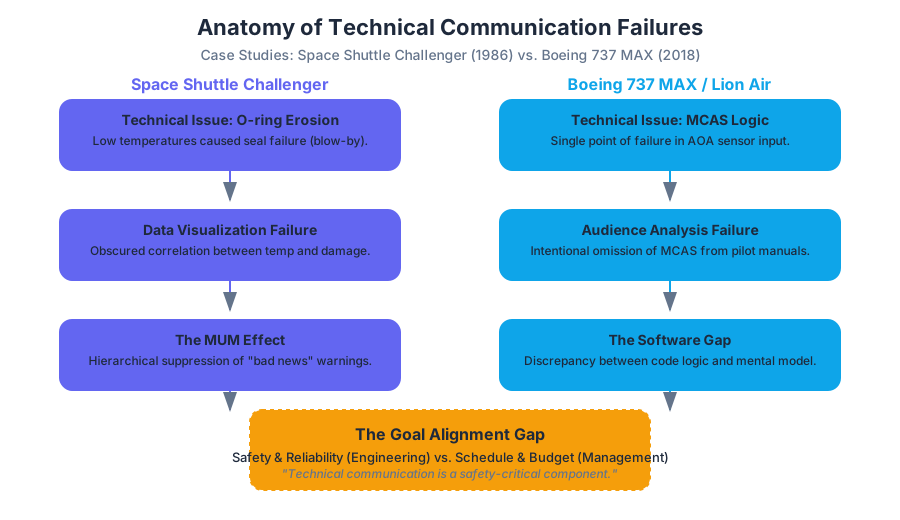
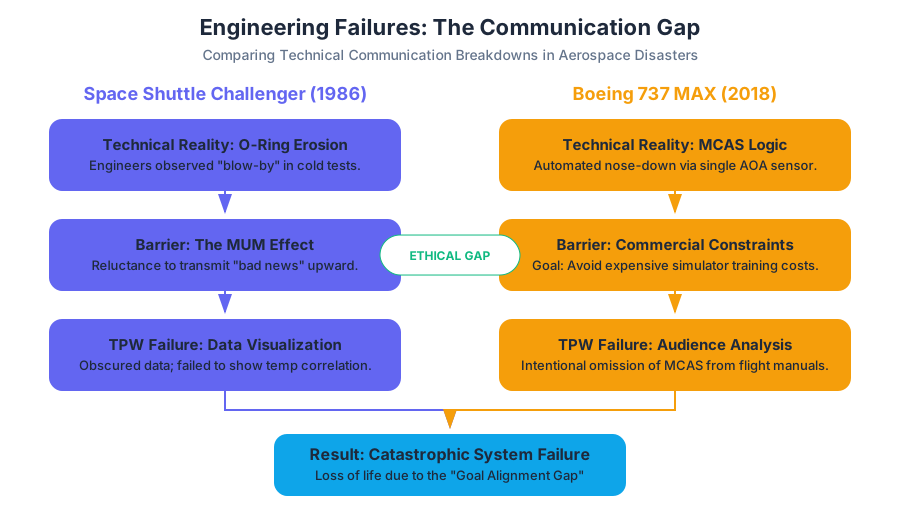
Engineers at Morton Thiokol, the contractor responsible for the SRBs, had known about O-ring erosion for years. They had observed "blow-by" (soot behind the rings) in previous flights. However, this data was transmitted through an organizational hierarchy that suffered from the MUM Effect (Minimizing Unpleasant Messages).
Definition: The MUM Effect A phenomenon in organizational communication where individuals are reluctant to transmit "bad news" upward due to fear of being blamed or the desire to maintain a positive relationship with superiors.
In the case of the Challenger, the technical data regarding O-ring resiliency was presented in a way that lacked rhetorical force. Instead of a clear warning, engineers provided complex charts that failed to correlate temperature with erosion clearly.
Engineering vs. Management Perspectives
The night before the launch, a teleconference took place between Morton Thiokol and NASA. The engineers recommended a delay, citing the cold weather. However, NASA managers, facing pressure to maintain the launch schedule, challenged the engineers to "prove" the shuttle was unsafe. This shifted the burden of proof from "prove it is safe" to "prove it will fail."
| Perspective | Primary Goal | View of Data | Communication Style |
|---|---|---|---|
| Engineering | Safety and Reliability | Probabilistic; focuses on anomalies. | Detailed, cautious, technical. |
| Management | Schedule and Budget | Binary (Go/No-Go); focuses on "flight history." | Action-oriented, persuasive, bottom-line. |
| The Conflict | Goal Alignment Gap | Engineers saw a risk; Managers saw a lack of definitive proof. | Hierarchical suppression of dissent. |
The Technical Writing Failure: Data Visualization
Edward Tufte, a pioneer in data visualization, later argued that the Challenger disaster could have been prevented if the data had been presented more clearly. The engineers provided 13 charts, but none of them simply plotted the relationship between temperature and O-ring damage across all previous flights. By burying the "bad news" in a sea of irrelevant data, the engineers failed to achieve Clarity.
The Boeing 737 MAX: The MCAS Software Gap
Three decades after the Challenger, the crash of Lion Air Flight 610 (and later Ethiopian Airlines Flight 302) revealed a new era of technical communication failure: the intentional omission of critical information to satisfy commercial goals.
The MCAS System
The Boeing 737 MAX featured larger, more fuel-efficient engines. Because these engines were placed further forward and higher on the wing, they changed the plane's aerodynamics, creating a tendency for the nose to pitch up under certain conditions. To compensate, Boeing developed the Maneuvering Characteristics Augmentation System (MCAS).
MCAS was designed to automatically push the nose down if it sensed the plane was approaching a stall. However, the system relied on a single point of failure: a single Angle of Attack (AOA) sensor.
The Rhetorical Situation: Audience Analysis Failure
In technical writing, Audience Analysis is the process of determining what the reader needs to know to perform a task. Boeing’s audience analysis was driven by a commercial constraint: they wanted to ensure the 737 MAX did not require expensive "Level B" simulator training for pilots transitioning from the 737 NG.
To achieve this, Boeing made a fateful decision in their technical documentation: they omitted MCAS from the flight manuals.
Key Concept: The Software Gap The discrepancy between the actual logic of a system (the code) and the user's mental model of that system (the manual). When the MCAS activated on Lion Air 610 due to a faulty sensor, the pilots had no mental model of the system fighting them, leading to a fatal struggle for control.
Code Logic vs. Documentation
Note how the "Single Point of Failure" is hardcoded into the logic, yet this logic was never explained to the end-users (the pilots).
\text{If } (AOA_{sensor} > \theta_{threshold}) \text{ AND } (Flaps == UP) \text{ AND } (Autopilot == OFF):
    \text{Apply } \Delta_{nose\_down} \text{ for } 10 \text{ seconds}
    \text{Wait } 5 \text{ seconds}
    \text{Repeat until } AOA_{sensor} \leq \theta_{threshold}
In the Lion Air case, the AOA sensor was providing a false reading. The system repeatedly pushed the nose down. Because the manual contained no mention of MCAS, the pilots performed standard troubleshooting for "Runaway Stabilizer," which was insufficient to counter the specific behavior of the MCAS logic.
Comparative Analysis: Challenger vs. Lion Air
While the technologies differed (solid rocket boosters vs. flight control software), the communication failures follow a strikingly similar pattern.
| Feature | Space Shuttle Challenger (1986) | Boeing 737 MAX (Lion Air, 2018) |
|---|---|---|
| Technical Trigger | O-ring thermal degradation. | Faulty AOA sensor triggering MCAS. |
| Communication Gap | Ambiguous data visualization; MUM effect. | Intentional omission of system info in manuals. |
| Organizational Pressure | Launch schedule/Political pressure. | Avoiding simulator training costs/Competition. |
| Audience Failure | Managers failed to understand engineering risk. | Pilots were unaware of automated system logic. |
| Ethical Breach | Suppression of dissenting engineering voices. | Prioritizing "marketability" over "informed operation." |
Professional Responsibility and Ethical Reporting
Technical writers and engineers operate under a Professional Responsibility to ensure that "bad news" is not just transmitted, but understood. This requires navigating the Organizational Hierarchy effectively.
Strategies for Transmitting Bad News
- Clarity over Ambiguity: Avoid "weasel words" like appears to, might, or could potentially. Use direct language: "The system will fail at temperatures below 53°F."
- Visual Hierarchy: Place the most critical warnings at the beginning of the document (the "Front Matter") and use standardized safety icons (DANGER, WARNING, CAUTION).
- The P.A.L.E.S. Criteria: Evaluate every document based on Purpose, Audience, Language, Ethics, and Structure.
Example: The "Management Hat" Problem
During the Challenger teleconference, a senior executive told the lead engineer to "take off your engineering hat and put on your management hat." This is a classic example of an ethical boundary violation. In technical communication, the "Engineering Hat" represents Data Integrity, while the "Management Hat" represents Organizational Expediency.
Common Pitfalls in Technical Reporting
In professional exams and real-world scenarios, these patterns of failure recur. Recognizing them is the first step toward prevention.
1. The "Single Point of Failure" in Documentation
Just as a system shouldn't rely on one sensor, a safety critical process shouldn't rely on a single mention in a 500-page manual.
- Correction: Use redundancy in communication. Mention critical risks in the "Safety Summary," the "Operation" section, and the "Troubleshooting" appendix.
2. Ambiguous Criticality Ratings
Using vague terms to describe risk levels can lead to misinterpretation by management.
| Rating | Ambiguous Definition (Bad) | Precise Definition (Good) |
|---|---|---|
| Criticality 1 | "Very important." | "Loss of life or vehicle if component fails." |
| Criticality 2 | "Needs attention." | "Loss of mission objectives if component fails." |
| Criticality 3 | "Minor issue." | "Redundant system available; no mission impact." |
3. Passive Voice in Warnings
"It was discovered that the sensor may fail" is weaker than "The sensor fails when moisture exceeds 80%." Passive voice hides the agent and the certainty of the event.
Worked Example: Redesigning a Warning
Original (Similar to Boeing's internal memos):
"The MCAS function is capable of commanding significant stabilizer nose-down movement. In certain flight conditions, this may be perceived by the crew as a runaway stabilizer. Pilots should be aware of the existing cutout switches."
Critique:
- Audience: Pilots don't know what "MCAS" is because it's not in the manual.
- Language: "May be perceived" is ambiguous.
- Clarity: It doesn't explain why the plane is doing this.
Redesign (Ethical Technical Communication):
WARNING: UNCOMMANDED NOSE-DOWN TRIM (MCAS) The aircraft is equipped with MCAS, an automated system that adjusts pitch to prevent stalls. If an AOA sensor fails, MCAS will repeatedly push the nose down. ACTION REQUIRED: If uncommanded nose-down trim occurs, immediately move STAB TRIM CUTOUT switches to CUTOUT. Failure to do so will result in loss of aircraft control.
Conclusion: The Technical Writer as Ethical Gatekeeper
The Lion Air and Challenger cases prove that technical writing is not a neutral act. Every choice—whether to include a system in a manual, how to plot a data point, or whether to use the passive voice—carries ethical weight.
As a technical communicator, your role is to bridge the gap between complex engineering reality and the user’s need for actionable, clear information. When organizational hierarchies pressure you to "soften" the message or "bury" the data, remember that the document you are writing is often the last line of defense against disaster.
- MUM Effect: The tendency to withhold or soften bad news when communicating upward in a hierarchy.
- MCAS: Maneuvering Characteristics Augmentation System; the automated trim system on the 737 MAX.
- O-ring: The rubber seal that failed on the Challenger due to cold-induced loss of resiliency.
- Rhetorical Situation: The combination of Purpose, Audience, and Context that shapes a document.
- Normalization of Deviance: The dangerous tendency to accept technical anomalies as "normal" because they haven't caused a failure yet.
- Criticality 1: A NASA designation for a component whose failure results in loss of life or vehicle.
- Audience Analysis: The process of identifying the reader's knowledge level, needs, and environment.
-
Why did Edward Tufte criticize the Morton Thiokol engineers' charts?
- A) They used the wrong colors.
- B) They failed to show the correlation between temperature and O-ring damage.
- C) They were too short.
- D) They used digital instead of hand-drawn graphics. (Correct: B)
-
What was the primary commercial motivation for Boeing omitting MCAS from pilot manuals?
- A) To keep the technology secret from competitors.
- B) To reduce the file size of the digital manuals.
- C) To avoid the requirement for expensive simulator training.
- D) Because the software was not yet finished. (Correct: C)
-
In the context of the Challenger, what does "taking off the engineering hat" signify?
- A) Retiring from the profession.
- B) Prioritizing management/schedule concerns over technical safety data.
- C) Putting on safety gear for the launchpad.
- D) Switching from C programming to project management software. (Correct: B)
-
Which TPW concept describes the gap between how a pilot thinks the plane works and how the software actually works?
- A) Visual Hierarchy.
- B) The Software Gap / Mental Model Mismatch.
- C) Passive Voice.
- D) P.A.L.E.S. Criteria. (Correct: B)
Summary of Key Lessons
- Clarity is Safety: Ambiguous language in technical reports can be fatal.
- Data Visualization Matters: How you present data is as important as the data itself.
- Know Your Audience: If pilots are the audience, they must know about every system that can take control of the aircraft.
- Ethical Courage: Technical professionals must resist organizational pressure to suppress "bad news."
- Single Points of Failure: Both in engineering (one sensor) and communication (one mention in a manual), single points of failure must be avoided through redundancy and clear warnings.
Exam Preparation Tips
- Be ready to analyze a "Bad Warning" and rewrite it using the P.A.L.E.S. criteria.
- Understand the difference between the Engineering Perspective (data-driven, cautious) and the Management Perspective (schedule-driven, bottom-line).
- Practice identifying the MUM Effect in case study descriptions.
- Remember the definition of Technical Communication from the STC: "Information that helps users perform a task or interact with a product."
Source Materials
Study TPW: Technical & Professional Writing on Lykke
This course page is free to open: signed out, you can read its first two sections, and signing in, on any plan, opens the rest. The free Lykke Chrome extension syncs your own Canvas courses, so ChatGPT, Claude and Muse can answer from your classes and deadlines. It only reads Canvas.
Add the free extensionSign in to open every sectionAll sections of TPW: Technical & Professional Writing · Browse more course pages