From the free course TPW: Technical & Professional Writing on Lykke
Advanced Audience Analysis
Key concepts: Audience Profile Sheet · Needs Assessment Template · Primary vs. Secondary Readers · Skimmers and Skeptics · Intended vs. Unintended Audience
Practical tools and strategies for profiling readers, including the Needs Assessment Template and the Audience Profile Sheet.
Advanced Audience Analysis
In the realm of technical communication, the audience is not a passive recipient of information; it is a dynamic system of constraints, expectations, and cognitive biases. Advanced Audience Analysis is the rigorous process of mapping these variables to ensure that a document achieves its intended rhetorical effect. While academic writing often targets a generalized "educated reader," technical writing targets specific stakeholders with distinct operational needs.
To master this, one must move beyond demographic surface-level data and into the psychographics and situational contexts of the readers. This involves quantifying knowledge gaps, anticipating resistance, and designing for varied reading modalities.
The Audience Profile Sheet (APS)
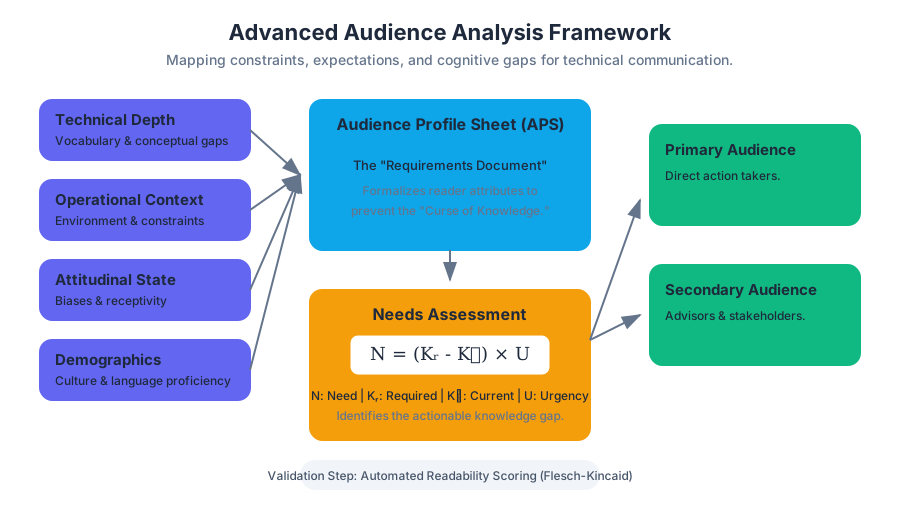
The Audience Profile Sheet (APS) is a diagnostic instrument used to formalize the attributes of the target reader. It serves as the "requirements document" for the writing process. In professional environments, an APS prevents "scope creep" in content by pinning down exactly who the information is for and, equally importantly, who it is not for.
What it is
An APS is a structured data set—often a table or a formal document—that categorizes the reader’s technical expertise, professional role, cultural background, and attitude toward the subject matter.
Why it matters
Without a formalized APS, writers often default to "writing for themselves" or for an imaginary version of the reader that possesses the same context as the author. This leads to the Curse of Knowledge, where the writer assumes the reader understands jargon or logic leaps that are actually opaque.
How it works: The Parameters of Analysis
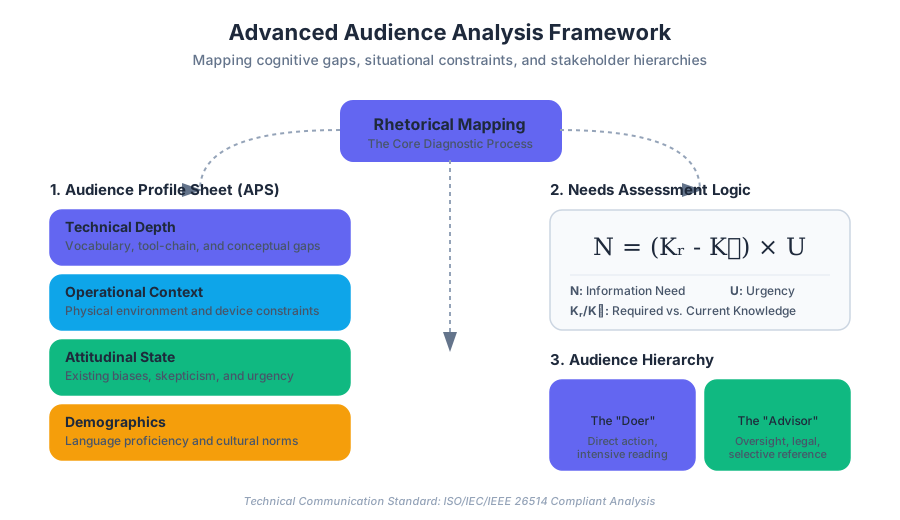
The APS typically evaluates four primary dimensions:
| Dimension | Parameters | Metric/Value |
|---|---|---|
| Technical Depth | Vocabulary, conceptual familiarity, tool-chain knowledge | Expert, Informed, Layperson |
| Operational Context | Physical environment, time constraints, device usage | Mobile/Field, Office, High-Stress |
| Attitudinal State | Receptivity to message, existing biases, urgency | Positive, Neutral, Skeptical, Hostile |
| Demographics | Language proficiency, education level, cultural norms | Variable |
Needs Assessment Template
While the APS focuses on who the reader is, the Needs Assessment focuses on what the reader must accomplish. It is an exigence-based analysis that identifies the gap between the reader's current state and their desired goal.
The Logic of Needs Assessment
We can formalize the "Need" ($N$) as the difference between the Required Knowledge ($K_r$) for a task and the Current Knowledge ($K_c$) of the audience, mediated by the Situational Urgency ($U$).
N = (K_r - K_c) \times U
If $K_c \geq K_r$, the document may be redundant. If $K_r \gg K_c$, the document requires significant scaffolding (glossaries, tutorials).
Components of the Template
A robust Needs Assessment covers the following:
- Task Analysis: What specific actions will the reader take?
- Information Gaps: What specific data points are currently missing?
- Constraint Identification: What limits the reader’s ability to use the info (e.g., "Must be readable in low-light conditions")?
Primary vs. Secondary Readers
In complex organizational ecosystems, a single document rarely has one reader. We categorize these into a hierarchy of influence.
Primary Audience: The person or group who will act upon the information or for whom the document is directly intended (e.g., the technician following a manual).
Secondary Audience: Individuals who may advise the primary reader or who are affected by the actions taken (e.g., the legal department reviewing the manual for liability).
Comparison of Audience Roles
| Feature | Primary Audience | Secondary Audience |
|---|---|---|
| Action Level | Direct implementation | Oversight, validation, or support |
| Knowledge Focus | How-to, procedural, technical specs | Legal, financial, or strategic impact |
| Reading Style | Intensive, sequential | Selective, reference-based |
| Example | Software Developer | Project Manager / CTO |
Worked Example: The Security Audit Report
Consider a report on a data breach:
- Primary Audience: The IT Security Team. They need the raw logs, the exploit vector, and the patch requirements.
- Secondary Audience: The Legal Team. They need to know if PII (Personally Identifiable Information) was leaked to determine if they must notify the state.
- Tertiary Audience: The Board of Directors. They need a high-level summary of the financial risk and the "bottom line" on brand reputation.
Skimmers and Skeptics
Readers do not consume technical content like they consume a novel. They adopt specific cognitive postures based on their goals.
The Skimmer
Skimmers are high-velocity readers. They are often "Primary" readers in a hurry or "Tertiary" readers looking for the "so-what." They look for headings, bolded text, and bulleted lists.
- Strategy: Use the Inverted Pyramid style. Put the most important information (the conclusion or the "ask") at the very top. Use high-contrast document design.
The Skeptic
Skeptics are readers who are looking for reasons to disagree with your findings or to find flaws in your logic. These are often peer reviewers, auditors, or competing stakeholders.
- Strategy: Provide "Proof Burdens." Use extensive citations, data appendices, and transparent methodology sections. Anticipate counter-arguments and address them in a "Limitations" or "FAQ" section.
Design Strategies for Mixed Modalities
| Design Element | Benefit to Skimmer | Benefit to Skeptic |
|---|---|---|
| Executive Summary | Provides the answer in 30 seconds. | Sets the scope of the argument. |
| Data Tables | Allows for quick value-checking. | Provides the raw evidence for verification. |
| Internal Hyperlinks | Allows for non-linear navigation. | Allows for deep-diving into sources. |
| Appendices | Can be safely ignored. | Essential for validating the "how." |
Intended vs. Unintended Audience
One of the most dangerous pitfalls in technical writing is the Unintended Audience. In the digital age, documents are rarely "deleted"; they are leaked, archived, or subpoenaed.
Intended Audience
These are the people you want to read the document. You have analyzed them, used the APS, and tailored your tone to them.
Unintended Audience
These are readers you did not design the document for, but who may gain access to it.
- The Public/Media: A leaked internal memo about product flaws.
- Legal/Courts: Internal Slack logs or emails used as evidence in a lawsuit.
- Competitors: Proprietary processes revealed in a poorly secured white paper.
Risk Mitigation: The "Front Page" Rule
A common heuristic in professional writing is: Never write anything in a technical document that you would be ashamed to see on the front page of a national newspaper.
Common Pitfalls in Audience Analysis
- The "Average User" Fallacy: Designing for an "average" user often results in a document that is too simple for experts and too complex for beginners. Instead, design for the Complex Audience by layering information (e.g., a "Quick Start" guide followed by "Deep Dive" chapters).
- Tone Mismatch: Using overly formal language for a field technician or overly casual language for a C-suite executive.
- Ignoring the "Physical" Audience: Forgetting that the reader might be wearing gloves (requiring larger buttons/pages) or using a screen reader (requiring Alt-text).
Comparison of Tone and Context
| Context | Recommended Tone | Pitfall to Avoid |
|---|---|---|
| Emergency Procedures | Imperative, direct, brief | Politeness markers ("Please consider...") |
| Research Proposal | Persuasive, evidence-based | Over-confidence or lack of citations |
| Internal Memo | Professional, collaborative | Jargon that excludes new hires |
Summary of the Analytical Pipeline
To perform an advanced audience analysis, follow this algorithmic approach:
- Identify the Exigence: Why is this document being written now?
- Map the Stakeholders: List all Primary, Secondary, and potential Unintended readers.
- Execute the APS: Fill out the profile sheet for the Primary reader.
- Conduct Needs Assessment: Identify the specific delta between what they know and what they need to do.
- Select the Modality: Choose a document design that satisfies both Skimmers (via layout) and Skeptics (via evidence).
- Review for Unintended Exposure: Sanitize the document for "worst-case" readers.
Source Materials
Study TPW: Technical & Professional Writing on Lykke
This course page is free to open: signed out, you can read its first two sections, and signing in, on any plan, opens the rest. The free Lykke Chrome extension syncs your own Canvas courses, so ChatGPT, Claude and Muse can answer from your classes and deadlines. It only reads Canvas.
Add the free extensionSign in to open every sectionAll sections of TPW: Technical & Professional Writing · Browse more course pages