From the free course Relations and Functions Course Wiki on Lykke
Historical Note
Key concepts: History of Functions · Descartes · Leibnitz · Euler · Dirichlet · Cantor
This section offers a brief historical overview of the evolution of the concept of 'function,' tracing its development through the contributions of prominent mathematicians from Descartes to Cantor.
Historical Note
The concept of a function is fundamental to nearly every branch of modern mathematics, serving as a cornerstone for calculus, analysis, algebra, and computer science. Its evolution, however, was not linear but rather a fascinating journey spanning centuries, reflecting humanity's increasing need to describe relationships between varying quantities with greater precision and abstraction. This historical note traces the development of the function concept, highlighting the pivotal contributions of key mathematicians who shaped our understanding from implicit geometric notions to the rigorous set-theoretic definition we use today.
Overview of the Evolution of Functions
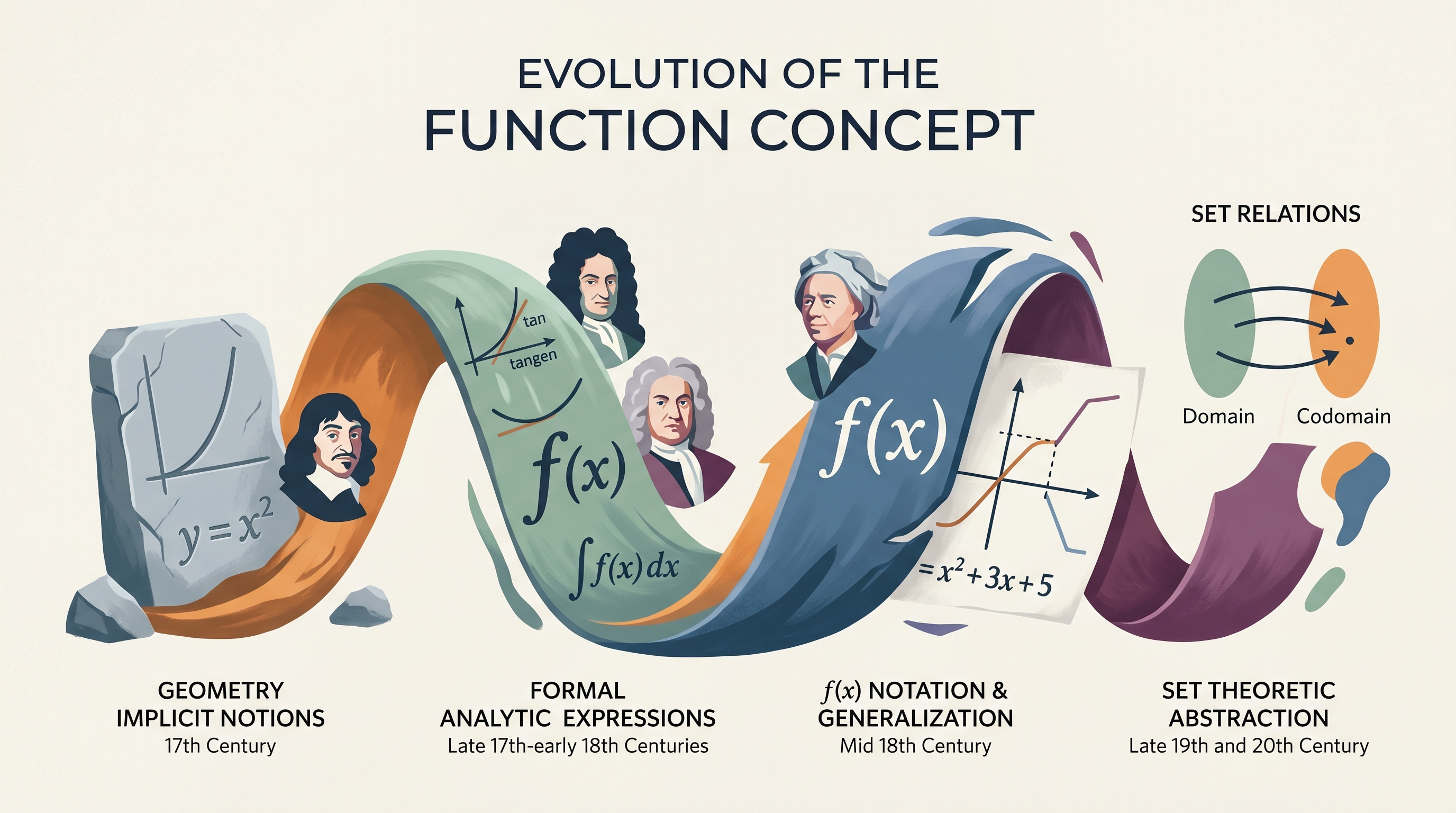
The journey of the function concept can be broadly categorized into several phases, each marked by a shift in perspective and an increase in generality:
- Early Implicit Notions (17th Century): Functions were initially understood as relationships described by geometric curves or algebraic equations, without a formal, explicit definition.
- Formalization and Analytical Expressions (Late 17th - Early 18th Century): Mathematicians began to define functions more explicitly as quantities derived from variables and constants, often tied to analytical formulas.
- Generalization to Arbitrary Rules (Mid-18th - Early 19th Century): The scope expanded to include functions defined by any rule, even those without a single, continuous analytical expression.
- Set-Theoretic Abstraction (Late 19th - Early 20th Century): The modern, rigorous definition emerged, viewing functions as special types of relations between sets, independent of formulas or graphs.
This evolution reflects a progressive move from concrete, visual representations to abstract, formal definitions, driven by the demands of new mathematical problems and the pursuit of logical rigor.
Early Implicit Notions: Descartes and Gregory
The seeds of the function concept were sown in the 17th century with the advent of analytical geometry. Before this, algebra and geometry were largely separate disciplines. René Descartes (1596–1650), in his seminal work La Géométrie (1637), revolutionized mathematics by demonstrating how geometric curves could be represented by algebraic equations. This established a profound connection: an equation like y = x² describes a parabola, where for every value of x, there is a corresponding value of y. While Descartes did not explicitly define "function," his work provided the crucial framework where variables were seen as dependent on others, paving the way for the idea of a functional relationship.
James Gregory (1638–1675), a Scottish mathematician, is sometimes credited with one of the earliest explicit (though informal) uses of the term "function" in the context of infinite series. He referred to a quantity "depending on another quantity" in his work on calculus. This early usage, though not a formal definition, underscored the growing recognition of dependent variables.
Why it matters: This period was crucial because it provided the visual and algebraic tools to think about how one quantity determines another. The ability to express curves as equations allowed for the study of their properties using algebraic methods, laying the groundwork for the development of calculus, where understanding rates of change and accumulation inherently relies on functional relationships.
Formalization and Analytical Expressions: Leibnitz and Bernoulli
The late 17th and early 18th centuries saw the first attempts to formally define "function." Gottfried Wilhelm Leibnitz (1646–1716), one of the co-inventors of calculus, introduced the term "function" in 1673. He initially used it to refer to geometric quantities associated with curves, such as tangents, normals, and chords. By 1694, he refined his usage to describe any quantity that "varies from point to point" along a curve.
Johann Bernoulli (1667–1748), a prominent Swiss mathematician, provided a more explicit and analytical definition in 1718. He defined a function as:
"a quantity composed in any manner whatever of a variable quantity and constants."
This definition marked a significant step forward, moving away from purely geometric interpretations towards an algebraic understanding. It emphasized that functions could be constructed using basic arithmetic operations and constants.
Comparison of Early Definitions:
| Feature | Descartes (Implicit) | Leibnitz (Early Explicit) | Bernoulli (Formal Analytical) |
|---|---|---|---|
| Primary Context | Geometric curves/equations | Geometric properties of curves | Algebraic expressions |
| Core Idea | Dependence of y on x |
Quantity varying along a curve | Quantity formed from variable x and constants |
| Formal Definition | None (implied by equations) | Informal, evolving | Explicit, analytical |
| Notation | y = x² (equation) |
No specific function notation | No specific function notation |
Why it matters: These definitions were crucial for the development of calculus. By defining functions as analytical expressions, mathematicians could apply the new tools of differentiation and integration to a broad class of problems, leading to rapid advancements in physics and engineering.
Euler's Transformative Contributions
Leonhard Euler (1707–1783), arguably the most prolific mathematician in history, played a pivotal role in solidifying and generalizing the function concept. In his Introductio in analysin infinitorum (1748), Euler initially adopted a definition similar to Bernoulli's:
"A function of a variable quantity is an analytical expression composed in any way from that variable quantity and numbers or constant quantities."
This definition emphasized functions as expressions like x² + 3x + 5 or sin(x). Crucially, Euler introduced the now-standard notation f(x) to denote a function, making it easier to discuss and manipulate functions abstractly.
However, Euler later broadened his definition in response to problems involving vibrating strings (the D'Alembert-Euler controversy). He realized that a function didn't necessarily need to be described by a single, continuous analytical formula. He proposed a more general definition:
"If, however, some quantities depend on others in such a way that if the latter are changed the former undergo change, then the former quantities are called functions of the latter."
This was a radical departure, allowing for functions defined piecewise or even empirically, as long as there was a definite rule of correspondence.
How it works: Euler's shift allowed for functions like:
f(x) = x² for x ≥ 0
f(x) = -x for x < 0
Such functions, while not described by a single analytical expression over their entire domain, still assign a unique output for every input.
Why it matters: Euler's work was transformative. His notation f(x) became universal, simplifying the language of mathematics. More importantly, his generalized definition liberated the concept of a function from the strict confines of analytical formulas, opening the door for functions that could be discontinuous, piecewise, or even defined by tables of values. This broader understanding was essential for the development of Fourier series and the study of more complex physical phenomena.
Generalization to Arbitrary Correspondences: Lagrange and Dirichlet
Following Euler, Joseph-Louis Lagrange (1736–1813) initially tried to base all analysis on power series, effectively returning to a more analytical expression-centric view of functions. However, the need for a more general definition persisted, particularly with the rise of Fourier analysis.
It was Peter Gustav Lejeune Dirichlet (1805–1859) who, in 1837, provided what is often considered the first truly modern and rigorous definition of a function, moving beyond the requirement of an analytical expression entirely. Dirichlet defined a function as:
"If a variable
yis so related to a variablexthat whenever a numerical value is assigned tox, there is a rule according to which a unique value ofyis determined, thenyis said to be a function ofx."
This definition emphasizes the rule of correspondence and the uniqueness of the output for each input, regardless of whether that rule is an algebraic formula, a geometric construction, or a simple table. It explicitly allows for functions like the Dirichlet function:
D(x) = 1 if x is a rational number
D(x) = 0 if x is an irrational number
This function cannot be described by any simple analytical expression but perfectly fits Dirichlet's definition.
Why it matters: Dirichlet's definition was a landmark. It completely detached the concept of a function from its historical ties to "formulas" or "curves," paving the way for functions defined over abstract sets and for the rigorous study of continuity, differentiability, and integrability. It was crucial for understanding functions that arise in fields like signal processing and probability.
Set Theory and the Modern Definition: Cantor
The final major step in the evolution of the function concept came with the development of set theory in the late 19th century, primarily by Georg Cantor (1845–1918). Set theory provided the language and framework for defining mathematical objects with unprecedented rigor and abstraction. Within this framework, a function is understood as a special type of relation.
As reviewed in foundational mathematics (e.g., Lemh101), a relation R from a set A to a set B is any subset of the Cartesian product A × B. Each element of this subset is an ordered pair (a, b) where a ∈ A and b ∈ B.
The modern set-theoretic definition of a function formalizes Dirichlet's idea of a unique correspondence:
A function
ffrom a setA(the domain) to a setB(the codomain), denotedf: A → B, is a relationf ⊆ A × Bsuch that for every elementa ∈ A, there exists exactly one elementb ∈ Bfor which(a, b) ∈ f. The elementbis called the image ofaunderf, writtenf(a) = b. The set of all imagesf(a)fora ∈ Ais called the range off.
This definition is entirely abstract, independent of any specific formula, graph, or rule. It simply requires a unique mapping for every element in the domain.
How it works:
Consider sets A = {1, 2, 3} and B = {a, b, c, d}.
A function f: A → B could be defined as the set of ordered pairs f = {(1, a), (2, c), (3, b)}.
Here, each element in A (1, 2, 3) is paired with exactly one element in B.
The domain is A, the codomain is B, and the range is {a, b, c}.
Why it matters: This set-theoretic definition provides the ultimate level of rigor and generality. It allows mathematicians to define functions between any types of sets (numbers, vectors, other functions, abstract objects), forming the bedrock for advanced topics like functional analysis, abstract algebra, and category theory. It is the definition universally accepted in contemporary mathematics, underpinning concepts like one-one (injective) and onto (surjective) functions, and the existence of inverse functions (as discussed in Lemh102).
Summary of the Evolution of the Function Concept
The journey from Descartes' geometric curves to Cantor's abstract set-theoretic mappings illustrates a profound intellectual progression. Each stage built upon the last, expanding the scope and rigor of what a "function" could represent.
Key Milestones in the Definition of a Function:
| Era / Mathematician | Primary Definition / Concept | Key Contribution | Limitations Overcome |
|---|---|---|---|
| Descartes (17th C.) | Implicit in equations of geometric curves (y = f(x)) |
Linked algebra and geometry; y depends on x |
No explicit definition; tied to geometry |
| Leibnitz (Late 17th C.) | Quantity varying from point to point on a curve | Coined "function"; more analytical focus | Still somewhat geometric; informal |
| Bernoulli (Early 18th C.) | Quantity composed of variable and constants | First analytical definition; algebraic expressions | Restricted to single analytical formulas |
| Euler (Mid-18th C.) | Initially analytical expression; later, any rule of correspondence | Standardized f(x) notation; generalized to arbitrary rules |
Freed from single formula; allowed piecewise functions |
| Dirichlet (Early 19th C.) | A rule determining a unique y for each x |
Fully abstract rule of correspondence; uniqueness | Decoupled from analytical formulas/continuity |
| Cantor (Late 19th C.) | A special type of relation between two sets | Rigorous set-theoretic definition; universal | Provided ultimate abstraction and logical foundation |
This historical progression highlights how mathematical concepts evolve to meet new challenges and achieve greater clarity and universality, ultimately leading to the robust and versatile tool that the function is in modern mathematics.


Source Materials
Study Relations and Functions Course Wiki on Lykke
This course page is free to open: signed out, you can read its first two sections, and signing in, on any plan, opens the rest. The free Lykke Chrome extension syncs your own Canvas courses, so ChatGPT, Claude and Muse can answer from your classes and deadlines. It only reads Canvas.
Add the free extensionSign in to open every sectionAll sections of Relations and Functions Course Wiki · Browse more course pages