From the free course Precalculus on Lykke
Complex Numbers and Polar Form
Key concepts: Complex plane · Polar coordinates · De Moivre's Theorem · Magnitude and argument
Explores the representation of complex numbers in the complex plane and the conversion between rectangular and polar forms.
Complex Numbers and Polar Form
The transition from the real number line to the complex plane represents one of the most significant leaps in mathematical history. While real numbers allow us to measure magnitude along a single dimension, complex numbers introduce the concept of phase and rotation, providing a two-dimensional framework for algebra. In this deep dive, we move beyond the basic definition of the imaginary unit $i = \sqrt{-1}$ to explore the Polar Form of complex numbers—a representation that transforms difficult algebraic expansions into simple geometric rotations.
The Geometry of the Complex Plane
To understand polar form, we must first master the environment in which complex numbers live: the Complex Plane (or Argand Diagram). Unlike the standard Cartesian plane where $x$ and $y$ represent two independent physical dimensions, the complex plane treats the horizontal axis as the Real axis ($\text{Re}$) and the vertical axis as the Imaginary axis ($\text{Im}$).
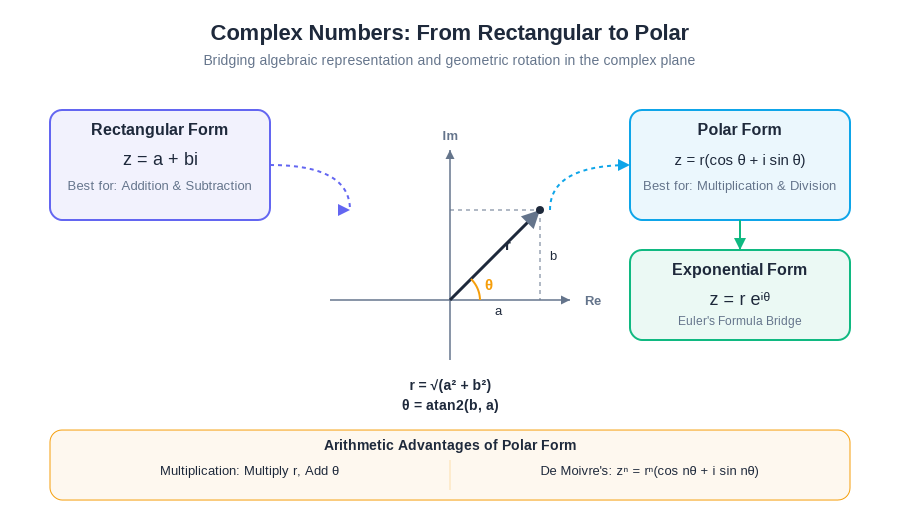
A complex number $z = a + bi$ is represented as a point $(a, b)$ or a vector originating from the origin to that point.
The Modulus and Argument
Every point in the complex plane can be uniquely identified by its distance from the origin and its angle relative to the positive real axis.
- Modulus ($r$ or $|z|$): The non-negative distance from the origin to the point $a + bi$. By the Pythagorean theorem, $r = \sqrt{a^2 + b^2}$.
- Argument ($\theta$ or $\arg(z)$): The angle formed with the positive real axis, typically measured in radians. It is calculated using the arctangent function, though care must be taken regarding the quadrant: $\theta = \operatorname{atan2}(b, a)$.
Definition: The Principal Argument While any angle $\theta + 2\pi k$ (for integer $k$) identifies the same point, the Principal Argument $\operatorname{Arg}(z)$ is restricted to the interval $(-\pi, \pi]$ or $[0, 2\pi)$.
| Property | Rectangular Form ($a + bi$) | Polar Form ($r(\cos \theta + i \sin \theta)$) |
|---|---|---|
| Primary Use | Addition and Subtraction | Multiplication, Division, and Powers |
| Components | Real part ($a$) and Imaginary part ($b$) | Magnitude ($r$) and Phase ($\theta$) |
| Visual Logic | Grid-based displacement | Vector length and rotation |
| Zero Value | $0 + 0i$ | $r = 0$, $\theta$ is undefined |
Conversion Mechanics: Rectangular to Polar
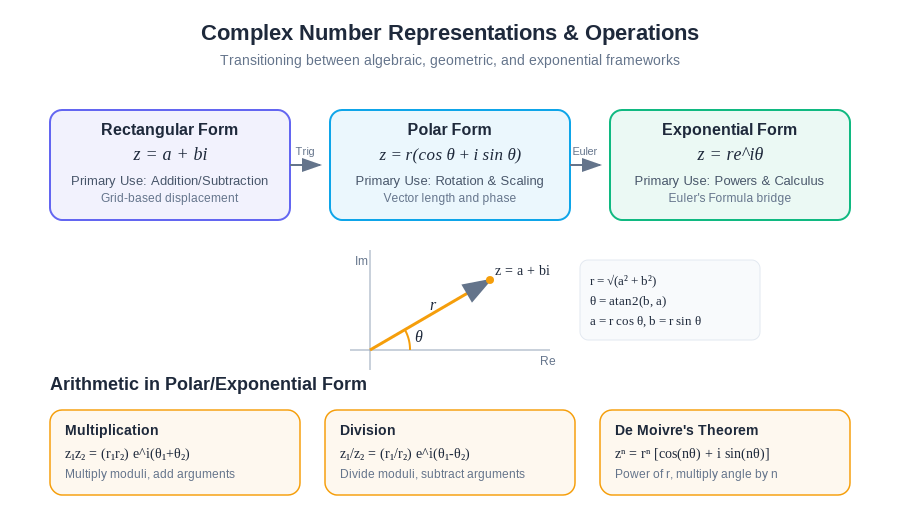
The bridge between the rectangular and polar worlds is built on basic trigonometry. If we treat the modulus $r$ as the hypotenuse of a right triangle, the legs are $a = r \cos \theta$ and $b = r \sin \theta$.
The Polar Representation
Substituting these into $z = a + bi$ gives: $$z = r \cos \theta + i(r \sin \theta) = r(\cos \theta + i \sin \theta)$$ This is often abbreviated as $r \operatorname{cis} \theta$.
Worked Example: Converting $z = -1 + i\sqrt{3}$
- Find $r$: $r = \sqrt{(-1)^2 + (\sqrt{3})^2} = \sqrt{1 + 3} = 2$.
- Find $\theta$: The point $(-1, \sqrt{3})$ lies in the second quadrant. $$\tan \theta = \frac{\sqrt{3}}{-1} = -\sqrt{3}$$ The reference angle is $\pi/3$. In the second quadrant, $\theta = \pi - \pi/3 = 2\pi/3$.
- Result: $z = 2(\cos \frac{2\pi}{3} + i \sin \frac{2\pi}{3})$.
Euler’s Formula: The Exponential Bridge
The most profound realization in complex analysis is Euler's Formula, which links trigonometric functions to the natural exponential function: $$e^{i\theta} = \cos \theta + i \sin \theta$$ This allows us to write complex numbers in Exponential Form: $z = re^{i\theta}$. This is not merely a shorthand; it reveals that complex multiplication is governed by the laws of exponents.
Arithmetic in Polar Form
While adding complex numbers in rectangular form is trivial ($(a+bi) + (c+di) = (a+c) + (b+d)i$), multiplication and division are cumbersome. In polar form, these operations become elegant.
Multiplication
To multiply two complex numbers, multiply their moduli and add their arguments: $$z_1 z_2 = (r_1 e^{i\theta_1})(r_2 e^{i\theta_2}) = r_1 r_2 e^{i(\theta_1 + \theta_2)}$$
Division
To divide two complex numbers, divide their moduli and subtract their arguments: $$\frac{z_1}{z_2} = \frac{r_1}{r_2} e^{i(\theta_1 - \theta_2)}$$
| Operation | Rectangular Complexity | Polar Complexity | Geometric Interpretation |
|---|---|---|---|
| Multiplication | High (FOIL + $i^2$ simplification) | Low (Scalar mult + Addition) | Scaling and Rotation |
| Division | High (Conjugate multiplication) | Low (Scalar div + Subtraction) | Inverse Scaling and Rotation |
| Powers | Extremely High (Binomial expansion) | Negligible (De Moivre's) | Repeated Rotation |
De Moivre’s Theorem
When we raise a complex number to an integer power $n$, the polar form yields a powerful shortcut known as De Moivre's Theorem: $$z^n = [r(\cos \theta + i \sin \theta)]^n = r^n(\cos n\theta + i \sin n\theta)$$
Derivation via Euler's Formula
The proof becomes trivial when using the exponential form: $$(re^{i\theta})^n = r^n (e^{i\theta})^n = r^n e^{i(n\theta)}$$ Converting back to trigonometric form: $$r^n (\cos(n\theta) + i \sin(n\theta))$$
\begin{aligned}
\text{Problem: Calculate } (1+i)^8 \\
\text{1. Convert to Polar: } & r = \sqrt{1^2+1^2} = \sqrt{2}, \theta = \pi/4 \\
& z = \sqrt{2} e^{i\pi/4} \\
\text{2. Apply De Moivre's: } & z^8 = (\sqrt{2})^8 e^{i(8 \cdot \pi/4)} \\
& z^8 = 2^4 e^{i(2\pi)} \\
\text{3. Simplify: } & 16(\cos 2\pi + i \sin 2\pi) \\
& 16(1 + 0i) = 16
\end{aligned}
Finding Complex Roots (Roots of Unity)
One of the most important applications of polar form is solving equations of the form $z^n = w$. Unlike real numbers, where a number might have only one or two real roots, every non-zero complex number has exactly $n$ distinct $n$-th roots.
To find the $n$-th roots of $w = R(\cos \phi + i \sin \phi)$:
- Take the $n$-th root of the modulus: $r = \sqrt[n]{R}$.
- Divide the argument by $n$ and add increments of $2\pi/n$: $$\theta_k = \frac{\phi + 2\pi k}{n} \quad \text{for } k = 0, 1, 2, \dots, n-1$$
The $n$-th Roots of Unity
The roots of $z^n = 1$ are called the Roots of Unity. Geometrically, they form a regular $n$-gon inscribed in the unit circle, with one vertex at $(1, 0)$.
| $n$ | Equation | Roots (Exponential Form) | Geometric Shape |
|---|---|---|---|
| 2 | $z^2 = 1$ | $e^{i0}, e^{i\pi}$ | Line segment (1, -1) |
| 3 | $z^3 = 1$ | $e^{i0}, e^{i2\pi/3}, e^{i4\pi/3}$ | Equilateral Triangle |
| 4 | $z^4 = 1$ | $e^{i0}, e^{i\pi/2}, e^{i\pi}, e^{i3\pi/2}$ | Square |
| 6 | $z^6 = 1$ | $e^{i2\pi k/6}$ for $k \in {0..5}$ | Regular Hexagon |
Real-World Application: Phasors and AC Circuits
In electrical engineering, alternating current (AC) signals are sinusoidal. Analyzing circuits with resistors, capacitors, and inductors using differential equations is difficult. Instead, engineers use Phasors—complex numbers in polar form that represent the amplitude and phase of the sine wave.
- Voltage: $V(t) = V_{peak} \cos(\omega t + \phi)$ is represented as $V_{peak} \angle \phi$.
- Impedance ($Z$): Resistors have real impedance ($R$), while capacitors and inductors have imaginary impedance ($jX$).
- Ohm's Law for AC: $V = I \cdot Z$. Because these are complex numbers, this single equation handles both the change in magnitude and the shift in phase simultaneously.
Common Pitfalls and Edge Cases
- The
atanTrap: When converting to polar form, the simple formula $\theta = \arctan(b/a)$ only works for the first and fourth quadrants ($a > 0$). If $a < 0$, you must add $\pi$ (or 180°) to the result to reach the correct quadrant. - The Zero Modulus: The number $0 + 0i$ has a modulus of 0, but its argument is undefined. In polar form, the origin is a singularity.
- Degree vs. Radian Confusion: Most theoretical mathematics (and De Moivre's Theorem) assumes radians. Using degrees inside $e^{i\theta}$ is a common notation error in physics that can lead to calculation failures in software.
- Multi-valued Roots: Forgetting that there are $n$ roots for $z^n = w$. Students often find the "principal" root and ignore the other $n-1$ rotations.
Summary Table: Domain Mapping
| Field | Usage of Polar Form | Key Benefit |
|---|---|---|
| Quantum Mechanics | Wavefunctions ($\psi$) | Probability amplitudes are complex; phase represents interference. |
| Signal Processing | Fourier Transforms | Decomposes signals into frequency components (magnitude/phase). |
| Control Theory | Stability Analysis | Poles and zeros in the complex plane determine system oscillation. |
| Computer Graphics | 2D Rotations | Multiplying by $e^{i\theta}$ rotates a point without matrix math. |
Study Precalculus on Lykke
This course page is free to open: signed out, you can read its first two sections, and signing in, on any plan, opens the rest. The free Lykke Chrome extension syncs your own Canvas courses, so ChatGPT, Claude and Muse can answer from your classes and deadlines. It only reads Canvas.
Add the free extensionSign in to open every section