From the free course Precalculus on Lykke
Vectors
Key concepts: Vector components and magnitude · Scalar multiplication · Vector addition and subtraction · Rectangular and polar conversion
Introduction to vector quantities, covering components, magnitude, and operations like addition and scalar multiplication.
Vectors: The Geometry of Direction and Magnitude
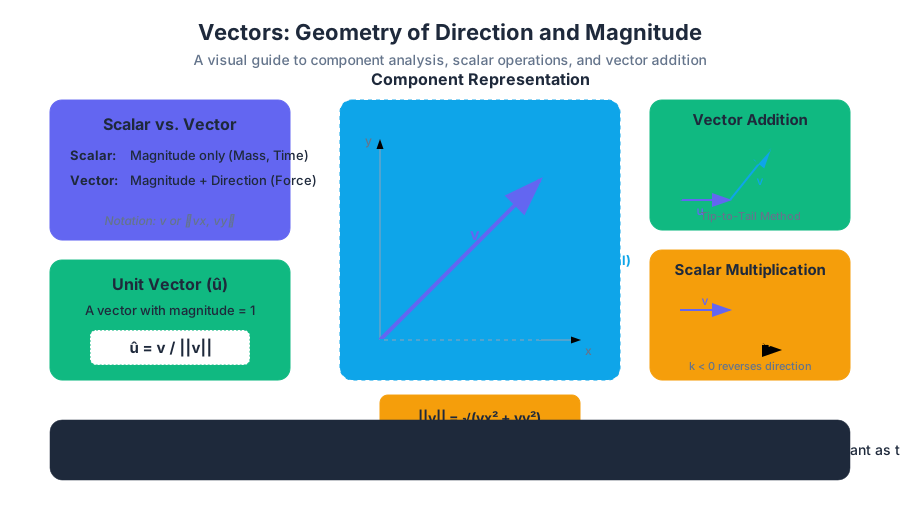
In the study of mathematics and physics, we distinguish between two fundamental types of quantities: scalars and vectors. While a scalar is defined solely by its magnitude (such as temperature, mass, or time), a vector is a mathematical object that possesses both magnitude and direction.
In a Euclidean space, a vector is often visualized as a directed line segment—an arrow—starting at an initial point and ending at a terminal point. However, in modern linear algebra and engineering, we treat vectors more abstractly as elements of a vector space, typically represented by their components in a coordinate system. This section explores the rigorous foundations of vector algebra, from basic component analysis to the nuances of polar-rectangular conversions.
Vector Components and Magnitude
At its core, a vector in $\mathbb{R}^2$ or $\mathbb{R}^3$ can be decomposed into its constituent parts along the axes of a coordinate system. These parts are known as components.
The Component Representation
If a vector $\vec{v}$ has its initial point at the origin $(0,0)$ and its terminal point at $(x, y)$, we say the vector is in standard position. The component form is written as: $$\vec{v} = \langle v_x, v_y \rangle$$ where $v_x$ is the horizontal displacement and $v_y$ is the vertical displacement. In three dimensions, this extends to $\vec{v} = \langle v_x, v_y, v_z \rangle$.
Calculating Magnitude
The magnitude (or norm) of a vector, denoted as $|\vec{v}|$, represents the length of the directed line segment. By the Pythagorean theorem, the magnitude of a 2D vector is the square root of the sum of the squares of its components: $$|\vec{v}| = \sqrt{v_x^2 + v_y^2}$$
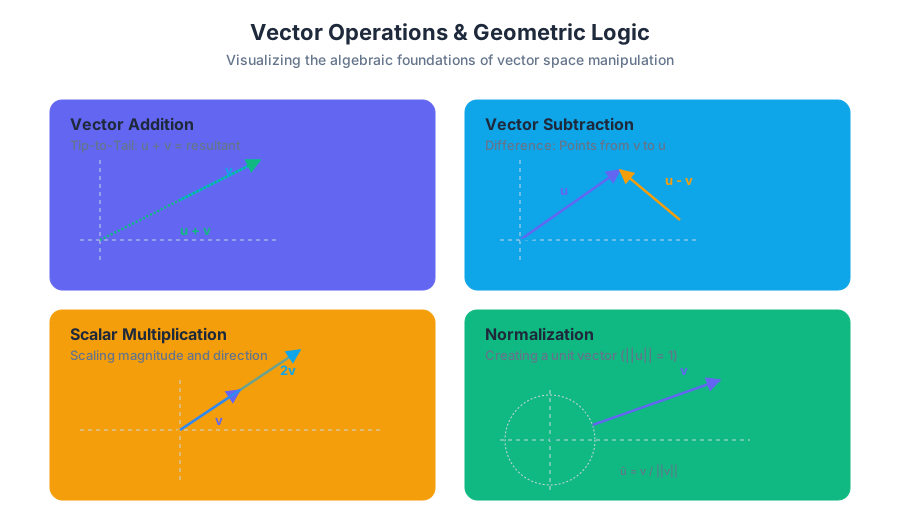
Definition: The Unit Vector A unit vector is a vector with a magnitude of exactly 1. Any non-zero vector $\vec{v}$ can be "normalized" into a unit vector $\hat{u}$ by dividing the vector by its magnitude: $$\hat{u} = \frac{\vec{v}}{|\vec{v}|}$$
| Property | Scalar | Vector |
|---|---|---|
| Definition | Magnitude only | Magnitude and Direction |
| Examples | Speed, Mass, Energy | Velocity, Force, Acceleration |
| Notation | $s$ (italic) | $\vec{v}$ or v (bold/arrow) |
| Dimensionality | 1D (Rank 0 Tensor) | n-D (Rank 1 Tensor) |
Scalar Multiplication
Scalar multiplication involves changing the magnitude (and potentially the direction) of a vector by multiplying it by a real number $k$.
Mechanics of Scaling
When a vector $\vec{v} = \langle x, y \rangle$ is multiplied by a scalar $k$, the operation is applied component-wise: $$k\vec{v} = \langle kx, ky \rangle$$
The effect on the vector depends on the value of $k$:
- If $k > 1$: The vector is stretched (dilated).
- If $0 < k < 1$: The vector is shrunk (compressed).
- If $k = 0$: The vector becomes the zero vector $\vec{0} = \langle 0, 0 \rangle$.
- If $k < 0$: The vector's direction is reversed ($180^\circ$ flip) and its magnitude is scaled by $|k|$.
Geometric Interpretation
Geometrically, scalar multiplication keeps the vector on the same line of action (it remains parallel to the original) but alters its reach. This is fundamental in defining collinearity: two vectors are parallel if and only if one is a scalar multiple of the other.
Vector Addition and Subtraction
Vector addition is not as simple as adding magnitudes. Because vectors have direction, we must account for their spatial orientation using either geometric or algebraic methods.
The Tip-to-Tail Method (Geometric)
To add $\vec{u}$ and $\vec{v}$ geometrically:
- Draw vector $\vec{u}$.
- Place the initial point (tail) of $\vec{v}$ at the terminal point (tip) of $\vec{u}$.
- The resultant vector $\vec{u} + \vec{v}$ is the vector drawn from the tail of $\vec{u}$ to the tip of $\vec{v}$.
Component-wise Addition (Algebraic)
Algebraically, addition is performed by summing the corresponding components: $$\vec{u} + \vec{v} = \langle u_x + v_x, u_y + v_y \rangle$$
Vector Subtraction
Subtraction is defined as the addition of a negative vector: $\vec{u} - \vec{v} = \vec{u} + (-\vec{v})$. Geometrically, if $\vec{u}$ and $\vec{v}$ share the same initial point, $\vec{u} - \vec{v}$ is the vector pointing from the tip of $\vec{v}$ to the tip of $\vec{u}$.
| Operation | Algebraic Formula | Geometric Meaning |
|---|---|---|
| Addition | $\langle x_1+x_2, y_1+y_2 \rangle$ | Diagonal of a parallelogram |
| Subtraction | $\langle x_1-x_2, y_1-y_2 \rangle$ | Vector connecting two points |
| Scalar Mult. | $\langle kx, ky \rangle$ | Resizing the vector |
| Normalization | $\langle \frac{x}{|\vec{v}|}, \frac{y}{|\vec{v}|} \rangle$ | Finding the direction unit |
Rectangular and Polar Conversion
While rectangular coordinates (Cartesian) are excellent for addition and subtraction, polar coordinates are often more intuitive for describing movement, such as a plane flying at a certain heading or a force applied at an angle.
From Polar to Rectangular
A vector in polar form is defined by its magnitude $r$ and its direction angle $\theta$ (usually measured counter-clockwise from the positive x-axis). To find the components: $$x = r \cos \theta$$ $$y = r \sin \theta$$
From Rectangular to Polar
To convert from components $\langle x, y \rangle$ back to $(r, \theta)$:
- Magnitude: $r = \sqrt{x^2 + y^2}$
- Direction: $\theta = \tan^{-1}\left(\frac{y}{x}\right)$
The Quadrant Warning The standard
arctanfunction only returns values in the range $(-\pi/2, \pi/2)$. If your vector is in the second or third quadrant ($x < 0$), you must add $180^\circ$ (or $\pi$ radians) to the result to get the correct direction. In programming, theatan2(y, x)function handles this logic automatically.
Mathematical Derivation: The Rotation Matrix
If we wish to rotate a vector $\vec{v}$ by an angle $\phi$, we can derive the new coordinates using the polar conversion logic.
Let v = <r cos(theta), r sin(theta)>
After rotating by phi, the new angle is (theta + phi).
x' = r cos(theta + phi) = r(cos theta cos phi - sin theta sin phi)
y' = r sin(theta + phi) = r(sin theta cos phi + cos theta sin phi)

Substituting x = r cos theta and y = r sin theta:
x' = x cos phi - y sin phi
y' = x sin phi + y cos phi

This yields the Rotation Matrix R:
[ x' ]   [ cos phi  -sin phi ] [ x ]
[ y' ] = [ sin phi   cos phi ] [ y ]
Practical Applications and Worked Examples
Case Study: Resultant Velocity
An airplane is flying at an airspeed of 500 km/h at a bearing of $30^\circ$ North of East. A wind is blowing from the South at 80 km/h. What is the ground speed and actual direction of the plane?
Step 1: Convert to Rectangular Components
- Plane ($\vec{p}$): $r=500, \theta=30^\circ$
- $p_x = 500 \cos(30^\circ) \approx 433.01$
- $p_y = 500 \sin(30^\circ) = 250$
- Wind ($\vec{w}$): $r=80, \theta=90^\circ$ (From South means blowing North)
- $w_x = 80 \cos(90^\circ) = 0$
- $w_y = 80 \sin(90^\circ) = 80$
Step 2: Add Components
- $\vec{R} = \vec{p} + \vec{w} = \langle 433.01 + 0, 250 + 80 \rangle = \langle 433.01, 330 \rangle$
Step 3: Convert back to Polar
- Ground Speed: $|\vec{R}| = \sqrt{433.01^2 + 330^2} \approx 544.4$ km/h
- Direction: $\theta = \tan^{-1}(330 / 433.01) \approx 37.3^\circ$ North of East.
Common Pitfalls and Edge Cases
- Confusing Bearing with Standard Angle: In navigation, "Bearing" is often measured clockwise from North. In mathematics, $\theta$ is measured counter-clockwise from the positive X-axis (East). Always convert bearings to standard angles before using $\sin$ and $\cos$.
- Magnitude of Subtraction: Beginners often think $|\vec{u} - \vec{v}| = |\vec{u}| - |\vec{v}|$. This is false. The magnitude of the difference depends on the angle between the vectors (Law of Cosines).
- Floating Point Precision: When comparing if two vectors are equal or if a vector is a unit vector, always use an epsilon ($\epsilon$) threshold rather than
== 1.0due to rounding errors insqrtandtrigfunctions.
| Feature | Rectangular (Cartesian) | Polar |
|---|---|---|
| Best For | Addition, Subtraction, Integration | Rotation, Circular Motion, Navigation |
| Components | $x, y$ | $r, \theta$ |
| Zero Vector | $\langle 0, 0 \rangle$ | $r=0, \theta$ is undefined |
| Uniqueness | Unique representation | Multiple (e.g., $\theta$ vs $\theta + 2\pi$) |
Summary of Key Formulas
| Concept | Formula |
|---|---|
| Magnitude | $|\vec{v}| = \sqrt{x^2 + y^2}$ |
| Unit Vector | $\hat{u} = \frac{1}{|\vec{v}|} \langle x, y \rangle$ |
| Addition | $\vec{u} + \vec{v} = \langle u_x + v_x, u_y + v_y \rangle$ |
| Scalar Mult. | $k\vec{v} = \langle kx, ky \rangle$ |
| X-Component | $x = r \cos \theta$ |
| Y-Component | $y = r \sin \theta$ |
| Angle | $\theta = \operatorname{atan2}(y, x)$ |
Source Materials
Study Precalculus on Lykke
This course page is free to open: signed out, you can read its first two sections, and signing in, on any plan, opens the rest. The free Lykke Chrome extension syncs your own Canvas courses, so ChatGPT, Claude and Muse can answer from your classes and deadlines. It only reads Canvas.
Add the free extensionSign in to open every section