From the free course Precalculus on Lykke
Series and Binomial Theorem
Key concepts: Arithmetic and geometric series · Sigma (Σ) notation · Binomial theorem · Pascal's triangle
Focuses on arithmetic and geometric series, summation notation, and the expansion of binomial expressions using Pascal's Triangle.
Series and Binomial Theorem
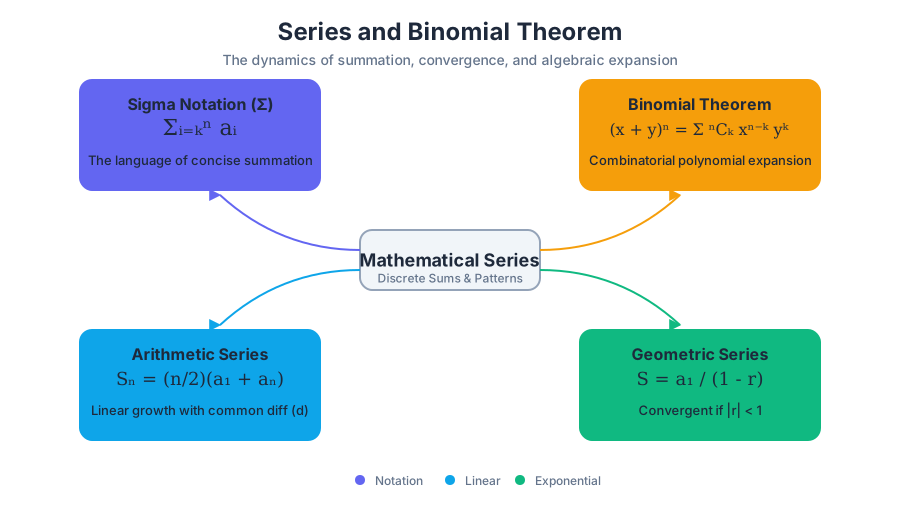
The study of series and the Binomial Theorem represents a critical transition point in mathematics. It is here that we move from the static world of individual numbers and simple algebraic expressions into the dynamic realm of infinite processes and combinatorial structures. In essence, a series is the sum of the terms of a sequence, while the Binomial Theorem provides a powerful algebraic shortcut for expanding powers of binomials.
These concepts are not merely academic exercises; they form the bedrock of modern finance (calculating compound interest and annuities), physics (approximating complex wave functions), and computer science (analyzing algorithm complexity and data structures).
The Language of Summation: Sigma (Σ) Notation
Before diving into specific types of series, we must master the notation used to describe them. Sigma notation is a concise way to represent the sum of many terms that follow a specific pattern.
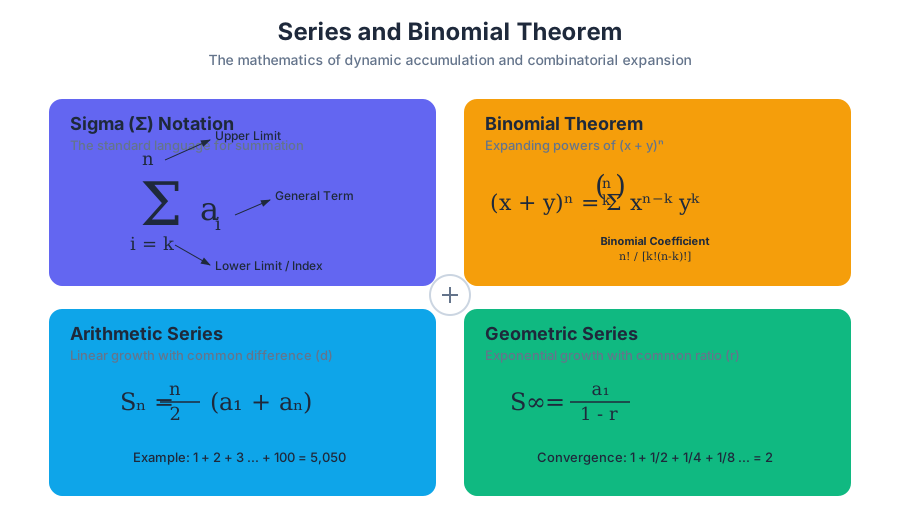
Definition: Sigma Notation The expression $\sum_{i=k}^{n} a_i$ denotes the sum of terms $a_i$ starting from the index $i=k$ and ending at $i=n$.
- $\Sigma$ (Sigma): The Greek capital letter for "S," standing for "Sum."
- $i$: The index of summation (the "counter").
- $k$: The lower limit (starting value).
- $n$: The upper limit (ending value).
- $a_i$: The general term or formula for the $i$-th element.
Properties of Summation
To manipulate series effectively, we rely on several fundamental properties:
| Property | Mathematical Expression | Description |
|---|---|---|
| Linearity (Scalar) | $\sum ca_i = c \sum a_i$ | Constants can be factored out of the summation. |
| Linearity (Addition) | $\sum (a_i + b_i) = \sum a_i + \sum b_i$ | The sum of a sum is the sum of the individual sums. |
| Constant Sum | $\sum_{i=1}^{n} c = nc$ | Adding a constant $c$ to itself $n$ times is $n \times c$. |
| Index Shifting | $\sum_{i=1}^{n} a_i = \sum_{i=0}^{n-1} a_{i+1}$ | The index can be adjusted as long as the terms remain identical. |
Arithmetic Series: Linear Accumulation
An Arithmetic Series is the sum of the terms of an arithmetic sequence—a sequence where the difference between consecutive terms is constant. This constant is known as the common difference ($d$).
The Sum Formula
The sum of the first $n$ terms of an arithmetic series ($S_n$) is given by: $$S_n = \frac{n}{2}(a_1 + a_n)$$ Alternatively, by substituting the formula for the $n$-th term ($a_n = a_1 + (n-1)d$), we get: $$S_n = \frac{n}{2}[2a_1 + (n-1)d]$$
Derivation: The Gaussian Trick
Legend has it that Carl Friedrich Gauss, as a young student, was asked to sum the numbers from 1 to 100. He realized that if you write the series twice—once forward and once backward—and add the columns, each column sums to the same value.
- $S_n = a_1 + (a_1 + d) + (a_1 + 2d) + \dots + a_n$
- $S_n = a_n + (a_n - d) + (a_n - 2d) + \dots + a_1$
- $2S_n = (a_1 + a_n) + (a_1 + a_n) + \dots + (a_1 + a_n)$
- $2S_n = n(a_1 + a_n) \implies S_n = \frac{n}{2}(a_1 + a_n)$
Geometric Series: Exponential Accumulation
A Geometric Series is the sum of the terms of a geometric sequence, where each term is found by multiplying the previous term by a common ratio ($r$).
Finite Geometric Sum
The sum of the first $n$ terms is: $$S_n = a_1 \left( \frac{1 - r^n}{1 - r} \right), \quad r \neq 1$$
Infinite Geometric Series and Convergence
Unlike arithmetic series, which always diverge (grow to infinity) unless all terms are zero, a geometric series can converge to a finite value even if it has an infinite number of terms. This happens if and only if the absolute value of the common ratio is less than 1 ($|r| < 1$).
Theorem: Infinite Geometric Sum If $|r| < 1$, the sum $S$ of the infinite geometric series $a_1 + a_1r + a_1r^2 + \dots$ is: $$S = \frac{a_1}{1 - r}$$
Comparison of Convergence Behaviors
| Ratio Condition | Behavior | Example ($a_1=1$) | Result |
|---|---|---|---|
| $ | r | < 1$ | Convergent |
| $r \geq 1$ | Divergent (to $\infty$) | $1 + 2 + 4 + 8 + \dots$ | Sum = $\infty$ |
| $r \leq -1$ | Divergent (Oscillatory) | $1 - 1 + 1 - 1 + \dots$ | No Sum |
Derivation of the Finite Sum
To find $S_n = a_1 + a_1r + a_1r^2 + \dots + a_1r^{n-1}$:
- Multiply the entire sum by $r$: $rS_n = a_1r + a_1r^2 + \dots + a_1r^n$
- Subtract the two equations: $S_n - rS_n = a_1 - a_1r^n$
- Factor out $S_n$: $S_n(1 - r) = a_1(1 - r^n)$
- Solve for $S_n$: $S_n = a_1 \frac{1 - r^n}{1 - r}$
\begin{aligned}
&\text{Derivation of Infinite Sum as } n \to \infty:\\
&S = \lim_{n \to \infty} a_1 \frac{1 - r^n}{1 - r} \\
&\text{If } |r| < 1, \text{ then } \lim_{n \to \infty} r^n = 0 \\
&S = a_1 \frac{1 - 0}{1 - r} = \frac{a_1}{1 - r}
\end{aligned}
The Binomial Theorem: Expanding Polynomials
The Binomial Theorem provides a systematic way to expand expressions of the form $(x + y)^n$. Without this theorem, expanding $(x + y)^{10}$ would require tedious repeated multiplication.
The Formula
For any positive integer $n$: $$(x + y)^n = \sum_{k=0}^{n} \binom{n}{k} x^{n-k} y^k$$ Where $\binom{n}{k}$ is the binomial coefficient, calculated using combinations: $$\binom{n}{k} = \frac{n!}{k!(n-k)!}$$
Understanding the Coefficients
The binomial coefficient $\binom{n}{k}$ (read as "$n$ choose $k$") represents the number of ways to choose $k$ items from a set of $n$ items. In the context of expansion, it represents how many ways we can pick the variable $y$ from $k$ of the $n$ available binomial factors.
| Power ($n$) | Expansion | Coefficients |
|---|---|---|
| 0 | 1 | 1 |
| 1 | $x + y$ | 1, 1 |
| 2 | $x^2 + 2xy + y^2$ | 1, 2, 1 |
| 3 | $x^3 + 3x^2y + 3xy^2 + y^3$ | 1, 3, 3, 1 |
| 4 | $x^4 + 4x^3y + 6x^2y^2 + 4xy^3 + y^4$ | 1, 4, 6, 4, 1 |
Worked Example: Expand $(2x - 3)^4$
- Identify terms: $a = 2x$, $b = -3$, $n = 4$.
- Apply formula:
- $k=0: \binom{4}{0}(2x)^4(-3)^0 = 1 \cdot 16x^4 \cdot 1 = 16x^4$
- $k=1: \binom{4}{1}(2x)^3(-3)^1 = 4 \cdot 8x^3 \cdot (-3) = -96x^3$
- $k=2: \binom{4}{2}(2x)^2(-3)^2 = 6 \cdot 4x^2 \cdot 9 = 216x^2$
- $k=3: \binom{4}{3}(2x)^1(-3)^3 = 4 \cdot 2x \cdot (-27) = -216x$
- $k=4: \binom{4}{4}(2x)^0(-3)^4 = 1 \cdot 1 \cdot 81 = 81$
- Combine: $16x^4 - 96x^3 + 216x^2 - 216x + 81$
Pascal’s Triangle: The Geometric Connection
Pascal's Triangle is a triangular array of numbers where each number is the sum of the two numbers directly above it. This triangle is a visual representation of binomial coefficients.
Construction and Properties
- Symmetry: Each row is a palindrome.
- Row Sums: The sum of the elements in the $n$-th row is $2^n$.
- Prime Rows: If the first element of a row (after the 1) is a prime number $p$, then all other elements in that row (except the 1s) are divisible by $p$.
- Hockey Stick Identity: The sum of a diagonal of numbers starting at a 1 equals the number below and to the opposite side of the last number in the diagonal.
Relationship to Probability
Pascal's Triangle is deeply linked to the Binomial Distribution in statistics. If you flip a coin $n$ times, the coefficients in the $n$-th row of Pascal's Triangle tell you the number of ways to get $k$ heads. For example, in 4 flips (Row 4: 1, 4, 6, 4, 1), there are 6 ways to get exactly 2 heads.
Advanced Applications and Extensions
1. Taylor and Maclaurin Series
In Calculus, we extend the idea of series to represent functions like $\sin(x)$, $e^x$, and $\ln(x)$ as infinite sums of polynomials. This is known as a Taylor Series. $$f(x) = \sum_{n=0}^{\infty} \frac{f^{(n)}(a)}{n!}(x-a)^n$$ This allows computers to calculate complex transcendental functions using only basic arithmetic (addition and multiplication).
2. The General Binomial Theorem
Isaac Newton generalized the Binomial Theorem for non-integer exponents (fractions and negative numbers). This requires an infinite series: $$(1+x)^\alpha = 1 + \alpha x + \frac{\alpha(\alpha-1)}{2!}x^2 + \frac{\alpha(\alpha-1)(\alpha-2)}{3!}x^3 + \dots$$ This expansion is valid for $|x| < 1$.
3. Financial Mathematics: Annuities
A series of equal payments made at regular intervals is an annuity. Calculating the present value of an annuity is essentially finding the sum of a geometric series: $$PV = P \sum_{t=1}^{n} \frac{1}{(1+i)^t}$$ Where $P$ is the payment, $i$ is the interest rate, and $n$ is the number of periods.
Common Pitfalls and Edge Cases
- Divergence Check: Before calculating an "infinite sum," always check if $|r| < 1$. Attempting to use $\frac{a}{1-r}$ on a divergent series (like $1+2+4+...$) will yield a mathematically nonsensical result (like $-1$).
- Index Alignment: When using Sigma notation, ensure the index in the formula matches the starting value of the counter. A common error is being "off by one."
- Signs in Binomials: When expanding $(x - y)^n$, remember that the $y$ term is negative. This causes the signs in the expansion to alternate ($+, -, +, -, \dots$).
- Factorial Growth: Binomial coefficients grow extremely fast. In computational contexts, calculating $n!$ directly often leads to integer overflow. Use the multiplicative formula shown in the Rust example instead.
Source Materials
Study Precalculus on Lykke
This course page is free to open: signed out, you can read its first two sections, and signing in, on any plan, opens the rest. The free Lykke Chrome extension syncs your own Canvas courses, so ChatGPT, Claude and Muse can answer from your classes and deadlines. It only reads Canvas.
Add the free extensionSign in to open every section