From the free course Precalculus on Lykke
Rational Functions
Key concepts: Vertical and horizontal asymptotes · Removable discontinuities (holes) · End behavior · Rational expression arithmetic
Analysis of functions defined as quotients of polynomials, focusing on their graphical behavior and discontinuities.
Rational Functions
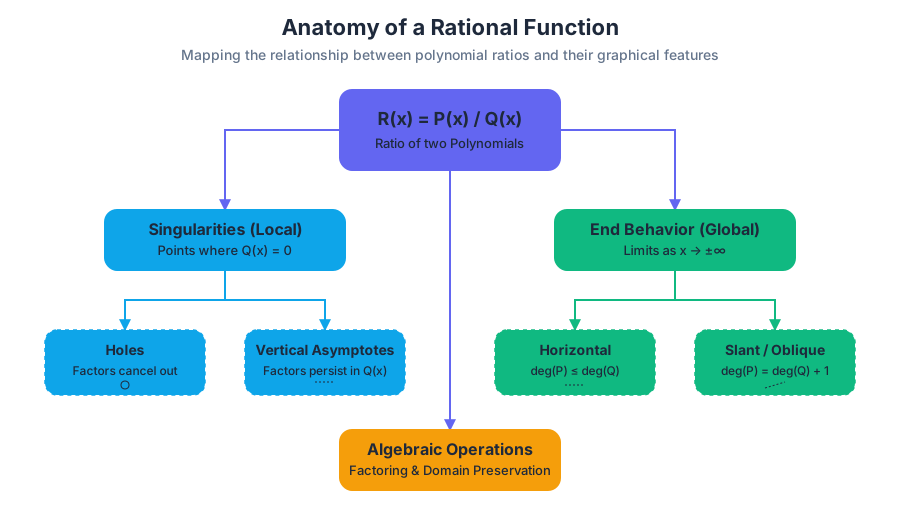
Rational functions represent the ratio of two polynomial expressions. In the landscape of algebraic structures, they serve as the bridge between simple polynomial behavior and the complex world of transcendental functions. While a polynomial is defined for all real numbers and exhibits relatively predictable end behavior, a rational function is defined by its singularities—the points where the function "breaks" or heads toward infinity.
Formally, a rational function $R(x)$ is defined as:
Definition: $R(x) = \frac{P(x)}{Q(x)}$, where $P(x)$ and $Q(x)$ are polynomial functions and $Q(x) \neq 0$.
The domain of $R(x)$ is the set of all real numbers except for the roots of the denominator $Q(x)$. These excluded values are the architects of the function's most interesting features: vertical asymptotes and removable discontinuities.
Arithmetic of Rational Expressions
Before analyzing the calculus-like behavior of these functions, one must master the algebraic manipulation of the underlying expressions. Arithmetic with rational expressions mirrors arithmetic with fractions, requiring a common denominator for addition and subtraction, and prime factorization (in this case, polynomial factoring) for simplification.
Simplification and Domain Preservation
To simplify a rational expression, we factor both the numerator and denominator and cancel common factors. However, a critical "memory" of the original function must be maintained. If a factor $(x - c)$ is canceled, the value $x = c$ is still excluded from the domain of the original function, even if the simplified version appears defined there.
| Operation | Procedure | Key Requirement |
|---|---|---|
| Multiplication | $\frac{A}{B} \cdot \frac{C}{D} = \frac{AC}{BD}$ | Factor first to cancel common terms across numerators/denominators. |
| Division | $\frac{A}{B} \div \frac{C}{D} = \frac{A}{B} \cdot \frac{D}{C}$ | Multiply by the reciprocal; check domain for both $C$ and $D$. |
| Addition | $\frac{A}{B} + \frac{C}{D} = \frac{AD + BC}{BD}$ | Find the Least Common Multiple (LCM) of the denominators. |
| Simplification | $\frac{k \cdot P(x)}{k \cdot Q(x)} = \frac{P(x)}{Q(x)}$ | $k$ must be a non-zero polynomial factor. |
Discontinuities: Holes vs. Asymptotes
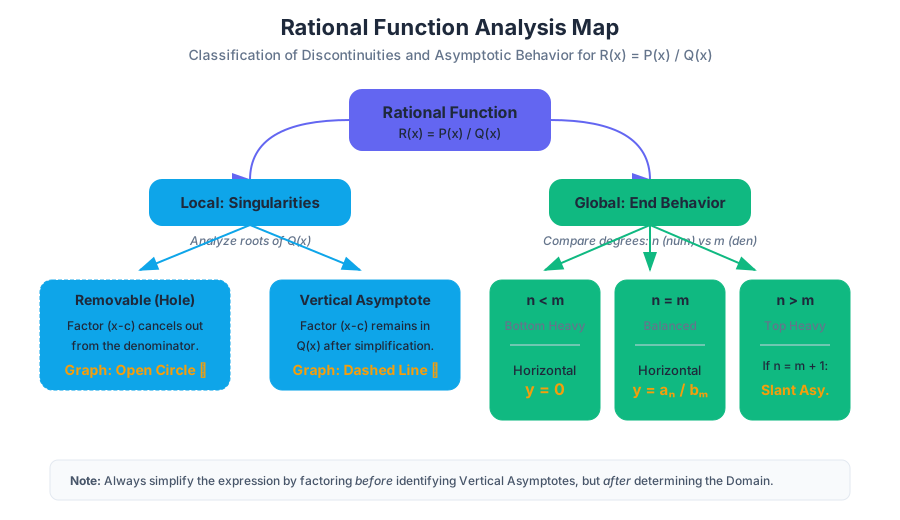
The most fundamental task in analyzing a rational function is determining what happens at the values of $x$ where $Q(x) = 0$. These points of undefined behavior fall into two distinct categories: Removable Discontinuities and Non-removable Discontinuities.
Removable Discontinuities (Holes)
A hole occurs at $x = c$ if the factor $(x - c)$ exists in both the numerator and the denominator. When you evaluate the limit of the function as $x$ approaches $c$, the result is a finite number, even though the function itself is undefined at that exact point.
Non-removable Discontinuities (Vertical Asymptotes)
A vertical asymptote occurs at $x = c$ if, after simplifying the expression, the factor $(x - c)$ remains in the denominator. As $x$ approaches $c$, the function's output grows without bound ($+\infty$ or $-\infty$).
| Feature | Mathematical Condition | Graphical Representation |
|---|---|---|
| Hole | $(x-c)$ is a factor of both $P(x)$ and $Q(x)$ with equal or greater multiplicity in $P(x)$. | An open circle at $(c, L)$, where $L$ is the limit. |
| Vertical Asymptote | $(x-c)$ is a factor of $Q(x)$ after all common factors are canceled. | A vertical dashed line $x=c$ that the graph never crosses. |
End Behavior and Horizontal Asymptotes
While vertical asymptotes describe "local" behavior near specific points, Horizontal Asymptotes describe the "global" or End Behavior of the function as $x \to \infty$ or $x \to -\infty$. This behavior is determined entirely by the degrees of the numerator ($n$) and the denominator ($m$).
The Degree Comparison Rule
Let $P(x) = a_n x^n + \dots$ and $Q(x) = b_m x^m + \dots$.
- If $n < m$: The denominator grows faster than the numerator. The horizontal asymptote is the x-axis: $y = 0$.
- If $n = m$: The numerator and denominator grow at the same rate. The horizontal asymptote is the ratio of the leading coefficients: $y = \frac{a_n}{b_m}$.
- If $n > m$: The numerator grows faster. There is no horizontal asymptote.
- If $n = m + 1$, there is a Slant (Oblique) Asymptote, found via polynomial long division.
- If $n > m + 1$, the end behavior follows the power function $x^{n-m}$.
Formal Derivation via Limits
To prove the $n=m$ case, we divide every term in the expression by $x^n$ (the highest power).
\lim_{x \to \infty} \frac{a_n x^n + a_{n-1} x^{n-1} + \dots}{b_n x^n + b_{n-1} x^{n-1} + \dots}
= \lim_{x \to \infty} \frac{a_n + \frac{a_{n-1}}{x} + \dots}{b_n + \frac{b_{n-1}}{x} + \dots}
= \frac{a_n + 0 + \dots}{b_n + 0 + \dots}
= \frac{a_n}{b_n}
This derivation highlights why lower-degree terms become irrelevant at extreme values of $x$: they vanish as their denominators grow.
Oblique (Slant) Asymptotes
When the degree of the numerator is exactly one higher than the degree of the denominator, the function does not settle into a horizontal line; instead, it approaches a linear path.
Theorem: If $R(x) = \frac{P(x)}{Q(x)}$ and $\text{deg}(P) = \text{deg}(Q) + 1$, then $R(x)$ can be written as $R(x) = (mx + b) + \frac{r(x)}{Q(x)}$, where $mx + b$ is the quotient and $r(x)$ is the remainder. As $x \to \infty$, $\frac{r(x)}{Q(x)} \to 0$, and the graph approaches the line $y = mx + b$.
Worked Example: Finding a Slant Asymptote
Consider $f(x) = \frac{x^2 + 3x + 2}{x - 1}$.
- Perform Long Division: Divide $x^2 + 3x + 2$ by $x - 1$.
- Quotient: $x + 4$.
- Remainder: $6$.
- Result: $f(x) = x + 4 + \frac{6}{x - 1}$.
- Asymptote: As $x \to \infty$, the term $\frac{6}{x-1}$ vanishes. The slant asymptote is $y = x + 4$.
Graphing Rational Functions: A Systematic Pipeline
Graphing a rational function manually requires synthesizing all the concepts discussed. A senior mathematician follows a specific "pipeline" to ensure no features are missed.
- Factor Everything: Completely factor $P(x)$ and $Q(x)$.
- Find Intercepts:
- y-intercept: Set $x=0$.
- x-intercepts (Zeros): Set the simplified numerator to zero.
- Identify Discontinuities:
- Find roots of $Q(x)$.
- Classify as holes or vertical asymptotes.
- Determine End Behavior: Compare degrees to find horizontal or slant asymptotes.
- Sign Analysis (Test Points): Use the zeros and vertical asymptotes to divide the x-axis into intervals. Determine if the function is positive or negative in each interval.
- Check for Asymptote Crossing: Unlike vertical asymptotes, a function can cross a horizontal asymptote. Solve $R(x) = \text{Asymptote Value}$ to check.
Common Pitfalls and Edge Cases
Even experienced students stumble on the nuances of rational functions.
- The "Hole" Displacement: Forgetting that a hole has a y-coordinate. To find it, plug the x-value of the hole into the simplified function.
- Crossing Asymptotes: Believing that a graph can never cross a horizontal asymptote. Horizontal asymptotes only describe behavior at the ends of the graph; the function can cross them many times in the middle.
- Multiplicity at Asymptotes: If a vertical asymptote factor $(x-c)$ has an even multiplicity (e.g., $1/(x-c)^2$), the graph goes to the same infinity on both sides (a "volcano" shape). If it's odd, they go to opposite infinities.
- Domain of the Inverse: When finding the inverse of a rational function, the horizontal asymptote of the original becomes the vertical asymptote (domain restriction) of the inverse.
| Pitfall | Correction |
|---|---|
| Ignoring Holes | Always factor and simplify before identifying vertical asymptotes. |
| Misidentifying Slant Asymptotes | Only exists if $\text{deg}(Num) = \text{deg}(Den) + 1$. |
| Incorrect Sign Analysis | Signs only change at zeros or vertical asymptotes with odd multiplicity. |
Extensions: Partial Fraction Decomposition
In Calculus, specifically for integration, we often need to reverse the process of adding rational expressions. This is called Partial Fraction Decomposition (PFD). It allows us to break a complex rational function into a sum of simpler "partial" fractions.
For example: $$\frac{5x - 1}{(x - 3)(x + 2)} = \frac{A}{x - 3} + \frac{B}{x + 2}$$
By solving for $A$ and $B$, we transform a product-based denominator into a sum of simple linear denominators, which are significantly easier to integrate or transform using Laplace methods. This highlights the "Why it matters" aspect: rational functions are the building blocks for solving differential equations in engineering.
Source Materials
Study Precalculus on Lykke
This course page is free to open: signed out, you can read its first two sections, and signing in, on any plan, opens the rest. The free Lykke Chrome extension syncs your own Canvas courses, so ChatGPT, Claude and Muse can answer from your classes and deadlines. It only reads Canvas.
Add the free extensionSign in to open every section