From the free course Precalculus on Lykke
Conic Sections
Key concepts: Standard equations of ellipses · Standard equations of hyperbolas · Foci, vertices, and centers · Planetary motion applications
Study of the geometric and algebraic properties of ellipses and hyperbolas, including their standard equations and real-world applications.
Conic Sections
Conic sections represent the locus of points formed by the intersection of a plane and a right circular double cone. While the circle and parabola are fundamental members of this family, the ellipse and the hyperbola represent the most mathematically rich and physically significant structures in the group. From the celestial mechanics governing the motion of planets to the hyperbolic trajectories of non-returning comets and the design of sophisticated cooling towers, these curves provide the geometric language for the physical universe.
In this deep dive, we will move beyond basic recognition of shapes to explore the rigorous algebraic derivations, the relationship between focal points and vertices, and the practical implementation of these curves in computational models.
The Geometric Foundation: Slicing the Cone
The nature of a conic section is determined by the angle at which the plane intersects the cone relative to the cone's slant height.
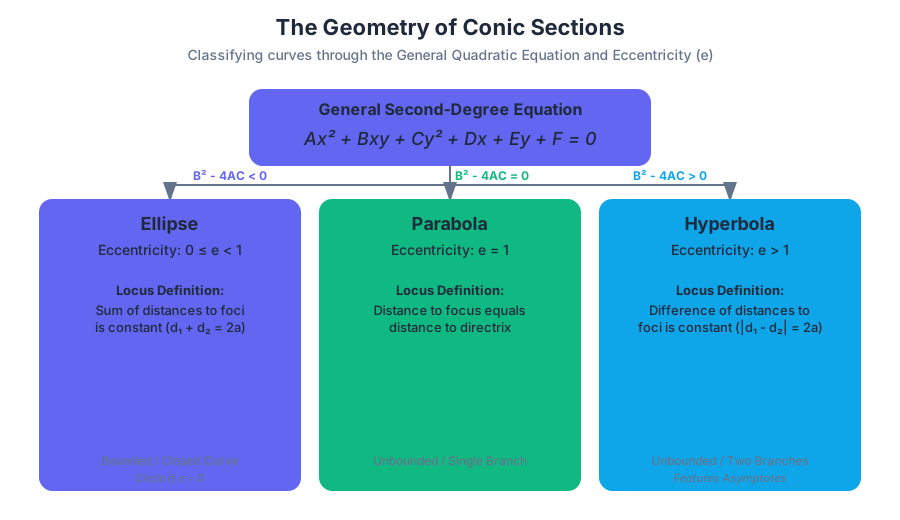
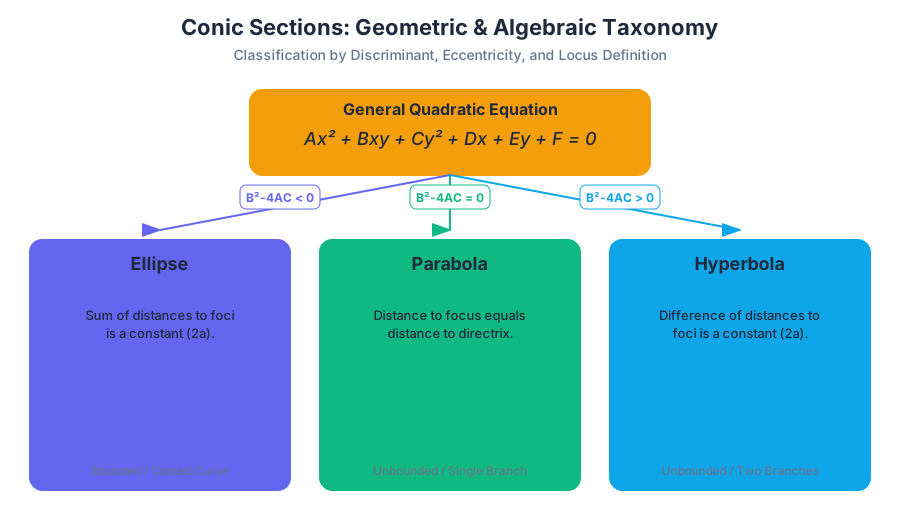
Definition: The General Quadratic Equation Every conic section can be represented by the general second-degree equation in two variables: $$Ax^2 + Bxy + Cy^2 + Dx + Ey + F = 0$$ The discriminant ($B^2 - 4AC$) determines the type of curve:
- If $B^2 - 4AC < 0$, the curve is an ellipse (or a circle if $A=C$ and $B=0$).
- If $B^2 - 4AC > 0$, the curve is a hyperbola.
- If $B^2 - 4AC = 0$, the curve is a parabola.
Comparison of Conic Properties
| Property | Ellipse | Hyperbola | Parabola |
|---|---|---|---|
| Eccentricity ($e$) | $0 \le e < 1$ | $e > 1$ | $e = 1$ |
| Locus Definition | Sum of distances to foci is constant ($d_1 + d_2 = 2a$) | Difference of distances to foci is constant ($ | d_1 - d_2 |
| Boundedness | Bounded (Closed curve) | Unbounded (Two branches) | Unbounded (One branch) |
| Major Features | Two foci, two vertices, center | Two foci, two vertices, center, two asymptotes | One focus, one vertex, directrix |
The Ellipse: The Closed Curve of Sums
An ellipse is the set of all points $(x, y)$ in a plane such that the sum of the distances from two fixed points (the foci) is a constant, denoted as $2a$. This constant $2a$ is also the length of the major axis.
Standard Equations and Orientation
The orientation of an ellipse depends on which denominator is larger. We define $a$ as the semi-major axis and $b$ as the semi-minor axis, where $a > b$.
| Orientation | Standard Equation (Center $(h, k)$) | Foci Locations | Vertices |
|---|---|---|---|
| Horizontal | $\frac{(x-h)^2}{a^2} + \frac{(y-k)^2}{b^2} = 1$ | $(h \pm c, k)$ | $(h \pm a, k)$ |
| Vertical | $\frac{(x-h)^2}{b^2} + \frac{(y-k)^2}{a^2} = 1$ | $(h, k \pm c)$ | $(h, k \pm a)$ |
The Pythagorean Relationship
In an ellipse, the distance from the center to each focus is $c$. These values are related by the equation: $$c^2 = a^2 - b^2$$ This relationship is intuitive if one considers a point at the end of the minor axis. The distance from that point to either focus is exactly $a$, forming a right triangle with legs $b$ and $c$ and hypotenuse $a$.
Derivation of the Standard Form
To understand why the equation takes this form, consider an ellipse centered at $(0,0)$ with foci at $(-c, 0)$ and $(c, 0)$. Let $P(x, y)$ be a point on the ellipse. By definition: $$\sqrt{(x+c)^2 + y^2} + \sqrt{(x-c)^2 + y^2} = 2a$$ By isolating one radical, squaring both sides, simplifying, and then squaring again, we eventually arrive at: $$(a^2 - c^2)x^2 + a^2y^2 = a^2(a^2 - c^2)$$ Substituting $b^2 = a^2 - c^2$ yields: $$b^2x^2 + a^2y^2 = a^2b^2$$ Dividing by $a^2b^2$ gives the standard form: $\frac{x^2}{a^2} + \frac{y^2}{b^2} = 1$.
The Hyperbola: The Open Curve of Differences
A hyperbola is the set of all points $(x, y)$ such that the absolute difference of the distances from two fixed foci is a constant $2a$. Unlike the ellipse, the hyperbola consists of two separate curves called branches.
Standard Equations and Asymptotes
The "direction" of the hyperbola is determined by which variable is positive. The axis containing the foci and vertices is the transverse axis.
| Orientation | Standard Equation (Center $(h, k)$) | Foci | Asymptotes |
|---|---|---|---|
| Horizontal | $\frac{(x-h)^2}{a^2} - \frac{(y-k)^2}{b^2} = 1$ | $(h \pm c, k)$ | $y - k = \pm \frac{b}{a}(x - h)$ |
| Vertical | $\frac{(y-k)^2}{a^2} - \frac{(x-h)^2}{b^2} = 1$ | $(h, k \pm c)$ | $y - k = \pm \frac{a}{b}(x - h)$ |
Key Distinction: In a hyperbola, $a^2$ is always the denominator of the positive term, not necessarily the larger number. The relationship between the parameters is $c^2 = a^2 + b^2$.
The Role of Asymptotes
As $|x|$ and $|y|$ increase, the hyperbola approaches two intersecting lines called asymptotes. These lines pass through the center of the hyperbola and the corners of a "central rectangle" with dimensions $2a$ and $2b$. These lines serve as the boundary for the curve's end behavior.
Eccentricity: The Measure of "Flatness"
The eccentricity ($e$) of a conic section describes its shape. It is defined as the ratio of the distance between the foci to the length of the major (or transverse) axis: $$e = \frac{c}{a}$$
- For an Ellipse ($0 < e < 1$): As $e \to 0$, the foci move toward the center, and the ellipse becomes a circle. As $e \to 1$, the ellipse becomes increasingly elongated.
- For a Hyperbola ($e > 1$): As $e \to 1$, the branches of the hyperbola become very narrow (pointed). As $e$ increases, the branches open up wider.
Eccentricity Comparison Table
| Eccentricity ($e$) | Shape Description | Physical Example |
|---|---|---|
| $e = 0$ | Perfect Circle | Idealized planetary orbit |
| $e = 0.0167$ | Near-circular Ellipse | Earth's orbit around the Sun |
| $e = 0.967$ | Highly elongated Ellipse | Halley's Comet |
| $e = 1.0$ | Parabola | Escape velocity trajectory |
| $e > 1.0$ | Hyperbola | Oumuamua (interstellar object) |
Shifted Conics and General Form Analysis
When a conic is not centered at the origin, we use the translations $(x-h)$ and $(y-k)$. Identifying a conic from its general form often requires completing the square.
Worked Example: Identifying a Shifted Hyperbola
Given the equation: $9x^2 - 4y^2 - 36x - 8y - 4 = 0$
- Group terms: $(9x^2 - 36x) - (4y^2 + 8y) = 4$
- Factor out coefficients: $9(x^2 - 4x) - 4(y^2 + 2y) = 4$
- Complete the square: $9(x^2 - 4x + 4) - 4(y^2 + 2y + 1) = 4 + 36 - 4$ $9(x-2)^2 - 4(y+1)^2 = 36$
- Divide by 36: $\frac{(x-2)^2}{4} - \frac{(y+1)^2}{9} = 1$
Analysis:
- Type: Horizontal Hyperbola (positive $x$ term).
- Center: $(2, -1)$.
- $a = 2, b = 3$.
- $c = \sqrt{4+9} = \sqrt{13}$.
- Vertices: $(2 \pm 2, -1) \to (4, -1)$ and $(0, -1)$.
Applications: Planetary Motion and Beyond
The most profound application of conic sections is found in Kepler’s Laws of Planetary Motion.
- Kepler's First Law: The orbit of every planet is an ellipse with the Sun at one of the two foci.
- Kepler's Second Law: A line joining a planet and the Sun sweeps out equal areas during equal intervals of time (conservation of angular momentum).
- Kepler's Third Law: The square of the orbital period ($T$) is proportional to the cube of the semi-major axis ($a$) of its orbit ($T^2 \propto a^3$).
Hyperbolic Navigation (LORAN)
Before GPS, the Long Range Navigation (LORAN) system used hyperbolas. A navigator would measure the difference in arrival time of radio signals from two synchronized stations. Since the difference in distance to the two stations was constant, the navigator knew the ship was located somewhere along a specific hyperbolic curve. By using a second pair of stations, a second hyperbola was generated; the intersection of the two curves provided the ship's exact location.
Computational Implementation
In modern engineering, we often need to generate these curves programmatically for simulations or CAD software.
2. Mathematical Derivation (LaTeX Representation)
The following logic represents the derivation of the focal distance $c$ for a hyperbola from the definition $|d_1 - d_2| = 2a$.
\text{Let } P(x,y) \text{ be on the hyperbola with foci } F_1(-c, 0), F_2(c, 0).
\sqrt{(x+c)^2 + y^2} - \sqrt{(x-c)^2 + y^2} = \pm 2a
\text{Square both sides:}
(x+c)^2 + y^2 = 4a^2 \pm 4a\sqrt{(x-c)^2 + y^2} + (x-c)^2 + y^2
x^2 + 2xc + c^2 = 4a^2 \pm 4a\sqrt{(x-c)^2 + y^2} + x^2 - 2xc + c^2
4xc - 4a^2 = \pm 4a\sqrt{(x-c)^2 + y^2}
xc - a^2 = \pm a\sqrt{(x-c)^2 + y^2}
\text{Square again:}
x^2c^2 - 2xca^2 + a^4 = a^2(x^2 - 2xc + c^2 + y^2)
x^2c^2 + a^4 = a^2x^2 + a^2c^2 + a^2y^2
x^2(c^2 - a^2) - a^2y^2 = a^2(c^2 - a^2)
\text{Let } b^2 = c^2 - a^2:
x^2b^2 - a^2y^2 = a^2b^2 \implies \frac{x^2}{a^2} - \frac{y^2}{b^2} = 1
Common Pitfalls and Misconceptions
- Confusing $a$ and $b$ in Hyperbolas: In an ellipse, $a$ is always the largest denominator. In a hyperbola, $a^2$ is simply the denominator of the positive term. A hyperbola can have $b > a$.
- The $c^2$ Formula: Students often swap the formulas. Remember:
- Ellipse: $c^2 = a^2 - b^2$ (The foci are inside the vertices, so $c < a$).
- Hyperbola: $c^2 = a^2 + b^2$ (The foci are outside the vertices, so $c > a$).
- Asymptote Slopes: For a horizontal hyperbola, the slope is $b/a$. For a vertical hyperbola, it is $a/b$. Always check "rise over run" relative to the $y$ and $x$ denominators.
- Major Axis: The longest diameter of an ellipse, passing through both foci.
- Transverse Axis: The axis of a hyperbola that passes through the vertices and foci.
- Foci: Fixed points used to define the conic section; in planetary motion, the Sun occupies one focus.
- Asymptotes: Lines that the branches of a hyperbola approach but never touch as they extend to infinity.
- Eccentricity: A numerical value ($e = c/a$) that describes the deviation of a conic section from being a perfect circle.
- Directrix: A fixed line used in the alternative definition of conics involving the ratio of distances.
- If an ellipse has a horizontal major axis of length 10 and a minor axis of length 6, what is the distance from the center to each focus? (Answer: 4)
- True or False: A hyperbola with $a=5$ and $b=5$ has perpendicular asymptotes. (Answer: True, these are called rectangular hyperbolas)
- Which conic section is formed when the plane is parallel to the slant height of the cone? (Answer: Parabola)
- What happens to the shape of an ellipse as its eccentricity approaches 0? (Answer: It becomes a circle)
- In the equation $4x^2 - 9y^2 = 36$, what are the equations of the asymptotes? (Answer: $y = \pm \frac{2}{3}x$)
Core Mastery Checklist:
- Convert general quadratic equations to standard form by completing the square.
- Identify the center, vertices, and foci for any given ellipse or hyperbola.
- Sketch a hyperbola using the central rectangle and asymptotes.
- Calculate eccentricity and explain its physical significance in orbital mechanics.
- Solve real-world problems involving the reflective properties of conics (e.g., whispering galleries or satellite dishes).
Further Reading:
- Apollonius of Perga: Conics Books I-VII for the historical geometric perspective.
- Kepler’s Astronomia Nova for the application of ellipses to celestial motion.
- Modern Navigation Systems for the evolution from hyperbolic LORAN to trilateration-based GPS.
Source Materials
Study Precalculus on Lykke
This course page is free to open: signed out, you can read its first two sections, and signing in, on any plan, opens the rest. The free Lykke Chrome extension syncs your own Canvas courses, so ChatGPT, Claude and Muse can answer from your classes and deadlines. It only reads Canvas.
Add the free extensionSign in to open every section