From the free course Precalculus on Lykke
Composite and Inverse Functions
Key concepts: Function Composition notation (g ∘ h)(x) · Invertible functions · Domain restriction · Verifying inverses by composition · Modeling with functions
This section introduces the mechanics of combining functions and finding their inverses, focusing on algebraic substitution, tabular analysis, and domain restrictions.
Composite and Inverse Functions
In the study of advanced algebra and precalculus, functions are often treated as static entities—mappings from a set $A$ to a set $B$. However, the true power of functional analysis emerges when we treat functions as dynamic components that can be linked, reversed, and transformed. Composite and inverse functions represent the "connective tissue" of mathematical modeling, allowing us to describe complex, multi-stage processes and backtrack from results to their original inputs.
Function Composition: The Pipeline of Mathematics
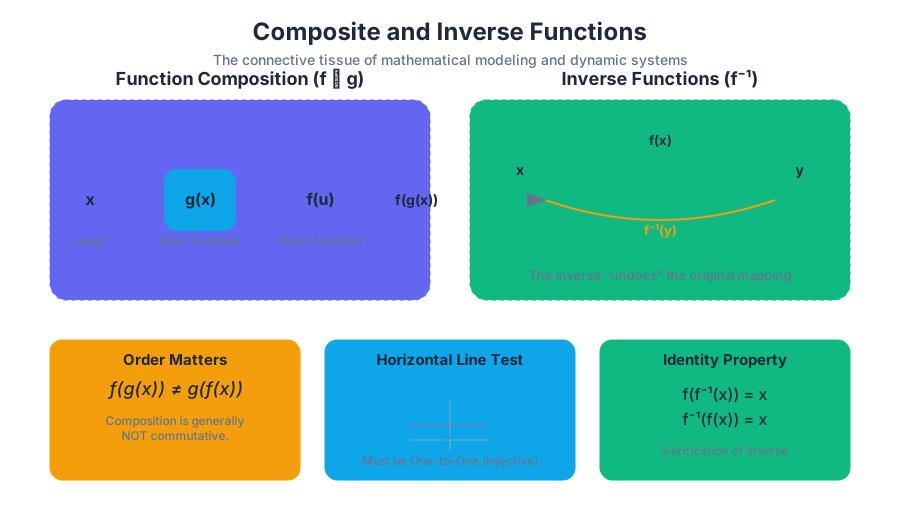
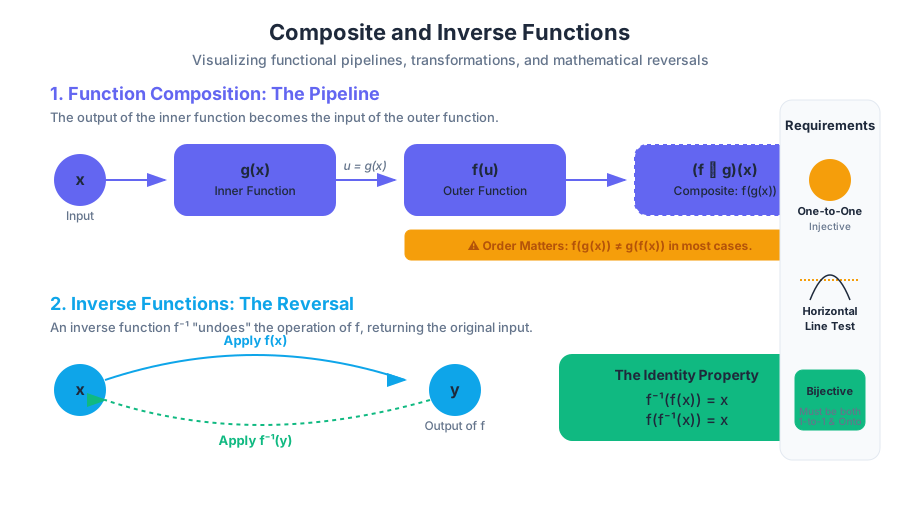
Function composition is the process of applying one function to the results of another. If we have two functions, $f$ and $g$, the composition $f \circ g$ (read as "$f$ composed with $g$") represents a sequence where the output of $g$ becomes the input of $f$.
Formal Definition
Let $g: A \to B$ and $f: B \to C$ be two functions. The composite function, denoted by $(f \circ g)(x)$, is defined as: $$(f \circ g)(x) = f(g(x))$$ The domain of $f \circ g$ consists of all $x$ in the domain of $g$ such that $g(x)$ is in the domain of $f$.
Mechanics and Order of Operations
It is a common pitfall to assume that composition is commutative. In almost all cases, $(f \circ g)(x) \neq (g \circ f)(x)$. The "inner" function is always evaluated first. Think of it as a manufacturing assembly line: if $g$ is the "painting" station and $f$ is the "packaging" station, the order matters immensely. Packaging a non-painted item results in a different final product than painting a packaged item.
| Feature | Composition $(f \circ g)(x)$ | Multiplication $(f \cdot g)(x)$ |
|---|---|---|
| Notation | $f(g(x))$ | $f(x) \cdot g(x)$ |
| Operation | Substitution | Arithmetic product |
| Commutative? | No (usually $f(g(x)) \neq g(f(x))$) | Yes ($f(x)g(x) = g(x)f(x)$) |
| Domain Requirement | $g(x)$ must be in domain of $f$ | $x$ must be in domains of both $f$ and $g$ |
Invertibility and the One-to-One Requirement
Not every function can be reversed. For a function to have an inverse, it must be one-to-one (injective). This means that every unique output must correspond to exactly one unique input.
The Horizontal Line Test (HLT)
While the Vertical Line Test determines if a relation is a function, the Horizontal Line Test determines if a function is invertible. If any horizontal line intersects the graph of a function more than once, the function is not one-to-one and thus lacks a global inverse.
Bijectivity
For a function to be truly invertible over its entire range, it must be:
- Injective (One-to-One): No two $x$-values share the same $y$-value.
- Surjective (Onto): Every value in the codomain is mapped to by at least one value in the domain.
A function that meets both criteria is bijective.
| Function Type | Example | Invertible? | Reason |
|---|---|---|---|
| Linear | $f(x) = 3x + 2$ | Yes | Passes Horizontal Line Test |
| Quadratic | $f(x) = x^2$ | No | $f(-2) = 4$ and $f(2) = 4$ |
| Cubic | $f(x) = x^3$ | Yes | Strictly increasing |
| Sine | $f(x) = \sin(x)$ | No | Periodic; repeats values |
Finding and Verifying Inverse Functions
The inverse of a function $f$, denoted as $f^{-1}$, effectively "undoes" the operation of $f$. If $f$ maps $x$ to $y$, then $f^{-1}$ maps $y$ back to $x$.
Algebraic Derivation
To find the inverse of a function $y = f(x)$ algebraically, we follow a standard three-step protocol:
- Replace $f(x)$ with $y$.
- Swap $x$ and $y$.
- Solve the resulting equation for $y$.
\begin{aligned}
&\text{Given: } f(x) = \frac{2x - 5}{3} \\
&\text{1. Swap } x \text{ and } y: \\
&x = \frac{2y - 5}{3} \\
&\text{2. Multiply by 3: } \\
&3x = 2y - 5 \\
&\text{3. Add 5: } \\
&3x + 5 = 2y \\
&\text{4. Divide by 2: } \\
&y = \frac{3x + 5}{2} \\
&\text{Result: } f^{-1}(x) = \frac{3x + 5}{2}
\end{aligned}
Verification by Composition
The definitive test for an inverse relationship is the Identity Property. Two functions $f$ and $g$ are inverses if and only if:
- $f(g(x)) = x$ for all $x$ in the domain of $g$.
- $g(f(x)) = x$ for all $x$ in the domain of $f$.
If either of these compositions results in anything other than the identity $x$, the functions are not inverses.
Domain Restriction: Forcing Invertibility
Many essential functions are not one-to-one. The parabola $f(x) = x^2$ fails the Horizontal Line Test because both $x=2$ and $x=-2$ yield $y=4$. To find an "inverse" for such functions (like the square root), we must apply a Domain Restriction.
The Principle of Restriction
By limiting the domain of a non-invertible function to an interval where it is strictly increasing or strictly decreasing, we create a new function that is one-to-one.
Example: The Square Root The function $f(x) = x^2$ is not invertible on $(-\infty, \infty)$. However, if we restrict the domain to $[0, \infty)$, the function becomes one-to-one. Its inverse is $f^{-1}(x) = \sqrt{x}$, with a domain of $[0, \infty)$.
Trigonometric Inverse Restrictions
This concept is most vital in trigonometry. Because sine, cosine, and tangent are periodic, they repeat values infinitely. To define $\arcsin(x)$, $\arccos(x)$, and $\arctan(x)$, mathematicians agreed upon standard restricted intervals:
| Function | Natural Domain | Restricted Domain for Inverse | Range of Inverse (Principal Values) |
|---|---|---|---|
| $\sin(x)$ | $(-\infty, \infty)$ | $[-\pi/2, \pi/2]$ | $[-1, 1]$ |
| $\cos(x)$ | $(-\infty, \infty)$ | $[0, \pi]$ | $[-1, 1]$ |
| $\tan(x)$ | $x \neq \pi/2 + k\pi$ | $(-\pi/2, \pi/2)$ | $(-\infty, \infty)$ |
Modeling with Functions: Real-World Applications
Composition and inversion are not merely abstract exercises; they are the primary tools for translating complex real-world systems into solvable mathematics.
Multi-Stage Modeling
Consider a scenario where a stone is dropped into a pond, creating a circular ripple.
- The radius $r$ of the ripple grows as a function of time $t$: $r(t) = 0.5t$ (where $t$ is in seconds and $r$ is in meters).
- The area $A$ of the ripple is a function of the radius: $A(r) = \pi r^2$.
To find the area as a function of time, we compose them: $$(A \circ r)(t) = A(r(t)) = \pi(0.5t)^2 = 0.25\pi t^2$$
Inverse Modeling
Inversion is used when we need to find the "cause" for a specific "effect." If a thermometer outputs a voltage $V$ based on temperature $T$, but we want to know the temperature based on a voltage reading, we are seeking the inverse function $T(V)$.
Common Pitfalls and Misconceptions
- Confusing $f^{-1}(x)$ with $1/f(x)$: The superscript $-1$ in function notation denotes an inverse, not an exponent. $f^{-1}(x)$ is the inverse function; $[f(x)]^{-1}$ is the reciprocal.
- Ignoring Domain Restrictions: When composing $f(g(x))$, one must ensure that the output of $g$ is valid for $f$. For example, if $f(x) = \sqrt{x}$ and $g(x) = x - 5$, the composition $\sqrt{x-5}$ is only defined for $x \geq 5$.
- Order of Composition: Students often evaluate from left to right. In $f(g(x))$, $g$ is the "inner" function and must be processed first.
- Graphical Reflection: The graph of $f^{-1}(x)$ is a reflection of $f(x)$ across the line $y = x$. If a point $(a, b)$ is on $f$, then $(b, a)$ must be on $f^{-1}$.
Advanced Concept: Composition of Linear Transformations
In linear algebra, function composition is represented by matrix multiplication. If a transformation $T_1$ is represented by matrix $A$ and $T_2$ by matrix $B$, then the composition $T_1(T_2(x))$ is represented by the product $AB$. This highlights why matrix multiplication is non-commutative: because function composition is non-commutative.
- Function Composition: An operation where the output of one function becomes the input of another, denoted $f(g(x))$.
- Injective (One-to-One): A property where each output corresponds to exactly one input; required for invertibility.
- Horizontal Line Test: A visual method to determine if a function is one-to-one.
- Inverse Function ($f^{-1}$): A function that reverses the mapping of the original function such that $f(f^{-1}(x)) = x$.
- Domain Restriction: The process of limiting a function's input values to make it one-to-one and thus invertible.
- Identity Function: The function $I(x) = x$, which is the result of composing a function with its inverse.
- Bijective: A function that is both injective and surjective, ensuring a perfect one-to-one correspondence across its entire range.
- If $f(x) = x^2$ and $g(x) = x + 3$, what is $(f \circ g)(2)$? (Answer: 25)
- True or False: Every function has an inverse. (Answer: False, it must be one-to-one)
- What is the standard restricted domain for $f(x) = \cos(x)$ to allow for an inverse? (Answer: $[0, \pi]$)
- If the point $(3, 7)$ lies on the graph of $f$, what point must lie on the graph of $f^{-1}$? (Answer: $(7, 3)$)
- Simplify $f(f^{-1}(10))$ assuming $f$ is invertible. (Answer: 10)
- Why is $(f \circ g)(x)$ generally not equal to $(g \circ f)(x)$? (Answer: Composition is non-commutative; the order of operations changes the result.)
Mastery Checklist:
- Can you evaluate $(f \circ g)(x)$ given algebraic definitions?
- Can you evaluate $(f \circ g)(x)$ using a table of values or a coordinate graph?
- Can you find the domain of a composite function, accounting for the restrictions of both the inner and outer functions?
- Can you determine if a function is invertible using the Horizontal Line Test?
- Can you algebraically solve for $f^{-1}(x)$ by swapping $x$ and $y$?
- Can you prove two functions are inverses using the composition identity $f(g(x)) = x$?
- Do you understand why $\sin(x)$ needs a domain restriction of $[-\pi/2, \pi/2]$ to have an inverse?
- Can you sketch the graph of an inverse function by reflecting the original across $y = x$?
Source Materials
Study Precalculus on Lykke
This course page is free to open: signed out, you can read its first two sections, and signing in, on any plan, opens the rest. The free Lykke Chrome extension syncs your own Canvas courses, so ChatGPT, Claude and Muse can answer from your classes and deadlines. It only reads Canvas.
Add the free extensionSign in to open every section